
 100% FREE ACCESS
12th Standard Syllabus & Materials
12th Standard
TN 12th Computer Applications மின்னணு தரவு பரிமாற்றம் Sample Question Papers Study Material - QB365 Set A
NEW12th Standard
TN 12th Computer Applications மின் - வணிக பாதுகாப்பு அமைப்புகள் Sample Question Papers Study Material - QB365 Set A
NEW12th Standard
TN 12th Computer Applications மின்னணு செலுத்தல் முறைகள் Sample Question Papers Study Material - QB365 Set A
NEW12th Standard
TN 12th Computer Applications மின் - வணிகம் Sample Question Papers Study Material - QB365 Set A
NEW12th Standard
TN 12th Computer Applications திறந்த மூல கருத்துருக்கள் Sample Question Papers Study Material - QB365 Set A
NEW12th Standard
TN 12th Computer Applications வலையமைப்பு வடமிடல் Sample Question Papers Study Material - QB365 Set A

Published on: 31/12/2022
QB365 provides a detailed and simple solution for every Possible Questions in Class 12 Physics Subject - Important 2 Mark English Medium. It will help Students to get more practice questions, Students can Practice these question papers in addition to score best marks.
Download Tamil Nadu 12th Standard Physics question papers, model tests, one-mark questions, important questions, and public exam papers in PDF format. Free study materials and answer keys for TN State Board students.
Questions + Answers key
Take MCQ Physics Test1.
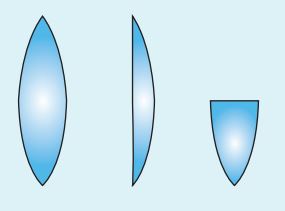
A biconvex lens has focal length f and intensity of light I passing through it. What will be the focal length and intensity for portions of lenses obtained by cutting it vertically and horizontally as shown in figure?
2.
Write notes on Ampere-Maxwell law.
3.
A polaroid (I) is placed in front of a monochromatic source. Another polaroid (II) is placed in front of this polaroid (I) and rotated till no light passes. A third polaroid (III) is now placed in between (I) and (II). In this case, will light emerge from (II)? Explain
4.
How does the maximum kinetic energy of electrons emitted vary with the work function of the metal?
5.
When light of wavelength 2200 Å falls on Cu, photo electrons are emitted from it. Find
(i) the threshold wavelength and
(ii) the stopping potential.
Given: the work function for Cu is ϕ0 = 4.65 eV.
6.
An electron and an alpha particle have same kinetic energy. How are the de Broglie wavelengths associated with them related?
7.
What are black holes?
8.
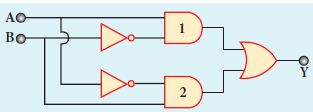
In the combination of the following gates, write the Boolean equation for output Y in terms of inputs A and B.
9.
A diode is called as a unidirectional device. Explain.
10.
Consider two hydrogen atoms HA and HB in ground state. Assume that hydrogen atom HA is at rest and hydrogen atom HB is moving with a speed and make head-on collision with the stationary hydrogen atom HA. After the collision, both of them move together. What is minimum value of the kinetic energy of the moving hydrogen atom HB, such that any one of the hydrogen atoms reaches first excitation state.
11.
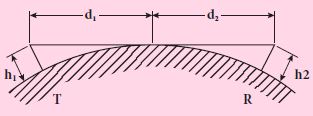
A transmitting antenna has a height of 40 m and the height of the receiving antenna is 30 m. What is the maximum distance between them for line-of-sight communication? The radius of the earth is 6.4 × 10⁶ m.
12.
What is isobar? Give an example.
13.
What is call 'grating element'?
14.
Write a short note on quantum theory of light.
15.
Why does sky appear blue?
16.
Why do stars twinkle?
17.
Why are Infrared radiation referred to as heatwaves? Name the radiations, which are next to these radiation having
(i) shorter λ
(ii) longer λ.
18.
Define remanence or retentivity?
19.
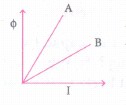
A graph of magnetic flux (Ф) versus current CI is shown for two inductors A & B, which has a larger value of self-inductance?
20.
How is sign convention followed while applying Kirchhoff's first rule?
21.
When does a dielectric said to be polarized?
22.
How will you define Q-factor?
23.
What is displacement current?
24.
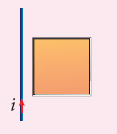
If the current i flowing in the straight conducting wire as shown in the figure decreases, find out the direction of induced current in the metallic square loop placed near it.
25.
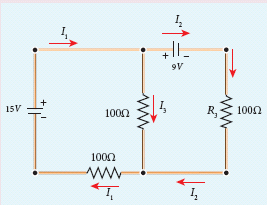
Calculate the currents in the following circuit.
26.
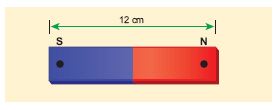
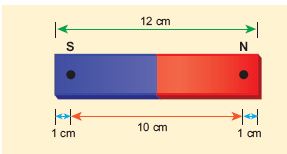
Compute the magnetic length of a uniform bar magnet if the geometrical length of the magnet is 12 cm. Mark the positions of magnetic pole points.
27.
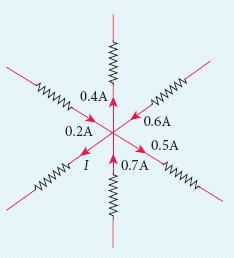
For the given circuit find the value of I.
28.
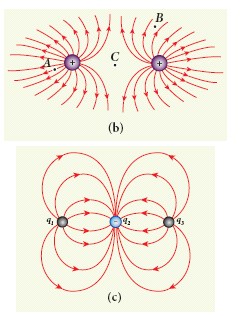
The following pictures depict electric field lines for various charge configurations.
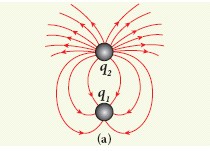
(i) In figure (a) identify the signs of two charges and find the ratio \(\left| \frac { { q }_{ 1 } }{ { q }_{ 2 } } \right| \)
(ii) In figure (b), calculate the ratio of two positive charges and identify the strength of the electric field at three points A, B, and C
(iii) Figure (c) represents the electric field lines for three charges. If q2 = -20 nC, then calculate the values of q1 and q3.
29.
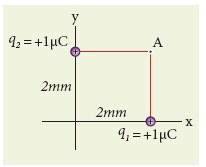
Consider the charge configuration as shown in the figure. Calculate the electric field at point A. If an electron is placed at points A, what is the acceleration experienced by this electron? (mass of the electron = 9.1 x 10⁻³¹ kg and charge of electron = −1.6 x 10⁻¹⁹ C)
30.
A copper wire of cross-sectional area 0.5 mm2 carries a current of 0.2 A. If the free electron density of copper is 8.4 x 1028 m-3 then compute the drift velocity of free electrons.
1.
we have \(\frac{1}{f}=(n-1)[\frac{1}{R_1}-\frac{1}{R_2}]\)
For equi-convex lens, R1 = R and R2 =-R
\(\frac{1}{f}=(n-1)[\frac{1}{R}-\frac{1}{-R}]=(n-1)[\frac{1}{R}+\frac{1}{R}]\)
\(\frac{1}{f}=(n-1) \frac{2}{R} \Rightarrow 2f=\frac{R}{(n-1)}\)
(i) when the lens is cut into two parts vertically,
For 1st part, R1 = R and R2 = ∞
\(Therefore\ \frac{1}{\mathrm{f}_{\mathrm{1}}}=(n-1)(\frac{1}{R}-\frac{1}{(-∞)})=\frac{(n-1)}{R}(or)\frac{R}{n-1}(or)f_1=2f\)
Intensity does not change as the amount of light passing through the lens is same.
(ii) When the lens is cut into two parts horizontally, the radius of curvature remains same, therefore focal length remains same but intensity is reduced.
2.
(i) Ampere- Maxwell law relates the magnetic field around any closed path to the conduction current and displacement current through that path.
\(\oint_{i} \vec{B} \cdot \overrightarrow{d l}=\mu_{0}i =\mu_0(i_c+i_d)\)
(ii) \(\oint_{i} \vec{B} \cdot \overrightarrow{d l}=\mu_{0} i_{C}+\mu_{0} \varepsilon_{0} \frac{dΦ_E}{d t}\) where \(\vec{B}\) is the magnetic field.
(iii) This equation shows that both conduction current and displacement current produce magnetic field.
3.
(i) Only in the special cases when the pass axis of (III) is parallel to (I) or (II) there shall be no light emerging.
(ii) In all other cases there shall be light emerging because the pass axis of (II) is no longer perpendicular to the pass axis of (III).
4.
Maximum kinetic energy Ek = hv - W
Clearly, smaller the work function W, greater is the Ek This means that when work function of a metal increases, maximum kinetic energy of photoelectrons decreases.
5.
i) The threshold wavelength is given by
\({ \lambda }=\frac { hc }{ { \phi }_{ 0 } } =\frac { 6.626\times { 10 }^{ -34 }\times 3\times { 10 }^{ 8 } }{ 4.65\times 1.6\times 10^{ -19 } } \)
= 2672 \(\mathring { A }\)
ii) Energy of the photon of wavelength 2200 \(\mathring { A }\) is
E = \(\frac { hc }{ \lambda } =\frac { 6.626\times { 10 }^{ -34 }\times 3\times { 10 }^{ 8 } }{ 2200\times 10^{ -10 } } \)
= 9.035 x 10⁻¹⁹ J = 5.65 eV
We know that kinetic energy of fastest photo electron is
Kmax = hv - ϕ0 = 5.65 - 4.65
= 1 eV
From equation (7.3), Kmax = eV0
V0 = \(\frac { { K }_{ max } }{ e } =\frac { 1\times 1.6\times { 10 }^{ -19 } }{ 1.6\times { 10 }^{ -19 } } \)
Therefore, stopping potential = 1 V
6.
The de Broglie wavelength associated with the kinetic energy k is given as \(\lambda=\frac{h}{\sqrt{2 m k}}\) , where m is the mass of the particle.
Therefore \(\lambda_{\mathrm{e}}=\frac{\mathrm{h}}{\sqrt{2 \mathrm{~m}_{\mathrm{e}} \mathrm{k}_{\mathrm{e}}}} \text { and } \lambda_{\alpha}=\frac{\mathrm{h}}{\sqrt{2 \mathrm{~m}_{\alpha} \mathrm{k}_{\alpha}}} \text {. But } \mathrm{k}_{\mathrm{e}}=\mathrm{k}_{\alpha} . \)
Therefore \(\frac{\lambda_{\mathrm{e}}}{\lambda_{\alpha}}=\sqrt{\frac{\mathrm{m}_{\alpha}}{\mathrm{m}_{\mathrm{e}}}} \mathrm{m}_{\alpha}>\mathrm{m}_{\mathrm{e}^{*}} \text {. Therefore, } \lambda_{\mathrm{e}}>\lambda_{\alpha^{\circ}}\)
7.
Black holes are end stage of stars whose mass ranges from 20 times to 1 million times the mass of the sun. Because of their dense mass, they have very strong gravitational force such that no particle or even light can escape from it. Therefore they are not visible to human eye. Every galaxy has black hole at its center.
8.
The output at the 1st AND gate : A\(\overline { B } \)
The output at the 2nd AND gate : ĀB
The output at the OR gate: Y = A. \(\overline { B } \) + Ā .B
9.
When a PN junction diode is forward biased, the depletion region decreases and the diode conduct once after the barrier potential is crossed, when it is reverse biased the depletion region increases and the diode does not conduct sci it is called as unidirectional device.
10.
Kinetic energies,
KEAi = 0
KEAf = KEBt
It should obey law of conservation of energy
Total Initial KE = Total final KE
\(\mathrm{KE}_{\mathrm{A}_{i}}+\mathrm{KE}_{\mathrm{B}_{i}}=\mathrm{KE}_{\mathrm{A}_{\mathrm{t}}}+\mathrm{KE}_{\mathrm{B}_{\mathrm{t}}} \)
\(0+\mathrm{KE}_{\mathrm{B}_{i}}=\mathrm{KE}_{\mathrm{A}_{\mathrm{f}}}+\mathrm{KE}_{\mathrm{A}_{t}} \)
\(\mathrm{KE}_{\mathrm{B}_{\mathrm{i}}}=2 \mathrm{KE}_{\mathrm{A}_{\mathrm{f}}} \)
Minimum energy required for excite the hydrogen atom is 10.2eV
Hence minimum Kinetic energy of HB is
\(\mathrm{KE}_{\mathrm{B}_{1}}=2 \times 10.2 \mathrm{eV}=20.4 \mathrm{eV}\)
11.
The total distance d between the transmitting and receiving antennas will be the sum of the individual distances of coverage.
d = d1 + d2
\(=\sqrt { 2R{ h }_{ 1 } } +\sqrt { 2{ Rh }_{ 2 } } \)
\(=\sqrt { 2R } \left( \sqrt { { h }_{ 1 } } +\sqrt { { h }_{ 2 } } \right) \)
\(=\sqrt { 2\times 6.4\times { 10 }^{ 6 } } \times (\sqrt { 40 } +\sqrt { 30 } )\)
\(=16\times { 10 }^{ 2 }\sqrt { 5 } \times (6.32+5.48)\)
= 42217 m = 42.217 km
12.
Isobars are the atoms of different elements having the same mass number A, but different atomic number Z.
Example: \({ }_{16}^{40} \mathrm{~S},{ }_{17}^{40} \mathrm{Cl},{ }_{18}^{40} \mathrm{Ar}\)
13.
(i) In Grating, the combined width of a ruling and a slit is called 'grating element' (1.e.) e = a + b.
14.
Quantum theory of light:
Quantum theory states that light waves consist of small packets of energy called photons. The energy associated with each photon is E = hv, Where 'h' is Planck's constant (h = 6.625 x 10⁻³⁴ J s) and v is frequency of electromagnetic radiation.
15.
\(\mathrm{I} ∝ \frac{1}{\lambda^{4}}\)
According to Rayleigh's scattering equation, violet colour which has the shortest wavelength gets much scattered during day time. The next scattered colour is blue. As our eyes are more sensitive to blue colour than violet colour the sky appears blue during day time.
16.
Stars appear twinkling because of the movement of the atmospheric layer with varying refractive indices due to refraction.
17.
Infrared radiation waves are produced by hot bodies and molecules so it is referred as heat waves. (eg. Sun)
(i) Electromagnetic waves having shorter λ than Infrared radiation are visible, U - v, X-rays, and ૪ - rays.
(ii) Electromagnetic waves having longer λ than Infrared radiation are microwaves, radiowaves.
18.
It is defined as the ability of the materials to retain the magnetism in them even magnetising field vanishes.
19.
Ф = LI
For same current ФA > ФB
So LA > LB
i.e conductor a has a larger value of self-induction
For a series LCR circuit power factor is
\(\frac { R }{ z } =\frac { R }{ \sqrt { { R }^{ 2 }+\left( \omega L-\frac { 1 }{ \omega c } \right) } } \)
The maximum value of power factor = 1
The minimum value of power factor = 0
20.
The convention is that the current entering the junction is taken as positive and current leaving the junction is taken as negative.
21.
When an external electric field is applied, the centers of positive and negative charges are separated by a small distance which induces dipole moment in the direction of the external electric field. Then the dielectric is said to be polarized by an external electric field.
22.
Q factor is defined as the ratio of voltage across L or C to resonance to the applied voltage
Q - factor = \(\frac{Voltage \ across \ L \ or \ C \ resonance }{Applied \ voltage}\)
\(Q-factor=\frac{X_{L}}{R}=\frac{1}{R}\sqrt\frac{{L}}{C}\)
23.
The displacement current can be defined as the current which comes into play in the region in which the electric field or the electric flux is changing with time.
24.
From right hand rule, the magnetic field by the straight wire is directed into the plane of the square loop perpendicularly and its magnetic flux is decreasing. The decrease in flux is opposed by the current induced in the loop by producing a magnetic field in the same direction as the magnetic field of the wire. Again from right hand rule, for this inward magnetic field, the direction of the induced current in the loop is clockwise.
25.
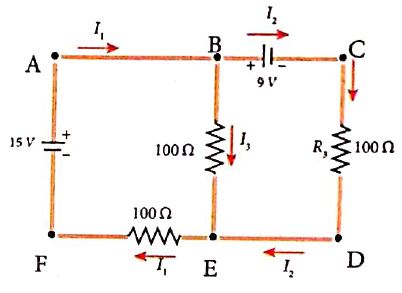
Apply Kirchoff's 1st law at junction B
II - I2 - I3 = 0
I3 = I1 - I2 ....(1)
Applying Kirchoff's IInd law at path ABEFA,
100I3 + 100 I1 = 15 ....(2)
Substitute equation (1) in equation (2),
100 (I1 - I2) + 100 I1 = 15
100 I1 - 100 I2 + 100 I1 = 15
200 I1 - 100 I2 = 15 ....(3)
Apply Kirchhoffs 2nd law ar path BCDEB,
100 I2 - 100 I3 = -9 ....(4)
Substitute equation (1) in above equation (4),
100 I2 - 100(I1 - I2) 100 = -9
100 I2 - 100 I1 + 100 I2 = -9
200 I2 - 100 I1 = - 9 ....(5)
Solve equation (3) and (5), we get
Eqn (3) ⇒ 200 I1 - 100 I2 = 15
2 x Eqn (5) ⇒ -200 I1 + 400I2 = -18
________________
300 I2 = -3
I2 = -3 /300 = -0.01 A
I2 = -0.01 A
Substitute I2 value in equation (5)
200 I2 -100 I1 = - 9
200 x (- 0.01) - 100 I1 = - 9
- 2 - 100 I1 = -9
-100 I1 = -9 + 2
-100 I1 = -7
I1 = 7/100
I1 = 0.07A
Substitute I1, I2 value in equation (1)
I3 = I1 - I2
= 0.07 + 0.01
I3 = 0.08 A
I1 = 0.07 A, I2 = - 0.01 A and I3 = 0.08 A
26.
The geometrical length of the bar magnet is 12 cm
Magnetic length = \(\frac { 5 }{ 6 } \times \)(geometrical length)
= \(\frac { 5 }{ 6 } \times \)12 = 10 cm
In this figure, the dot implies the pole points.
27.
Applying Kirchoff’s rule to the point P in the circuit,
The arrows pointing towards P are positive and away from P are negative.
Therefore, 0.2A - 0.4A + 0.6A - 0.5A + 0.7A - I = 0
0.7 A - I = 0
1.5A - 0.9A – I = 0
0.6A - I = 0
I = 0.6 A
28.
(i) The electric field lines start at q2 and end at q1. In figure (a), q2 is positive and q1 is negative. The number of lines starting from q2 is 18 and number of the lines ending at q1 is 6. So q2 has greater magnitude. The ratio of \(\left| \frac { { q }_{ 1 } }{ { q }_{ 2 } } \right| =\frac { { N }_{ 1 } }{ { N }_{ 2 } } =\frac { 6 }{ 18 } =\frac { 1 }{ 3 } \). It implies that |q2| = 3|q1|.
(ii) In figure (b), the number of field lines emanating from both positive charges are equal (N = 18). So the charges are equal. At point A, the electric field lines are denser compared to the lines at point B. So the electric field at point A is greater in magnitude compared to the field at point B. Further, no electric field line passes through C, which implies that the resultant electric field at C due to these two charges is zero.
(iii) In the figure (c), the electric field lines start at q1 and q3 and end at q2. This implies that q1 and q3 are positive charges. The ratio of the number of field lines is \(\left| \frac { { q }_{ 1 } }{ { q }_{ 2 } } \right| =\frac { 8 }{ 16 } =\left| \frac { { q }_{ 3 } }{ { q }_{ 2 } } \right| =\frac { 1 }{ 2 } \), implying that q1 and q3 are half of the magnitude of q2. So q1 = q3 = +10 nc.
29.
By using superposition principle, the net electric field at point A is
\(\vec { E_{ A } } =\frac { 1 }{ 4\pi { \varepsilon }_{ 0 } } \frac { { q }_{ 1 } }{ { r }_{ 1A }^{ 2 } } \hat { { r }_{ 1A } } +\frac { 1 }{ 4\pi { \varepsilon }_{ 0 } } \frac { { q }_{ 1 } }{ { r }_{ 2A }^{ 2 } } \hat { { r }_{ 2A } } \)
where r1A and r2A are the distances of point A from the two charges respectively
\(\vec { E_{ A } } =\frac { 9\times 10^{ 4 }\times 1\times { 10 }^{ -6 } }{ (2\times { 10 }^{ -3 })^{ 2 } } (\hat { j } )+\frac { 9\times 10^{ 9 }\times 1\times { 10 }^{ -6 } }{ (2\times 10^{ -3 })^{ 2 } } (\hat { i } )\)\(\)
= 2.25 x 10⁹\(\hat { j } \) + 2.25 x 10⁹\(\hat { i } \) = 2.25 x 10⁹ (\((\hat { i } +\hat { j } )\)
The magnitude of electric field
\(|\vec { { E }_{ A } } |=\sqrt { (2.25\times { 10 }^{ 9 })^{ 2 }+(2.25\times 10^{ 9 })^{ 2 } } \)
= 2.25 x \(\sqrt { 2 } \) x 109 NC-1
The direction of \(\vec { { E }_{ A } } \) is given by \(\frac { \vec { { E }_{ A } } }{ |\vec { { E }_{ A } } | } =\frac { 2.25\times 10^{ 9 }(\hat { i } +\hat { j } ) }{ 2.25\times \sqrt { 2 } \times { 10 }^{ 9 } } =\frac { (\hat { i } +\hat { j } ) }{ \sqrt { 2 } } \), which is the unit vector along OA as shown in the figure.
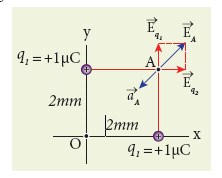
The acceleration experienced by an electron placed at point A is
\(\vec { a_{ A } } =\frac { \vec { F } }{ m } =\frac { q\vec { { E }_{ A } } }{ m } \)
=\(\frac { (-1.6\times 10^{ -19 })\times (2.25\times 10^{ 9 })(\hat { i } +\hat { j } ) }{ 9.1\times { 10 }^{ -31 } } \)
= -3.95 x 10²⁰ \((\hat { i } +\hat { j } )\)Nkg-1
The electron is accelerated in a direction exactly opposite to \(\vec { { E }_{ A } } \).
30.
The relation between drift velocity of electrons and current in a wire of cross- sectional area A is
\({ v }_{ d }=\frac { I }{ neA } =\frac { 0.2 }{ 8.4\times { 10 }^{ 28 }\times 1.6\times { 10 }^{ -19 }\times 0.5\times { 10 }^{ -6 } }\)
vd = 0.03 x 10⁻³ m s-1

12th Standard Syllabus & Materials
12th Standard
TN 12th Computer Applications களப்பெயர் முறைமை (DNS) Sample Question Papers Study Material - QB365 Set A
NEW12th Standard
TN 12th Computer Applications வலையமைப்பு எடுத்துக்காட்டுகள் மற்றும் நெறிமுறைகள் Sample Question Papers Study Material - QB365 Set A
NEW12th Standard
TN 12th Computer Applications கணினி வலையமைப்பு ஓர் அறிமுகம் Sample Question Papers Study Material - QB365 Set A
NEW12th Standard
TN 12th Computer Applications PHP-உடன் MySQL-ஐ இணைத்தல் Sample Question Papers Study Material - QB365 Set A



Tamilnadu Stateboard 12th Standard Subjects

Maths

Chemistry
Physics

Biology

Computer Science

Business Maths and Statistics

Economics

Commerce

Accountancy

History

Computer Applications
Biology
Computer Technology
Computer Applications
Computer Science
Business Maths and Statistics
Commerce
Economics
Maths
Chemistry
Physics
Computer Technology
History
Accountancy

Tamil

English

French
Tamilnadu Stateboard Standards

