
 100% FREE ACCESS
12th Standard Syllabus & Materials
12th Standard
TN 12th Computer Applications மின்னணு தரவு பரிமாற்றம் Sample Question Papers Study Material - QB365 Set A
NEW12th Standard
TN 12th Computer Applications மின் - வணிக பாதுகாப்பு அமைப்புகள் Sample Question Papers Study Material - QB365 Set A
NEW12th Standard
TN 12th Computer Applications மின்னணு செலுத்தல் முறைகள் Sample Question Papers Study Material - QB365 Set A
NEW12th Standard
TN 12th Computer Applications மின் - வணிகம் Sample Question Papers Study Material - QB365 Set A
NEW12th Standard
TN 12th Computer Applications திறந்த மூல கருத்துருக்கள் Sample Question Papers Study Material - QB365 Set A
NEW12th Standard
TN 12th Computer Applications வலையமைப்பு வடமிடல் Sample Question Papers Study Material - QB365 Set A

Published on: 02/09/2020
12th Standard Physics English Medium Important 3 Mark Creative Questions (New Syllabus) 2020
Download Tamil Nadu 12th Standard Physics question papers, model tests, one-mark questions, important questions, and public exam papers in PDF format. Free study materials and answer keys for TN State Board students.
Questions + Answers key
Take MCQ Physics Test1.
What is thin lens?
2.
Define refractive index of a medium.
3.
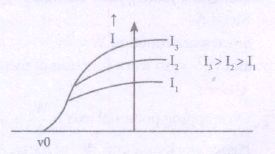
(i) Draw a graph showing variation of photoelectric current (I) with anode potential (V) for different intensities of incident radiation. Name the characteristic of the incident radiation that is kept constant in this experiment.
(ii) If the potential difference used to accelerate electrons is doubled, by what factor does the de-Broglie wavelength associated with the electrons change?
4.
List out the laws of photoelectric effect. (or) Write any three Laws of Photoelectric Effect
5.
Write the aim of artificial intelligence in robots.
6.
Why space wave propagation is limited upto small distance over earth's surface?
7.
What is electronics?
8.
Write the properties of neutrino?
9.
The charge on a parallel plate capacitor varies as q = qo cos 2\(\pi \gamma \)t. The plates are very large and close together. (area - A. separation - d) find the displacement current through the capacitor?
10.
Can a galvanometer be used for measuring the current? Explain.
11.
In a certain region of space, electric field \(\vec { E } \) and magnetic field \(\vec { B } \) are perpendicular to each other. An electron enters the region perpendicular to the direction of both \(\vec { B } \) & \(\vec { E } \) and moves undeflected. Find the velocity of the electron.
12.
Tabulate the difference between Coulomb's law and Biot-Savort's law.
13.
Derive a relation between internal resisance and emf of a cell.
14.
How does the capacitive reactance depend on frequency? & What is the reactance of a capacitor at hertz to the study at?
15.
Explain the Lightning arrester or lightning conductor.
16.
Derive the expressions for the potential energy of a system of point charges.
1.
(i) A lens is formed by a transparent material bounded between two spherical surfaces or one plane and another spherical surface.
(ii) In a thin lens, the distance between the surfaces is very small. If there are two spherical surfaces, then there will be two centers of curvature C1 and C2 and correspondingly two radii of curvature R1 and R2.
(iii) A plane surface has its center of curvature C at infinity and its radius of curvature R is infinity (R = ∞).
2.
Refractive index of a transparent medium is defined as the ratio of speed of light in vacuum (or air) to the speed of light in that medium refractive index n of a medium.
= \(\cfrac { speed\ of lightin\ vacuum\left( c \right) }{ speed\ of \ light\ inmedium\left( v \right) } \)
3.
1) The frequency of incident radiation was kept constant.
2) de Broglie wavelength,
\(\lambda =\frac { h }{ \sqrt { 2mqV } } \alpha \frac { 1 }{ V } \)
If potential difference V is doubled, the de-Broglie wavelength is decreased to \(\frac { 1 }{ \sqrt { 2 } } \) time.
4.
Laws of photoelectric effect:
(i) For a given surface, the emission of photoelectrons takes place only if the frequency of incident light is greater than a certain minimum frequency called the threshold frequency.
(ii) For a given frequency of incident light, the number of photoelectrons emitted is directly proportional to the intensity of the incident light. The saturation current is also directly proportional to the intensity of incident light.
(iii) Maximum kinetic energy of the photoelectrons is independent of the intensity of the incident light.
(iv) Maximum kinetic energy of the photoelectrons from a given metal is directly proportional to the frequency of incident light.
(v) There is no time lag between the incidence of light and the ejection of photoelectrons.
5.
(i) Face recognition.
(ii) Providing response to player's actions in computer games.
(iii) Taking decisions based on previous actions.
(iv) To regulate the traffic by analyzing the density of traffic on roads.
(v) Translate words from one language to another.
6.
(i) Because the transmission of signal directly from the transmitting antenna to receiving antenna called a line of sight communication.
(ii) The waves traveling directly from the transmitting antenna to the receiving antenna get blocked due to curvature of the earth.
(iii) It limits both the maximum line of sight distance between the two antennas arid also the maximum distance up to which transmission can be received.
7.
(i) It is the branch of physics incorporated with technology towards the design of circuits using transistors and microchips.
(ii) It depicts the behavior and movement of electrons in a semiconductor, vacuum, or gas.
(iii) Electronics deals with electrical circuits that involve active components such as transistors, diodes, integrated circuits, and sensors, associated with the passive components like resistors, inductors, capacitors, and transformers.
8.
The neutrino has the following properties
(i) It has zero charge
(ii) It has an antiparticle called anti-neutrino.
(iii) Recent experiments showed that the neutrino has very tiny mass
(iv) It interacts very weakly with the matter. Therefore, it is very difficult to detect In fact, in every second, trillions of neutrinos coming from the sun are passing through our body without any interaction.
9.
Conduction current Ie = Displacement current ID
\({ I }_{ C }={ I }_{ s }=\frac { dq }{ dt } =\frac { d }{ dt } ({ q }_{ 0 }cos2\pi \gamma t)\)
\(=-2\pi { q }_{ 0 }\gamma sin2\pi \gamma t\)
10.
A galvanometer cannot be used for measuring the current
(i) A galvanometer has a finite large resistance and is connected in series in the circuit. So it will increase the resistance of circuit and hence change the value of current in the circuit.
(ii) A galvanometer is a very sensitive device, it gives a full scale deflection for the current of the order of microampere hence if connected, it will not measure current of the order of ampere.
11.
Net force an electron moving in the combined electric field \(\vec { E } \) and a magnetic field \(\vec { B } \) is
\(\vec { F } =-e[\vec { E } +\vec { v } \times \vec { B } ]\)
Since electron moves undeflected then \(\vec { F } \) = 0
\(\vec { E } +(\vec { v } \times \vec { B } )\) = 0
\(|\vec { E } |=(|\vec { v } |\times |\vec { B } |)\Rightarrow |\vec { v } |=\frac { |\vec { E } | }{ |\vec { B } | } \).
12.
| S.No | Electric field | Magnetic field |
| (i) | Produced by a scalar source i.e., an electric charge q | Produced by a vector source i.e., current element I\(\vec { dl } \) |
| (ii) | It is directed along the position vector joining the source and the point at which the field is calculated. | it is directed perpendicular to the position vector \(\hat { r } \) and the current element I\(\vec { dl } \) |
| (iii) | Does not depend on the angle | Depends on the angle between the position vector \(\hat { r } \) and the current element I\(\vec { dl } \) |
13.
(i) The emf of cell \(\xi \) is measured by connecting a high resistance voltmeter across it without connecting the external resistance R.
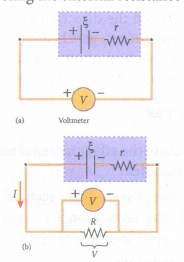
(ii) Since the voltmeter draws very little current for deflection, the circuit may be considered as open. Hence the voltmeter reading gives the emf of the cell.
(iii) Then, external resistance R is included in the circuit, and current I is established in the circuit. The potential difference across R is equal to the potential difference across the cell (V).
(iv) The potential drop across the resistor R is V + IR
(v) Due to internal resistance r of the cell, the voltmeter reads a value V, which is less than the emf of cell . It is because a certain amount of voltage (Ir) has dropped across the internal resistance r.
Then \(V=\xi -Ir\)
\(Ir=\xi -V\)
(vi) Dividing equation (2) by equation (1) we get
\(\cfrac { Ir }{ IR } =\cfrac { \xi -V }{ V } \)
\(r=\left| \cfrac { \xi -V }{ V } \right| R\)
Since \(\xi \) V and R are known, internal resistance r can be determined.
14.
Current leads the applied voltage by \(\frac{\pi}{2}\) in a capacitive circuit.
This is the resistance offered by the capacitor, called capacitive reactance (Xc). It measured in ohm.
\({ X }_{ c }=\frac { 1 }{ \omega C } \)
The capacitive reactance (Xc) varies inversely as the frequency. For a steady current, f = 0
∴\({ X }_{ c }=\frac { 1 }{ \omega C } -\frac { 1 }{ 2\pi fC } =\frac { 1 }{ 0 } =\infty \)
Thus a capacitive circuit offers infinite resistance to the steady current.
15.
(i) This device consists of a long thick copper rod passing from top of the building to the ground. The upper end of the rod has a sharp spike or a sharp needle as shown in Figure 1.64 (a) and (b).
(ii) The lower end of the rod is connected to the copper plate which is buried deep into the ground. When a negatively charged cloud is passing above the building, it induces a positive charge on the spike.
(iii) Since the induced charge density on thin sharp spike is large, it results in a corona discharge.
(iv) This positive charge ionizes the surrounding air which in turn neutralizes the negative charge in the cloud.
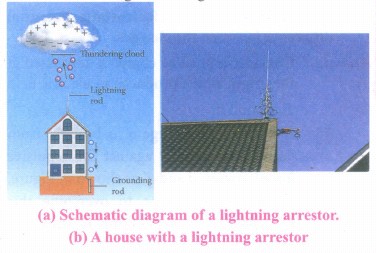
(v) The negative charge pushed to the spikes passes through the copper rod and is safely diverted to the earth.
(vi) The lightning arrester does not stop the lightning; rather it diverts the lightning to the ground safely.
16.
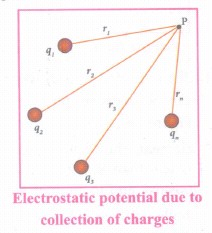
(i) The electric potential at a point P due to a collection of charges q1, q2, q3, ···qn is equal to sum of the electric potentials due to individual charges.
\({ V }_{ tot }=\frac { k{ q }_{ 1 } }{ { r }_{ 1 } } +\frac { { kq }_{ 2 } }{ { r }_{ 2 } } +\frac { { kq }_{ 3 } }{ { r }_{ 3 } } +...\frac { { kq }_{ n } }{ { r }_{ n } } =\frac { 1 }{ 4\pi { \varepsilon }_{ 0 } } { \sum { } }_{ i=1 }^{ n }\frac { { q }_{ i } }{ { r }_{ i } } \)
(ii) where r1, r2, r3 .... rn are the distances of q1, q2, q3 ..... qn respectively from P(Figure).

12th Standard Syllabus & Materials
12th Standard
TN 12th Computer Applications களப்பெயர் முறைமை (DNS) Sample Question Papers Study Material - QB365 Set A
NEW12th Standard
TN 12th Computer Applications வலையமைப்பு எடுத்துக்காட்டுகள் மற்றும் நெறிமுறைகள் Sample Question Papers Study Material - QB365 Set A
NEW12th Standard
TN 12th Computer Applications கணினி வலையமைப்பு ஓர் அறிமுகம் Sample Question Papers Study Material - QB365 Set A
NEW12th Standard
TN 12th Computer Applications PHP-உடன் MySQL-ஐ இணைத்தல் Sample Question Papers Study Material - QB365 Set A



Tamilnadu Stateboard 12th Standard Subjects

Maths

Chemistry
Physics

Biology

Computer Science

Business Maths and Statistics

Economics

Commerce

Accountancy

History

Computer Applications
Biology
Computer Technology
Computer Applications
Computer Science
Business Maths and Statistics
Commerce
Economics
Maths
Chemistry
Physics
Computer Technology
History
Accountancy

Tamil

English

French
Tamilnadu Stateboard Standards

