
 100% FREE ACCESS
12th Standard Syllabus & Materials
12th Standard
TN 12th Maths Applications of Matrices and Determinants Sample Question Papers Study Material - QB365 Set A
NEW12th Standard
TN 12th Computer Applications மின்னணு தரவு பரிமாற்றம் Sample Question Papers Study Material - QB365 Set A
NEW12th Standard
TN 12th Computer Applications மின் - வணிக பாதுகாப்பு அமைப்புகள் Sample Question Papers Study Material - QB365 Set A
NEW12th Standard
TN 12th Computer Applications மின்னணு செலுத்தல் முறைகள் Sample Question Papers Study Material - QB365 Set A
NEW12th Standard
TN 12th Computer Applications மின் - வணிகம் Sample Question Papers Study Material - QB365 Set A
NEW12th Standard
TN 12th Computer Applications திறந்த மூல கருத்துருக்கள் Sample Question Papers Study Material - QB365 Set A

Published on: 01/09/2022
QB365 provides a detailed and simple solution for every Possible Book Back Questions in Class 12 Physics Subject - Magnetism and Magnetic Effects of Electric Current, English Medium. It will help Students to get more practice questions, Students can Practice these question papers in addition to score best marks.
Download Tamil Nadu 12th Standard Physics question papers, model tests, one-mark questions, important questions, and public exam papers in PDF format. Free study materials and answer keys for TN State Board students.
Questions + Answers key
Take MCQ Physics Test1.
The resistance of a moving coil galvanometer is made twice its original value in order to increase current sensitivity by 50%. Find the percentage change in voltage sensitivity.
2.
What happens to the domains in a ferromagnetic material in the presence of external magnetic field?
3.
Give the properties of dia / para / ferromagnetic materials.
4.
Why is the path of a charged particle not a circle when its velocity is not perpendicular to the magnetic field?
5.
Explain the concept of velocity selector.
6.
Is an ammeter connected in series or parallel in a circuit? Why?
7.
State Fleming's left hand rule.
8.
What is resonance condition in cyclotron?
9.
Define magnetic declination and inclination.
10.
Define ampere.
11.
A circular coil with cross-sectional area 0.1 cm2 is kept in a uniform magnetic field of strength 0.2 T. If the current passing in the coil is 3 A and plane of the loop is perpendicular to the direction of magnetic field. Calculate
(a) total torque on the coil
(b) total force on the coil
(c) average force on each electron in the coil due to the magnetic field. (The free electron density for the material of the wire is 1028 m–3).
12.
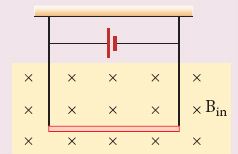
A conductor of linear mass density 0.2 g m–1 suspended by two flexible wire as shown in figure. Suppose the tension in the supporting wires is zero when it is kept inside the magnetic field of 1 T whose direction is into the page. Compute the current inside the conductor and also the direction of the current. Assume g = 10 m s–2
13.
A bar magnet having a magnetic moment \({ \vec { { p } } }_{ m }\) is cut into four pieces i.e., first cut into two pieces along the axis of the magnet and each piece is further cut along the axis into two pieces. Compute the magnetic moment of each piece.
14.
What is meant by hysteresis?
15.
Compare dia, para and ferro-magnetism.
16.
State Ampere’s circuital law.
17.
What is magnetic permeability?
18.
What is magnetic susceptibility?
19.
State Coulomb’s inverse law.
20.
Define magnetic dipole moment.
21.
Define magnetic flux.
22.
What is meant by magnetic induction?
23.
Suppose a cyclotron is operated to accelerate protons with a magnetic field of strength 1 T. Calculate the frequency in which the electric field between two Dees could be reversed.
24.
Let E be the electric field of magnitude 6.0 x 10⁶ N C–1 and B be the magnetic field magnitude 0.83 T. Suppose an electron is accelerated with a potential of 200 V, will it show zero deflection?. If not, at what potential will it show zero deflection.
25.
A particle of charge q moves with velocity\(\vec { v } \) along positive y-direction in a magnetic field \(\vec { B } \) .Compute the Lorentz force experienced by the particle
(a) when magnetic field is along positive y - direction
(b) when magnetic field points in positive z - direction
(c) when magnetic field is in zy - plane and making an angle θ with velocity of the particle. Mark the direction of magnetic force in each case
26.
Compute the magnitude of the magnetic field of a long, straight wire carrying a current of 1 A at distance of 1m from it. Compare it with Earth’s magnetic field.
27.
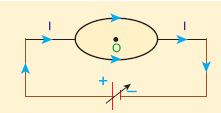
What is the magnetic field at the centre of the loop shown in figure?
28.
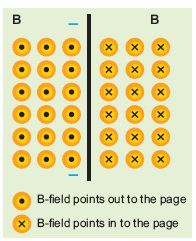
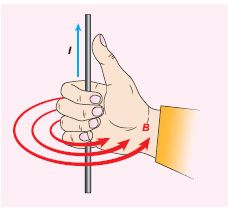
The magnetic field shown in the figure is due to the current carrying wire. In which direction does the current flow in the wire?
29.
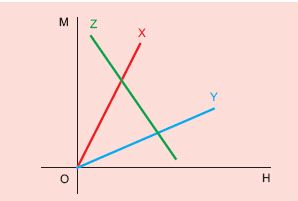
The following figure shows the variation of intensity of magnetisation with the applied magnetic field intensity for three magnetic materials X, Y and Z. Identify the materials X, Y and Z.
30.
Two materials X and Y are magnetised whose values of intensity of magnetisation are 500 A m–1 and 2000 A m–1 respectively. If the magnetising field is 1000 A m–1, then which one among these materials can be easily magnetized?
31.
Using the relation \(\overset { \rightarrow }{ B } =\mu _{ ° }(\overset { \rightarrow }{ H+ } \overset { \rightarrow }{ M } )\) show that \({ x }_{ m }={ \mu }_{ r }-{ 1 }\)
32.
The repulsive force between two magnetic poles in air is 9 x 10⁻³ N. If the two poles are equal in strength and are separated by a distance of 10 cm, calculate the pole strength of each pole.
33.
Calculate the magnetic flux coming out from closed surface containing magnetic dipole (say, a bar magnet) as shown in figure.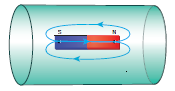
34.
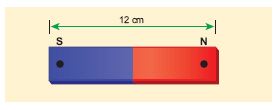
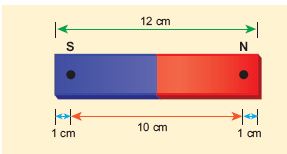
Compute the magnetic length of a uniform bar magnet if the geometrical length of the magnet is 12 cm. Mark the positions of magnetic pole points.
35.
Let the magnetic moment of a bar magnet be \(\overset { \rightarrow }{ { p }_{ m } } \) whose magnetic length is d = 2l and pole strength is qm. Compute the magnetic moment of the bar magnet when it is cut into two pieces
(a) along its length
(b) perpendicular to its length.
36.
The horizontal component and vertical component of Earth’s magnetic field at a place are 0.15 G and 0.26 G respectively. Calculate the angle of dip and resultant magnetic field. (G - gauss, cgs unit for magnetic field 1G = 10–4 T)
1.
Voltage sensitivity is \(V_{S}=\frac{I_{S}}{R_{g}}\)
When the resistance is doubled, then new resistance is \(R_{g}^{\prime}=2 R_{g}\)
Increase in current sensitivity is \(I_{S}^{\prime}=\left(1+\frac{50}{100}\right) I_{S}=\frac{3}{2} I_{S}\)
The new voltage sensitivity is \(V_{S}^{\prime}=\frac{\frac{3}{2} I_{S}}{2 R_{g}}=\frac{3}{4} V_{S}\)
Hence the voltage sensitivity decreases. The percentage decrease in voltage sensitivity is \(\frac{V_{S}-V_{S}^{\prime}}{V_{S}} \times 100 \%=25 \%\).
2.
In the presence of external magnetic field, two processes take place.
(i) The domains having magnetic moments parallel to the field grow bigger in size.
(ii) The other domains (not parallel to field) are rotated, so that they are aligned with the field.
3.
The properties of diamagnetic materials are:
(i) Magnetic susceptibility is negative and it is temperature independent.
(ii) Relative permeability is slightly less than unity.
(iii) The magnetic field lines are repelled or expelled from diamagnetic materials when placed in a magnetic field.
(iv) Example: Copper, Bismuth.
The properties of paramagnetic materials are:
(i) Magnetic susceptibility is positive and small and it is inversely proportional to the temperature.
(ii) Relative permeability is greater than unity.
(iii) The magnetic field lines are attracted into the paramagnetic materials when placed in a magnetic field.
(iv) Example: Chromium, Aluminium.
The properties of ferromagnetic materials are:
(i) Magnetic susceptibility is positive and large and it is inversely proportional to the temperature.
(ii) Relative permeability is large.
(iii) The magnetic field lines are strongly attracted into the ferromagnetic materials when placed in a magnetic field.
(iv) Example: Nickel, Iron
4.
If a charged particle moves in a region of uniform magnetic field such that its velocity is not perpendicular to the magnetic field, then the velocity of the particle is split up into two components: one component is parallel to the field while the other component perpendicular to the field. The component of velocity parallel to field remains unchanged and the component perpendicular to the field keeps changing due to Lorentz force. Hence, the path of the particle is not a circle, it is a helix around the field lines.
5.
It is an arrangement of eletric field (E) and magnetic field (B) perpendicular to each other. When charged particles enter that region, particles with a certain velocity can pass through that region.
v = E/B
The speed is independent of charge and mass.
6.
An ammeter is connected in series with the circuit because the purpose of the ammeter is to measure the current through the circuit. Since the ammeter is a low impedance device connecting it in parallel with the circuit would cause a short circuit, damaging the ammeter and the circuit.
7.
(i) Stretch out forefinger, the middle finger and the thumb of the left hand such that they are in three mutually perpendicular directions.
(ii) If the forefinger points in the direction of magnetic field, the middle finger in the direction of the electric current, then thumb will point in the direction of the force experienced by the conductor.
8.
Resonance condition happens, when the frequency f at which the positive ion circulates in the magtetic field must be equal to the constant frequency of the electrical oscillator fosc.
\(\mathrm{f}_{\mathrm{osc}}=\frac{\mathrm{q} \mathrm{B}}{2 \pi \mathrm{m}}\)
9.
(i) Magnetic declination is the angle between magnetic meridian at a point and geographical meridian.
(ii) Magnetic inclination or dip at a point is defined as the angle subtended by the Earth's total magnetic field \(\vec{B}\) with the horizontal direction in the magnetic meridian.
10.
One ampere is defined as that constant current when it is passed through each of the two infinitely long parallel straight conductors kept side by side parallely at a distance of one meter apart in vacuum causes each conductor to experience a force of 2 x 10⁻⁷ newton per meter length of conductor.
11.
Magnetic field B = 0.2 T
Current flowing through the coil I = 3A
Cross sectional area of a circular coil A = 0.1 cm2
∴ A = 0.1 x 10⁻⁴ m2
(a) Total torque on the coil:
\(\tau=\text { IBA } \cos \theta\)
Here, the plane of the loop is perpendicular to the direction of magnetic field
\(\therefore \theta=90^{\circ} \)
\(\therefore \tau=\text { IBA } \cos 90^{\circ} \) (∵ cos90o = 0)
= 3 x 0.2 x 0.1 x 10-4 x 0
= zero
∴ Total Torque on the coil = zero
(b) Total force on the coil \(F=B q v \sin \theta \)
\(Here\ \theta=0 \)
\(\therefore F=0.2 \times \mathrm{qv} \times \sin \theta=\text { zero } \)
Total force on the coil = zero
c) Average force: F = Bqv
Charge density \(=\sigma=\frac{q}{A} \)
∴ Charge \(q =\sigma A \)
\(=10^{28} \times 0.1 \times 10^{-4} \)
\(q=10^{23} \mathrm{C} \)
Force = Bll and I = 1 m
F = 0.2 x 3 x 1 = 0.6 N
∴ Average force on each electron
\(=\frac{F}{q}=\frac{0.6}{10^{23}} \)
\(F =0.6 \times 10^{-23} \mathrm{~N} \)
12.
Linear mass density of the conductor is = 0.2 g/m
Mass per unit length \(\frac{M}{l}=0.2 \times 10^{-3} \mathrm{~kg} / \mathrm{m}\)
Magnetic field B = 1T.
Acceleration due to gravity, g = 10 ms-2
Force \(=\frac{m}{l} \times g\)
= 0.2 x 10-3 x 10 = 0.2 x 10⁻²
F = 2 x 10⁻³ N ....(1)
If the coil is placed in the magnetic field then the force acting on the coil is
F= BIl ....(2)
From the equation (1) and (2) we get
BIl = 2 x 10⁻³
∴ 1 x L x I = 2 x 10⁻³
∴ I = 2 x 10⁻³ A [∴ l = 1m]
∴ I = 2mA
13.
Magnetic moment of a bar magnet = \({ \vec { { p } } }_{ m }\)
.jpg)
First, When the bar magnet is cut into two pieces along the axis of the magnet. New magnetic pole strength is \(\frac{q_{m}}{2}\), but magnetic length is 2l
Second, Each piece is further cut into two pieces along the axis of the magnet, we get
New magnetic pole strength is,
\(q_{m}^{{\prime}}=\frac{q_{m}}{4}\)
But, magnetic length = 2l.
.JPG)
So, new magnetic moment of each piece is
\(\vec{p_m}_{\text {new }} =q'_{m} \times2 l \)
\(=\frac{q_{m}}{4} \times 2 l \)
\(=\frac{1}{4}\left(q_{m} \times 2 l\right) \)
\(\because \overrightarrow{\mathbf{p}}_{\mathrm{m}_{\text {new }}} =\frac{1}{4} (\vec{p_{m})} \) \((\because{p}_{m} =(q_{\mathrm{m}} \times 2 l) )\)
14.
Hysteresis is the phenomenon of lagging of magnetic induction behind the magnetising field.
15.
| sno | Dia magnetic materials | Para magnetic materials | Ferromagnetic materials |
| (i) | In diamagnetic materials each electron orbit has finite orbital magnetic dipole moment. | In paramagnetic materials each atom (or) molecule has net magnetic dipole moment. |
The ferromagnetic materials have net dipole moment as in a paramagnetic material. |
| (ii) | Since the orbital planes are oriented in random manner, the vector sum of magnetic moments is zero. | Due to the random orientation of these magnetic moments, the net magnetic moment of the material is zero. | Within each domain, the magnetic moments are spontaneously aligned in a direction. |
| (iii) | The resultant magnetic moment for each atom is zero. | There is net magnetic dipole moment induced in the direction of the applied field. | Since the direction of magnetisation varies from domain to domain, net magnetisation of the specimen is zero. |
16.
Ampere's circuital law states that the line integral of magnetic field over a closed loop is μ0, times net current enclosed by the loop.
\(\oint _{ c }^{ }{ \vec { B } \vec { dl } } \) = μ0I enclosed.
17.
Magnetic permeability is the measure of ability of the material to allow the passage of magnetic field lines through it.
18.
Magnetic susceptibility is defined as the ratio of the intensity of magnetisation (\(\vec { M } \)) induced in the material due to the magnetising field |\(\vec H\)|.
\( \chi _{ m }=\frac { |\vec { M } | }{ |\vec { H } | } \).
19.
Coulomb's inverse square law states that the force of attraction or repulsion between two magnetic poles is directly proportional to the product of their pole strengths and inversely proportional to the square of the distance between them.
\(\vec { F } =k \frac { { q }_{ m_{A} }{ q }_{ m_{B} } }{ { r }^{ 2 } } \hat { r } \)
20.
Magnetic dipote moment \(\vec { p }_{ m } \) is defined as the product of its pole strength and magnetic length. It is a vector quantity denoted by \(\vec { p }_{ m } \)
\(\vec { p }_{ m } ={ q }_{ m }\vec { d } \)
21.
Magnetic flux is defined as the number of magnetic field lines crossing per unit area kept normal to the direction of lines of force.
22.
(i) When a substance is placed in a uniform magnetising field, the substance gets magnetised.
(ii) The total magnetic field inside the specimen is equal to the sum of the magnetic field produced in vacuum due to the magnetising field and the magnetic field due to the induced magnetism of the substance.
23.
Magnetic field B = 1 T
Mass of the proton, mp = 1.67 x 10⁻²⁷kg
Charge of the proton, q = 1.60 x 10⁻¹⁹C
\(f=\frac { qB }{ { { 2\pi m }_{ p } } } =\frac { \left( 1.60\times { 10 }^{ -19 } \right) \left( 1 \right) }{ 2\left( 3.14 \right) \left( 1.67\times { 10 }^{ -27 } \right) } \)
= 15.3 x 10⁶ Hz = 15.3 MHz
24.
Electric field, E = 6.0 x 10⁶ N C-1 and magnetic field, B = 0.83 T.
Then.
\(v=\frac { E }{ B } =\frac { { 6.0\times 10 }^{ 6 } }{ 0.83 } =7.23\times { 10 }^{ 6 }{ ms }^{ -1 }\)
When an electron goes with this velocity, it shows null deflection. Since the accelerating potential is 200 V, the electron acquires kinetic energy because of this accelerating potential. Hence,
\(\frac { 1 }{ 2 } mv^{ 2 }=eV \)
\(v=\sqrt { \frac { 2eV }{ m } }\)
Since the mass of the electron, m = 9.1 x 10⁻³¹kg and charge of an electron, \(\left| q \right| =e=1.6\times { 10 }^{ -19 }C.\) The velocity acquired by the electron due to accelerating potential 200 V is
\({ v }_{ 200 }=\sqrt { \frac { 2\left( 1.6\times { 10 }^{ -19 } \right) \left( 200 \right) }{ \left( 9.1\times { 10 }^{ -31 } \right) } } =8.39\times { 10 }^{ 6 }m{ s }^{ -1 }\)
Since the speed v200 > v, the electron is deflected towards direction of Lorentz force. So, in order to have null deflection, the potential, we have to supply is
\(v=\frac { { 1mv }^{ 2 } }{ 2\quad e } =\frac { \left( 9.1\times { 10 }^{ -31 } \right) \times \left( 7.23\times { 10 }^{ 6 } \right) ^{ 2 } }{ 2\times \left( 1.6\times { 10 }^{ -19 } \right) } \)
V = 148.65 V
25.
Velocity of the particle is \(\vec { v } =v\hat { j } \)
(a) Magnetic field is along positive y-direction, this implies \(\vec B=B\hat { j } \)
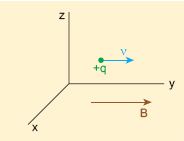
From Lorentz force, \( {\vec F } _{ m }=q(v\hat { j } \times B\hat { j } )=\vec 0\)
So, no force acts on the particle when it moves along the direction of magnetic field.
(b) Since the magnetic field points in positive z - direction, this implies, \(\vec { B } =B\hat { k } \)
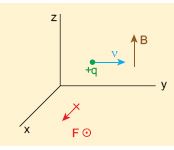
From Lorentz force, \( {\vec F } _{ m }=q(v\hat { j } \times B\hat { k } )=qvB\vec i \)
Therefore, the magnitude of the Lorentz force is qvB and direction is along positive x - direction.
(c) Magnetic field is in zy - plane and making an angle θ with the velocity of the particle, which implies \( {\vec B } =Bcos\theta \hat { j } +Bsin\theta \hat { k } \)
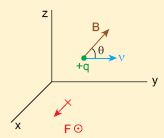
From Lorentz force,
\({ \vec F }_{ m }=q(v\hat { j } )\times (Bcos\theta \hat { j } +Bsin\theta \hat k)\)
\(=qvBsin\theta \hat { i } \)
26.
Given that I = 1 A and radius r = 1 m
Bstraightwire = \(=\frac { { \mu }_{ ° }I }{ 2\pi r } =\frac { 4\pi \times { 10 }^{ -7 }\times 1 }{ 2\pi \times 1 } =2\times { 10 }^{ -7 }T\)
But the Earth’s magnetic field is Bearth \(\sim { 10 }^{ -5 }T\)
So, Bstraightwire is one hundred times smaller than BEarth.
27.
The magnetic field due to current in the upper semicircle and lower semicircle of the circular coil are equal in magnitude but opposite in direction. Hence, the net magnetic field at the center of the loop (at point O) is zero \(\overset { \rightarrow }{ B } =\overset { \rightarrow }{ 0 } \).
28.
Using right hand rule, current flows upwards.
29.
The slope of M-H graph measures the magnetic susceptibility, which is given by
\({ x }_{ m }=\frac { M }{ H } \)
Material X : Slope is positive and larger value. So, it is a ferromagnetic material.
Material Y : Slope is positive and lesser value than X. So, it could be a paramagnetic material.
Material Z : Slope is negative and hence, it is a diamagnetic material.
30.
The susceptibility of material X is
Xm,x = \(\frac { \left| \overset { \rightarrow }{ M } \right| }{ \left| \overset { \rightarrow }{ H } \right| } =\frac { 500 }{ 1000 } =0.5\)
The susceptibility of material Y is
Xm,y = \(\frac { \left| \overset { \rightarrow }{ M } \right| }{ \left| \overset { \rightarrow }{ H } \right| } =\frac { 2000 }{ 1000 } =2\)
Since, susceptibility of material Y is greater than that of material X, material Y can be easily magnetized than X.
31.
\(\overset { \rightarrow }{ B } =\mu _{ ° }(\overset { \rightarrow }{ H+ } \overset { \rightarrow }{ M } )\)
But from equation (3.33), in vector form,
\(\overset { \rightarrow }{ M } ={ x }_{ m }\overset { \rightarrow }{ H } \)
Hence, \(\overset { \rightarrow }{ B } =\mu _{ ° }({ x }_{ m }+1)\overset { \rightarrow }{ H } \Rightarrow \overset { \rightarrow }{ B } =\mu \overset { \rightarrow }{ H } \)
where, \(\mu =\mu _{ ° }({ x }_{ m }+1)\Rightarrow { x }_{ m }+1=\frac { \mu }{ \mu _{ ° } } =\mu _{ r }\)
\(\Rightarrow { x }_{ m }=\mu _{ r }-1\)
32.
The magnitude of the force between two poles is given by
\( F =k\frac { { q }_{ m_A }{ q }_{ { m }_{ B } } }{ { r }^{ 2 } } \)
(Given : F = 9 × 10⁻³ N, r = 10 cm = 10 × 10–2 m
Since qmA = qmB = qm, we have
9 x 10-3 = 10-7 x \(\frac { { q }_{ m }^{ 2 } }{ { \left( 10\times { 10 }^{ -2 } \right) }^{ 2 } } \Rightarrow { q }_{ m }\) = 30NT-1
33.
The total flux emanating from the closed surface S enclosing the dipole is zero. So,
\({ \Phi }_{ B }=\oint { \overset { \rightarrow }{ B } .d\overset { \rightarrow }{ A } } =0\)
Here the integral is taken over closed surface. Since no isolated magnetic pole (called magnetic monopole) exists, this integral is always zero,
\(\oint { \overset { \rightarrow }{ B } .d\overset { \rightarrow }{ A } } =0\)
This is similar to Gauss’s law in electrostatics.
34.
The geometrical length of the bar magnet is 12 cm
Magnetic length = \(\frac { 5 }{ 6 } \times \)(geometrical length)
= \(\frac { 5 }{ 6 } \times \)12 = 10 cm
In this figure, the dot implies the pole points.
35.
(a) a bar magnet cut into two pieces along its length:
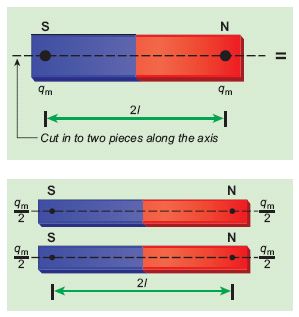
When the bar magnet is cut along the axis into two pieces, new magnetic pole strength is \({ q }_{ m }^{ ' }=\frac { { q }_{ m } }{ 2 } \) but magnetic length does not change. So, the magnetic moment is
\({ p }_{ m }^{ ' }={ q' }_{ m }2l\)
\({ p }_{ m }^{ ' }=\frac { { q }_{ m } }{ 2 } 2l=\frac { 1 }{ 2 } ({ q }_{ m }2l)=\frac { 1 }{ 2 }p_ m\)
In vector notation, \(\vec{p}'_m=\frac{1}{2}\vec{p}_m\)
(b) a bar magnet cut into two pieces perpendicular to the axis:
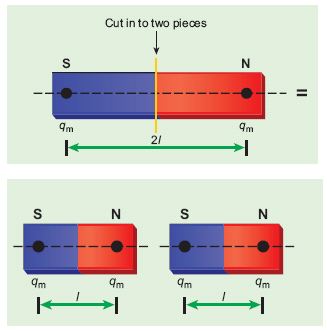
When the bar magnet is cut perpendicular to the axis into two pieces, magnetic pole strength will not change but magnetic length will be halved. So the magnetic moment is
\({ p }_{ m }^{ ' }={ q }_{ m }\times \frac { 1 }{ 2 } (2l)=\frac { 1 }{ 2 } ({ q }_{ m }.2l)=\frac { 1 }{ 2 } { p }_{ m }\)
In vector notation, \(\vec{p}'_m=\frac{1}{2}\vec{p}_m\)
36.
BH = 0.15 G and BV = 0.26 G
tan I = \(\frac { 0.26 }{ 0.15 } \Rightarrow I=ta{ n }^{ -1 }(1.732)=60°\)
The resultant magnetic field of the Earth is
\(B=\sqrt { { B }_{ H }^{ 2 }+{ B }_{ V }^{ 2 } } =0.3G\)

12th Standard Syllabus & Materials
12th Standard
TN 12th Computer Applications வலையமைப்பு வடமிடல் Sample Question Papers Study Material - QB365 Set A
NEW12th Standard
TN 12th Computer Applications களப்பெயர் முறைமை (DNS) Sample Question Papers Study Material - QB365 Set A
NEW12th Standard
TN 12th Computer Applications வலையமைப்பு எடுத்துக்காட்டுகள் மற்றும் நெறிமுறைகள் Sample Question Papers Study Material - QB365 Set A
NEW12th Standard
TN 12th Computer Applications கணினி வலையமைப்பு ஓர் அறிமுகம் Sample Question Papers Study Material - QB365 Set A



Tamilnadu Stateboard 12th Standard Subjects

Maths

Chemistry
Physics

Biology

Computer Science

Business Maths and Statistics

Economics

Commerce

Accountancy

History

Computer Applications
Biology
Computer Technology
Computer Applications
Computer Science
Business Maths and Statistics
Commerce
Economics
Maths
Chemistry
Physics
Computer Technology
History
Accountancy

Tamil

English

French
Tamilnadu Stateboard Standards

