
 100% FREE ACCESS
12th Standard Syllabus & Materials
12th Standard
TN 12th Computer Applications மின்னணு தரவு பரிமாற்றம் Sample Question Papers Study Material - QB365 Set A
NEW12th Standard
TN 12th Computer Applications மின் - வணிக பாதுகாப்பு அமைப்புகள் Sample Question Papers Study Material - QB365 Set A
NEW12th Standard
TN 12th Computer Applications மின்னணு செலுத்தல் முறைகள் Sample Question Papers Study Material - QB365 Set A
NEW12th Standard
TN 12th Computer Applications மின் - வணிகம் Sample Question Papers Study Material - QB365 Set A
NEW12th Standard
TN 12th Computer Applications திறந்த மூல கருத்துருக்கள் Sample Question Papers Study Material - QB365 Set A
NEW12th Standard
TN 12th Computer Applications வலையமைப்பு வடமிடல் Sample Question Papers Study Material - QB365 Set A

Published on: 01/09/2022
QB365 provides a detailed and simple solution for every Possible Creative Questions in Class 12 Physics Subject - Magnetism and Magnetic Effects of Electric Current, English Medium. It will help Students to get more practice questions, Students can Practice these question papers in addition to score best marks.
Download Tamil Nadu 12th Standard Physics question papers, model tests, one-mark questions, important questions, and public exam papers in PDF format. Free study materials and answer keys for TN State Board students.
Questions + Answers key
Take MCQ Physics Test1.
Obtain an expression for magnetic Lorentz force?
2.
State that a current carrying loop behaves as a magnetic dipole. Hence write an expression for its magnetic dipole moment.
3.
Tabulate the difference between Coulomb's law and Biot-Savort's law.
4.
Mention the properties of Magnetic field lines?
5.
Write the Properties of magnet.
6.
What are the types of magnets? Give example.
7.
Write the value of
(i) Horizontal component &
(ii) vertical component of Earth's magnetic field.
8.
Define Voltage sensitivity?
9.
Define Current sensitivity?
10.
Write the Similarities between Coulomb's law and Biot-Savort's law.
11.
State Maxwell's right hand cork screw rule?
12.
What are electromagnets? Mention examples.
13.
What is meant by coercivity?
14.
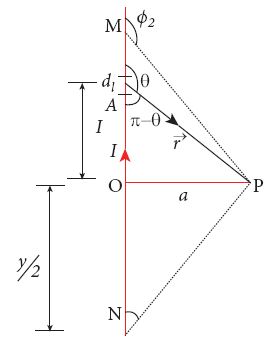
Calculate the magnetic field at a point P which is perpendicular bisector to current carrying straight wire as shown in figure.
15.
Show the time period of oscillation when a bar magnet is kept in a uniform magnetic field is \(T=2\pi \sqrt { \frac { 1 }{ { p }_{ m }B } } \) in second, where I represents a moment of inertia of the bar magnet, pm is the magnetic moment and B is the magnetic field.
1.
When an electric charge q is moving with velocity \(\vec { v } \) in the magnetic field \(\vec { B } \), it experiences a force, called magnetic force \(\vec { { F }_{ m } } \). After careful experiments, Lorentz deduced the force experienced by a moving charge in the magnetic field \(\vec { { F }_{ m } } \).
\(\vec { { F }_{ m } } =q(\vec { v } \times \vec { B } )\) ...........(1)
In magnitude, Fm = qvB sinθ .......(2)
The equations (1) and equation (2) imply
(i) \(\vec { { F }_{ m } } \) is directly proportional to the magnetic field \(\vec { B } \).
(ii) \(\vec { { F }_{ m } } \) is directly proportional to the velocity \(\vec { v } \).
(iii) \(\vec { { F }_{ m } } \) is directly proportional to sine of the angle between the velocity and magnetic field.
(iv) \(\vec { { F }_{ m } } \) is directly proportional to the magnitude of the charge q.
(v) The-direction of \(\vec { { F }_{ m } } \) is always perpendicular to \(\vec { v } \) and B as \(\vec { { F }_{ m } } \) in the cross product of \(\vec { v } \) and \(\vec { B } \).
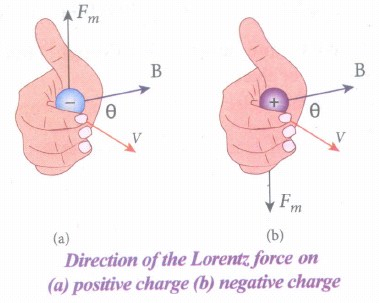
(vi) The direction of \(\vec { { F }_{ m } } \) on a negative charge is opposite to the direction of \(\vec { { F }_{ m } } \) on positive charge provided other factors are identified as shown in Figure.
(vii) If the velocity \(\vec { v } \) of the charge, q is along the magnetic field \(\vec { B } \) then, \(\vec { { F }_{ m } } \) is zero.
2.
The magnetic field from the center of a circular loop of radius R along the axis is given by
\(\vec { B } =\frac { { \mu }_{ 0 }I }{ 2 } \frac { { R }^{ 2 } }{ ({ R }^{ 2 }+{ z }^{ 2 })^{ \frac { 3 }{ 2 } } } \hat { k } \)
At larger distance z >> R, therefore R2 + z2 ≈ z2,
we have
\(\vec { B } =\frac { { \mu }_{ 0 }I }{ 2 } \frac { { R }^{ 2 } }{ { z }^{ 3 } } \hat { k } \) ........(1)
Let A be the area of the circular loop A = πR2. So rewriting the equation (1) in terms of the area of the loop, we have
\(\vec { B } =\frac { { \mu }_{ 0 }I }{ 4\pi } \frac { { R }^{ 2 } }{ { z }^{ 3 } } \hat { k } \)
\(\vec { B } =\frac { { \mu }_{ 0 } }{ 4\pi } \frac { 2IA }{ { z }^{ 3 } } \hat { k } \) .......(2)
Comparing equation (2) with equation (1) dimensionally, we get
pm = IA
where Pm is called a magnetic dipole moment. In vector notation,
\(\vec { { p }_{ m } } =I\vec { A } \) .........(3)
This implies that a current - carrying circular loop behaves as a magnetic dipole of the magnetic moment \(\vec { { p }_{ m } } \) So, the magnetic dipole moment of any current loop is equal to the product of the current and area of the loop.
3.
| S.No | Electric field | Magnetic field |
| (i) | Produced by a scalar source i.e., an electric charge q | Produced by a vector source i.e., current element I\(\vec { dl } \) |
| (ii) | It is directed along the position vector joining the source and the point at which the field is calculated. | it is directed perpendicular to the position vector \(\hat { r } \) and the current element I\(\vec { dl } \) |
| (iii) | Does not depend on the angle | Depends on the angle between the position vector \(\hat { r } \) and the current element I\(\vec { dl } \) |
4.
(i) Magnetic field lines are continuous closed curves. The direction of magnetic field lines is from the North pole to the South pole outside the magnet and South pole to the North pole inside the magnet.
(ii) The direction of a magnetic field at any point on the curve is known by drawing a tangent to the magnetic line of force at that point.
(iii) Magnetic field lines never intersect each other.
(iv) The degree of closeness of the field lines determines the relative strength of the magnetic field. The magnetic field is strong where magnetic field lines crowd and weak where magnetic field lines thin out.
5.
(i) A freely suspended bar magnet will always point along the north-south direction.
(ii) A magnet attracts another magnet or magnetic substances towards itself. The attractive force is maximum near the end of the bar magnet. When a bar magnet is dipped into iron filling, they cling to the ends of the magnet.
(iii) When a magnet is broken into pieces, each piece behaves like a magnet with poles at its ends.
(iv) Two poles of magnet have pole strength equal to one another.
(v) The length of the bar magnet is called geometrical length and the length between two magnetic poles in a bar magnet is called magnetic length. Magnetic length is always slightly smaller than geometrical length.
6.
(i) Magnets are classified into natural magnets and artificial magnets.
(ii) For example, iron, cobalt, nickel, etc. are natural magnets.
(iii) Strengths of natural magnets are very weak and the shapes of the magnet are irregular.
(iv) Artificial magnets are made by us in order to have desired shape and strength.
(v) If the magnet is in the form of rectangular shape or cylindrical shape, then it is known as bar magnet.
7.
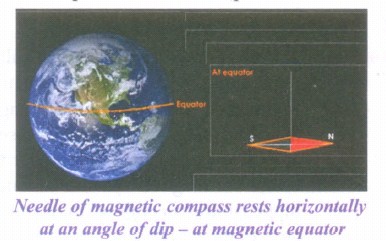
(i) Horizontal component:
The Earth's magnetic field is parallel to the surface of the Earth (i.e., horizontal) which implies that the needle of the magnetic compass rests horizontally at an angle of dip, I = 00 as shown in the figure.
BH = BE
Bv = 0
This implies that the horizontal component is maximum at the equator and the vertical component is zero at the equator.
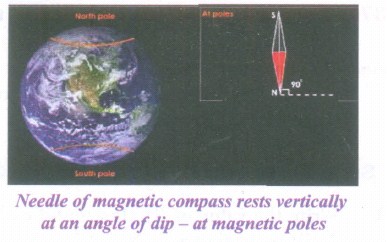
(ii) Vertical component: The Earth's magnetic field is perpendicular to the surface of the Earth (i.e., vertical) which implies that the needle of magnetic compass rests vertically at an angle of dip, I = 90° as shown in Figure
Hence,
BH = 0
Bv = BE
This implies that the vertical component is maximum at poles and the horizontal component is zero at poles.
8.
It is defined as the deflection produced per unit voltage applied across the galvanometer.
Vs =\(\frac { \theta }{ V } \)
Vs = \(\frac { \theta }{ IR_{ g } } =\frac { NAB }{ KR_{ g } } =V_{ s }=\frac { 1 }{ GR_{ g } } =\frac { { I }_{ s } }{ { R }_{ g } } \)
9.
It is defined as the deflection produced per unit current flowing through the galvanometer.
Is = \(\frac { \theta }{ I } =\frac { NAB }{ K } \Rightarrow I_{ s }=\frac { I }{ G } \).
10.
(i) Obey inverse square law, so they are long-range fields.
(ii) obey the principle of superposition and are linear with respect to source in magnitude,
E ∝ q
B ∝ Idl
11.
If we rotate aright-handed screw by ascrew driver, then the direction of current is same as the direction in which screw advances and the direction of rotation of the screw gives the direction of the magnetic field.
12.
The materials with high initial permeability, low retentivity, low coercivity and thin hysteresis loop with smaller area are preferred to make electromagnets.
13.
The magnitude of the reverse magnetising field for which the residual magnetism of the material vanishes is called its coercivity.
14.
Let the length MN = y and the point P is on its perpendicular bisector. Let O be the point on the conductor as shown in figure. Therefore,
\(OM=ON=\frac { y }{ 2 } ,then\)
\(cos\varphi _{ 1 }=\frac { \frac { y }{ 2 } }{ \sqrt { \frac { { y }^{ 2 } }{ 4 } +{ d }^{ 2 } } } =\frac { adjacent \ length }{ hypotenuse \ length } \)
\(=\frac { ON }{ PH } =-\frac { \frac { y }{ 2 } }{ \sqrt { \frac { { y }^{ 2 } }{ 4 } +{ a }^{ 2 } } } =-\frac { y }{ \sqrt { { y }^{ 2 }+{ 4a }^{ 2 } } } \)
\(cos\varphi _{ 1 }=\frac { adjacent \ length }{ hypotenuse \ length } =\frac { OM }{ PM } \)
\(=-\frac { \frac { y }{ 2 } }{ \sqrt { \frac { { y }^{ 2 } }{ 4 } +{ a }^{ 2 } } } =-\frac { y }{ \sqrt { { y }^{ 2 }+{ 4a }^{ 2 } } } \)
Hence,
\(\overset { \rightarrow }{ B } =\frac { { \mu }_{ ° }I }{ 4\pi a\sqrt { { y }^{ 2 }+{ 4a }^{ 2 } } } \hat { n } \)
For long straight wire, Y\(\rightarrow \infty ,\)
\(\overset { \rightarrow }{ B } =\frac { { \mu }_{ ° }I }{ 2\pi a } \hat { n } \)
The result obtained is the same as we obtained in equation (3.39).
15.
The magnitude of deflecting torque (the torque which makes the object rotate) acting on the bar magnet will tend to align the bar magnet parallel to the direction of the uniform magnetic field \(\overset { \rightarrow }{ B } \)
\(\left| \overset { \rightarrow }{ r } \right| ={ p }_{ m }Bsin\theta \)
The magnitude of restoring torque acting on the bar magnet can be written as
\(\left| \overset { \rightarrow }{ r } \right| =I\frac { { d }^{ 2 }\theta }{ { dt }^{ 2 } } \)
Under equilibrium conditions, both magnitudes of deflecting torque and restoring torque will be equal but act in the opposite directions, which means
\(\frac { { d }^{ 2 }\theta }{ { dt }^{ 2 } } =-{ p }_{ m }Bsin\theta \)

12th Standard Syllabus & Materials
12th Standard
TN 12th Computer Applications களப்பெயர் முறைமை (DNS) Sample Question Papers Study Material - QB365 Set A
NEW12th Standard
TN 12th Computer Applications வலையமைப்பு எடுத்துக்காட்டுகள் மற்றும் நெறிமுறைகள் Sample Question Papers Study Material - QB365 Set A
NEW12th Standard
TN 12th Computer Applications கணினி வலையமைப்பு ஓர் அறிமுகம் Sample Question Papers Study Material - QB365 Set A
NEW12th Standard
TN 12th Computer Applications PHP-உடன் MySQL-ஐ இணைத்தல் Sample Question Papers Study Material - QB365 Set A



Tamilnadu Stateboard 12th Standard Subjects

Maths

Chemistry
Physics

Biology

Computer Science

Business Maths and Statistics

Economics

Commerce

Accountancy

History

Computer Applications
Biology
Computer Technology
Computer Applications
Computer Science
Business Maths and Statistics
Commerce
Economics
Maths
Chemistry
Physics
Computer Technology
History
Accountancy

Tamil

English

French
Tamilnadu Stateboard Standards

