
 100% FREE ACCESS
12th Standard Syllabus & Materials
12th Standard
TN 12th Maths Applications of Matrices and Determinants Sample Question Papers Study Material - QB365 Set A
NEW12th Standard
TN 12th Computer Applications மின்னணு தரவு பரிமாற்றம் Sample Question Papers Study Material - QB365 Set A
NEW12th Standard
TN 12th Computer Applications மின் - வணிக பாதுகாப்பு அமைப்புகள் Sample Question Papers Study Material - QB365 Set A
NEW12th Standard
TN 12th Computer Applications மின்னணு செலுத்தல் முறைகள் Sample Question Papers Study Material - QB365 Set A
NEW12th Standard
TN 12th Computer Applications மின் - வணிகம் Sample Question Papers Study Material - QB365 Set A
NEW12th Standard
TN 12th Computer Applications திறந்த மூல கருத்துருக்கள் Sample Question Papers Study Material - QB365 Set A

Published on: 27/01/2021
12th Standard Physics English Medium Magnetism and Magnetic Effects of Electric Current Reduced Syllabus Important Questions with Answer key 2021
Download Tamil Nadu 12th Standard Physics question papers, model tests, one-mark questions, important questions, and public exam papers in PDF format. Free study materials and answer keys for TN State Board students.
Questions + Answers key
Take MCQ Physics Test1.
How is a galvanometer converted into (i) an ammeter and (ii) a voltmeter?
2.
Why is the path of a charged particle not a circle when its velocity is not perpendicular to the magnetic field?
3.
Why the Phosphor - bronze wire is used as the suspension wire in moving coil galvanometer?
4.
When is a galvanometer said to be sensitive?
5.
What is magnetic Lorentz force?
6.
State Right hand thumb rule.
7.
Define magnetic flux density.
8.
What is magnetic axis, magnetic meridian & magnetic equator?
9.
What are the causes for earth's magnetic field according to Gover?
10.
A circular coil with cross-sectional area 0.1 cm2 is kept in a uniform magnetic field of strength 0.2 T. If the current passing in the coil is 3 A and plane of the loop is perpendicular to the direction of magnetic field. Calculate
(a) total torque on the coil
(b) total force on the coil
(c) average force on each electron in the coil due to the magnetic field. (The free electron density for the material of the wire is 1028 m–3).
11.
What is magnetic susceptibility?
12.
Let E be the electric field of magnitude 6.0 x 10⁶ N C–1 and B be the magnetic field magnitude 0.83 T. Suppose an electron is accelerated with a potential of 200 V, will it show zero deflection?. If not, at what potential will it show zero deflection.
13.
A particle of charge q moves with velocity\(\vec { v } \) along positive y-direction in a magnetic field \(\vec { B } \) .Compute the Lorentz force experienced by the particle
(a) when magnetic field is along positive y - direction
(b) when magnetic field points in positive z - direction
(c) when magnetic field is in zy - plane and making an angle θ with velocity of the particle. Mark the direction of magnetic force in each case
14.
Calculate the magnetic flux coming out from closed surface containing magnetic dipole (say, a bar magnet) as shown in figure.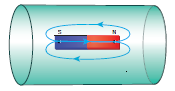
15.
Let the magnetic moment of a bar magnet be \(\overset { \rightarrow }{ { p }_{ m } } \) whose magnetic length is d = 2l and pole strength is qm. Compute the magnetic moment of the bar magnet when it is cut into two pieces
(a) along its length
(b) perpendicular to its length.
16.
How will the magnetic field intensity at the contre of a circular coil carrying current change if the current through the coil is doubled and the radius of the coil is halved?
17.
Two identical charged produces moving with the same speed enter a region of uniform magnetic field. If one of these enters normal to the field direction and the other enters along a direction at 30° with the field. What would be the ratio of their angular frequencies.
18.
Write the expression in a vector form for the
(i) Lorentz magnetic force \(\vec { F } \) due to a charge moving with velocity \(\vec { v } \) in a magnetic field \(\vec { B } \) What is the direction of force?
(ii) If the magnetic force \(\vec { F } \) acting it is non-zero would the particle gain any energy?
19.
Write the value of
(i) Horizontal component &
(ii) vertical component of Earth's magnetic field.
20.
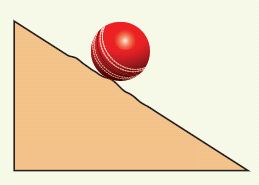
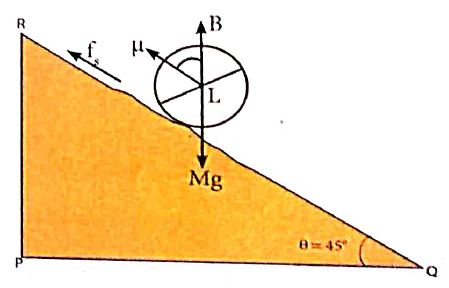
A non - conducting sphere has a mass of 100 g and radius 20 cm. A flat compact coil of wire with turns 5 is wrapped tightly around it with each turns concentric with the sphere. This sphere is placed on an inclined plane such that plane of coil is parallel to the inclined plane. A uniform magnetic field of 0.5 T exists in the region in vertically upward direction. Compute the current I required to rest the sphere in equilibrium.
21.
An electron moving perpendicular to a uniform magnetic field 0.500 T undergoes circular motion of radius 2.50 mm. What is the speed of electron?
22.
A coil of a tangent galvanometer of diameter 0.24 m has 100 turns. If the horizontal component of Earth’s magnetic field is 25 x 10–6 T then, calculate the current which gives a deflection of 60o .
23.
Consider a magnetic dipole which on switching ON external magnetic field orient only in two possible ways i.e., one along the direction of the magnetic field (parallel to the field) and another anti-parallel to magnetic field. Compute the energy for the possible orientation.
24.
The magnitude of the magnetic Lorentz force does not depend on ______
mass of the charged particle
velocity of the charged particle
magnetic induction
direction of motion of the charged particle
25.
The direction of force on a current carrying conductor placed in a magnetic field is given by _____
Fleming's Left Hand Rule
Fleming's Right Hand Rule
Ampere's velocity
Biot-Savart Law
26.
To convert a galvanometer into an ammeter we connect which one of the following to the galvanometer?
a low resistance in series
a high resistance in series
a low resistance in parallel
a high resistance in parallel
27.
The angular frequency of a charged particle moving in a uniform magnetic field ____________.
depends upon the mass and velocity of the particle
depends upon mass and radius of circular path
depends upon the charge and velocity of the particle
neither depends upon the velocity nor the radius of circular path
28.
The unit of pole strength (magnetic charge) is _______
A/m
Am2
A/m2
Am
29.
The direction of the magnetic field due to a solenoid is given by ___________________.
Amperes circuital law
Biot-Savart law
Right hand palm rule
Flemings right hand law
30.
Magnetic flux density at the center of a circular coil of diameter 20 cm carrying a current 5 A kept in air is _______________.
6.28 x 10⁻⁵ tesla
1.57 x 10⁻⁵ tesla
3.14 x 10⁻⁵ tesla
9.42 x 10⁻⁵ tesla
31.
The magnetic induction at the center of a circular coil having 5 turn and radius 2π cm carrying a current of 50 mA is ________________.
2π x 10-7 T
50π x 10-7 T
25π x 10-7 T
2.5π x 10-7 T
32.
The unit of magnetic field is _______________.
ampere-turn
ampere
newton coulomb
tesla
33.
Lorentz force generally refers to force experienced by a charge due to combined action of _________________.
magnetic fields
electric fields
electric, magnetic & gravitational fields
electric and magnetic fields
34.
Consider the motion of a charged particle in a uniform magnetic field directed into the paper. If velocity v of the particle is in the plane of the paper, the charged particle will describe a _____________.
straight line
circle
ellipse
hyperbola
35.
The direction of the magnetic force on a positive charge moving in a magnetic field is given by ________________.
thumb rule
left hand rule
right hand rule
cork screw rule
36.
A wire of length l carrying a current I along the Y direction is kept in a magnetic field is given by \(\vec { B } =\frac { \beta }{ \sqrt { 3 } } =(\hat { i } +\hat { j } +\hat { k } )T.\) The magnitude of Lorentz force acting on the wire is _____.
\(\sqrt { \frac { 2 }{ { 3 } } } \beta Il\)
\(\sqrt { \frac { 1 }{ { 3 } } } \beta Il\)
\(\sqrt { 2 } \beta Il\)
\(\sqrt { \frac { 1 }{ 2 } } \beta Il\)
37.
Three wires of equal lengths are bent in the form of loops. One of the loops is circle, another is a semi-circle and the third one is a square. They are placed in a uniform magnetic field and same electric current is passed through them. Which of the following loop configuration will experience greater torque?
Circle
Semi-circle
Square
All of them
38.
A particle having mass m and charge q accelerated through a potential difference V. Find the force experienced when it is kept under perpendicular magnetic field \(\vec { B } \).
\(\sqrt { \frac { 2{ q }^{ 3 }BV }{ m } } \)
\(\sqrt { \frac { { q }^{ 3 }{ B }^{ 2 }V }{ 2m } } \)
\(\sqrt { \frac { 2{ q }^{ 3 }{ B }^{ 2 }V }{ m } } \)
\(\sqrt { \frac { { 2q }^{ 3 }BV }{ { m }^{ 3 } } } \)
39.
A rectangular coil of area 2 x 10⁻⁴ m2 and 40 turns is pivoted about one of its vertical sides. The coil is in a radial horizontal field of 60G. What is the torsional constant of the hair springs connected to the coil if a current of 4.0 mA produces an angular deflection of 16°?
40.
Describe the motion of a charged particle in a uniform magnetic field.
41.
Calculate the magnetic field inside and outside of the long solenoid using Ampere’s circuital law.
42.
Explain the principle and working of a moving coil galvanometer.
1.
(i) A galvanometer is converted into an ammeter by connecting a low resistance in parallel with the galvanometer.
(ii) A galvanometer is converted into a volmeter by connecting high resistance Rs in series with the galvanometer.
2.
If a charged particle moves in a region of uniform magnetic field such that its velocity is not perpendicular to the magnetic field, then the velocity of the particle is split up into two components: one component is parallel to the field while the other component perpendicular to the field. The component of velocity parallel to field remains unchanged and the component perpendicular to the field keeps changing due to Lorentz force. Hence, the path of the particle is not a circle, it is a helix around the field lines.
3.
Phosphor - bronze wire is used as the suspension wire because the couple per unit twist is very small.
4.
The galvanometer is said to be sensitive if it shows large scale deflection even though a small current is passed through it or a small voltage is applied across it.
5.
When an electric charge q is kept at rest in a magnetic field, no force acts on it. At the same time, if the charge moves in the magnetic field, it experiences a force. This force is different from Coulomb's force. This force is known as magnetic Lorentz force
\(\vec { F } =q(\vec { v } \times \vec { B } )\)
In general, if the charge is moving in both the electric and magnetic fields, the total force experienced by the charge is given by \(\vec { F } =q(\vec { v } \times \vec { B } )q\vec { E } \) . It is known as Lorentz force.
6.
If we hold the current carrying conductor in our right hand such that the thumb points in the direction of current flow, then the fingers encircling the wire points in the direction of the magnetic field lines produced.
7.
The magnetic flux density can also be defined as the number of magnetic field lines crossing unit area kept normal to the direction of line of force.
Its unit is Wb m-2 or telsa.
8.
The straight line which connects magnetic poles of Earth is known as magnetic axis. A vertical plane passing through magnetic axis is called magnetic meridian and a great circle perpendicular to Earth's magnetic axis is called magnetic equator.
9.
Gover suggested that the Earth's magnetic field is due to hot rays coming out from the Sun. These rays will heat up the air near equatorial region. Once air becomes hotter, it rises above and will move towards northern and southern hemispheres and get electrified. This may be responsible to magnetize the ferromagnetic materials near the Earth's surface.
10.
Magnetic field B = 0.2 T
Current flowing through the coil I = 3A
Cross sectional area of a circular coil A = 0.1 cm2
∴ A = 0.1 x 10⁻⁴ m2
(a) Total torque on the coil:
\(\tau=\text { IBA } \cos \theta\)
Here, the plane of the loop is perpendicular to the direction of magnetic field
\(\therefore \theta=90^{\circ} \)
\(\therefore \tau=\text { IBA } \cos 90^{\circ} \) (∵ cos90o = 0)
= 3 x 0.2 x 0.1 x 10-4 x 0
= zero
∴ Total Torque on the coil = zero
(b) Total force on the coil \(F=B q v \sin \theta \)
\(Here\ \theta=0 \)
\(\therefore F=0.2 \times \mathrm{qv} \times \sin \theta=\text { zero } \)
Total force on the coil = zero
c) Average force: F = Bqv
Charge density \(=\sigma=\frac{q}{A} \)
∴ Charge \(q =\sigma A \)
\(=10^{28} \times 0.1 \times 10^{-4} \)
\(q=10^{23} \mathrm{C} \)
Force = Bll and I = 1 m
F = 0.2 x 3 x 1 = 0.6 N
∴ Average force on each electron
\(=\frac{F}{q}=\frac{0.6}{10^{23}} \)
\(F =0.6 \times 10^{-23} \mathrm{~N} \)
11.
Magnetic susceptibility is defined as the ratio of the intensity of magnetisation (\(\vec { M } \)) induced in the material due to the magnetising field |\(\vec H\)|.
\( \chi _{ m }=\frac { |\vec { M } | }{ |\vec { H } | } \).
12.
Electric field, E = 6.0 x 10⁶ N C-1 and magnetic field, B = 0.83 T.
Then.
\(v=\frac { E }{ B } =\frac { { 6.0\times 10 }^{ 6 } }{ 0.83 } =7.23\times { 10 }^{ 6 }{ ms }^{ -1 }\)
When an electron goes with this velocity, it shows null deflection. Since the accelerating potential is 200 V, the electron acquires kinetic energy because of this accelerating potential. Hence,
\(\frac { 1 }{ 2 } mv^{ 2 }=eV \)
\(v=\sqrt { \frac { 2eV }{ m } }\)
Since the mass of the electron, m = 9.1 x 10⁻³¹kg and charge of an electron, \(\left| q \right| =e=1.6\times { 10 }^{ -19 }C.\) The velocity acquired by the electron due to accelerating potential 200 V is
\({ v }_{ 200 }=\sqrt { \frac { 2\left( 1.6\times { 10 }^{ -19 } \right) \left( 200 \right) }{ \left( 9.1\times { 10 }^{ -31 } \right) } } =8.39\times { 10 }^{ 6 }m{ s }^{ -1 }\)
Since the speed v200 > v, the electron is deflected towards direction of Lorentz force. So, in order to have null deflection, the potential, we have to supply is
\(v=\frac { { 1mv }^{ 2 } }{ 2\quad e } =\frac { \left( 9.1\times { 10 }^{ -31 } \right) \times \left( 7.23\times { 10 }^{ 6 } \right) ^{ 2 } }{ 2\times \left( 1.6\times { 10 }^{ -19 } \right) } \)
V = 148.65 V
13.
Velocity of the particle is \(\vec { v } =v\hat { j } \)
(a) Magnetic field is along positive y-direction, this implies \(\vec B=B\hat { j } \)
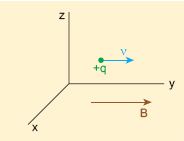
From Lorentz force, \( {\vec F } _{ m }=q(v\hat { j } \times B\hat { j } )=\vec 0\)
So, no force acts on the particle when it moves along the direction of magnetic field.
(b) Since the magnetic field points in positive z - direction, this implies, \(\vec { B } =B\hat { k } \)
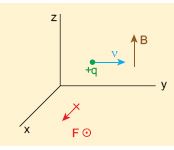
From Lorentz force, \( {\vec F } _{ m }=q(v\hat { j } \times B\hat { k } )=qvB\vec i \)
Therefore, the magnitude of the Lorentz force is qvB and direction is along positive x - direction.
(c) Magnetic field is in zy - plane and making an angle θ with the velocity of the particle, which implies \( {\vec B } =Bcos\theta \hat { j } +Bsin\theta \hat { k } \)
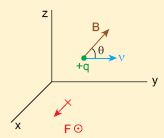
From Lorentz force,
\({ \vec F }_{ m }=q(v\hat { j } )\times (Bcos\theta \hat { j } +Bsin\theta \hat k)\)
\(=qvBsin\theta \hat { i } \)
14.
The total flux emanating from the closed surface S enclosing the dipole is zero. So,
\({ \Phi }_{ B }=\oint { \overset { \rightarrow }{ B } .d\overset { \rightarrow }{ A } } =0\)
Here the integral is taken over closed surface. Since no isolated magnetic pole (called magnetic monopole) exists, this integral is always zero,
\(\oint { \overset { \rightarrow }{ B } .d\overset { \rightarrow }{ A } } =0\)
This is similar to Gauss’s law in electrostatics.
15.
(a) a bar magnet cut into two pieces along its length:
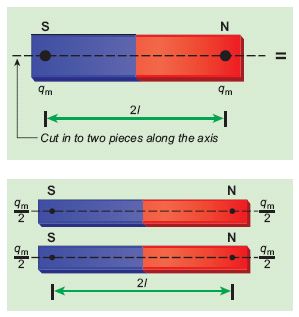
When the bar magnet is cut along the axis into two pieces, new magnetic pole strength is \({ q }_{ m }^{ ' }=\frac { { q }_{ m } }{ 2 } \) but magnetic length does not change. So, the magnetic moment is
\({ p }_{ m }^{ ' }={ q' }_{ m }2l\)
\({ p }_{ m }^{ ' }=\frac { { q }_{ m } }{ 2 } 2l=\frac { 1 }{ 2 } ({ q }_{ m }2l)=\frac { 1 }{ 2 }p_ m\)
In vector notation, \(\vec{p}'_m=\frac{1}{2}\vec{p}_m\)
(b) a bar magnet cut into two pieces perpendicular to the axis:
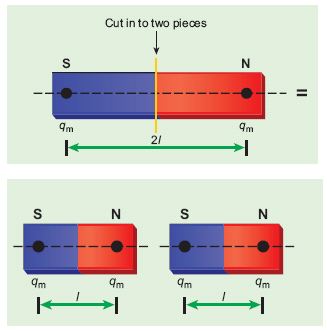
When the bar magnet is cut perpendicular to the axis into two pieces, magnetic pole strength will not change but magnetic length will be halved. So the magnetic moment is
\({ p }_{ m }^{ ' }={ q }_{ m }\times \frac { 1 }{ 2 } (2l)=\frac { 1 }{ 2 } ({ q }_{ m }.2l)=\frac { 1 }{ 2 } { p }_{ m }\)
In vector notation, \(\vec{p}'_m=\frac{1}{2}\vec{p}_m\)
16.
The magnetic field at the center of a circular coil
B = \(\frac { { \mu }_{ 0 }NI }{ 2R } \)
When current I is doubled and radius R is halved,
B' = \(\frac { { \mu }_{ 0 }N\times 2I }{ 2\left( \frac { R }{ 2 } \right) } \) = 4B
∴ magnetic field becomes four times the original field.
17.
w = \(\frac { qB }{ m } \) independence of angle of the entrance with the magnetic field.
W1 : w2 = 1 : 1
18.
If the magnetic force \(\vec { F } =q(\vec { v } \times \vec { B } )\)
(i) The force on a charged particles is perpendicular to both \(\vec { v } \) and magnetic field \(\vec { B } \).
(ii) No, This is since the charged particle moves on a circular path.
\(\vec { F } =q(\vec { v } \times \vec { B } )\)
The particle does not gain energy.
19.
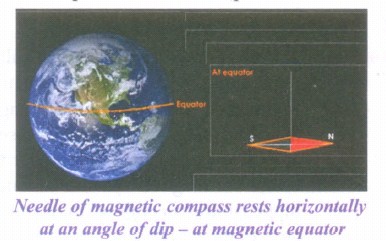
(i) Horizontal component:
The Earth's magnetic field is parallel to the surface of the Earth (i.e., horizontal) which implies that the needle of the magnetic compass rests horizontally at an angle of dip, I = 00 as shown in the figure.
BH = BE
Bv = 0
This implies that the horizontal component is maximum at the equator and the vertical component is zero at the equator.
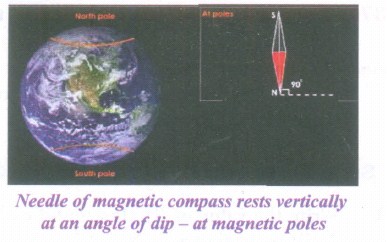
(ii) Vertical component: The Earth's magnetic field is perpendicular to the surface of the Earth (i.e., vertical) which implies that the needle of magnetic compass rests vertically at an angle of dip, I = 90° as shown in Figure
Hence,
BH = 0
Bv = BE
This implies that the vertical component is maximum at poles and the horizontal component is zero at poles.
20.
M = 100 g = 100 x 10-3 kg
M = 0.1 kg
g = 10 m/s2
N = 5
B = 0.5 T
R = 20 cm = 20 x 10-2 m
When, the sphere is in translational equilibrium
\(\mathrm{f}_{\mathrm{s}}-\mathrm{Mg} \sin \theta =0 \ldots(1) \)
\(\mathrm{f}_{\mathrm{s}} =\mathrm{Mg} \sin \theta \)
When, the sphere is in rotational equilibrium,
Torque ፒ = μB sin θ
For Equilibrium, fsR - ፒ = 0
\(f_{s} R-\mu B \sin \theta=0 \ldots(2)\)
eqn (1) subs. eqn (2)
\(M g \sin \theta R-\mu B \sin \theta =0 \)
\(\sin \theta(M g R-\mu B) =0 \)
\(M g R =\mu B \)
\(\text { Now } \mu =N I \pi R^{2} \)
\(\therefore \operatorname{MgR} =N I \pi R^{2} B \)
\(\therefore I =\frac{M g}{N \pi R B} \)
\(I =\frac{0.1 \times 10}{5 \times \pi \times 20 \times 10^{-2}\times 0.5 }\)
\(=\frac{1}{\pi \times 50 \times 10^{-2}}=\frac{1 \times 10^{2}}{\pi \times 50}=\frac{100}{\pi \times 50}\)
\(\mathbf{I} =2 / \pi \mathrm{A} \)
21.
Charge of an electron q = –1.60 × 10⁻¹⁹ C ⇒ |q| = 1 60 x 10-19 C
Magnitude of magnetic field B = 0.500 T
Mass of the electron, m = 9.11 × 10⁻³¹ kg
Radius of the orbit, r = 2.50 mm = 2.50 × 10⁻³ m
Speed of the electron, V = \(q \frac{\mathrm{rB}}{\mathrm{m}}\)
\( v = 1.60 \times 10^{-19} \times\frac{ 2.50 \times 10^{-3} \times 0.500}{9.11 \times 10^{-31}}\)
\(v=2.195 \times 10^8 \mathrm{~m} \mathrm{s} ^{-1}\)
22.
The diameter of the coil is 0.24 m. Therefore, radius of the coil is 0.12 m.
Number of turns is 100 turns. Earth’s magnetic field is 25 x 10-6 T
Deflection is
\(\theta =60°\Rightarrow tan60°=\sqrt { 3 } =1.732\)
\(I=\frac { 2R{ B }_{ H } }{ { \mu }_{ ° }N } tan\theta \)
\(=\frac { 2\times 0.12\times 25\times 1{ 0 }^{ -6 } }{ 4\times 1{ 0 }^{ -7 }\times 3.14\times 100 } \times 1.732=0.82\times 1{ 0 }^{ -1 }A\)
I = 0.082 A
23.
Let \(\vec{p}_m\)be the dipole and before switching ON the external magnetic field, there is no orientation. Therefore, the energy U = 0.
As soon as external magnetic field is switched ON, the magnetic dipole orient parallel (θ = 0o) to the magnetic field with energy,
Uparallel = Uminimum = -pmBcos 0
Uparallel = -pmB
since cos 0o = 1
Otherwise, the magnetic dipole orients anti-parallel (θ = 180o) to the magnetic field with energy,
U anti-parallel = U maximum = -pmBcos 180
\(\Rightarrow \) Uanti-parallel = PmB
since cos 180o = -1
24.
(a)
mass of the charged particle
25.
(a)
Fleming's Left Hand Rule
26.
(c)
a low resistance in parallel
27.
(d)
neither depends upon the velocity nor the radius of circular path
28.
(d)
Am
29.
(c)
Right hand palm rule
30.
Magnetic flux density = \(\frac{\mu_{o}I}{2a}\)
\(=\frac{4 \pi \times 10^{-7} \times 5}{2 \times 20 \times 10^{-2}}\)
= 1.57 x 10⁻⁵ T
31.
(c)
25π x 10-7 T
32.
(d)
tesla
33.
(d)
electric and magnetic fields
34.
(b)
circle
35.
(c)
right hand rule
36.
\(\vec { B } =\frac { \beta }{ \sqrt { 3 } } =(\hat { i } +\hat { j } +\hat { k } )T\)
Using an equation,
Lorentz force, \(\vec{F}=Il\hat{j}\times\vec B\)
We can get,
Lorentz force \(F=\sqrt { \frac { 2 }{ { 3 } } } \beta Il\)
37.
(a)
Circle
38.
Lorentz force F = Bqv
Energy w = qV
Energy is equal to kinetic energy,
\(qV=\frac{1}{2}mv^2\)
\(v=\sqrt { \frac {2qV }{ m } } \)
\(\therefore Lorentz \ force \ F= Bq\times \sqrt \frac{2qV}{m}=\sqrt { \frac { 2{ B }^{ 2 }{ q }^{ 3 }V }{ m } } \)
39.
B = 60G, A = 2 x 10⁻⁴m2
N = 40, I = 4mA = 4 x 10⁻³A
θ = 160
I =\(\frac { K\theta }{ BAN } \)
K = \(\frac { BANI }{ \theta } \)
= \(\frac { 40\times 60\times 2\times 10^{ -4 }\times 4\times 10^{ -3 } }{ 16 } \)
= 1.2 x 10⁻⁴ Nm/degree
40.
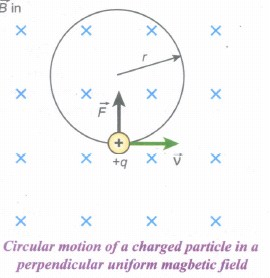
(i) Consider a charged particle of charge 'q' having mass m enters into a region of a uniform magnetic field \(\vec { B } \) with velocity \(\vec { v } \).
(ii) Such that velocity is perpendicular to the magnetic field and velocity \(\vec{v}\).
(iii) The charged particle moves in a circular orbit.
(iv) Lorentz force.
\(\vec { F } =q(\vec { v } \times \vec { B } )\)
In magnitude F = qVB
(v) This Lorentz force acts as centripetal force for the particle to execute circular motion. Therefore,
qvB = m\(\frac { { v }^{ 2 } }{ r } \)
The radius of the circular path is
r = \(\frac { mv }{ qB } =\frac { p }{ qB } \) ..........(1)
(vi) where p = mv is the magnitude of the linear momentum of the particle. Let T be the time taken by the particle to finish one complete circular motion, then
T = \(\frac { 2\pi r }{ v } \) .............(2)
Hence substituting (1) in (2), we get,
T = \(\frac { 2\pi m }{ qB } \) .............(3)
(vii) Equation (3) is called the cyclotron period. The reciprocal of time period is the frequency f, which is
f = \(\frac { 1 }{ T } \)
f = \(\frac { qB }{ 2\pi m } \) ...........(4)
In terms of angular frequency ω,
ω = 2πf = \(\frac { q }{ m } \)B ...........(5)
(viii) Equations (4) and equation (5) are called cyclotron frequency or gyrofrequency.
(ix) Time period and frequency depend only on charge-to-mass ratio (specific charge) and independent of velocity or radius.
41.
Consider a solenoid of length L having N turns. The diameter of the solenoid is assumed to be much smaller when compared to its length and the coil is wound very closely.
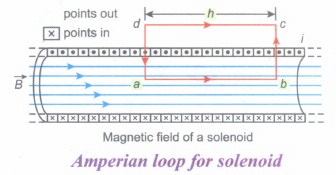
Consider a rectangular loop abcd. Then from Ampere's circuital law,
\(\oint _{ C }^{ }{ \vec { B } .\vec { dl } } \) = μ0 Ienclosed = μ0 x (total current enclosed by Amperian loop)
The left hand side of the equation is
\(\oint _{ C }^{ }{ \vec { B } .\vec { dl } } =\int _{ a }^{ b }{ \vec { B } .\vec { dl } } +\int _{ b }^{ c }{ \vec { B } .\vec { dl } } +\int _{ c }^{ d }{ \vec { B } .\vec { dl } } +\int _{ d }^{ a }{ \vec { B } .\vec { dl } } \)
Elemental lengths bc and da are perpendicular to magnetic field.
\(\therefore \int _{ b }^{ c }{ \vec { B } .\vec { dl } } =\int _{ b }^{ c }{ |\vec { B } ||\vec { dl } | } cos 90^o = 0\)
similarly,
\(\int _{ d }^{ a }{ \vec { B } .\vec { dl } } = 0\)
Since the magnetic field outside the solenoid is zero,
\(\int _{ c }^{ d }{ \vec { B } .\vec { dl } } =0\) and
\(\int _{ a }^{ b }{ \vec { B } .\vec { dl } } =BL \quad \quad (\because \theta =0^o)\)
Let I be the current passing through the solenoid of N turns, then
\(\int _{ a }^{ b }{ \vec { B } .\vec { dl } } = BL = μ_o NI ⇒ B = μ_o\frac {NI}{L}\)
The number of turns per unit length is given by \(\frac { N }{ L } \) = n, Then
B = \(\mu_o \frac { nLI }{ L } \) = μ0nI
Since n is a constant for a given solenoid and μ0 is also constant. For a fixed current I, the magnetic field inside the solenoid is also a constant.
42.
Principle : When a current carrying loop is placed in a uniform magnetic field it experiences a torque.
Construction : A moving coil galvanometer consists of a rectangular coil PQRS of insulated thin copper wire. The coil contains a large number of turns wound over a light metallic frame. A cylindrical soft-iron core is placed symmetrically inside the coil as shown in Figure. The rectangular coil is suspended freely between two pole pieces of a horse-shoe magnet.
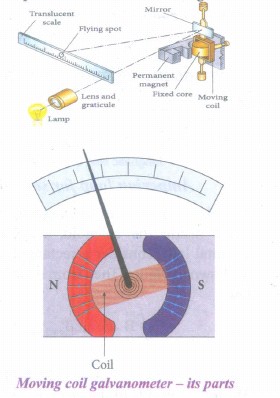
The upper end of the rectangular coil is attached to one end of fine strip of phosphor bronze and the lower end of the coil is connected to a hair spring which is also made up of phosphor bronze. In a fine suspension strip, a small plane mirror is attached in order to measure the deflection of the coil with the help of lamp and scale arrangement. The other end of the mirror is connected to a torsion head. In order to pass electric current through the galvanometer, the suspension strip and the spring S are connected to terminals.
Working : Consider a single turn of the rectangular coil PQRS whose length be l and breadth b. PQ = RS = l and QR = SP = b.
Let I be the electric current flowing through the rectangular coil PQRS as shown in Figure. The horse-shoe magnet has hemi - spherical magnetic poles which produces a radial magnetic field. Due to this radial field, the sides QR and SP are always parallel to the magnetic field B and experience no force. The sides PQ and RS are always parallel to the magnetic field and experience force in opposite directions. Due to this, torque is produced.
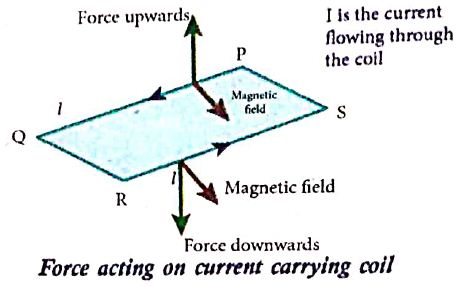
For single turn, the deflection torque is,
て = bF = bBIl = (lb)BI
て = ABI
since, area of the coil A = lb
For coil with N turns, we get
て = NABI ........(1)
Due to this deflecting torque, the coil gets twisted and restoring torque (also known as restoring couple) is developed. Hence the moment of restoring couple is proportional to the amount of twist θ. Thus
て = Kθ ............(2)
where K is the restoring couple per unit twist or torsional constant of the spring.
At equilibrium, the deflection couple is equal to the restoring couple. Therefore by comparing equations (1) and (2), we get,
NABI = Kθ
⇒ I =\(\frac { K }{ NAB } \) θ ...........(3)
(or) I = Gθ
where G = \(\frac { K }{ NAB } \) is called galvanometer constant or current reduction factor of the galvanometer.
Since, suspended moving coil galvanometer is very sensitive, we have to handle with high care while doing experiments. Most of the galvanometer we use are pointer type moving coil galvanometer.

12th Standard Syllabus & Materials
12th Standard
TN 12th Computer Applications வலையமைப்பு வடமிடல் Sample Question Papers Study Material - QB365 Set A
NEW12th Standard
TN 12th Computer Applications களப்பெயர் முறைமை (DNS) Sample Question Papers Study Material - QB365 Set A
NEW12th Standard
TN 12th Computer Applications வலையமைப்பு எடுத்துக்காட்டுகள் மற்றும் நெறிமுறைகள் Sample Question Papers Study Material - QB365 Set A
NEW12th Standard
TN 12th Computer Applications கணினி வலையமைப்பு ஓர் அறிமுகம் Sample Question Papers Study Material - QB365 Set A



Tamilnadu Stateboard 12th Standard Subjects

Maths

Chemistry
Physics

Biology

Computer Science

Business Maths and Statistics

Economics

Commerce

Accountancy

History

Computer Applications
Biology
Computer Technology
Computer Applications
Computer Science
Business Maths and Statistics
Commerce
Economics
Maths
Chemistry
Physics
Computer Technology
History
Accountancy

Tamil

English

French
Tamilnadu Stateboard Standards

