
 100% FREE ACCESS
12th Standard Syllabus & Materials
12th Standard
TN 12th Computer Applications மின்னணு தரவு பரிமாற்றம் Sample Question Papers Study Material - QB365 Set A
NEW12th Standard
TN 12th Computer Applications மின் - வணிக பாதுகாப்பு அமைப்புகள் Sample Question Papers Study Material - QB365 Set A
NEW12th Standard
TN 12th Computer Applications மின்னணு செலுத்தல் முறைகள் Sample Question Papers Study Material - QB365 Set A
NEW12th Standard
TN 12th Computer Applications மின் - வணிகம் Sample Question Papers Study Material - QB365 Set A
NEW12th Standard
TN 12th Computer Applications திறந்த மூல கருத்துருக்கள் Sample Question Papers Study Material - QB365 Set A
NEW12th Standard
TN 12th Computer Applications வலையமைப்பு வடமிடல் Sample Question Papers Study Material - QB365 Set A

Published on: 02/09/2020
12th Standard Physics English Medium Model 3 Mark Creative Questions (New Syllabus) 2020
Download Tamil Nadu 12th Standard Physics question papers, model tests, one-mark questions, important questions, and public exam papers in PDF format. Free study materials and answer keys for TN State Board students.
Questions + Answers key
Take MCQ Physics Test1.
Use the lens equation to deduce algebraically the following:
"An object placed within the focus of a convex lens produces a virtual and enlarged image".
2.
Write the difference between paraxial rays and marginal rays.
3.
Two metals A and B have work functions 4eV and 10eV respectively. Which metal has the higher threshold wavelength?
4.
List out the laws of photoelectric effect. (or) Write any three Laws of Photoelectric Effect
5.
Write the aim of artificial intelligence in robots.
6.
Explain why TV transmission towers made high.
7.
What are the advantages and Limitations of FM?
8.
Energy released per fission of a nucleus is of the order of 200 MeV whereas that per fusion, is of the order of 10 MeV. But a fusion bomb (Hydrogen bomb) is said to be more powerful than a fission bomb. Explain why?
9.
Write the properties of neutrino?
10.
Name the parts of Electromagnetic spectrum which is
(i) used to destroy becteria.
(ii) produced by where is a sudden deceleration of high speed electrons.
(iii) used in food industry.
11.
Write the production of gamma rays and mention its properties and uses.
12.
Can a galvanometer be used for measuring the current? Explain.
13.
In a certain region of space, electric field \(\vec { E } \) and magnetic field \(\vec { B } \) are perpendicular to each other. An electron enters the region perpendicular to the direction of both \(\vec { B } \) & \(\vec { E } \) and moves undeflected. Find the velocity of the electron.
14.
Mention the properties of Magnetic field lines?
15.
What is impedance? When does LCR circuit have minimum impedance?
16.
Find the expression for the equivalent emf & internal resistance of the series combination of cells.
17.
What is Phasort and How to draw phasor diagram.
18.
How does one can understand the temperature dependence of resistivity of a conductor?
19.
What is dielectrics or insulators.
20.
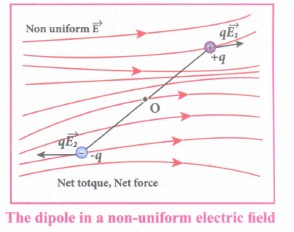
What happens when and electric dipole is held in a non-uniform electric field?
1.
\(\cfrac { 1 }{ v } -\cfrac { 1 }{ u } =\cfrac { 1 }{ f } \) or \(\cfrac { 1 }{ v } =\cfrac { 1 }{ f } +\cfrac { 1 }{ u } \)
convex lens : f > 0 ; u < 0 (object on the left)
For 0 < I u I
Also for this case, \(\cfrac { 1 }{ \left| v \right| } <\cfrac { 1 }{ |u| } .i.e.\left| u \right| <\left| v \right| \) (image enlarged)
2.
|
Paraxial Rays |
Marginal Rays |
|---|---|
| The rays traveling very close to the principal axis and make small angles with it are called paraxial rays. | the rays traveling far away from the principal axis and fall on the mirror far away from the pole are called marginal rays. |
3.
Work function W = hvo = \(\frac{hc}{\lambda_o}\)
\({ \lambda }_{ o }\alpha \frac { 1 }{ W } \)
As WA
i.e., the threshold wavelength of metal A is higher.
4.
Laws of photoelectric effect:
(i) For a given surface, the emission of photoelectrons takes place only if the frequency of incident light is greater than a certain minimum frequency called the threshold frequency.
(ii) For a given frequency of incident light, the number of photoelectrons emitted is directly proportional to the intensity of the incident light. The saturation current is also directly proportional to the intensity of incident light.
(iii) Maximum kinetic energy of the photoelectrons is independent of the intensity of the incident light.
(iv) Maximum kinetic energy of the photoelectrons from a given metal is directly proportional to the frequency of incident light.
(v) There is no time lag between the incidence of light and the ejection of photoelectrons.
5.
(i) Face recognition.
(ii) Providing response to player's actions in computer games.
(iii) Taking decisions based on previous actions.
(iv) To regulate the traffic by analyzing the density of traffic on roads.
(v) Translate words from one language to another.
6.
i) The TV signals are frequency modulated. The transmission of TV signals cannot be obtained the ground wave propagation, as such signals get absorbed by ground due to their high frequency.
ii) TV signals cannot be transmitted via skywave propagation as the ionosphere is unable to reflect radio waves of frequencies greater than 40 MHz.
iii) Therefore, the only way out for the transmission of TV signals is that receiving antenna should directly intercept the signal from the transmitting antenna.
7.
Advantages of AM :
(i) Easy transmission and reception
(ii) Lesser bandwidth requirements
(iii) Low cost
Limitations of AM :
i) Noise level is high
i) Low efficiency
ii) Small operating range
8.
(i) Energy-produced per fusion is less but the number of nuclei per unit mass is larger on account of smaller mass number.
(ii) So, energy released per unit mass is greater. On the other hand, the fissionable materials have high atomic weight.
(iii) The number of fission nuclei per unit mass is less. So, energy released is less.
9.
The neutrino has the following properties
(i) It has zero charge
(ii) It has an antiparticle called anti-neutrino.
(iii) Recent experiments showed that the neutrino has very tiny mass
(iv) It interacts very weakly with the matter. Therefore, it is very difficult to detect In fact, in every second, trillions of neutrinos coming from the sun are passing through our body without any interaction.
10.
(i) u - v rays
(ii) X - rays
(iii) ૪ - rays.
11.
(i) It is produced by transitions of atomic nuclei and decay of certain elementary particles. They produce chemical reactions on photographic plates, fluorescence, ionization, diffraction.
(ii) Gamma rays provide information about the structure of atomic nuclei. It is used in radiotherapy for the treatment of cancer and tumor, in the food industry to kill pathogenic microorganisms.
12.
A galvanometer cannot be used for measuring the current
(i) A galvanometer has a finite large resistance and is connected in series in the circuit. So it will increase the resistance of circuit and hence change the value of current in the circuit.
(ii) A galvanometer is a very sensitive device, it gives a full scale deflection for the current of the order of microampere hence if connected, it will not measure current of the order of ampere.
13.
Net force an electron moving in the combined electric field \(\vec { E } \) and a magnetic field \(\vec { B } \) is
\(\vec { F } =-e[\vec { E } +\vec { v } \times \vec { B } ]\)
Since electron moves undeflected then \(\vec { F } \) = 0
\(\vec { E } +(\vec { v } \times \vec { B } )\) = 0
\(|\vec { E } |=(|\vec { v } |\times |\vec { B } |)\Rightarrow |\vec { v } |=\frac { |\vec { E } | }{ |\vec { B } | } \).
14.
(i) Magnetic field lines are continuous closed curves. The direction of magnetic field lines is from the North pole to the South pole outside the magnet and South pole to the North pole inside the magnet.
(ii) The direction of a magnetic field at any point on the curve is known by drawing a tangent to the magnetic line of force at that point.
(iii) Magnetic field lines never intersect each other.
(iv) The degree of closeness of the field lines determines the relative strength of the magnetic field. The magnetic field is strong where magnetic field lines crowd and weak where magnetic field lines thin out.
15.
(i) The total resistance offered to the flow of current due to resistance R, inductive resistance XL, and capacitive reactance Xc in a circuit is called impedance.
It is given by \(z=\sqrt { { R }^{ 2 }+({ { X }_{ L }-{ X }_{ C }) }^{ 2 } } \)
(ii) At resonance, when XL= XC
16.
(i) Suppose n cells, each of emf \(\xi \) volts and internal resistance r ohms are connected in series with an external resistance R.
(ii) The total emf of the battery = \(n\xi \) The total resistance in the circuit = nr + R By Ohm's law, the current in the circuit is
\(I=\cfrac { totalemf }{ taoal\ resistance } =\cfrac { n\xi }{ nr+R } \)
\(I=\cfrac { n\xi }{ R } =n{ l }_{ 1 }\)
(iii) where II is the current due to a single cell
\(\left( { I }_{ 1 }=\cfrac { \xi }{ R } \right) \)
Thus, if r is negligible when compared to R the current supplied by the battery is n times that supplied by a single cell.
Case (b) If r >> R,\(I=\cfrac { n\xi }{ nr } =\cfrac { \xi }{ r } \)
(iv) It is the current due to a single cell. That is, current due to the whole battery is the same as that due to a single cell and hence there is no advantage in connecting several cells.
(v) Thus series connection of cells is advantageous only when the effective internal resistance of the cells is negligibly small compared with R.
17.
Phasor: A sinusoidal alternating voltage (or current) can be represented by a vector that rotates about the origin in an anti-clockwise direction at a constant angular velocity ω. Such a rotating vector is called a phasor. A phasor is drawn in such a way that
(i) the length of the line segment equals the peak value Vm (or Im) of the alternating voltage (or current)
(ii) its angular velocity w is equal to the angular frequency of the alternating voltage (or current)
(iii) the projection of phasor on any vertical axis gives the instantaneous value of the alternating voltage (or current)
(iv) the angle between the phasor and the axis of reference (positive x-axis) indicates the phase of the alternating voltage (or current).
The notion of phasors is introduced to analyze the phase relationship between voltage and current in different AC circuits.
Phasor diagram
The diagram which shows various phasors and their phase relations is called the phasor diagram.
18.
(i) For conductors a is positive. If the temperature of a conductor increases, the average kinetic energy of electrons in the conductor increases. This results in more frequent collisions and hence the resistivity increases.
(ii) The graph of the Even though, the resistivity of conductors like metals varies linearly for a wide range of temperatures, there also exists a nonlinear region at very low temperatures.
(iii) The resistivity approaches some finite value as the temperature approaches absolute zero.
(iv) As the resistance is directly proportional to the resistivity of the material, we can also write the resistance of a conductor at temperature T °C as
\({ R }_{ T }=R\left[ 1+\alpha \left( T-{ T }_{ 0 } \right) \right] \)
\(\alpha =\cfrac { { R }_{ T }-{ R }_{ 0 } }{ { R }_{ 0 }\left( T-{ T }_{ 0 } \right) } =\cfrac { 1\Delta R }{ { R }_{ 0 }\Delta T } \)
\(\alpha =\cfrac { 1 }{ { R }_{ 0 } } \cfrac { \Delta R }{ \Delta T } \)
where \(\Delta R={ R }_{ 1 }-{ R }_{ 0 }\) is a change in resistance during the changing temperature \(\Delta T=T-{ T }_{ 0 }\)
19.
(i) A dielectric is a non-conducting material and has no free electrons. The electrons in a dielectric are bound within the atoms. Ebonite, glass and mica are some examples of dielectrics.
(ii) When an external electric field is applied, the electrons are not free to move anywhere but they are realigned in a specific way. A dielectric is made up of either polar molecules or non-polar molecules.
20.
If the electric field is not uniform, then the force experienced by +q is different from that experienced by -q. In addition to the torque, there will be net force acting on the dipole.

12th Standard Syllabus & Materials
12th Standard
TN 12th Computer Applications களப்பெயர் முறைமை (DNS) Sample Question Papers Study Material - QB365 Set A
NEW12th Standard
TN 12th Computer Applications வலையமைப்பு எடுத்துக்காட்டுகள் மற்றும் நெறிமுறைகள் Sample Question Papers Study Material - QB365 Set A
NEW12th Standard
TN 12th Computer Applications கணினி வலையமைப்பு ஓர் அறிமுகம் Sample Question Papers Study Material - QB365 Set A
NEW12th Standard
TN 12th Computer Applications PHP-உடன் MySQL-ஐ இணைத்தல் Sample Question Papers Study Material - QB365 Set A



Tamilnadu Stateboard 12th Standard Subjects

Maths

Chemistry
Physics

Biology

Computer Science

Business Maths and Statistics

Economics

Commerce

Accountancy

History

Computer Applications
Biology
Computer Technology
Computer Applications
Computer Science
Business Maths and Statistics
Commerce
Economics
Maths
Chemistry
Physics
Computer Technology
History
Accountancy

Tamil

English

French
Tamilnadu Stateboard Standards

