
 100% FREE ACCESS
12th Standard Syllabus & Materials
12th Standard
TN 12th Computer Applications மின்னணு தரவு பரிமாற்றம் Sample Question Papers Study Material - QB365 Set A
NEW12th Standard
TN 12th Computer Applications மின் - வணிக பாதுகாப்பு அமைப்புகள் Sample Question Papers Study Material - QB365 Set A
NEW12th Standard
TN 12th Computer Applications மின்னணு செலுத்தல் முறைகள் Sample Question Papers Study Material - QB365 Set A
NEW12th Standard
TN 12th Computer Applications மின் - வணிகம் Sample Question Papers Study Material - QB365 Set A
NEW12th Standard
TN 12th Computer Applications திறந்த மூல கருத்துருக்கள் Sample Question Papers Study Material - QB365 Set A
NEW12th Standard
TN 12th Computer Applications வலையமைப்பு வடமிடல் Sample Question Papers Study Material - QB365 Set A

Published on: 29/09/2020
12th Standard Physics English Medium Model 5 Mark Book Back Questions (New Syllabus 2020)
Download Tamil Nadu 12th Standard Physics question papers, model tests, one-mark questions, important questions, and public exam papers in PDF format. Free study materials and answer keys for TN State Board students.
Questions + Answers key
Take MCQ Physics Test1.
A beam of light of wavelength 600 nm from a distant source falls on a single slit 1 mm wide and the resulting diffraction pattern is observed on a screen 2 m away. What is the distance between the first dark fringes on either side of the central bright fringe?
2.
A bar magnet having a magnetic moment \({ \vec { { p } } }_{ m }\) is cut into four pieces i.e., first cut into two pieces along the axis of the magnet and each piece is further cut along the axis into two pieces. Compute the magnetic moment of each piece.
3.
When does power factor of a series RLC circuit become maximum?
4.
Suppose a cyclotron is operated to accelerate protons with a magnetic field of strength 1 T. Calculate the frequency in which the electric field between two Dees could be reversed.
5.
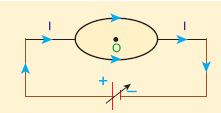
What is the magnetic field at the centre of the loop shown in figure?
6.
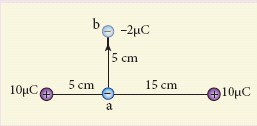
A point charge of +10 μC is placed at a distance of 20 cm from another identical point charge of +10 μC. A point charge of -2 μC is moved from point a to b as shown in the figure. Calculate the change in potential energy of the system? Interpret your result.
7.
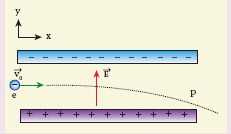
Consider an electron travelling with a speed vo and entering into a uniform electric field \(\vec{E}\) which is perpendicular to \(\vec { { v }_{ 0 } } \) as shown in the Figure. Ignoring gravity, obtain the electron’s acceleration, velocity and position as functions of time.
8.
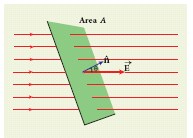
Calculate the electric flux through the rectangle of sides 5 cm and 10 cm kept in the region of a uniform electric field 100 NC-1. The angle θ is 60°. If θ becomes zero, what is the electric flux?
9.
Find the de Broglie wavelength associated with an alpha particle which is accelerated through a potential difference of 400 V. Given that the mass of the proton is 1.67 x 10⁻²⁷ kg.
10.
When a 6000Å light falls on the cathode of a photo cell, photoemission takes place. If a potential of 0.8 V is required to stop emission of electron, then determine the
(i) frequency of the light
(ii) energy of the incident photon
(iii) work function of the cathode material
(iv) threshold frequency and
(v) net energy of the electron after it leaves the surface.
11.
A man with a near point of 25 cm reads a book which has small print using a magnifying lens of focal length 5 cm.
(a) What are the closest and the farthest distances at which he should keep the lens from the book?
(b) What are the maximum and the minimum magnification possible?
12.
Lights of two wavelengths 560 nm and 420 nm are used in Young’s double slit experiment. Find the least distance from the central fringe where the bright fringes of the two wavelengths coincide. Given D = 1 m and d = 3 mm.
13.
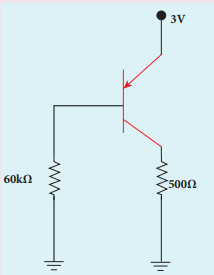
In the circuit shown in the figure, the BJT has a current gain (β) of 50. For an emitter-base voltage VEB = 600 mV, calculate the emitter-collector voltage VEC (in volts).
14.
Calculate the mass defect and the binding energy per nucleon of the \(_{ 47 }^{ 108 }{ Ag }\) nucleus. [atomic mass of Ag = 107.905949]
15.
A step-down transformer connected to main supply of 220 V is used to operate 11V, 88W lamp. Calculate
(i) Voltage transformation ratio and
(ii) Current in the primary.
16.
Let an electromagnetic wave propagate along the x-direction, the magnetic field oscillates at a frequency of 1010 Hz and has an amplitude of 10−5 T, acting along the y-direction. Then, compute the wavelength of the wave. Also write down the expression for electric field in this case.
17.
Find the instantaneous value of alternating voltage v = 10sin (3π x 104 t) volt at
i) 0 s
ii) 50 μs
iii) 75 μs.
18.
Compute the work done and power delivered by the Lorentz force on the particle of charge q moving with velocity \(\vec { v } \). Calculate the angle between Lorentz force and velocity of the charged particle and also interpret the result.
19.
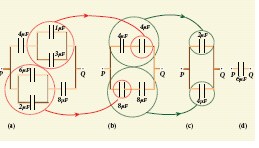
Find the equivalent capacitance between P and Q for the configuration shown below in the figure (a).
20.
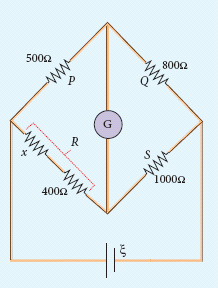
What is the value of x when the Wheatstone’s network is balanced?
P = 500 Ω, Q = 800 Ω, R = x + 400, S = 1000 Ω
21.
From the given circuit,
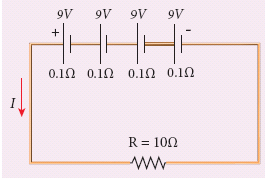
Find
i) Equivalent emf of the combination
ii) Equivalent internal resistance
iii) Total current
iv) Potential difference across external resistance
v) Potential difference across each cell
22.
Show that the magnetic field at any point on the axis of the solenoid having n turns per unit length is \(B=\frac { 1 }{ 2 } { \mu }_{ ° }nI(cos{ \theta }_{ 1 }-cos{ \theta }_{ 2 })\).
23.
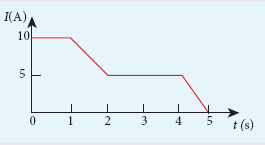
The current through an element is shown in the figure. Determine the total charge that pass through the element at a) t = 0 s, b) t = 2 s, c) t = 5s
1.
⋋2 = 600 x 10-9 m, ⇒ d = 1 x 10⁻³ m, D =2m
n⋋ = dsinθ
For first dark fringe
n = 1 For minimum
d sinθ = ⋋, here
CO = Nc (approximately)
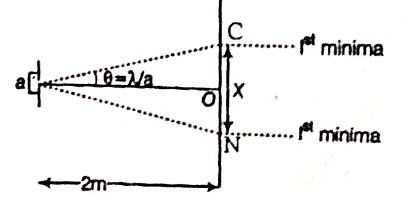
From Fig, sinθ \(=\frac{x/2}{D} =x/2D\)
\(sin \theta =\frac{ \lambda}{d} \)
\(\lambda/d=x/2D\)
\(\therefore x =\frac{2D\lambda}{d}=\frac{2 \times 2 \times 600\times 10^{-9}}{ 10^{-3}} \)
\(x=2.4 \times10^{-3}m =2.4\mathrm{~mm} \)
2.
Magnetic moment of a bar magnet = \({ \vec { { p } } }_{ m }\)
.jpg)
First, When the bar magnet is cut into two pieces along the axis of the magnet. New magnetic pole strength is \(\frac{q_{m}}{2}\), but magnetic length is 2l
Second, Each piece is further cut into two pieces along the axis of the magnet, we get
New magnetic pole strength is,
\(q_{m}^{{\prime}}=\frac{q_{m}}{4}\)
But, magnetic length = 2l.
.JPG)
So, new magnetic moment of each piece is
\(\vec{p_m}_{\text {new }} =q'_{m} \times2 l \)
\(=\frac{q_{m}}{4} \times 2 l \)
\(=\frac{1}{4}\left(q_{m} \times 2 l\right) \)
\(\because \overrightarrow{\mathbf{p}}_{\mathrm{m}_{\text {new }}} =\frac{1}{4} (\vec{p_{m})} \) \((\because{p}_{m} =(q_{\mathrm{m}} \times 2 l) )\)
3.
Power factor will be maximum, when Φ = 0 i.e., \(\tan ^{-1}\left(\frac{X_L-X_C}{R}\right)=0\)
\(\therefore X_L=X_C \Rightarrow L \omega=\frac{1}{C \omega} \)
\(\therefore \omega=\frac{1}{2 \pi \sqrt{L C}}\)
∴ Current I be max \(I_m=\frac{V_m}{R}\)
Hence power factor of a RLC series circuit becomes maximum, when
(i) \(X_L=X_C\)
(ii) Current \(I_m=\frac{V_m}{R}\) will be maximum
(iii) Frequency \(\omega_r=\frac{1}{2 \pi \sqrt{L C}}\)
4.
Magnetic field B = 1 T
Mass of the proton, mp = 1.67 x 10⁻²⁷kg
Charge of the proton, q = 1.60 x 10⁻¹⁹C
\(f=\frac { qB }{ { { 2\pi m }_{ p } } } =\frac { \left( 1.60\times { 10 }^{ -19 } \right) \left( 1 \right) }{ 2\left( 3.14 \right) \left( 1.67\times { 10 }^{ -27 } \right) } \)
= 15.3 x 10⁶ Hz = 15.3 MHz
5.
The magnetic field due to current in the upper semicircle and lower semicircle of the circular coil are equal in magnitude but opposite in direction. Hence, the net magnetic field at the center of the loop (at point O) is zero \(\overset { \rightarrow }{ B } =\overset { \rightarrow }{ 0 } \).
6.
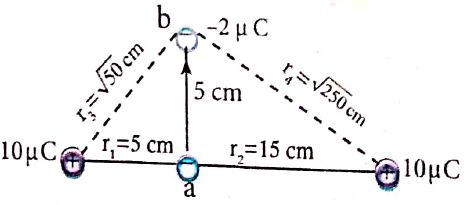
\(W =\left(V_{b}-V_{a}\right) q\left[where\ V=\frac{K Q}{r}\right] \)
To find Vb :
\(V_b=\frac{kQ}{r_3}+\frac{kQ}{r_4}\)
\(V_{b} =\frac{K \times 10 \times 10^{-6}}{\sqrt{50 \times 10^{-4}}}+\frac{K \times 10 \times 10^{-6}}{\sqrt{250 \times 10^{-4}}} \)
\(V_{b} =\frac{K \times 10^{-5}}{\sqrt{50} \times 10^{-2}}+\frac{K \times 10^{-5}}{\sqrt{250} \times 10^{-2}} \)
\(=K \times 10^{-3}\left[\frac{1}{\sqrt{50}}+\frac{1}{\sqrt{250}}\right] \)
\(=9 \times 10^{9} \times 10^{-3}\left[\frac{1}{\sqrt{50}}+\frac{1}{\sqrt{250}}\right] \)
Vb = 1842002 V
To find Va :
\(V_a=\frac{kQ}{r_1}+\frac{kQ}{r_2}\)
\(V_{a} =\frac{K \times 10 \times 10^{-6}}{\sqrt{5 \times 10^{-2}}}+\frac{K \times 10 \times 10^{-6}}{\sqrt{15 \times 10^{-2}}} \)
Va = 2400000 V
\(\therefore W_{D} =\left(V_{b}-V_{a}\right) q=(1842002-2400000)( -2 \times 10^{-6} )\)
W = +1.12J
Positive sign implies that to move the charge - 2 μC external work is required.
7.
(a) Acceleration of the electron \(a=\frac{F}{m}\)
Electrostatic force F = - eE
\(a=\frac{F}{m}=\frac{-e E \hat{j}}{m}\) ... ( 1)
(b) Let velocity of the electron be \(\vec{v}\)
v = u + at ...(2)
Here, \( u=v_{0} \hat{i} \), \(a=\frac{-e \bar{E}}{m} \hat{j}\)
Substituting these values in the equation (2) we get
\(\therefore \vec{v}=\nu_{0} \hat{i}-\frac{e E}{m} t \hat{j}\)
(c) Displacement \(\vec{r}\) represents position,
\( s=u t+\frac{1}{2} a t^{2} \) ...(3)
Let, \(s=\hat{r} \) and Here, \(u=v_{0} \hat{i} \), \(a=\frac{-e E}{m} \hat{j}\)
Substituting these values in the equation (3), we get,
\(\hat{r}=v_{0} t \hat{i}-\frac{1}{2} \frac{e E}{m} t^{2} \hat{j}\)
8.
The electric flux through the rectangular area
\({ \Phi }_{ E }=\vec { E } .\vec { A } \) = EA cosθ = 100 x 5 x 10 x 10-4 x cos60°
⇒ \({ \Phi }_{ E }\) = 0.25 Nm2C-1
For θ = 0°
\({ \Phi }_{ E }=\vec { E } .\vec { A } \)= EA
= 100 x 5 x 10 x 10-4 = 0.5 Nm2C-1
9.
An alpha particle contains 2 protons and 2 neutrons. Therefore, the mass M of the alpha particle is 4 times that of a proton (mp) (or a neutron) and its charge q is twice that of a proton (+e).
The de Broglie wavelength associated with it is
\(\lambda=\frac { h }{ \sqrt { 2MqV } } =\frac { h }{ \sqrt { 2\times (4m_{ p })\times (2e)\times V } } \)
\(=\frac { 6.626\times { 10 }^{ -34 } }{ \sqrt { 2\times 4\times 1.67\times 10^{ -27 }\times 2\times 1.6\times { 10 }^{ -19 }\times 400 } } \)
\(=\frac { 6.626\times 10^{ -34 } }{ 4\times 20\times { 10 }^{ -23 }\sqrt { 1.67\times 1.6 } } \) = 0.00507 \(\mathring { A }\)
10.
\(\lambda=6000Å=6000 \times 10^{-10} \mathrm{~m} ; \mathrm{V}=0.8 \mathrm{v} \)
\(\mathrm{k} \cdot \mathrm{E}=\mathrm{hv}-\phi \)
\(\mathrm{eV}_o=\mathrm{hv}-\phi=\frac{\mathrm{hc}}{\lambda}-\phi \)
\((i) v=\frac{c}{\lambda}=\frac{3 \times 10^{8}}{6000 \times 10^{-10}}=5 \times 10^{14} \mathrm{~Hz} \)
\((ii)\ \mathrm{E}=\frac{\mathrm{hc}}{\lambda}=\frac{6.626 \times 10^{-34} \times 3 \times 10^{8}}{6000 \times 10^{-10}}=3.313 \times 10^{-19} J\)
\(\mathrm{E}=\frac{3.313 \times 10^{-19}}{1.6 \times 10^{-19}}=2.07 \mathrm{eV} \)
\((iii) \ \mathrm{E}=\mathrm{hv}-\mathrm{W}\Rightarrow\mathrm{W}=\mathrm{h} v-\mathrm{E} \)
\(\mathrm{E}=\mathrm{eV_o}=1.6 \times 10^{-19} \times 0.8=1.2 8 \times10^{-19}J\)
\(\mathrm{hv}=6.626 \times 10^{-34} \times 5 \times 10^{14}=3.313 \times 10^{-19}J \)
\(\mathrm{~W}=\frac{(3.313-1.28) \times 10^{-19}}{1.6 \times 10^{-19}}=1.270 \mathrm{eV} \)
W = 1.27 eV
\((iv) \ \mathrm{W}=\mathrm{h} \mathrm{v}_{0} \)
\(v_{0}=\frac{W}{h}=\frac{2.033 \times 10^{-19}}{6.626 \times 10^{-34}}=3.07 \times 10^{14} \mathrm{~Hz} \)
\((v)\ \mathrm{E}=\mathrm{eV}_o=\frac{0.8 \times 1.6 \times 10^{-19}}{1.6 \times 10^{-19}}=\mathbf{0 . 8} \mathrm{eV}\)
11.
D = 25 cm;
The magnifying lens must be a convex lens of positive focal length
f = 5 cm;
For closest object distance u', the image distance, v is, –25 cm. (near point, v = –D)
For farthest object distance u', the corresponding image distance, v' is infinity.
(a) To find closest distance between lens and book, we can use lens equation,\(\cfrac { 1 }{ v } -\cfrac { 1 }{ u } =\cfrac { 1 }{ f } \)
Rewriting for closest object distance \(\cfrac { 1 }{ u } =\cfrac { 1 }{ v } -\cfrac { 1 }{ f } \)
Substituting,
\(\cfrac { 1 }{ u } =\cfrac { 1 }{ -25 } -\cfrac { 1 }{ 5 } =\cfrac { 1 }{ 25 } =\cfrac { 1 }{ 5 } \left( \cfrac { -1-5 }{ 25 } \right) =-\cfrac { 6 }{ 25 } \)
\(u=-\cfrac { 25 }{ 6 } =4.167cm\)
The closest distance between the lens and the book is, u = –4.167 cm
To find farthest object distance, lens equation is, \(\cfrac { 1 }{ v' } -\cfrac { 1 }{ u' } =\cfrac { 1 }{ f' } \)
Rewriting for farthest object distance,\(\cfrac { 1 }{ u' } =\cfrac { 1 }{ v' } -\cfrac { 1 }{ f' } \)
Substituting,\(\cfrac { 1 }{ u' } =\cfrac { 1 }{ \infty } -\cfrac { 1 }{ 5 } ;u=-5cm\)
The farthest distance at which the person can keep the book is, u' = -5 cm.
(b) To find magnification in near point focusing, \(m=1+\cfrac { D }{ f } =1+\cfrac { 25 }{ 5 } =6\)
To find magnification in normal focusing, \(m=\cfrac { D }{ f } =\cfrac { 25 }{ 5 } =5\)
12.
λ1 = 560 nm = 560 x 10-9m;
λ1 = 420 nm = 420 x 10-9m;
D = 1 m; d = 3 mm = 3 x 10⁻³m
Here, n and λ are inversely proportional for a given y.
Here, nth order bright fringe of longer wavelength λ1 coincides with (n+1)th order bright fringe of shorter wavelength λ2.
Equation for nth bright fringe is, \({ y }_{ n }=n\cfrac { \lambda D }{ d } \)
Here, \(n\cfrac { { \lambda }_{ 1 }D }{ d } =(n+1)\cfrac { { \lambda }_{ 2 }D }{ d } \) (as λ1>λ2)
\({ n\lambda }_{ 1 }=\left( n+1 \right) { \lambda }_{ 2 }\) (or) \(\cfrac { { \lambda }_{ 1 } }{ { \lambda }_{ 2 } } =\cfrac { (n+1) }{ n } ;1+\frac{1}{n}=\frac{\lambda_1}{\lambda_2}\)
\(1+\cfrac { 1 }{ n } =\cfrac { 560\times { 10 }^{ -9 } }{ 420\times { 10 }^{ -9 } } \) (or) \(1+\cfrac { 1 }{ n } =\cfrac { 4 }{ 3 } \)
\(\frac{1}{n}=\frac{1}{3}\) (or) n = 3
Thus, the 3rd bright fringe of λ1 and the 4th bright fringe of λ2 coincide at the least distance y.
The least distance from the central fringe where the bright fringes of the two wavelengths coincide is, \(y_{n}=n \frac{\lambda D}{d}\)
\(y_{n}=3 \times \frac{560 \times 10^{-9} \times 1}{3 \times 10^{-3}}=560 \times 10^{-6} \mathrm{~m}\)
\(y_{n}=0.560 \times 10^{-3} \mathrm{~m}=0.560 \mathrm{~mm}\)
13.
\(\beta =50 \)
\(V_{\beta E} =600 \mathrm{mV} \)
\(=0.6 \mathrm{~V} \)
\(\mathrm{V}_{\mathrm{B}} =\mathrm{V}_{\mathrm{E}}-\mathrm{V}_{\mathrm{EB}} \)
\(\mathrm{V}_{\mathrm{B}} =3-0.6 \)
\(=2.4 \mathrm{~V} \)
\(\mathrm{I}_{\mathrm{B}} =\frac{\mathrm{V}_{\mathrm{B}}}{R_B}=\frac{2.4}{60 \times 10^3}=40 \mu \mathrm{A} \)
\(\mathrm{I}_{\mathrm{C}} =\beta \mathrm{I}_{\mathrm{B}}=50 \times 40 \mu \mathrm{A} =2 \mathrm{~mA} \)
\(V_C=R_FI_C=500 \times 2 \times10^{-3}=1 V\)
\(V_{EC}=V_E-V_C\)
\(V_{EC}=V_E-V_C\)
\(V_{EC}=3-1=2V\)
14.
A = 108, Z =47, N = 108 - 47 = 61
mp = 1.007825 u, mn = 1.008665 u, M = 107.905949 u
(a) \(\Delta \mathrm{m}=Z \mathrm{~m}_{\mathrm{P}}+\mathrm{Nm}_{\mathrm{n}}-\mathrm{M} \)
\(\Delta \mathrm{m}\) = (47 x 1 .007825 + 61 x 1 .008665 - 107 .905949)
\(\Delta \mathrm{m}\) = 47.367775 + 61.528565 -107.905949
\(\Delta \mathrm{m}\) = 108.89634 - 107.905949
\(\Delta \mathrm{m}\) = 0.990391 u
\(\mathrm{BE}=\Delta \mathrm{m} \times 931 \mathrm{MeV} \)
BE = 0.990391 x 931 MeV = 922.054 MeV
(c) \(\overline{\mathbf{B E}}=\frac{\mathbf{B E}}{\mathbf{A}} \)
\(\overline{\mathrm{BE}}=\frac{922.054}{108}=8.537 \mathrm{MeV}=8.5 MeV\)
15.
Transformer ratio, \(\frac { { V }_{ s } }{ { V }_{ p } } =\frac { { N }_{ s } }{ N_p } \)
Here Vs = 11 V, Vr = 220 V, P = 88 W
(i) Voltage Transformation ratio = \(\frac { { V }_{ s } }{ { V }_{ p } } =\frac { { 11 } }{ 220 } \)
\(K =\frac { { 1 } }{ 20 } \)
(ii) Current in the primary, \(I_p =\frac { { P } }{ V_p } \)
\(=\frac { { 88 } }{220 } =\frac{4}{10}=0.4 A\)
∴ Ip = 0.4 A
16.
Amplitude of magnetic field B = 10-5 T
Frequency, f = 1010 HZ
(i) Wavelength of the wave,
\({\lambda}=\frac{c}{f} =\frac{3 \times 10^8}{ 10^{10}} \)
= 3 x 10⁸ - 10
Wavelength = 3 x 10⁻² m
(ii) Electric field E(x,t)\(\hat i\)
Angular frequency \(\omega =2 \pi f \)
\(\omega=2 \times 3.14 \times 10^{10}=6.28 \times 10^{10} rads^{-1}\)
\(k=\frac{2 \pi}{\lambda} =\frac{2 \times 3.14}{3 \times 10^{-2}} \)
\(=\frac{6.28}{3 \times 10^{-2}}=\frac{628}{3}=2.09 \times 10^{2} \)
k = 2.09 x 10²
(iii) Eo = BoC
Eo = 10-5 x 3 x 108
Eo = 3 x 10³ V m-1
The required expression for electric field is
\(\vec{E}(x, t)=E_o \sin \left(\frac{2 \pi}{\lambda} x-2 \pi f t\right) \hat{i} N C^{-1} \)
\(\vec{E}(x , t)=3 \times 10^{3} \sin \left(2.09 \times 10^{2} \mathrm{x}-6.28 \times 10^{10} \mathrm{t}\right) \hat(-{k}) N C^{-1} \)
17.
The given equation is v = 10 sin ( 3π x 104 t)
(i) At t = 0 s,
v = 10 sin0o = 0
(ii) At t = 50 µs,
v = 10sin( 3π x 104 x 50 x 10-6)
= \(10 \sin \left(150 \pi \times 10^{-2} \times \frac{180^{\circ}}{\pi}\right)\)
= 10sin (270o) = 10 x -1
= -10V
(iii) At t = 75 µs,
\(v=10 \sin \left(3 \pi \times 10^{4} \times 75 \times 10^{-6}\right)\)
= \(10 \sin \left(225 \pi \times 10^{-2} \times \frac{180^{\circ}}{\pi}\right)\)
= 10sin (405o) = 10sin45o
= \(10 \times 1 / \sqrt{2}=7.07 \mathrm{~V}\)
18.
For a charged particle moving on a magnetic field, \(\vec { F } \)= q(\(\vec { v } \)x\(\vec { B } \))
The work done by the magnetic field is
\(W=\int { \overset { \rightarrow }{ F } .{ d \vec r } =\int { \overset { \rightarrow }{ F } .\overset { \rightarrow }{ v } dt } } \)
\(W=q\int { \left( \overset { \rightarrow }{ v } \times \overset { \rightarrow }{ B } \right) } .\overset { \rightarrow }{ v } dt=0\)
Since \(\overset { \rightarrow }{ v } \times \overset { \rightarrow }{ B } \) is perpendicular to \(\vec { v } \) and hence \(\left( \overset { \rightarrow }{ v } \times \overset { \rightarrow }{ B } \right) .\overset { \rightarrow }{ v } =\overset { \rightarrow }{ 0 } \)
This means that Lorentz force does no work on the particle. From work-kinetic energy theorem, (Refer section 4.2.6, XI th standard Volume I)
\(\frac { dw }{ dt } =p=0\)
Since \(\overset { \rightarrow }{ F } .\overset { \rightarrow }{ v } =0\Rightarrow \overset { \rightarrow }{ F } \ and \ \overset { \rightarrow }{ v } \) are perpendicular to each other. The angle between Lorentz force and velocity of the charged particle is 90o. Thus Lorentz force changes the direction of the velocity but not the magnitude of the velocity. Hence Lorentz force does no work and also does not alter kinetic energy of the particle.
19.
The capacitors 1 μF and 3μF are connected in parallel and 6μF and 2 μF are also separately connected in parallel. So these parallel combinations reduced to equivalent single capacitances in their respective positions, as shown in the figure (b).
Ceq = 1 + 3 = 4μF
Ceq = 6 + 2 = 8μF
From the figure (b), we infer that the two 4 μF capacitors are connected in series and the two 8 μF capacitors are connected in series. By using formula for the series, we can reduce to their equivalent capacitances as shown in figure (c).
\(\frac { 1 }{ { C }_{ eq } } =\frac { 1 }{ 4 } +\frac { 1 }{ 4 } =\frac { 1 }{ 2 } \) ⇒ Ceq = 2μF and
\(\frac { 1 }{ C_{ eq } } =\frac { 1 }{ 8 } +\frac { 1 }{ 8 } =\frac { 1 }{ 4 } \) ⇒ Ceq = 4μF
From the figure (c), we infer that 2μF and 4μF are connected in parallel. So the equivalent capacitance is given in the figure (d).
Ceq = 2 + 4 = 6μF
Thus the combination of capacitances in figure (a) can be replaced by a single capacitance 6 μF.
20.
\(\frac { P }{ Q } =\frac { R }{ S } \), when the network is balanced
\(\frac { 500 }{ 800 } =\frac { x+400 }{ 1000 } \)
\(x+400=\frac { 5 }{ 8 } \times 1000\)
x + 400 = 625
x = 625 – 400
x = 225 Ω
21.
Equivalent emf of the combination
ξeq = nξ = 4 x 9 = 36 V
ii) Equivalent internal resistance req = nr = 4 x 0.1 = 0.4 Ω
iii) Total current \(I=\frac { n\xi }{ R+nr } \)
\(=\frac { 4\times 9 }{ 10+(4\times 0.1) } \)
\(=\frac { 4\times 9 }{ 10+0.4 } =\frac { 36 }{ 10.4 } \)
I = 3.46 A
iv) Potential difference across external resistance V = IR = 3.46 x 10 = 34.6 V. The remaining 1.4 V is dropped across the internal resistance of cells.
v) Potential difference across each cell \(\frac { V }{ n } =\frac { 34.6 }{ 4 } =8.65V\)
22.
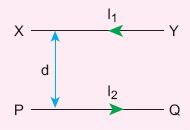
Let the current flowing be I.
Let the number of turns per unit length of the solenoid be n
Magnetic field B \(\mathrm{B}=\frac{\mu_{o} N l I}{l}=0 \)
But \(\mathbf{n}=\frac{N}{l} \)
\(B=\mu_{o} n I \)
But the magpetic field at any point on the axis of the solenoid is
\(B=\frac{1}{2}\left(\mu_{o} n I\right)\)
On the top of the solenoid, at a point magnetic field is
\(\mathrm{B}_{1}=\frac{1}{2} \mu_{o} n I \cos \theta_{1}\)
On the bottom of the solenoid, the magnetic field at a point is
\(B_{2} =\frac{1}{2} \mu_{0} n I \cos \theta_{2} \)
Resultant magnetic field \(B =B_{1}-B_{2} \)
\(B =\frac{1}{2} \mu_{0} n I\left[\cos \theta_{1}-\cos \theta_{2}\right] \)
23.
Charge Q = Current x Time interval
= I x t
At t = 0 s,
dq = dI x t
= 5 x 0
dq = 0 C
At t = 2 s,
dg = dI x t
=5 x 2
dq = 10 C
At t = 5 s,
dg = dl x t
=0 x 5
dq = 0 C
At t= 0 s, dg = 0 C; At t = 2 s, dg = 10 C; At t= 5 s, dg = 0 C.

12th Standard Syllabus & Materials
12th Standard
TN 12th Computer Applications களப்பெயர் முறைமை (DNS) Sample Question Papers Study Material - QB365 Set A
NEW12th Standard
TN 12th Computer Applications வலையமைப்பு எடுத்துக்காட்டுகள் மற்றும் நெறிமுறைகள் Sample Question Papers Study Material - QB365 Set A
NEW12th Standard
TN 12th Computer Applications கணினி வலையமைப்பு ஓர் அறிமுகம் Sample Question Papers Study Material - QB365 Set A
NEW12th Standard
TN 12th Computer Applications PHP-உடன் MySQL-ஐ இணைத்தல் Sample Question Papers Study Material - QB365 Set A



Tamilnadu Stateboard 12th Standard Subjects

Maths

Chemistry
Physics

Biology

Computer Science

Business Maths and Statistics

Economics

Commerce

Accountancy

History

Computer Applications
Biology
Computer Technology
Computer Applications
Computer Science
Business Maths and Statistics
Commerce
Economics
Maths
Chemistry
Physics
Computer Technology
History
Accountancy

Tamil

English

French
Tamilnadu Stateboard Standards

