
 100% FREE ACCESS
12th Standard Syllabus & Materials
12th Standard
TN 12th Maths Applications of Matrices and Determinants Sample Question Papers Study Material - QB365 Set A
NEW12th Standard
TN 12th Computer Applications மின்னணு தரவு பரிமாற்றம் Sample Question Papers Study Material - QB365 Set A
NEW12th Standard
TN 12th Computer Applications மின் - வணிக பாதுகாப்பு அமைப்புகள் Sample Question Papers Study Material - QB365 Set A
NEW12th Standard
TN 12th Computer Applications மின்னணு செலுத்தல் முறைகள் Sample Question Papers Study Material - QB365 Set A
NEW12th Standard
TN 12th Computer Applications மின் - வணிகம் Sample Question Papers Study Material - QB365 Set A
NEW12th Standard
TN 12th Computer Applications திறந்த மூல கருத்துருக்கள் Sample Question Papers Study Material - QB365 Set A

Published on: 29/09/2020
12th Standard Physics English Medium Model 5 Mark Creative Questions (New Syllabus 2020)
Download Tamil Nadu 12th Standard Physics question papers, model tests, one-mark questions, important questions, and public exam papers in PDF format. Free study materials and answer keys for TN State Board students.
Questions + Answers key
Take MCQ Physics Test1.
A convex lens, of focal length 20 cm, has a point object placed on its principal axis at distance of 40 cm from it. A plane mirror is placed 30 cm behind the convex lens. Locate the position of image formed by this combination.
2.
Two lenses of power +15 and - 5D are in contact with each otherforming a combination lens.
(a) What is the focal length of this combination?
(b) An object of size 3 cm is placed at 30 cm from this combination of lenses. Calculate the position and size of the image formed.
3.
An object is placed 40 cm from a convex lens of focal length 30 cm, If a concave lens of focal length 50 cm is introduced between the convex lens and the image formed such that it is 20 cm from the convex lens, find the change in the position of the image.
4.
The critical angle for a given piece of glass is 45°. Calculate the polarising angle for it. Also calculate the angle of refraction when light is incident on this glass at an angle of incident equal to ip.
5.
An electron and a proton, each have de Broglie wavelength of 1.00 nm.
(a) Find the ratio of their momenta.
(b) Compare the kinetic energy of the proton with that of the electron.
6.
The two lines A and B in figure show the plot of de Broglie wavelength λ as a function of \(\frac{1}{\sqrt V}\) for two particles having the same charge. V is the accelerating potential. Which of the two represents the particle of heavier mass?
7.
Monochromatic light of frequency 6 x 10¹⁴ Hz is produced by a laser. The power emitted is 2.0 x 10⁻³ W. How many photons per second on an average are emitted by the source?
8.
The wavelength of light from the spectral emission line of sodium is 589 nm. Find the kinetic energy at which
(a) an electron and
(b) a neutron would have the same Broglie wavelength.
9.
Explain the production of x-rays.
10.
What is meant by satellite communication? Give its applications.
11.
Explain and classify transistor as an oscillator.
12.
A nucleus of UX1 has a half-life of 24.1 days. How long a sample of UX1 will take to change 90% of it to UX2?
13.
Write the application of alpha decay in smoke detectors.
14.
The magnetic field amplitude of an Electromagnetic wave is 1.6 x 10⁻⁷ T. If the frequency is 30 MHz. determine electric field, any velocity K and λ.
15.
Calculate the force per unit length on a long straight wire carrying current of 4A due to a parallel wire carrying 6A current if the distance between the wires is 3cm.
16.
An Im long solenoid with a diameter of 2cm and 2000 turns has a secondary coil of 1000 turn could closely near its mid-point what will be the mutual inductance between the two coils?
17.
Describe the motion of a charged particle in a uniform magnetic field.
18.
A circular coil of radius 10cm, 500 turns and resistance 2000 is placed with its plane perpendicular to the horizontal component of earth's magnetic field. It is rotated about its vertical diameter through 1800 in 0.25s. Estimate the magnitudes of the emf and current induced in the coil. (BH = 3 x 10⁻⁵T)
19.
An aluminium wire of diameter 0.24 cm is connected in series to a copper wire of diameter 0.16 cm. The wires carry an electric current of 10 A. Determine the current density in aluminium wire.
20.
An infinite number of charges each equal to q are placed along X-axis at x = 1, x = 2, x = 3, x = 4, x = 8 and soon. Find the electric field at the point x = 0 due to this set up of charges.
21.
Using the concept of drift velocity of charge carries in a conductor, deduce the relationship between circuit density and resistivity of the conductor?
22.
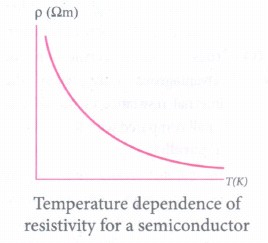
Explain the variation of resistivity of conductor and semiconductor with change in temperature.
23.
It requires 50 μJ of work to carry a 2C charge from point R to S. What is the potential difference between these points?
1.
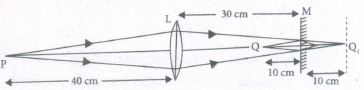
We first consider the effect of the lens. For the
lens, we have
u = - 40 cm and f = + 20 cm
Using the lens formula, we get
\(\cfrac { 1 }{ { v }_{ 1 } } -\cfrac { 1 }{ \left( -40 \right) } =\cfrac { 1 }{ 20 } \) ஃv1 = + 40 cm
Had there been the lens only the image would have been formed at Q1. The plane mirror M is at a distance of 30 cm from lens 1. We can, therefore, think of Q1, as a virtual object, located at a distance of 10cm, behind the plane mirror M. The plane mirror, therefore, forms a real image (of this virtual object Q1) at Q, 10 cm in front of it.
2.
P = P1 + P2 = (15 - 5) D = 10D
\(F=\cfrac { 1 }{ P } =\cfrac { 1 }{ 10 } m=10cm\)
(b) \(\cfrac { 1 }{ v } -\cfrac { 1 }{ u } =\cfrac { 1 }{ F } or\cfrac { 1 }{ F } +\cfrac { 1 }{ u } \)
or \(\cfrac { 1 }{ v } =\cfrac { 1 }{ 10 } +\cfrac { 1 }{ -30 } \) or v = 15cm
Again,\(\cfrac { I }{ O } =\cfrac { v }{ u } =\cfrac { 15 }{ -30 } =-\cfrac { 1 }{ 2 } \)
or \(I=-\cfrac { 1 }{ 2 } \times 3cm=-1.5cm\)
The negative sign indicates that the image is real and inverted.
3.
For the convex lens
Formula :\(\cfrac { 1 }{ { f }_{ 1 } } =\cfrac { 1 }{ { v }_{ 1 } } -\cfrac { 1 }{ { u }_{ 1 } } \)
\(\cfrac { 1 }{ +30 } =\cfrac { 1 }{ { v }_{ 1 } } -\cfrac { 1 }{ { u }_{ 1 } } \)
\(\cfrac { 1 }{ { v }_{ 1 } } =\cfrac { 1 }{ 30 } -\cfrac { 1 }{ 40 } =\cfrac { 1 }{ 120 } \)
vI = 120 cm a real image is formed.
On introducing a concave lens
f2 = 50cm and u2 = 120 - 20 = +100 cm from the concave lens
\(\cfrac { 1 }{ { f }_{ 2 } } =\cfrac { 1 }{ { v }_{ 2 } } -\cfrac { 1 }{ { u }_{ 2 } } \)
\(\cfrac { 1 }{ -50 } =\cfrac { 1 }{ { v }_{ 2 } } -\cfrac { 1 }{ +100 } \)
\(\therefore \cfrac { 1 }{ { v }_{ 2 } } =\cfrac { 1 }{ 580 } +\cfrac { 1 }{ 100 } =\cfrac { 1 }{ 100 } \)
v2 = -100cm
4.
Formula
We know \({ i }_{ c }=\cfrac { 1 }{ \mu } \)
\(\mu =\cfrac { 1 }{ { sini }_{ c } } =\cfrac { 1 }{ { sin45 }^{ o } } =\sqrt { 2 } \)
According to Brewster's law
\({ i }_{ p }=\mu =\sqrt { 2 } \)
\(\Rightarrow { i }_{ p }={ tan }^{ -1 }\sqrt { 2 } \)
= tan-1(1.414) ≅ 510 40o
When light is incident at an angle ip the corresponding angle of refraction 'r' is given by
ip + r = 90o
ஃ r = 90o- (51o40') = (38o 20')
5.
(a) λe =\(\frac { h }{ { p }_{ e } } \) and λp=\(\frac { h }{ { p }_{ p } } \), λe = λp =1.00 nm.
So, \(\frac { { \lambda }_{ e } }{ { \lambda }_{ p } } =\frac { { p }_{ p } }{ { p }_{ e } } =\frac { 1 }{ 1 } \Rightarrow \frac { { p }_{ p } }{ { p }_{ e } } =\frac { 1 }{ 1 } \) = 1:1
(b) From relation K=\(\frac { 1 }{ 2 } mv^{ 2 }=\frac { { p }^{ 2 } }{ 2m } \)
Ke = \(\\ \frac { { p }_{ e }^{ 2 } }{ 2me } \) and Kp = \(\frac { { p }_{ e }^{ 2 } }{ 2m_{ p } } \)
\(\frac { { K }_{ p } }{ { K }_{ e } } =\frac { { p }_{ p }^{ 2 } }{ 2{ m }_{ p } } \times \frac { 2{ m }_{ e } }{ { p }_{ e }^{ 2 } } =\frac { { m }_{ e } }{ { m }_{ p } } \)
Since me <<< mp, So Kp <<< Ke
\(\frac { { K }_{ p } }{ { K }_{ e } } =\frac { 9.1\times { 10 }^{ -31 } }{ 1.67\times 10^{ -27 } } \)
= 5.4 x 10⁻⁴
6.
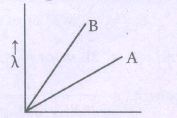
\(\frac { 1 }{ \sqrt { V } } \)
\(\lambda =\frac { h }{ \sqrt { 2mqV } } =\frac { h }{ \sqrt { 2mq } } .\frac { 1 }{ \sqrt { V } } \)
This equation represents a straight line of slope \(\frac { h }{ \sqrt { 2mq } } \)
Clearly, the slope is inversely proportional to \(\sqrt{m}\). Since the slope of line A is less than the slope of line B therefore the line. A represents the particle of heavier mass.
7.
Power of radiation, P =\(\frac { nhv }{ l } \) = Nhv, where N is a number of photons per sec.
or N =\(\frac { P }{ m } \)
= \(\frac { 2.0\times { 10 }^{ -3 } }{ 6.63\times 10^{ -34 }\times 6\times { 10 }^{ 14 } } \)
= 5 x 10¹⁵ photons per second.
8.
Given λ = 589 nm = 5.89 x 10⁻⁷ m
The de Broglie wavelength \(\lambda =\frac { h }{ p } =\frac { h }{ \sqrt { 2m{ E }_{ k } } } \Rightarrow { \lambda }^{ 2 }=\frac { { h }^{ 2 } }{ 2m{ E }_{ k } } \)
Kinetic energy \({ E }_{ k }=\frac { { h }^{ 2 } }{ 2m{ E }_{ k } } \)
(a) For electron \({ E }_{ k }=\frac { { h }^{ 2 } }{ 2m{ E }_{ k } } \)
\({ E }_{ k }=\frac { { (6.63\times 10 }^{ -34 })^{ 2 } }{ 2\times 9.1\times { 10 }^{ -31 }\times { ({ 5.89\times 10 }^{ -7 }) }^{ 2 } } \)
= 6.96 x 10⁻²⁵J
b) For neutron m = 1.67 x 10⁻²⁷ kg
\({ E }_{ k }=\frac { { (6.63\times 10 }^{ -34 })^{ 2 } }{ 2\times 1.67\times { 10 }^{ -31 }\times { ({ 5.89\times 10 }^{ -7 }) }^{ 2 } } \)
= 3.79 x1 0-28J
9.
i) X-rays are produced in x-ray tube which is essentially a discharge tube.
ii) A tungsten filament F is heated to incandescence by a battery. As a result, electrons are emitted from it by thermionic emission.
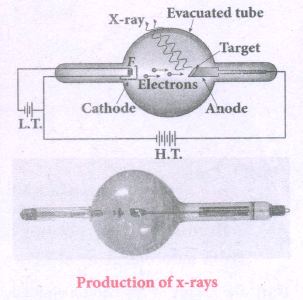
iii) The electrons are accelerated to high speeds by the voltage applied between the filament F and the anode.
iv) The target materials like tungsten, molybdenum are embedded in the face of the solid copper anode.
v) The face of the target is inclined at an angle with respect to the electron beam so that x-rays can leave the tube through its side.
vi) When high-speed electrons strike the target, they are decelerated suddenly and lose their kinetic energy.
vii) As a result, x-ray photons are produced. Since most of the kinetic energy of the bombarding electrons gets converted into heat, targets' made of high-melting-point metals and a cooling system are usually employed.
10.
(i) The satellite communication is a mode of transmission of signal between transmitter and receiver via satellite.
(ii) The message signal from the Earth station is transmitted to the satellite on board via an uplink (frequency band 6 GHz), amplified by a transponder and then retransmitted to another earth station via a downlink (frequency band 4 GHz).
Applications:
Satellites are classified into different types based on their applications.
(i) Weather Satellites:
They are used to monitor the weather and climate of Earth. By measuring cloud mass, these satellites enable us to predict rain and dangerous storms like hurricanes, cyclones etc.
(ii) Communication satellites:
They are used to transmit television, radio, internet signals etc. Multiple satellites are used for long distance communication
(iii) Navigation satellites:
These are employed to determine the geographic location of ships, aircraft or any other object.
11.
(i) An oscillator basically converts de energy into ac energy of high frequency ranging from a few Hz to several MHz.
(ii) There are two types of oscillators
a) Sinusoidal
b) Non-sinusoidal.
(iii) Sinusoidal oscillators generate oscillations in the form of sine wave at constant amplitude and frequency.
(iv) Non-sinusoidal oscillators generate complex non-sinusoidal waveforms like square wave, Triangular - wave or Sawtooth -wave
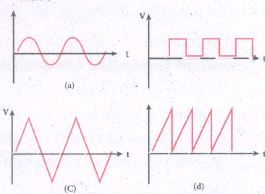
(v) Sinusoidal oscillations can be of two types:
a) Damped
b) undamped.
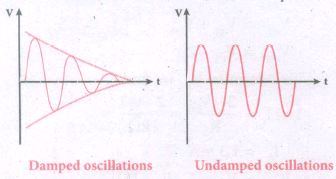
(vi) If the amplitude of the electrical oscillations decreases with time due to energy loss, is called damped oscillations
(vii) The amplitude of the electrical oscillations remains constant with time in undamped oscillations.
12.
Decay constant \(\lambda =\frac { 0.6931 }{ T } =\frac { 0.6931 }{ 24.1 } \) day-1
Also, \(\frac { N }{ { N }_{ o } } =\frac { 10 }{ 100 } =\frac { 1 }{ 10 } \)
Now, \(\frac { N }{ { N }_{ o } } ={ e }^{ -\lambda t };\frac { 1 }{ 10 } ={ e }^{ -\lambda t };{ e }^{ -\lambda t }=10\)
Taking logs, we get λt = log, 10 = 2.3
t = \(t=\frac { 23 }{ \lambda } =\frac { 2.3\times 24.1 }{ 06931 } \) days = 19.97 days
13.
(i) The smoke detector uses around 0.2 mg of a man-made weak radioactive isotope called americium \((_{ 95 }^{ 241 }{ Am })\)
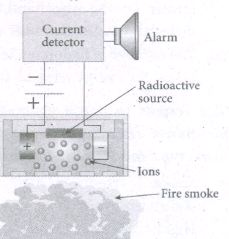
(ii) This radioactive source is placed between two oppositely charged metal plates and α radiations from \(_{ 95 }^{ 241 }{ Am }\) continuously ionize the nitrogen, oxygen molecules in the air space between the plates
(iii) As a result, there will be a continuous flow of small steady currents in the circuit.
(iv) If smoke enters, the radiation is being absorbed by the smoke particles rather than air molecules.
(v) As a result, the ionization and along with it the current is reduced. This drop-in current is detected by the circuit and the alarm starts.
(vi) The radiation dosage emitted by americium is very much less than the safe level, so it can be considered harmless.
14.
Given: The amplitude of magnetic field of an Electromagnetic wave B = 1.6 x 10⁻⁷ T
To find:
The amplitude of electric field of an Electromagnetic wave E = ?
frequency ૪ = 30 Mhz = 30 x 106 Hz.
To find: Angle velocity ω =?
Wavelength of Electromagnetic wave λ = ?
(i) Ampere of electric field E = ?
\(\frac { E }{ B } =C\Rightarrow E=C.B\Rightarrow 3\times { 10 }^{ 8 }\times 1.6\times { 10 }^{ -7 }\)
E = 48Vm-1.
(ii) Angle velocity, ω = 2π૪
ω = 2 x 3.14 x 30 x 106
ω = 1.885 x 10⁸ rad /s.
(iii) Wavelength of Electromagnetic wave, λ = \(\frac{C}{\gamma}\)
\(\gamma=\frac{3\times 10^8}{30\times 10^6}\) = 10m
λ = 10m
15.
I1 = 4A, I2= 6A, r = 3cm = 0.03A
\(\frac { F }{ l } =\frac { { \mu }_{ 0 } }{ 4\pi } \frac { 2{ I }_{ 1 }{ I }_{ 2 } }{ 0.03 } \)
\(\frac { F }{ 1 } =\frac { 10^{ -7 }\times 2\times 4\times 6 }{ 0.03 } \)
F = 1.6 x 10⁻⁴ N/m.
16.
Given: I = 1m, r = \(\frac22\) 1 cm = 10-2 m
Nl = 2000, N2 = 1000, A = ㅠr2
A = n(10-2)2m2
To find:
M = ?
Mutual inductance between the coils is given by
M = \(\frac { { \mu }_{ o }{ N }_{ 1 }{ N }_{ 2 }{ A }_{ 2 } }{ l } \)
= \(\frac { 4\pi \times { 10 }^{ -7 }\times 2000\times 1000\times { 10 }^{ -4 } }{ 1 } \)
M =78.89 x 10⁻⁵ H.
17.
(i) Consider a charged particle of charge 'q' having mass m enters into a region of a uniform magnetic field \(\vec { B } \) with velocity \(\vec { v } \).
(ii) Such that velocity is perpendicular to the magnetic field and velocity \(\vec{v}\).
(iii) The charged particle moves in a circular orbit.
(iv) Lorentz force.
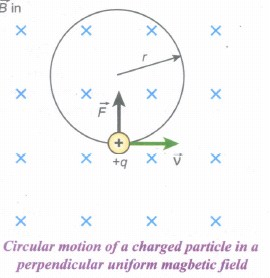
\(\vec { F } =q(\vec { v } \times \vec { B } )\)
In magnitude F = qVB
(v) This Lorentz force acts as centripetal force for the particle to execute circular motion. Therefore,
qvB = m\(\frac { { v }^{ 2 } }{ r } \)
The radius of the circular path is
r = \(\frac { mv }{ qB } =\frac { p }{ qB } \) ..........(1)
(vi) where p = mv is the magnitude of the linear momentum of the particle. Let T be the time taken by the particle to finish one complete circular motion, then
T = \(\frac { 2\pi r }{ v } \) .............(2)
Hence substituting (1) in (2), we get,
T = \(\frac { 2\pi m }{ qB } \) .............(3)
(vii) Equation (3) is called the cyclotron period. The reciprocal of time period is the frequency f, which is
f = \(\frac { 1 }{ T } \)
f = \(\frac { qB }{ 2\pi m } \) ...........(4)
In terms of angular frequency ω,
ω = 2πf = \(\frac { q }{ m } \)B ...........(5)
(viii) Equations (4) and equation (5) are called cyclotron frequency or gyrofrequency.
(ix) Time period and frequency depend only on charge-to-mass ratio (specific charge) and independent of velocity or radius.
18.
Given: Radius of the to roid r = 15cm
= 15 x 10-2m
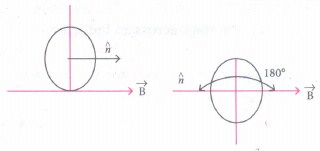
Initral magnetic flux Φi = NBA
= 500 x 3 x 10-5 x π (0.1)2
= 15π x 10-5 wb.
an turning by 1800
Final flux Φf= -NBA = -15π x 10-15wb.
Formula:
Magnitude of induced emf e = - \(\frac{dΦ}{dt}\)
Solution:
e = \(\frac { 2\times 15\pi \times { 10 }^{ -5 } }{ 0.25 } \) = 120π x 10-5V
= 376.8 x 10-5= 0.038V
Induced current = \(\frac{ε}{e}\) = \(\frac{0.038}{200}\)
= 19 x 10-5A
19.
Diameter d 0.24 cm = 0.24 x 10⁻² m
radius \(r=\cfrac { d }{ 2 } =0.12\times { 1 }^{ -2 }m\)
Current, I = 10A
Current density \(J=\cfrac { 1 }{ A } =\cfrac { 1 }{ { \pi r }^{ 2 } } \)
= \(\cfrac { 10 }{ 3.14\times \left( 0.12\times { 10 }^{ -2 } \right) ^{ 2 } } \)
= 2.2 x 10⁶ Am-2
20.
At the point x = 0, the electric field due to all the charges are in the same negative X-direction and hence get added up, i.e.,
\(E=\frac { q }{ 4\pi { \varepsilon }_{ 0 } } \left[ \frac { q }{ { (1) }^{ 2 } } +\frac { q }{ { (2) }^{ 2 } } +\frac { q }{ { (4) }^{ 2 } } +\frac { q }{ { (8) }^{ 2 } } +.... \right] \)
\(=\frac { 1 }{ 4\pi { \varepsilon }_{ 0 } } \left[ \frac { 1 }{ 1 } +\frac { 1 }{ 4 } +\frac { 1 }{ 16 } +\frac { 1 }{ 64 } +..... \right] \)
\(=\frac { q }{ 4\pi { \varepsilon }_{ 0 } } \left[ \frac { 1 }{ 1-\frac { 1 }{ 4 } } \right] =\frac { q }{ 3\pi { \varepsilon }_{ 0 } } \) (along negative X-axis)
21.
By the concept of Drift velocity \(I=nAeu_{ d }\)
\({ \mu }_{ d }=\cfrac { eE }{ m } \tau \)
\(\rho =\cfrac { m }{ { ne }^{ 2 }\tau } \)
\(\therefore\) Current density
\(J=\cfrac { I }{ A } ={ \cfrac { nA{ ev }_{ d } }{ A } =ne.\cfrac { em\tau }{ m } }=\left( \cfrac { { ne }^{ 2 }\tau }{ A } \right) E\)
\(J=\cfrac { 1 }{ \rho } .E\)
22.
(i) The resistivity of a material is dependent on temperature. The resistivity of a conductor increases with increase in temperature according to the expression
\({ \rho }_{ r }={ \rho }_{ 0 }[I+\alpha (T-{ T }_{ 0 })\)
(ii) Where PT is the resistivity of a conductor at ToC, is the resistivity of the conductor at some reference temperature To (usually at 20°C), and a is the temperature coefficient of resistivity.
(iii) It is defined as the ratio of increase in resistivity per degree rise in temperature to its resistivity at To
From equation (1), we can write
\({ \rho }_{ r }-{ \rho }_{ 0 }=\alpha { \rho }_{ 0 }(T-{ T }_{ 0 })\)
\(\therefore \alpha =\cfrac { { \rho }_{ r }-{ \rho }_{ 0 } }{ { \rho }_{ 0 }(T-{ T }_{ 0 }) } =\cfrac { \Delta \rho }{ { \rho }_{ 0 }\Delta T } \)
where \(\Delta \rho ={ \rho }_{ r }-{ \rho }_{ 0 }\) is change in resistivity for a change in temperature \(\Delta T=T-{ T }_{ 0 }\) Its unit is per oC \(\alpha \) of conductor:
(iv) For conductors a is positive. If the temperature of a conductor increases, the average kinetic energy of electrons in the conductor increases. This results in more frequent collisions and hence the resistivity increases.
(v) The graph of the Even though, the resistivity of conductors like metals varies linearly for wide range of temperatures, there also exists a nonlinear region at very low temperatures.
(vi) The resistivity approaches some finite values the temperature approaches absolute zero
(vii) As the resistance is directly proportional to the resistivity of the material, we can also write the resistance of a conductor at temperature T °C as
\({ R }_{ T }={ R }_{ 0 }\left[ 1+\left( T-{ T }_{ 0 } \right) \right] \)
\(\alpha =\cfrac { { R }_{ T }-{ R }_{ 0 } }{ { R }_{ 0 }\left( T-{ T }_{ 0 } \right) } =\cfrac { I }{ { R }_{ 0 } } \cfrac { \Delta R }{ \Delta T } \)
\(\alpha =\cfrac { I }{ { R }_{ 0 } } \cfrac { \Delta R }{ \Delta T } \)
where \(\Delta R={ R }_{ r }-{ R }_{ 0 }\) is the change in resistance during the change in temperature \(\Delta T=T-{ T }_{ 0 }\)
(viii) An of semiconductors For semiconductors, the resistivity decreases with increase in temperature. As the temperature increases, more electrons will be liberated from their atoms. Hence the current increases and therefore the resistivity decreases. A semiconductor with a negative temperature coefficient of resistance is called a thermistor.
23.
\({ V }_{ S }-{ V }_{ R }=\frac { W }{ q } \)
Work W = 50μJ = 50 x 10-6 J
Charge q = 2μC = 2 x 10⁻⁶ C
V = VS - VR \(=\frac { W }{ q } =\frac { 50\times { 10 }^{ -6 } }{ 2\times { 10 }^{ -6 } } =25V\)
V = 25V

12th Standard Syllabus & Materials
12th Standard
TN 12th Computer Applications வலையமைப்பு வடமிடல் Sample Question Papers Study Material - QB365 Set A
NEW12th Standard
TN 12th Computer Applications களப்பெயர் முறைமை (DNS) Sample Question Papers Study Material - QB365 Set A
NEW12th Standard
TN 12th Computer Applications வலையமைப்பு எடுத்துக்காட்டுகள் மற்றும் நெறிமுறைகள் Sample Question Papers Study Material - QB365 Set A
NEW12th Standard
TN 12th Computer Applications கணினி வலையமைப்பு ஓர் அறிமுகம் Sample Question Papers Study Material - QB365 Set A



Tamilnadu Stateboard 12th Standard Subjects

Maths

Chemistry
Physics

Biology

Computer Science

Business Maths and Statistics

Economics

Commerce

Accountancy

History

Computer Applications
Biology
Computer Technology
Computer Applications
Computer Science
Business Maths and Statistics
Commerce
Economics
Maths
Chemistry
Physics
Computer Technology
History
Accountancy

Tamil

English

French
Tamilnadu Stateboard Standards

