
 100% FREE ACCESS
12th Standard Syllabus & Materials
12th Standard
TN 12th Maths Applications of Matrices and Determinants Sample Question Papers Study Material - QB365 Set A
NEW12th Standard
TN 12th Computer Applications மின்னணு தரவு பரிமாற்றம் Sample Question Papers Study Material - QB365 Set A
NEW12th Standard
TN 12th Computer Applications மின் - வணிக பாதுகாப்பு அமைப்புகள் Sample Question Papers Study Material - QB365 Set A
NEW12th Standard
TN 12th Computer Applications மின்னணு செலுத்தல் முறைகள் Sample Question Papers Study Material - QB365 Set A
NEW12th Standard
TN 12th Computer Applications மின் - வணிகம் Sample Question Papers Study Material - QB365 Set A
NEW12th Standard
TN 12th Computer Applications திறந்த மூல கருத்துருக்கள் Sample Question Papers Study Material - QB365 Set A

Published on: 02/09/2022
QB365 provides a detailed and simple solution for every Possible Book Back Questions in Class 12 Physics Subject - Retirement and Death of a Partner, English Medium. It will help Students to get more practice questions, Students can Practice these question papers in addition to score best marks.
Download Tamil Nadu 12th Standard Physics question papers, model tests, one-mark questions, important questions, and public exam papers in PDF format. Free study materials and answer keys for TN State Board students.
Questions + Answers key
Take MCQ Physics Test1.
Keezhadi ((கீழடி),a small hamlet, has become one of the very important archaeological places of Tamilnadu. It is located in Sivagangai district. A lot of artefacts (gold coins, pottery, beads, iron tools, jewellery and charcoal, etc.) have been unearthed in Keezhadi which have given substantial evidence that an ancient urban civilization had thrived on the banks of river Vaigai. To determine the age of those materials, the charcoal of 200 g sent for carbon dating is given in the following figure (b). The activity of \(_{ 6 }^{ 14 }{ C }\) is found to be 37 decays/s. Calculate the age of charcoal.
.JPG)
Figure (a) Keezhadi – excavation site
.JPG)
Figure (b) – Characol which was sent for carbon dating
2.
A radioactive sample has 2.6μg of pure \(_{ 7 }^{ 13 }{ N }\) which has a half-life of 10 minutes.
(a) How many nuclei are present initially?
(b) What is the activity initially?
(c) What is the activity after 2 hours? (d) Calculate mean life of this sample.
3.
(a) Calculate the disintegration energy when stationary \(_{ 92 }^{ 232 }{ U }\) nucleus decays to thorium \(_{ 90 }^{ 228 }{ Th }\) with the emission of α particle. The atomic masses are of \(_{ 92 }^{ 232 }{ U }\) = 232.037156 u, \(_{ 90 }^{ 228 }{ Th }\) = 228.028741u and \(_{ 2 }^{ 4 }{ He }\) = 4.002603 u
(b) Calculate kinetic energies of \(_{ 90 }^{ 228 }{ Th }\) and α-particle and their ratio.
4.
Suppose the energy of an electron in hydrogen–like atom is given as En = \(-\frac { 54.4 }{ { n }^{ 2 } } eV\) where \(n \in \mathbb{N}\) . Calculate the following:
(a) Sketch the energy levels for this atom and compute its atomic number.
(b) If the atom is in ground state, compute its first excitation potential and also its ionization potential.
(c) When a photon with energy 42 eV and another photon with energy 51 eV are made to collide with this atom, does this atom absorb these photons?
(d) Determine the radius of its first Bohr orbit.
(e) Calculate the kinetic and potential energies of electron in the ground state.
5.
The Bohr atom model is derived with the assumption that the nucleus of the atom is stationary and only electrons revolve around the nucleus. Suppose the nucleus is also in motion, then calculate the energy of this new system.
6.
(a) Show that the ratio of velocity of an electron in the first Bohr orbit to the speed of light c is a dimensionless number.
(b) Compute the velocity of electrons in ground state, first excited state and second excited state in Bohr atom model for hydrogen atom.
7.
8.
Calculate the time required for 60% of a sample of radon undergo decay. Given T1/2 of radon = 3.8 days.
9.
On your birthday, you measure the activity of the sample 210Bi which has a half-life of 5.01 days. The initial activity that you measure is 1µCi.
(a) What is the approximate activity of the sample on your next birthday? Calculate
(b) the decay constant
(c) the mean life
(d) initial number of atoms.
10.
Half lives of two radioactive elements A and B are 20 minutes and 40 minutes respectively. Initially, the samples have equal number of nuclei. Calculate the ratio of decayed numbers of A and B nuclei after 80 minutes.
11.
Calculate the mass defect and the binding energy per nucleon of the \(_{ 47 }^{ 108 }{ Ag }\) nucleus. [atomic mass of Ag = 107.905949]
12.
Calculate the radius of the earth if the density of the earth is equal to the density of the nucleus.[mass of earth 5.97 x 1024 kg].
13.
(a) A hydrogen atom is excited by radiation of wavelength 97.5 nm. Find the principal quantum number of the excited state
(b) Show that the total number of lines in emission spectrum is \(\frac { n(n-1) }{ 2 } \) Compute the total number of possible lines in emission spectrum as given in(a).
14.
Write down the postulates of Bohr atom model.
15.
Write the properties of cathode rays.
16.
Give the results of Rutherford alpha scattering experiment.
1.
To calculate the age, we need to know the initial activity (R0) of the caracol (when the sample was alive).
The activity R of the sample
R = R0 e-λt ...(1)
To find the time t, rewriting the above equation (1),
\({ e }^{ \lambda t }=\frac { { R }_{ 0 } }{ R } \)
By taking the logarithm on both sides, we get \(t=\frac { 1 }{ \lambda } In\left( \frac { { R }_{ 0 } }{ R } \right) \) ..(2)
Here R = 38 decays/s = 38 Bq.
To find decay constant, we use the equation
\(\lambda =\frac { 0.6931 }{ { T }_{ 1/2 } } =\frac { 0.6931 }{ 5730yr\times 3.156\times { 10 }^{ 7 }s/yr } \)
[∴ 1yr = 365.25 x 24 x 60 x 60 s = 3.156 x 10⁷ s]
λ = 3.83 x 10⁻¹² s−1
To find the initial activity R0, we use the equation R0 = λN0. Here N0 is the number of carbon-14 atoms present in the sample when it was alive. The mass of the charcoal is 200 g. In 12 g of carbon, there are 6.02 x 10²³ carbon atoms. So 200 g contains,
\(\frac { 6.02\times { 10 }^{ 23 }atoms/mol }{ 12g/mol } \times 200\approx 1\times { 10 }^{ 25 }\) atoms
When the tree(sample) was alive, the ratio of \(_{ 6 }^{ 14 }{ C }{ e }\) to \(_{ 6 }^{ 12 }{ C }{ e }\) is 1.3 x 10⁻¹². So the total number of carbon-14 atoms is given by
N0 = 1 x 1025 x 1.3 x 10-12 atoms
The initial activity
R0 = 3.83 x 10-12 x 1.3 x 1013 ≈ 50 decays / s
= 50 Bq
By substituting the value of R0 and λ in the equation (2), we get
\(t=\frac { 1 }{ 3.83\times { 10 }^{ -12 } } \times In\left[ \frac { 50 }{ 37 } \right] \)
\(t=\frac { 0.301 }{ 3.83 } \times { 10 }^{ 12 }\approx 7.86\times { 10 }^{ 10 }\)sec
In years
\(t=\frac { 7.86\times { 10 }^{ 10 }s }{ 3.156\times { 10 }^{ 7 }s/yr } \approx 2500\) years
In fact, the excavated materials were to USA sent for carbon dating by the Archeological Department of Tamilnadu and the report confirmed that the age of Keezhadi artifacts lies between 2200 years to 2500 years (Sangam era- 400 BC to 200 BC). The Keezhadi excavations experimentally proved that urban civilization existed in Tamil Nadu even 2000 years ago!
2.
(a) To find N0, we have to find the number of \(_{ 7 }^{ 13 }{ N }\) atoms in 2.6μg. The atomic mass of nitrogen is 13. Therefore, 13 g of \(_{ 7 }^{ 13 }{ N }\) contains Avogadro number (6.02 x 10²³) of atoms.
In 1 g, the number of \(_{ 7 }^{ 13 }{ N }\) atoms present is equal to \(\frac { 6.02\times { 10 }^{ 23 } }{ 13 } \). So the number of \(_{ 7 }^{ 13 }{ N }\) atoms present in 2.6μg is
\({ N }_{ 0 }=\frac { 6.02\times { 10 }^{ 23 } }{ 13 } \times 2.6\times { 10 }^{ -6 }=12.04\times { 10 }^{ 16 }\) atoms
(b) To find the initial activity R0, we have to evaluate decay constant λ
\(\lambda =\frac { 0.6931 }{ { T }_{ 1/2 } } =\frac { 0.6931 }{ 10\times 60 } =1.155\times { 10 }^{ -3 }{ s }^{ -1 }\)
Therefore
R0 = λN0 = 1.155 x 10-3 x 12.04 x 1016
= 13.90 x 10 13 decays/s
= 13.90 x 10 13 Bq
In terms of a curie,
\({ R }_{ 0 }=\frac { 13.90\times { 10 }^{ 13 } }{ 3.7\times { 10 }^{ 10 } } =3.75\times { 10 }^{ 3 }Ci\)
since 1Ci = 3.7 x 10¹⁰Bq
(c) Activity after 2 hours can be calculated in two different ways:
Method 1: R = R0 e–λt
At t = 2 hr = 7200 s
R = 3.75 x 10³ x e-7200 x 1.155 x 10–3
R = 3.75 x 103 x 2.4 x 10–4 = 0.9 Ci
Method 2: \(R={ \left( \frac { 1 }{ 2 } \right) }^{ n }{ R }_{ 0 }\)
Here \(n=\frac { 120min }{ 10min } =12\)
\(R={ \left( \frac { 1 }{ 2 } \right) }^{ 12 }\times 3.75\times { 10 }^{ 3 }\) ≈ 0.9 Ci
(d) mean life ፒ = \(\frac{T_{1/2}}{0.6931}=\frac{10\times60}{0.6931}\)
= 865.67 s
3.
The difference in masses
Δm = (mU - mTh - mα)
= (232.037156–228.028741 – 4.002603)u
The mass lost in this decay = 0.005812 u
Since 1u = 931MeV, the energy Q released is
Q = (0.005812 u) x (931 MeV / u)
= 5.41 MeV
This disintegration energy Q appears as the kinetic energy of α particle and the daughter nucleus. In any decay, the total linear momentum must be conserved.
Total linear momentum of the parent nucleus = total linear momentum of the daughter nucleus and α particle. Since before decay, the uranium nucleus is at rest, its momentum is zero. By applying conservation of momentum, we get
0 = \({ m }_{ Th }{ \overrightarrow { \upsilon } }_{ Th }+{ m }_{ \alpha }\overrightarrow { \upsilon } _{ \alpha }\)
\({ m }_{ \alpha }\overrightarrow { \upsilon } _{ \alpha }\) = - \({ m }_{ Th }{ \overrightarrow { \upsilon } }_{ Th }\)
It implies that the alpha particle and daughter nucleus move in opposite directions.
In magnitude mα ሀα = mTh ሀTh
The velocity of α particle ሀα = \(\frac { { m }_{ Th } }{ { m }_{ \alpha } } { \upsilon }_{ Th }\)
Since mTh > mα , ሀα > ሀTh. The ratio of the kinetic energy of α particle to that the daughter nucleus,
\(\frac { K.{ E }_{ \alpha } }{ K.{ E }_{ Th } } =\frac { 1/2{ m }_{ \alpha }{ { \upsilon }_{ \alpha } }^{ 2 } }{ 1/2{ m }_{ Th }{ { \upsilon }_{ Th } }^{ 2 } } \)
By substituting, the value of ሀα into the above equation, we get \(\frac { K.{ E }_{ \alpha } }{ K.{ E }_{ Th } } =\frac { { m }_{ Th } }{ { m }_{ \alpha } } =\frac { 228.02871 }{ 4.002603 } =57\)
The kinetic energy of α particle is 57 times greater than the kinetic energy of the daughter nucleus (\(_{ 90 }^{ 228 }{ Th }\))
The disintegration energy Q = total kinetic energy of products
K.Eα + K.ETh = 5.41 MeV
57K.ETh + K.E Th = 5.41 MeV
K.ETh = \(\frac{5.41}{58}\) MeV = 0.0093 MeV
K.Eα = 57K.ETh = 57 x 0.093 = 5.301 MeV
In fact, 98% of total kinetic energy is taken by the α particle.
4.
(a) Given that En = \(\frac { 54.4 }{ { n }^{ 2 } } eV\)
For n = 1, the ground state energy E1 = –54.4 eV and for n = 2, E2 = –13.6 eV. Similarly, E3 = –6.04 eV, E4 = –3.4 eV and so on.
For large value of principal quantum number – that is, n = ∞, we get E∞ = 0 eV.
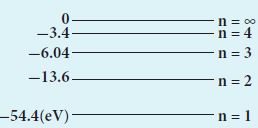
(b) For a hydrogen-like atom, ground state energy is
E1 =\(\frac { 13.6 }{ { n }^{ 2 } } { Z }^{ 2 }eV\)
where Z is the atomic number. Hence, comparing this energy with given energy, we get, – 13.6 Z2 = – 54.4 ⇒ Z = ±2. Since, atomic number cannot be negative number, Z = 2.
(c) The first excitation energy is
E1 = E2 - E1 = -13.6 eV - (-54.4eV)
= 40.8 eV
Hence, the first excitation potential is
\({ V }_{ 1 }=\frac { 1 }{ e } { E }_{ 1 }=\frac { (40.8eV) }{ e } \)
= 40.8 volt
The first ionization energy is
Eionization = E∞ - E1 = 0 -(-54.4eV)
= 54.4 eV
Hence, the first ionization potential is
\({ V }_{ ionization }=\frac { 1 }{ e } { E }_{ ionization }=\frac { (54.4eV) }{ e } \)
= 54.4 volt
(d) Consider two photons to be A and B.
Given that photon A with energy 42 eV and photon B with energy 51 eV
From Bohr assumption, difference in energy levels is equal to photon energy, then atom will absorb energy, otherwise, not.
E2 - E1 = -13.6eV - (-54.4eV)
= 40.8eV ≈ 41 eV
Similarly,
E3 - E1 = -6.04 eV - (-54.4eV)
= 48.36 eV
E4 - E1 = -3.4eV - (-54.4eV)
= 51 eV
E3 - E2 = -6.04eV - (-13.6eV)
= 7.56 eV
and so on.
But note that E2 – E1 ≠ 42 eV, E3 – E1 ≠ 42 eV, E4 – E1 ≠ 42 eV and E3 – E2 ≠ 42 eV
For all possibilities, no difference in energy is an integer multiple of photon energy. Hence, photon A is not absorbed by this atom. But for Photon B, E4 – E1 = 51 eV, which means, Photon B can be absorbed by this atom
(d) The radius of Bohr orbit is \(r_n=\frac { a_o\times n^2 }{ z }\)
For n = 1, z = 2
\(r_1=\frac { a_o }{ 2 }\)
\(=\frac { 0.529 }{ 2 }\)
= 0.265 Å
(e) Since total energy is equal to negative of kinetic energy in Bohr atom model, we get
\(K{ E }_{ n }=-{ E }_{ n }=-\left( -\frac { 54.4 }{ { n }^{ 2 } } eV \right) \)
\(=-\frac { 54.4 }{ { n }^{ 2 } } eV\)
Since, potential energy is negative of twice the kinetic energy,
\( U_{ n }=-2K{ E }_{ n }=-2\left( -\frac { 54.4 }{ { n }^{ 2 } } eV \right) \)
\(=-\frac { 108.8 }{ { n }^{ 2 } } eV\)
For a ground state, put n = 1
Kinetic energy is KE1 = 54.4 eV and Potential energy is U1 = –108.8 eV
5.
Let the mass of the electron be m and mass of the nucleus be M. Since there is no external force acting on the system, the centre of mass of hydrogen atom remains at rest. Hence, both nucleus and electron move about the centre of mass as shown in figure.
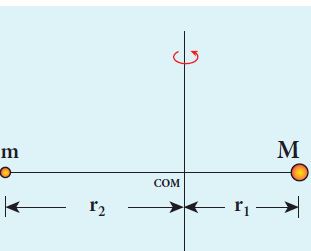
Let V be the velocity of the nuclear motion and υ be the velocity of electron motion. Since the total linear momentum of the system is zero,
−mሀ + Mሀ = 0 or
Mሀ = mሀ = p
\(\vec { { p }_{ e } } +\vec { { p }_{ n } } =\vec { 0 } \) or
\(|\vec { { p }_{ e } } |=|\vec { { p }_{ n } } |=p\)
Hence, the kinetic energy of the system is
KE = \(\frac { { { p }^{ 2 } }_{ n } }{ 2M } +\frac { { { p }^{ 2 } }_{ e } }{ 2m } =\frac { { p }^{ 2 } }{ 2 } \left( \frac { 1 }{ M } +\frac { 1 }{ m } \right) \)
Let \(\frac { 1 }{ M } +\frac { 1 }{ m } =\frac { 1 }{ { \mu }_{ m } } \). Here the reduced mass is
\({ \mu }_{ m }=\frac { mM }{ M+m } \)
Therefore, the kinetic energy of the system now is
\(KE=\frac { { p }^{ 2 } }{ { 2\mu }_{ m } } \)
Since the potential energy of the system is same, the total energy of the hydrogen can be expressed by replacing mass by reduced mass, which is
\({ E }_{ n }=-\frac { { \mu }_{ m }{ e }_{ 4 } }{ 8{ \epsilon ^{ 2 } }_{ 0 }{ h }^{ 2 } } \frac { 1 }{ { n }^{ 2 } } \)
Since the nucleus is very heavy compared to the electron, the reduced mass is closer to the mass of the electron.
6.
(a) The velocity of an electron in nth orbit is
\(\upsilon _{ n }=\frac { h }{ 2\pi m{ a }_{ 0 } } \frac { Z }{ n } \)
Where \({ a }_{ 0 }=\frac { { \epsilon }_{ 0 }{ h }^{ 2 } }{ \pi { me }^{ 2 } } \) = Bohr radius. Substituting for a0 in ሀn,
\({ \upsilon }_{ n }=\frac { { e }^{ 2 } }{ 2{ \epsilon }_{ 0 }h } \frac { Z }{ n } =c\left( \frac { { e }^{ 2 } }{ 2{ \epsilon }_{ 0 }hc } \right) \frac { Z }{ n } =\frac { \alpha cZ }{ n } \)
where c is the speed of light in free space or vacuum and its value is c = 3 x 10⁸ m s–1 and α is called fine structure constant.
For a hydrogen atom, Z = 1 and for the first orbit, n = 1, the ratio of velocity of electron in first orbit to the speed of light in vacuum or free space is
\(\frac { { \upsilon }_{ 1 } }{ c } =\alpha =\frac { { e }^{ 2 } }{ 2{ \epsilon }_{ 0 }hc } \)
\(\alpha =\frac { { (1.6\times { 10 }^{ -19 }C })^{ 2 } }{ 2\times (8.854\times { 10 }^{ -12 }{ C }^{ 2 }{ N }^{ -1 }{ m }^{ -2 }) } \) x \(\frac { 1 }{ (6.6\times { 10 }^{ -34 }{ Nms)\times (3\times { 10 }^{ 8 } }{ ms }^{ -1 }) } \)
≈ \(\frac{1}{136.9}=\frac{1}{137}\) which is a dimensionless number
⇒ α = \(\frac{1}{137}\)
(b) Using fine structure constant, the velocity of electron can be written as vn = \(\frac{αcZ}{n}\)
For hydrogen atom (Z = 1) the velocity of electron in nth orbit is vn = \(\frac{c}{137}\frac{1}{n}=(2.19\times10^6)\frac{1}{n}ms^{-1}\)
For the first orbit (ground state), the velocity of electron is v1 = 2.19 x 10⁶ms−1
For the second orbit (first excited state), the velocity of electron is v2 = 1.095 x 10⁶ms−1
For the third orbit (second excited state), the velocity of electron is v3 = 0.73 x 10⁶ms−1
Here, v1 > v2 > v3
7.
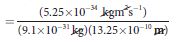
8.
Decayed = 60 %
Left undecayed = 40 %(ie) \(\frac{\mathrm{N}}{\mathrm{N}_{0}}=\frac{40}{100} \)
\(\mathrm{~T}_{\frac{1}{2}}=3.8 \text { days } \)
\(\mathbf{N}=\mathrm{N}_{0} \mathrm{e}^{-\lambda t} \)
\(\frac{\mathrm{N}}{\mathrm{N}_{0}}=\mathrm{e}^{-\lambda t} \)
\(\frac{40}{100}=\mathrm{e}^{-\lambda t} \Rightarrow \frac{100}{40}=2.5=\mathrm{e}^{\lambda t} \)
\(\therefore \mathrm{e}^{\lambda t} \) = 2.5
Taking log on both sides
\(\lambda t=\ln [2.5]=2.3026 \times \log (2.5)=2.3026 \times 0.3974 \)
\(t=\frac{0.9163}{\lambda}=\frac{0.9163}{0.6931} \times T_{1 / 2} \)
\(t=1.322 \times 3.8=5.022 \text { days } \)
9.
\(\mathrm{T}_{\frac{1}{2}}=5.01 \text { days} \), \(\mathrm{R}_{o}=1 μ \mathrm{Ci}=3.7 \times 10^{10} \times 10^{-6} \) decays per second
\(if\ \mathrm{t}=1\ year\ \mathrm{R}= ? \), \(\tau=? \), \(\lambda=? \), \(\mathrm{~N}_{o}=? \)
a) \(\mathrm{R}=\mathrm{R}_{o} \mathrm{e}^{-\lambda t} \)
\(\mathrm{R}=\mathrm{R}_{o} \mathrm{e}^{-\frac{0.6931}{\mathrm{~T}_{1 / 2} }t} \)
\(\mathrm{R}=\mathrm{R}_{o} \mathrm{e}^{-\frac{0.6931}{5.01} \times 365} \)
\(\mathrm{R}=\mathrm{R}_{o} \mathrm{e}^{-50.5}=\mathrm{R}_{o} \times 1.17 \times 10^{-22} \)
\(\mathrm{R}=1 \mu \mathrm{Ci} \times 1.17 \times 10^{-22}=1.17 \times 10^{-22} \mu \mathrm{Ci} \)
\(\mathrm{R}=1.17 \times 10^{-22} \mu \mathrm{Ci} \)
b) \(\lambda=\frac{0.6931}{T_{\frac{1}{2}}}=\frac{0.6931}{5.01}=0.1383 \text { day }^{-1} \)
\(\lambda=\frac{0.6931}{T_{\frac{1}{2}}}=\frac{0.6931}{5.01 \times 24 \times 60 \times 60}=1.6 \times 10^{-6} \mathrm{~s}^{-1} \)
\(\lambda=1.6 \times 10^{-6} \mathrm{~s}^{-1} \)
c) \(\tau=\frac{1}{\lambda}=\frac{1}{0.1383}=7.23 \text { days } \)
\(\tau=7.23 \text { days } \)
\(R_{o}=\lambda N_{o} \)
\(N_{o}=\frac{R_{o}}{\lambda}=\frac{3.7 \times 10^{10} \times 10^{-6}}{1.6 \times 10^{-6}}=2.3 \times 10^{10} \)
\(N_{o}=2.3 \times 10^{10} \)
10.
For A, Half life of \(, \mathrm{T}_{\mathrm{A}} \) = 20 minutes, n = 4
For B, Half life of \(, T_{B}\) = 40 minutes, n = 2
\(\mathrm{N}_{01}=\mathrm{N}_{02}=\mathrm{N}_{0}\)
sample left A, \(\frac{N_{1}}{N_{0}}=\left(\frac{1}{2}\right)^{n}=\left(\frac{1}{2}\right)^{4}=\frac{1}{16}\)
A-sample decayed \(=1-\frac{N_{1}}{N_{0}}=1-\frac{1}{16}=\frac{15}{16}\)
sample Ieft B, \(\frac{N_{1}}{N_{0}}=\left(\frac{1}{2}\right)^{n}=\left(\frac{1}{2}\right)^{2}=\frac{1}{4}\)
B-sample decayed \(=1-\frac{N_{2}}{N_{0}}=1-\frac{1}{4}=\frac{3}{4}\)
Ratio of decayed number of A and B \(=\frac{\frac{15}{16}}{\frac{1}{4}}=\frac{15}{16} \times \frac{4}{3}=\frac{5}{4}\)
Ratio of decayed number of A and |B = 5:4
11.
A = 108, Z =47, N = 108 - 47 = 61
mp = 1.007825 u, mn = 1.008665 u, M = 107.905949 u
(a) \(\Delta \mathrm{m}=Z \mathrm{~m}_{\mathrm{P}}+\mathrm{Nm}_{\mathrm{n}}-\mathrm{M} \)
\(\Delta \mathrm{m}\) = (47 x 1 .007825 + 61 x 1 .008665 - 107 .905949)
\(\Delta \mathrm{m}\) = 47.367775 + 61.528565 -107.905949
\(\Delta \mathrm{m}\) = 108.89634 - 107.905949
\(\Delta \mathrm{m}\) = 0.990391 u
\(\mathrm{BE}=\Delta \mathrm{m} \times 931 \mathrm{MeV} \)
BE = 0.990391 x 931 MeV = 922.054 MeV
(c) \(\overline{\mathbf{B E}}=\frac{\mathbf{B E}}{\mathbf{A}} \)
\(\overline{\mathrm{BE}}=\frac{922.054}{108}=8.537 \mathrm{MeV}=8.5 MeV\)
12.
Density \(\rho=2.3 \times 10^{17} \mathrm{kgm}^{-3}\), Mass M = 5.97 x 1024 kg
\(\rho=\frac{M}{V}=\frac{M}{\frac{4}{3}\pi R^3}\)
\(R=\left[\frac{M}{\frac{4}{3} \pi \rho}\right]^{\frac{1}{3}}=\left[\frac{3 \mathrm{M}}{4 \pi \rho}\right]^{\frac{1}{3}}=\left[\frac{3 \times 5.97 \times 10^{24}}{4 \times 3.14 \times 2.3 \times 10^{17}}\right]^{\frac{1}{3}}=\left[0.62 \times 10^{7}\right]^{\frac{1}{3}}\)
R = 183.7 m
R ≈180 m
13.
Wavelength of incident radiation = 97.5 nm = 97.5 x 10⁻⁹ m
Energy of hydrogen atom in its ground state = -13.6 eV
(a) Principal quantum number n = ?
(b) (i) Number of possible transitions = ?
(ii) Total number possible lines = ?
(a) Energy absorbed by Hydrogen atom
\(E=\frac{h c}{\lambda}=\frac{6.6 \times 10^{-34} \times 3 \times 10^{8}}{97.5 \times 10^{-9}} \mathrm{~J} \)
\(E=\frac{h c}{\lambda}=\frac{6.6 \times 10^{-34} \times 3 \times 10^{8}}{97.5 \times 10^{-9} \times 1.6 \times 10^{-19}} \mathrm{eV} \)
E = 12.74 eV
Energy of the electron in first orbit of Hydrogen is -13.6 ev
En = -13.6 + 12.74 = -0.86 eV
We know that
\(\mathrm{E}_{\mathrm{n}} =-\frac{13.6}{\mathrm{n}^{2}} \)
\(-0.86 =-\frac{13.6}{\mathrm{n}^{2}} \)
\(\mathrm{n}^{2} =15.88 \)
\(\mathrm{n} \cong 4 \)
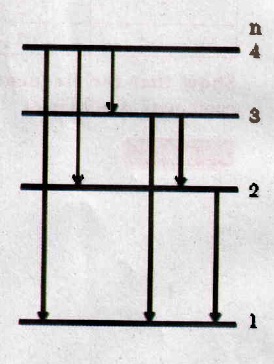
(b) (i) By using arithmetic progression, For the principle quantum number "n",
Total number of possible transition form level n is \(\frac{\mathrm{n}(\mathrm{n}-1)}{2}\)
(ii) Total number of possible transitions form level 4 is 3
Total number of possible transitions form level 3 is 2
Total number of possible transition form level 2 is 1
Hence total number of possible transitions is 3 + 2 + 1 = 6
14.
(i) The electron in an atom moves around nucleus in circular orbits under the influence of Coulomb electrostatic force of attraction. This Coulomb force gives necessary centripetal force for the electron to undergo circular motion.
(ii) Electrons in an atom revolve around the nucleus only in certain discrete orbits called stationary orbits where it does not radiate electromagnetic energy. Only those discrete orbits allowed are stable orbits.
(iii) The angular momentum of the electron in these stationary orbits are quantized (ie) L = \(\frac{nh}{2\pi}\) This is known as Bohr quantization condition.
(iv) The energy of the orbits are not continuous but only discrete. This is called quantization of energy.
(v) An electron can jump from one orbit to another orbit by absorbing or emitting a photon whose energy is equal to the difference in energy between the two orbital levels.
15.
(i) Cathode rays possess energy and momentum and travel in a straight line with high speed of the order of 107m s-1or \({ \left( \frac { 1 }{ 10 } \right) }^{ th }\) of the speed of light.
(ii) It can be deflected by application of electric and magnetic fields. The direction of deflection indicates that they are negatively charged particles.
(ii) When the cathode rays are allowed to fall on matter, they produce heat. They affect the photographic plates and also produce fluorescence when they fall on certain crystals and minerals.
(iii) When the cathode rays fall on a material of high atomic weight, x-rays are produced.
(iv) Cathode rays ionize the gas through which they pass.
16.
(i) Most of the alpha particles are un-deflected through the gold foil and went straight.
(ii) Some of the alpha particles are deflected through a small angle.
(iii) A few alpha particles (one in thousand) are deflected through the angle more than 90o.
(iv) Very few alpha particles returned back (ie) deflected back by 180o.

12th Standard Syllabus & Materials
12th Standard
TN 12th Computer Applications வலையமைப்பு வடமிடல் Sample Question Papers Study Material - QB365 Set A
NEW12th Standard
TN 12th Computer Applications களப்பெயர் முறைமை (DNS) Sample Question Papers Study Material - QB365 Set A
NEW12th Standard
TN 12th Computer Applications வலையமைப்பு எடுத்துக்காட்டுகள் மற்றும் நெறிமுறைகள் Sample Question Papers Study Material - QB365 Set A
NEW12th Standard
TN 12th Computer Applications கணினி வலையமைப்பு ஓர் அறிமுகம் Sample Question Papers Study Material - QB365 Set A



Tamilnadu Stateboard 12th Standard Subjects

Maths

Chemistry
Physics

Biology

Computer Science

Business Maths and Statistics

Economics

Commerce

Accountancy

History

Computer Applications
Biology
Computer Technology
Computer Applications
Computer Science
Business Maths and Statistics
Commerce
Economics
Maths
Chemistry
Physics
Computer Technology
History
Accountancy

Tamil

English

French
Tamilnadu Stateboard Standards

