
 100% FREE ACCESS
12th Standard Syllabus & Materials
12th Standard
TN 12th Computer Applications மின்னணு தரவு பரிமாற்றம் Sample Question Papers Study Material - QB365 Set A
NEW12th Standard
TN 12th Computer Applications மின் - வணிக பாதுகாப்பு அமைப்புகள் Sample Question Papers Study Material - QB365 Set A
NEW12th Standard
TN 12th Computer Applications மின்னணு செலுத்தல் முறைகள் Sample Question Papers Study Material - QB365 Set A
NEW12th Standard
TN 12th Computer Applications மின் - வணிகம் Sample Question Papers Study Material - QB365 Set A
NEW12th Standard
TN 12th Computer Applications திறந்த மூல கருத்துருக்கள் Sample Question Papers Study Material - QB365 Set A
NEW12th Standard
TN 12th Computer Applications வலையமைப்பு வடமிடல் Sample Question Papers Study Material - QB365 Set A

Published on: 01/09/2022
QB365 provides a detailed and simple solution for every Possible Book Back Questions in Class 12 Physics Subject - Current Electricity, English Medium. It will help Students to get more practice questions, Students can Practice these question papers in addition to score best marks.
Download Tamil Nadu 12th Standard Physics question papers, model tests, one-mark questions, important questions, and public exam papers in PDF format. Free study materials and answer keys for TN State Board students.
Questions + Answers key
Take MCQ Physics Test1.
State the applications of Seebeck effect.
2.
Write down the various forms of expression for power in electrical circuit.
3.
What are ohmic and non ohmic devices?
4.
Distinguish between drift velocity and mobility.
5.
Three identical lamps each having a resistance R are connected to the battery of emf ε as shown in the figure.
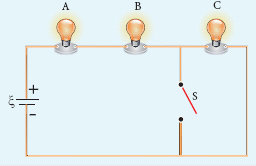
Suddenly the switch S is closed.
(a) Calculate the current in the circuit when S is open and closed
(b) What happens to the intensities of the bulbs A, B, and C.
(c) Calculate the voltage across the three bulbs when S is open and closed
(d) Calculate the power delivered to the circuit when S is opened and closed
(e) Does the power delivered to the circuit decrease, increase or remain same?
6.
An electric heater of resistance 10 Ω connected to 220 V power supply is immersed in the water of 1 kg. How long the electrical heater has to be switched on to increase its temperature from 30°C to 60°C. (Specific heat capacity of water is s = 4200 J kg-1 K-1)
7.
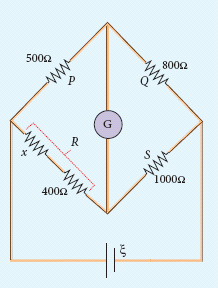
What is the value of x when the Wheatstone’s network is balanced?
P = 500 Ω, Q = 800 Ω, R = x + 400, S = 1000 Ω
8.
In a Wheatstone’s bridge P = 100 Ω, Q = 1000 Ω and R = 40 Ω. If the galvanometer shows zero deflection, determine the value of S.
9.
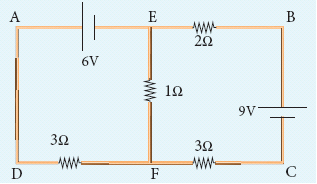
Calculate the current that flows in the 1 Ω resistor in the following circuit.
10.
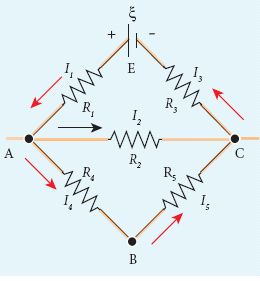
The following figure shows a complex network of conductors which can be divided into two closed loops like EACE and ABCA. Apply Kirchoff’s voltage rule(KVR)
11.
For the given circuit
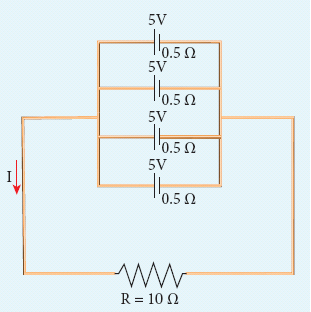
Find
i) Equivalent emf
ii) Equivalent internal resistance
iii) Total current (I)
iv) Potential difference across each cell
v) Current from each cell
12.
From the given circuit,
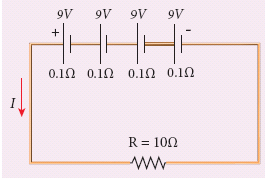
Find
i) Equivalent emf of the combination
ii) Equivalent internal resistance
iii) Total current
iv) Potential difference across external resistance
v) Potential difference across each cell
13.
Two electric bulbs marked 20 W – 220 V and 100 W – 220 V are connected in series to 440 V supply. Which bulb will get fused?
14.
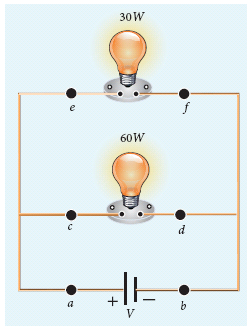
A battery of voltage V is connected to 30 W bulb and 60 W bulb as shown in the figure.
(a) Identify brightest bulb
(b) which bulb has greater resistance?
(c) Suppose the two bulbs are connected in series, which bulb will glow brighter?
15.
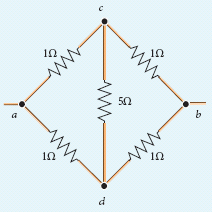
Five resistors are connected in the configuration as shown in the figure. Calculate the equivalent resistance between the points a and b.
16.
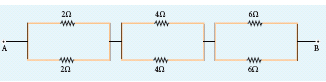
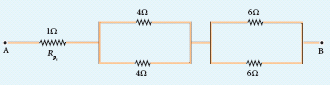
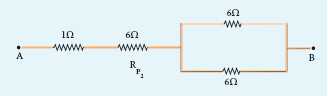
Calculate the equivalent resistance between A and B in the given circuit.
17.
Two resistors when connected in series and parallel, their equivalent resistances are 15 Ω and \(\frac{56}{15}\)Ω respectively. Find the individual resistances.
18.
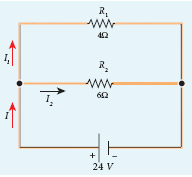
Calculate the equivalent resistance in the following circuit and also find the values of current I, I1 and I2 in the given circuit.
19.
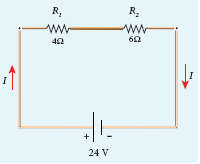
Calculate the equivalent resistance for the circuit which is connected to 24 V battery and also find the potential difference across each resistors in the circuit.
20.
Consider a rectangular block of metal of height A, width B and length C as shown in the figure.
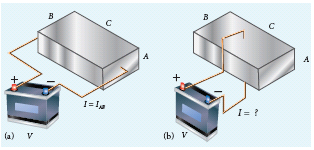
If a potential difference of V is applied between the two faces A and B of the block (figure (a)), the current IAB is observed. Find the current that flows if the same potential difference V is applied between the two faces B and C of the block (figure (b)). Give your answers in terms of IAB.
21.
The resistance of a wire is 20 Ω. What will be new resistance, if it is stretched uniformly 8 times its original length?
1.
Seebeck effect is used in
(i) Thermoelectric generators that are used in power plants to convert heat in to electricity.
(ii) In automobiles as automotive thermoelectric generators for increasing fuel efficiency.
(iii) Thermocouples and Thermopile are used to measure the temperature difference between two objects
2.
(i) Electrical power P = VI
(ii) Erectrical power \(P=V\left(\frac{V}{R}\right)=\frac{V^{2}}{R} \quad \therefore P=\frac{V^{2}}{R}\)
(iii) P = Iv = I(IR) = I2R
(iv) P = I2R
3.
Devices that follow Ohm's law are called Ohmic conductor. Devices that do not follow Ohm's law are called non - Ohmic conductors.
4.
| S.No | Drift velocity | Mobility |
| (i) | Drift velocity is the average velocity acquired by the electrons inside the conductor when it is subjected to an electric field. | Mobility is defined as the magnitude of the drift velocity per unit electric field. |
| (ii) | Vd = a\(\tau\) (or) Vd = μE. | μ =e\(\tau\)/m (or) u = vd/E. |
| (iii) | Its unit is m / s. | Its unit is m2/ Vs. |
5.
| Electrical quantities | Switch S is open | Switch S is closed |
| (a) Current | \(\frac { \varepsilon}{ 3R } \) | \(\frac { \varepsilon }{ 2R } \) |
| (b) Intensity | All the bulbs glow with equal intensity. | The intensities of the bulbs A and B equally increase. Bulb C will not glow since no current pass through it. |
| (c) Voltage | \({ V }_{ A }=\frac {\varepsilon }{ 3 } ,\) \({ V }_{ B }=\frac { \varepsilon }{ 3 } ,\) \({ V }_{ C }=\frac { \varepsilon }{ 3 } \) |
\({ V }_{ A }=\frac { \varepsilon }{ 2 } ,\) \({ V }_{ B }=\frac { \varepsilon }{ 2 } ,\) Vc= 0 |
| (d) Power | \(P_{ A }=\frac { {\varepsilon }^{ 2 } }{ 9R } ,\) \({ P }_{ B }=\frac { { \varepsilon }^{ 2 } }{ 9R } ,\) \({ P }_{ C }=\frac { { \varepsilon }^{ 2 } }{ 9R } \) |
\(P_{ A }=\frac { { \varepsilon }^{ 2 } }{ 4R } ,\) \({ P }_{ B }=\frac { {\varepsilon }^{ 2 } }{ 4R } ,\) Pc=0 |
| (e) Total power delivered to the circuit increases. | ||
6.
According to Joule’s heating law H = I2 Rt
The current passed through the electrical heater \(\\ \\ \\ \\ =\frac { 220V }{ 10\Omega } =22A\)
The heat produced in one second by the electrical heater H = I2 R
The heat produced in one second H = (22)2 x 10 = 4840 J = 4.84 k J. In fact the power rating of this electrical heater is 4.84 k W.
The amount of energy to increase the temperature of 1kg water from 30°C to 60°C is
Q = ms ΔT (Refer XI physics vol 2, unit 8)
Here m = 1 kg,
s = 4200 J kg-1K–1,
ΔT = 30,
so Q = 1 x 4200 x 30 = 126 kJ
The time required to produce this heat energy \(t=\frac { Q }{ { I }^{ 2 }R } =\frac { 126\times { 10 }^{ 3 } }{ 4840 } \approx 26.03s\)
7.
\(\frac { P }{ Q } =\frac { R }{ S } \), when the network is balanced
\(\frac { 500 }{ 800 } =\frac { x+400 }{ 1000 } \)
\(x+400=\frac { 5 }{ 8 } \times 1000\)
x + 400 = 625
x = 625 – 400
x = 225 Ω
8.
\(\frac { P }{ Q } =\frac { R }{ S } \)
\(S=\frac { Q }{ P } \times R\)
\(S=\frac { 1000 }{ 100 } \times 40S=400\Omega \)
9.
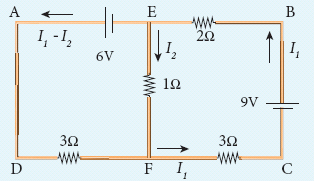
We can denote the current that flows from 9V battery as I1 and it splits up nto I2 and (I1 – I2) at the junction E according Kirchoff’s current rule (KCR).
Now consider the loop EFCBE and apply KVR, we get
1I2 + 3I1 + 2I1 = 9
5I1 + I2 = 9 (1)
Applying KVR to the loop EADFE, we get
3 (I1 – I2 ) – 1I2 = 6
3I1 – 4I2 = 6 (2)
Solving equation (1) and (2), we get
I1 = 1.83 A and I2 = -0.13 A
It implies that the current in the 1 ohm resistor flows from F to E.
10.
Thus applying Kirchoff’s second law to the closed loop EACE
I1R1 + I2R2 + I3R3 = ξ
and for the closed loop ABCA
I4R4 + I5R5 - I2R2 = 0
11.
i) Equivalent emf ξeq = 5 V
ii) Equivalent internal resistance,
\({ R }_{ eq }=\frac { r }{ n } =\frac { 0.5 }{ 4 } =0.125\Omega \)
iii) total current, \(I=\frac { \xi }{ { R }_{ 5 }+\frac { r }{ n } } \)
\(I=\frac { 5 }{ 10+0.125 } =\frac { 5 }{ 10.125 } \)
I ≈ 0.5 A
iv) Potential difference across each cell
V = IR = 0.5 x 10 = 5 V
v) Current from each cell, \(I'=\frac { I }{ n } \)
\(I'=\frac { 0.5 }{ 4 } =0.125A\)
12.
Equivalent emf of the combination
ξeq = nξ = 4 x 9 = 36 V
ii) Equivalent internal resistance req = nr = 4 x 0.1 = 0.4 Ω
iii) Total current \(I=\frac { n\xi }{ R+nr } \)
\(=\frac { 4\times 9 }{ 10+(4\times 0.1) } \)
\(=\frac { 4\times 9 }{ 10+0.4 } =\frac { 36 }{ 10.4 } \)
I = 3.46 A
iv) Potential difference across external resistance V = IR = 3.46 x 10 = 34.6 V. The remaining 1.4 V is dropped across the internal resistance of cells.
v) Potential difference across each cell \(\frac { V }{ n } =\frac { 34.6 }{ 4 } =8.65V\)
13.
To check which bulb will be fused, the voltage drop across each bulb has to be calculated.
The resistance of a bulb,
\(R=\frac { V^{ 2 } }{ P } =\frac { { (Ratedvoltage) }^{ 2 } }{ Ratedpower } \)
For 20W - 220V bulb,
\({ R }_{ 1 }=\frac { { \left( 220 \right) }^{ 2 } }{ 20 } \Omega =2420\Omega \)
For 100W - 220V bulb,
\({ R }_{ 2 }=\frac { { \left( 220 \right) }^{ 2 } }{ 20 } \Omega =484\Omega \)
Both the bulbs are connected in series. So same current will pass through both the bulbs. The current that passes through the circuit, \(I=\frac { V }{ { R }_{ tot } } \)
Rtot (R1 + R2)
Rtot = (484 + 2420) \(\Omega\) = 2904 \(\Omega\)
\(I=\frac { 440V }{ 2904\Omega } \approx 0.151A\)
The voltage drop across the 20W bulb is
\(V_1=IR_1=\frac { 440V }{ 2904 }\times2420 \approx 366.6V\)
The voltage drop across the 100W bulb is
\({ V }_{ 2 }=I{ R }_{ 2 }=\frac { 440 }{ 2904 } 484\approx 73.3A\)
The 20 W bulb will get fused because the voltage across it is more than the voltage rating.
14.
(a) The power delivered by the battery P = VI. Since the bulbs are connected in parallel, the voltage drop across each bulb is the same. If the voltage is kept fixed, then the power is directly proportional to current (P ∝ I). So 60 W bulb draws twice as much as current as 30 W and it will glow brighter than 30 W bulb.
(b) To calculate the resistance of the bulbs, we use the relation \(P=\frac { { v }^{ 2 } }{ R } \) In both the bulbs, the voltage drop is the same, so the power is inversely proportional to the resistance or resistance is inversely proportional to the power \(\left( R∝ \frac { 1 }{ P } \right) \). It implies that, the 30W has twice as much as resistance as 60 W bulb.
(c) When these two bulbs are connected in series, the current passing through each bulb is the same. It is equivalent to two resistors connected in series. The bulb which has higher resistance has higher voltage drop. So 30W bulb will glow brighter than 60W bulb. So the higher power rating does not always imply more brightness and it depends whether bulbs are connected in series or parallel.
15.
Case (a)
To find the equivalent resistance between the points a and b, we assume that current is entering the junction at a. Since all the resistances in the outside loop are the same (1Ω), the current in the branches ac and ad must be equal. Hence the points C and D are at the same potential and no current through 5 Ω. It implies that the 5 Ω has no role in determining the equivalent resistance and it can be removed. So the circuit is simplified as shown in the figure.
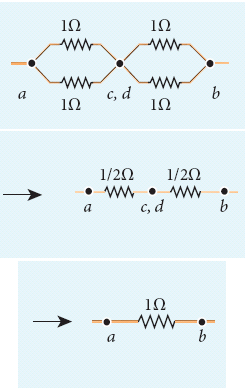
The equivalent resistance of the circuit between a and b is Req = 1Ω
16.
In all the sections, the resistors are connected in parallel.
Section I
\(\frac { 1 }{ { R }_{ { P }_{ 1 } } } =\frac { 1 }{ { R }_{ 1 } } +\frac { 1 }{ { R }_{ 2 } } \)
\(\frac { 1 }{ { R }_{ { P }_{ 1 } } } =\frac { 1 }{ 2 } +\frac { 1 }{ 2 } =\frac { 2 }{ 2 } \quad { R }_{ { p }_{ 1 } }=1\Omega \)
Section II
\(\frac { 1 }{ { R }_{ { P }_{ 1 } } } =\frac { 1 }{ 4 } +\frac { 1 }{ 4 } =\frac { 2 }{ 4 } ,\quad \frac { 1 }{ { R }_{ { P }_{ 2 } } } =\frac { 1 }{ 2 } ,{ R }_{ { p }_{ 2 } }=2\Omega \)
Section III
\(\frac { 1 }{ { R }_{ { P }_{ 3 } } } =\frac { 1 }{ 6 } +\frac { 1 }{ 6 } =\frac { 2 }{ 6 } \)
\(\frac { 1 }{ { R }_{ { P }_{ 3 } } } =\frac { 1 }{ 3 } ,{ R }_{ { p }_{ 3 } }=3\Omega \)
Equivalent resistance is given by
R = Rp1 + Rp2 + Rp3
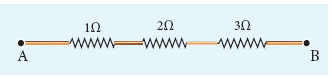
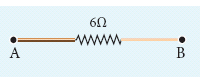
R = 1 Ω + 2 Ω + 3 Ω = 6 Ω
The circuit became,
Equivalent resistance between A and B is
17.
Rs = R1 + R2 = 15 Ω (1)
\({ R }_{ p }=\frac { { R }_{ 1 }{ R }_{ 2 } }{ { R }_{ 1 }{ +R }_{ 2 } } =\frac { 56 }{ 15 } \Omega \quad \) (2)
From equation (1) substituting for R1 + R2 in equation (2)
\(\frac { { R }_{ 1 }{ R }_{ 2 } }{ 15 } =\frac { 56 }{ 15 } \Omega \)
∴ R1R2 = 56
\({ R }_{ 2 }=\frac { 56 }{ 15 } \Omega \) (3)
Substituting for R2 in equation (1) from equation (3)
\({ R }_{ 1 }+\frac { 56 }{ { R }_{ 1 } } =15\)
Then, \(\frac { { R }_{ 1 }^{ 2 }+56 }{ { R }_{ 1 } } =15\)
R12 + 56 = 15 R1
R12 - 15 R1 + 56 = 0
The above equation can be solved using factorisation.
R1 = 8 Ω (or) R1 = 7 Ω
If (R1 = 8 Ω)
Substituting in equation (1)
8 + R2 = 15
R2 = 15 – 8 = 7 Ω ,
R2 = 7 Ω i.e , (when R1 = 8 Ω ; R2 = 7 Ω)
If R1= 7 Ω
Substituting in equation (1)
7 + R2 = 15
R2 = 8 Ω , i.e , (when R1 = 7 Ω ; R2 = 8 Ω )
18.
Since the resistances are connected in parallel, therefore, the equivalent resistance in the circuit is
\(\frac { 1 }{ { R }_{ p } } =\frac { 1 }{ { R }_{ 1 } } +\frac { 1 }{ { R }_{ 2 } } =\frac { 1 }{ 4 } +\frac { 1 }{ 6 } \)
\(\frac { 1 }{ { R }_{ p } } =\frac { 5 }{ 12 } \Omega \quad or\quad { R }_{ p }=\frac { 12 }{ 5 } \Omega \)
The resistors are connected in parallel, the potential difference (voltage) across them is the same.
\({ I }_{ 1 }=\frac { V }{ { R }_{ 1 } } =\frac { 24V }{ 4\Omega } =6A\)
\({ I }_{ 2 }=\frac { V }{ { R }_{ 2 } } =\frac { 24 }{ 6 } =4A\)
The current I is the sum of the currents in the two branches. Then,
I = I1 + I2 = 6 A + 4 A = 10 A
19.
Since the resistors are connected in series, the effective resistance in the circuit
= 4 Ω + 6 Ω = 10 Ω
The Current I in the circuit =\(\frac { V }{ { R }_{ eq } } =\frac { 24 }{ 10 } =2.4A\)
Voltage across 4Ω resistor
V1= IR1 = 2.4A x 4Ω = 9.6V
Voltage across 6 Ω resistor
V2 = IR2 = 2.4A x 6Ω = 14.4V
20.
In the first case, the resistance of the block
\({ R }_{ AB }=\rho \frac { length }{ Area } =\rho \frac { C }{ AB } \)
The current \({ I }_{ AB }=\frac { V }{ { R }_{ AB } } =\frac { V }{ \rho } .\frac { AB }{ C } \quad (1)\)
In the second case, the resistance of the block \({ R }_{ BC }=\rho \frac { A }{ BC } \)
The current \({ I }_{ BC }=\frac { V }{ { R }_{ BC } } =\frac { V }{ \rho } .\frac { BC }{ C } \quad (2)\)
To express IBC interms of IAB, we multiply and divide equation (2) by AC, we get
\({ I }_{ BC }=\frac { V }{ \rho } .\frac { BC }{ A } \frac { AC }{ AC } =\left( \frac { V }{ \rho } .\frac { AB }{ C } \right) .\frac { { C }^{ 2 } }{ { A }^{ 2 } } =\frac { { C }^{ 2 } }{ { A }^{ 2 } }.{ I }_{ AB }\)
Since C > A, the current IBC > IAB
21.
R1 = 20 Ω, R2 = ?
Let the original length of the wire (l1) be l.
New length, l2 = 8l1 (i.,e) l2 = 8l
Original resistance, R1 = \(\rho \frac { { l }_{ 1 } }{ { A }_{ 1 } } \)
New resistance R2 = \(\rho \frac { { l }_{ 2 } }{ { A }_{ 2 } } =\frac { \rho (8l) }{ { A }_{ 2 } } \)
Though the wire is stretched, its volume is unchanged.
Initial volume = Final volume
A1l1 = A2l2 , A1l = A2(8l)
\(\frac { { A }_{ 1 } }{ { A }_{ 2 } } =\frac { 8l }{ l } =8\)
By dividing equation R2 by equation R1, we get
\(\frac { { R }_{ 2 } }{ { R }_{ 1 } } =\frac { \rho (8l) }{ { A }_{ 2 } } \times \frac { { A }_{ 1 } }{ \rho l } \)
\(\frac { { R }_{ 2 } }{ { R }_{ 1 } } =\frac { { A }_{ 1 } }{ { A }_{ 2 } } \times 8\)
Substituting the value of \(\frac { { A }_{ 1 } }{ { A }_{ 2 } } \), we get
\(\frac { { R }_{ 2 } }{ { R }_{ 1 } } =8\times 8=64\)
R2 = 64 x 20 = 1280 Ω
Hence, stretching the length of the wire has increased its resistance.

12th Standard Syllabus & Materials
12th Standard
TN 12th Computer Applications களப்பெயர் முறைமை (DNS) Sample Question Papers Study Material - QB365 Set A
NEW12th Standard
TN 12th Computer Applications வலையமைப்பு எடுத்துக்காட்டுகள் மற்றும் நெறிமுறைகள் Sample Question Papers Study Material - QB365 Set A
NEW12th Standard
TN 12th Computer Applications கணினி வலையமைப்பு ஓர் அறிமுகம் Sample Question Papers Study Material - QB365 Set A
NEW12th Standard
TN 12th Computer Applications PHP-உடன் MySQL-ஐ இணைத்தல் Sample Question Papers Study Material - QB365 Set A



Tamilnadu Stateboard 12th Standard Subjects

Maths

Chemistry
Physics

Biology

Computer Science

Business Maths and Statistics

Economics

Commerce

Accountancy

History

Computer Applications
Biology
Computer Technology
Computer Applications
Computer Science
Business Maths and Statistics
Commerce
Economics
Maths
Chemistry
Physics
Computer Technology
History
Accountancy

Tamil

English

French
Tamilnadu Stateboard Standards

