
 100% FREE ACCESS
12th Standard Syllabus & Materials
12th Standard
TN 12th Computer Applications மின்னணு தரவு பரிமாற்றம் Sample Question Papers Study Material - QB365 Set A
NEW12th Standard
TN 12th Computer Applications மின் - வணிக பாதுகாப்பு அமைப்புகள் Sample Question Papers Study Material - QB365 Set A
NEW12th Standard
TN 12th Computer Applications மின்னணு செலுத்தல் முறைகள் Sample Question Papers Study Material - QB365 Set A
NEW12th Standard
TN 12th Computer Applications மின் - வணிகம் Sample Question Papers Study Material - QB365 Set A
NEW12th Standard
TN 12th Computer Applications திறந்த மூல கருத்துருக்கள் Sample Question Papers Study Material - QB365 Set A
NEW12th Standard
TN 12th Computer Applications வலையமைப்பு வடமிடல் Sample Question Papers Study Material - QB365 Set A

Published on: 02/09/2022
QB365 provides a detailed and simple solution for every Possible Book Back Questions in Class 12 Physics Subject - Retirement and Death of a Partner, English Medium. It will help Students to get more practice questions, Students can Practice these question papers in addition to score best marks.
Download Tamil Nadu 12th Standard Physics question papers, model tests, one-mark questions, important questions, and public exam papers in PDF format. Free study materials and answer keys for TN State Board students.
Questions + Answers key
Take MCQ Physics Test1.
The 300 turn primary of a transformer has resistance 0.82 Ω and the resistance of its secondary of 1200 turns is 6.2 Ω. Find the voltage across the primary if the power output from the secondary at 1600V is 32 kW. Calculate the power losses in both coils when the transformer efficiency is 80%.
2.
A 200V/120V step-down transformer of 90% efficiency is connected to an induction stove of resistance 40 Ω. Find the current drawn by the primary of the transformer.
3.
A step-down transformer connected to main supply of 220 V is used to operate 11V, 88W lamp. Calculate
(i) Voltage transformation ratio and
(ii) Current in the primary.
4.
The solenoids S1 and S2 are wound on an iron-core of relative permeability 900. The areas of their cross-section and their length are the same and are 4 cm2 and 0.04 m respectively. If the number of turns in S1 is 200 and that in S2 is 800. Calculate the mutual inductance between the solenoids. If the current in solenoid 1 is increased form 2A to 8A in 0.04 second. Calculate the induced emf in solenoid 2.
5.
A 200 turn circular coil of radius 2 cm is placed co-axially within a long solenoid of 3 cm radius. If the turn density of the solenoid is 90 turns per cm, then calculate mutual inductance of the coil and the solenoid.
6.
A long solenoid having 400 turns per cm carries a current 2A. A 100 turn coil of cross-sectional area 4 cm2 is placed co-axially inside the solenoid so that the coil is in the field produced by the solenoid. Find the emf induced in the coil if the current through the solenoid reverses its direction in 0.04 sec.
7.
Two air core solenoids have the same length of 80 cm and same cross-sectional area 5 cm2. Find the mutual inductance between them if the number of turns in the first coil is 1200 turns and that in the second coil is 400 turns.
8.
A coil of 200 turns carries a current of 0.4 A. If the magnetic flux of 4 mWb is linked with each turn of the coil, find the inductance of the coil.
9.
A 50 cm long solenoid has 400 turns per cm. The diameter of the solenoid is 0.04 m. Find the magnetic flux linked with each turn when it carries a current of 1 A.
10.
Obtain an expression for motional emf from Lorentz force.
11.
Find the instantaneous value of alternating voltage v = 10sin (3π x 104 t) volt at
i) 0 s
ii) 50 μs
iii) 75 μs.
12.
A 500 μH inductor, \(\\ \frac { 80 }{ { \pi }^{ 2 } } pF\) capacitor and a 628 Ω resistor are connected to form a series RLC circuit. Calculate the resonant frequency and Q-factor of this circuit at resonance.
13.
The current in an inductive circuit is given by 0.3 sin (200t – 40°) A. Write the equation for the voltage across it if the inductance is 40 mH.
14.
A series RLC circuit which resonates at 400 kHz has 80 μH inductors, 2000 pF capacitor and 50 Ω resistor. Calculate
(i) Q-factor of the circuit
(ii) the new value of capacitance when the value of inductance is doubled and
(iii) the new Q-factor.
15.
Find the impedance of a series RLC circuit if the inductive reactance, capacitive reactance and resistance are 184 Ω, 144 Ω and 30 Ω respectively.
16.
The equation for an alternating current is given by i = 77 sin 314t. Find the peak current, frequency, time period and instantaneous value of current at t = 2 ms.
17.
A capacitor of capacitance \(\frac { { 10 }^{ -4 } }{ \pi } F\), an inductor of inductance \(\frac { 2 }{ \pi } H\) and a resistor of resistance 100 Ω are connected to form a series RLC circuit. When an AC supply of 220 V, 50 Hz is applied to the circuit, determine
(i) the impedance of the circuit
(ii) the peak value of current flowing in the circuit
(iii) the power factor of the circuit and
(iv) the power factor of the circuit at resonance.
18.
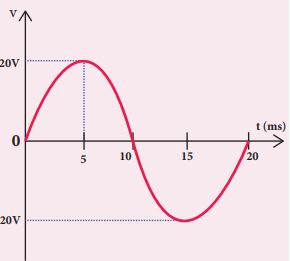
Write down the equation for a sinusoidal voltage of 50 Hz and its peak value is 20 V. Draw the corresponding voltage versus time graph.
19.
An inverter is common electrical device which we use in our homes. When there is no power in our house, inverter gives AC power to run a few electronic appliances like fan or light. An inverter has inbuilt step-up transformer which converts 12 V AC to 240 V AC. The primary coil has 100 turns and the inverter delivers 50 mA to the external circuit. Find the number of turns in the secondary and the primary current.
20.
An ideal transformer has 460 and 40,000 turns in the primary and secondary coils respectively. Find the voltage developed per turn of the secondary if the transformer is connected to a 230 V AC mains. The secondary is given to a load of resistance 104 Ω. Calculate the power delivered to the load.
21.
A rectangular coil of area 70 cm2 having 600 turns rotates about an axis perpendicular to a magnetic field of 0.4 Wb m–2. If the coil completes 500 revolutions in a minute, calculate the instantaneous emf when the plane of the coil is
(i) perpendicular to the field
(ii) parallel to the field and
(iii) inclined at 60o with the field.
22.
23.
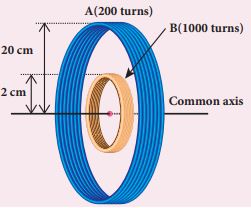
Consider two coplanar, co-axial circular coils A and B as shown in figure. The radius of coil A is 20 cm while that of coil B is 2 cm. The number of turns in coils A and B are 200 and 1000 respectively. Calculate the mutual inductance between the coils. If the current in coil A changes from 2 A to 6 A in 0.04 s, determine the induced emf in coil B and the rate of change of flux through the coil B at that instant.
24.
A solenoid of 500 turns is wound on an iron core of relative permeability 800. The length and radius of the solenoid are 40 cm and 3 cm respectively. Calculate the average emf induced in the solenoid if the current in it changes from 0 to 3 A in 0.4 second.
25.
A conducting rod of length 0.5 m falls freely from the top of a building of height 7.2 m at a place in Chennai where the horizontal component of Earth’s magnetic field is 4.04 × 10⁻⁵ T. If the length of the rod is perpendicular to Earth’s horizontal magnetic field, find the emf induced across the conductor when the rod is about to touch the ground. (Assume that the rod falls down with constant acceleration of 10 m s–2)
26.
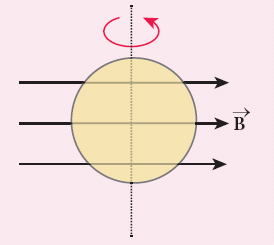
A circular loop of area 5 x 10⁻² m2 rotates in a uniform magnetic field of 0.2T. If the loop rotates about its diameter which is perpendicular to the magnetic field as shown in figure. Find the magnetic flux linked with the loop when its plane is
(i) normal to the field
(ii) inclined 60o to the field and
(iii) parallel to the field.
27.
What are step-up and step-down transformers?
1.
\(N_z=300, N_s=1200, R_p=0.82 \Omega, R_s=6.2 \Omega, \)
\(\text {Output power }=32 \mathrm{~kW}, \mathrm{~V}_{\mathrm{s}}=1600 \mathrm{~V}, \eta=80 \% \)
\(V_s I_s=32000 \mathrm{~W} \)
\(1600 \times I_s=32000 \)
\(\therefore I_s=\frac{32000}{1600} \)
\(I_s=20 \mathrm{~A}\) ......(1)
∴ Power loss in secondary coil \(P =I_{\mathrm{s}}^2 \times R_{\mathrm{s}} \) ......(2)
\(=(20)^2 \times 6.2 \)
\(=400 \times 6.2=2480.0 \)
\(=2480 \mathrm{~W}=2.48 \mathrm{~kW}\)
∴ Power loss in secondary coil P = 2.48 kW ......(3)
Efficiency \( \eta =\frac{V_s I_s}{V_P I_P} \)
\(\therefore \frac{80}{100} =\frac{32 \times 10^3}{V_P I_P} \)
\(\therefore V_P I_p =\frac{32 \times 10^3 \times 100}{80} \)
\(=\frac{3200 \times 10^3}{80} \)
\(V_P I_P =40 \times 10^3 \mathrm{~W}\) ......(4)
We know that, \(\frac{N_p}{N_s}=\frac{V_P}{V_S}\) ......(5)
\(\frac{300}{1200}=\frac{V_p}{1600} \Rightarrow V_p =\frac{300 \times 1600}{1200} \)
\(=400 \mathrm{~V}\) ......(6)
From (4), VpIp = 40 x 103
400 Ip = 40 x 103
\(\therefore I_p =\frac{40 \times 10^3} { 400}={100A} \)
∴ Power loss in the primary coil = I2pRp
= (100)2 x 0.82
= 104 x 0.82 = 8200 W
∴ Power loss in the primary coil = 8.2 kW
2.
Vp = 200 V; Vs = 120V;
Efficiency, η = 90% \(= \frac{90}{100}\)
Resistance, R = 40Ω;
Efficiency. \(\eta =\frac { { V }_{ s }{ I }_{ s } }{ { V }_{ p }{ I }_{ p } }\)
\(=\frac { 90 }{ 100 } = \frac{ 120 }{ 200 }\times \frac{I_s}{I_p}\)
\(=\frac { I_s }{ I_p } =\frac{90 \times 200}{120 \times 100}=\frac{18000}{12000}=\frac{3}{2}=1.5\)
\(\therefore I_p=\frac{I_s}{1.5}\)
\(But,{ I }_{ s }=\frac { 120 }{ 40} =3\)
\(\therefore I_p =\frac { 3}{1.5}=2A\)
Current drawn by the primary Ip = 2A
3.
Transformer ratio, \(\frac { { V }_{ s } }{ { V }_{ p } } =\frac { { N }_{ s } }{ N_p } \)
Here Vs = 11 V, Vr = 220 V, P = 88 W
(i) Voltage Transformation ratio = \(\frac { { V }_{ s } }{ { V }_{ p } } =\frac { { 11 } }{ 220 } \)
\(K =\frac { { 1 } }{ 20 } \)
(ii) Current in the primary, \(I_p =\frac { { P } }{ V_p } \)
\(=\frac { { 88 } }{220 } =\frac{4}{10}=0.4 A\)
∴ Ip = 0.4 A
4.
Relative permeability of an iron core = μr = 900
Area of cross-section, A1 = A2 = 4 x 10⁻⁴ m-2
Current in solenoid, \(\mathrm{I}=1_2-I_1=8-2=6 \mathrm{~A}, Length, l_1=l_2=4 \times 10^{-2} \mathrm{~m}=0.04 \mathrm{~m} \)
Number of turns in S1 = N1 = 200, Number of turns in S2 = N2 = 800,
\(\text {Mutual inductance } M =\frac{\mu_0 \mu, \mathrm{N}_1 \mathrm{~N}_2 A_2}{l} \)
\(\therefore M =\frac{4 \times 3.14 \times 10^{-7} \times 900 \times 200 \times 800 \times 4 \times 10^{-4}}{4 \times 10^{-2}} \)
M = 1.81 H
\(\text {Induced emf } e =-M \frac{d I}{d t} \)
\(=-1.81 \times \frac{6}{0.04}=-271.5 \mathrm{~V} \)
\(M=1.81 \mathrm{H}, \text { Induced } \mathrm{emf} e =-271.5 \mathrm{~V}\)
5.
No of turns of small solenoid, N2 = 200
Radius of small solenoid r = 2 cm = 2 x 10⁻² m
Area of small solenoid, A2= πr2 = 3.14 x 4 x 10-4 m2
Turn density of long solenoid, \(\frac { { N }_{ 1 } }{ l } =90\times10^2m^{-1}, M=?\)
M = μ0\(\frac { { N }_{ 1 } }{ l } \)N2A2
=4 x 3.14 x 10-7 x 90 x 102 x 200 x 3.14 x 4 x 10-4 = 2.84 x 10⁻³ H
M = 2.84 mH
6.
\(N_1 =4 \times 10^4, \mathrm{~N}_2=100, \mathrm{I}=2 \mathrm{~A}, \mathrm{~A}=4 \times 10^{-4} \mathrm{~m}^2 \)
\(\mathrm{t} =0.04 \mathrm{~s}, \mathrm{e}=? \)
\(\mathrm{~B} =\mu_0 \mathrm{n}_1 \mathrm{I}=\frac{\mu_0 \mathrm{~N}_1 \mathrm{I}}{l}=\frac{4 \pi \times 10^{-7} \times 4 \times 10^4 \times 2}{1} \)
\(\mathrm{~B} =100.48 \times 10^{-3} \mathrm{~T} \)
\(\phi =\mathrm{BA}=100.48 \times 10^{-3} \times 4 \times 10^{-4} \)
\(\therefore \phi_1 =\phi_2=\phi=401.92 \times 10^{-7} \mathrm{wb} \)
\(\mathrm{d} \phi =\phi_1-\left(-\phi_2\right)=2 \phi=2 \times 401.92 \times 10^{-7} \)
\(\therefore \mathrm{d} \phi =803.84 \times 10^{-7} \mathrm{wb}\)
EMF induced in the coil,
\(e=-N_2 \frac{d \phi}{d t} \)
\(e=\frac{-100 \times 803.84 \times 10^{-7}}{0.04}=-200.96 \times 10^{-3} \mathrm{~V}\)
\(e=-0.2 \mathrm{~V}\)
7.
μr = 1 (air core)
Length of two solenoids, \(l_1=l_2=80 \times 10^{-2} \mathrm{~m}\)
Cross-sectional area of two solenoids, \(A_1=A_2=5 \times 10^{-4} \mathrm{~m}^2\)
Number of turns in the first coll, N1=1200 turns
Number of turns in the second coil, N2 = 400 turns
\(n_1=\frac{N_1}{l}=\frac{1200}{80 \times 10^{-2}}=15 \times 10^{-2}=1500 \)
\(n_2=\frac{N_2}{l}=\frac{400}{80 \times 10^{-2}}=500\)
Mutual inductance, \(M= μ_0μ_r n_1 n_2 A_2 l\)
\(M =4 \times 3.14 \times 10^{-7} \times 1 \times 1500 \times 500 \times 5 \times 10^{-4} \times 80 \times 10^{-2} \)
\(=12.56 \times 10^{-7} \times 75 \times 10^4 \times 5 \times 10^{-4} \times 80 \times 10^{-2} \)
\(=3.76,800 \times 10^{-9}=0.376 \times 10^{-3} \mathrm{H}=0.376 \mathrm{mH} \)
\(=0.38 \mathrm{mH} \)
\(\therefore \text {Mutual inductance } =0.38 \mathrm{mH}\)
8.
Current, I = 0.4 A, Magnetic flux, Φ = 4 x 10⁻³ Wb, Number of turns, N = 200
Inductance, L = \(\frac { N\Phi }{ I }\)
\(L=\frac { 200\times 4\times 10^{ -3 } }{ 0.4 } =200 \times10^{-3+1}\)
= 200 x 10-2 = 2H.
∴ Inductance of the coil = 2 H.
9.
μ0 = 4π x 10-7 H/m, I = 1 A, n = 400 turns/cm = 40000 turns/m
Area A = πr2 = 3.14 x (0.02)2 = 12.56 x 10⁻⁴ m2
Magnetite flux of n turns of the coil, Φ =μ0nlA
4π x 10-7 x 40000 x 1x 12.56 x 10-4 = 4 x 3.14 x 4 x 12.56 x 10-7
Φ = 0.631 x 10⁻⁴ Wb
10.
(i) Consider a straight conducting rod AB of length I in a uniform magnetic field \(\vec { B } \) which is directed perpendicularly into the plane of the paper.
(ii) The length of the rod is normal to the magnetic field. Let the rod move with a constant velocity \(\vec { v } \) towards right side
(iii) When the rod moves, the free electrons present in it also move with same velocity \(\vec { v } \) in \(\vec { B } \). As a result, the Lorentz force acts on free electrons in the direction from B to A and is given by the relation
.JPG)
\({ \vec { F } }_{ B }=-e(\vec v\times \vec { B } )\)
(iv) The action of this Lorentz force is to accumulate the free electrons at the end A. This accumulation of free electrons produces a potential difference across the rod which in turn establishes an electric field \(\vec { E } \) directed along BA
(v) Due to the electric field \(\vec { E } \), the coulomb force starts acting on the free electrons along AB and is given by
\({ \vec { F } }_{ E }=-e\vec { F } \)
(vi) The magnitude of the electric field \(\vec { E } \) keeps on increasing as long as accumulation of electrons at the end A continues. The force \({ \vec { F } }_{ E }\) also increases until equilibrium is reached.
(vii) At equilibrium, the magnetic Lorentz force \({ \vec { F } }_{ B }\) and the coulomb force \({ \vec { F } }_{ E }\) balance each other and no further accumulation of free electrons at the end A takes place.
| \(\left| { \vec { F } }_{ B } \right| =\left| { \vec { F } }_{ E } \right| \) \(\left| -e(\vec { v } \times \vec { B } ) \right| =\left| -e\vec { E } \right| \) vB Sin 900 = E ⇒vB = E |
The potential difference between two ends of the rod is
V = El
V = vBl
Thus, the Lorentz force on the free electrons is responsible to maintain this potential difference and hence produces an emf
ε = Blv
As this emf is produced due to the movement of the rod, it is often called as motional emf. If the ends A and B are connected by an external circuit or total resistance R, then current \(i=\frac {ε}{R}=\frac{Blv}{R}\)flows in it. The direction of the current is found from right-hand thumb rule.
11.
The given equation is v = 10 sin ( 3π x 104 t)
(i) At t = 0 s,
v = 10 sin0o = 0
(ii) At t = 50 µs,
v = 10sin( 3π x 104 x 50 x 10-6)
= \(10 \sin \left(150 \pi \times 10^{-2} \times \frac{180^{\circ}}{\pi}\right)\)
= 10sin (270o) = 10 x -1
= -10V
(iii) At t = 75 µs,
\(v=10 \sin \left(3 \pi \times 10^{4} \times 75 \times 10^{-6}\right)\)
= \(10 \sin \left(225 \pi \times 10^{-2} \times \frac{180^{\circ}}{\pi}\right)\)
= 10sin (405o) = 10sin45o
= \(10 \times 1 / \sqrt{2}=7.07 \mathrm{~V}\)
12.
L = 500 x 10-6H; C\(=\frac { 80 }{ { \pi }^{ 2 } } \times { 10 }^{ -12 }F;R=628\Omega \)
(i) Resonant frequency is
\({ f }_{ r }=\frac { 1 }{ 2\pi \sqrt { LC } } =\frac { 1 }{ 2\pi \sqrt { 500\times { 10 }^{ -6 }\times \frac { 80 }{ { \pi }^{ 2 } } \times { 10 }^{ -12 } } } \)
\(=\frac { 1 }{ 2\sqrt { 40,000\times { 10 }^{ -18 } } } \)
\(=\frac { 10,000\times { 10 }^{ 3 } }{ 4 } = 2500\)
fr = 2500 KHz
(ii) Q–factor
\(=\frac { { \omega }_{ r }L }{ R } =\frac { 2\times 3.14\times 2500\times { 10 }^{ 3 }\times 500\times { 10 }^{ -6 } }{ 628 } \)
Q = 12.5
13.
L = 40 x 10-3 H; i = 0.3 sin (200t – 40o)
XL = ωL = 200 x 40 x 10-3 = 8 Ω
Vm = Im XL = 0.3 x 8 = 2.4 V
In an inductive circuit, the voltage leads the current by 90o Therefore,
v = Vmsin (ωt + 90o)
v = 2.4sin (200t - 40o + 90o)
v = 2.4sin (200t + 50o)volt
14.
L = 80 x 10-6H; C = 2000 x 10-12 F
R = 50 Ω; fr = 400 x 103Hz
(i) Q-factor, \(Q_1=\frac { 1 }{ R } \sqrt { \frac { L }{ C } } \)
=\(\frac { 1 }{ 50 } \sqrt { \frac { 80\times { 10 }^{ -6 } }{ 200\times 10^{ -12 } } } \)=4
(ii) When L2 = 2 L
= 2 x 80 x 10-6 H
= 160 x 10-6 H,
C2 = \(\frac { 1 }{ 4{ \pi }^{ 2 }{ f }_{ r }^{ 2 }{ L }_{ 2 } } \)
=\(\frac { 1 }{ 4\times 3.14^{ 2 }\times (400\times 10^{ 3 })^2\times 160\times 10^{ -6 } } \)
\(\simeq \) 1000 x 10-12 F
C2 = 1000 pF
(iii) Q2 = \(\frac { 1 }{ R } \sqrt { \frac { { L }_{ 2 } }{ { C }_{ 2 } } } =\frac { 1 }{ 50 } \sqrt { \frac { 160\times 10^{ -6 } }{ 1000\times 10^{ -12 } } } \)
= \(\frac { 1 }{ 50 } \sqrt { \frac { 16\times { 10 }^{ -5 } }{ { 10 }^{ -9 } } } =\frac { 4\times { 10 }^{ 2 } }{ 50 } \) = 8
15.
XL = 184 Ω; XC = 144 Ω
R = 30 Ω
(i ) The impedance is
\(Z=\sqrt { { R }^{ 2 }+{ \left( { X }_{ L }-{ X }_{ C } \right) }^{ 2 } } \)
\(=\sqrt { { 30 }^{ 2 }+{ (184-144) }^{ 2 } } \)
\(=\sqrt { 900+1600 } \)
Z = 50Ω
\(\text { (ii) } \phi =\tan ^{-1}\left(\frac{X_1-X_c}{R}\right) \)
\( \phi =\tan ^{-1}\left(\frac{184-144}{30}\right) \)
\(\phi =53.1^{\circ} \)
16.
i = 77 sin 314t ; t = 2 ms = 2 x 10⁻³ s
The general equation of an alternating current is i = Im sinωt. On comparison,
(i) Peak current, Im = 77A
(ii) Frequency, \(f=\frac { \omega }{ 2\pi } =\frac { 314 }{ 2\times 3.14 } =50Hz\)
(iii) Time period, \(T-\frac { 1 }{ f } =\frac { 1 }{ 50 } =0.02s\)
(iv) At t = 2 m s, Instantaneous current, i = 77sin(314 x 2 x 10−3)
\( =77 \sin \left(314 \times 2 \times 10^{-3} \times \frac{180^{\circ}}{3.14}\right) \)
\(=77 \sin 36^{\circ}=77 \times 0.5878 \)
= 45.26 A
17.
L = \(\frac { 2 }{ \pi } \)H; C = \(\frac { { 10 }^{ -4 } }{ \pi } F\); R = 100Ω
VRMS = 220 V; f = 50Hz
XL= 2πfl = 2π x 50 x \(\frac { 2 }{ \pi } \) = 200Ω
Xc = \(\frac { 1 }{ 2\pi fC } =\frac { 1 }{ 2\pi \times 50\times \frac { 10^{ -4 } }{ \pi } } 100 \Omega\)
(i) Impedance, Z = \(\sqrt { { R }^{ 2 }+({ X }_{ L }-{ X }_{ C })^2 } \)
=\(\sqrt { 100^{ 2 }+(200-100)^{ 2 } } \) = 141.4Ω
(ii) Peak value of current,
Im = \(\frac { { v }_{ m } }{ Z } =\frac { \sqrt { 2 } V_{ RMS } }{ Z } \)
= \(\frac { \sqrt { 2 } \times 220 }{ 141.4 } \) = 2.2 A
(iii) Power factor of the circuit
\(cos\phi =\frac { R }{ Z } =\frac { 100 }{ 141.4 } \)= 0.707
(iv) Power factor at resonance
\(cos\phi =\frac { R }{ Z } =\frac { R }{ R } \) = 1
18.
f = 50Hz ; Vm = 20V
Instantaneous voltage, υ = Vm sinωt
= Vm sin2πvt
= 20sin(2π x 50)t = 20sin(100 x 3.14)t
υ = 20sin 314t
Time for one cycle, \(T=\frac { 1 }{ f } =\frac { 1 }{ 50 } =0.02s\)
= 20 x 10−3 s = 20ms
The wave form is given below
19.
Vp = 12 V; Vs = 240 V
Is = 50 mA; Np = 100 turns
\(\frac { { V }_{ s } }{ { V }_{ P } } =\frac { { N }_{ s } }{ { N }_{ p } } =\frac { { I }_{ P } }{ { I }_{ S } } =K\)
Transformation ratio, K = \(\frac{240}{12}=20\)
The number of turns in the secondary
NS = NP x K = 100 x 20 = 2000
Primary current,
IP = K x Is = 20 x 50 mA = 1 A
20.
NP = 460 turns; NS = 40,000 turns
VP = 230 V; RS = 104 Ω
(i) Secondary voltage,
\({ V }_{ s }=\frac { { V }_{ p }{ N }_{ s } }{ { N }_{ p } } =\frac { 230\times 40,000 }{ 460 } \)
= 20,000V
Secondary voltage per turn,\(\frac { { V }_{ S } }{ { N }_{ S } } =\frac { 20,000 }{ 40,000 } =0.5V\)
(ii) Power delivered
= \({ V }_{ s }{ I }_{ s }=\frac { { V }_{ s }^{ 2 } }{ { R }_{ s } } =\frac { 20,000\times 20,000 }{ { 10 }^{ 4 } } =40kW\)
21.
A = 70 x 10-4m2; N = 600 turns
B = 0.4 Wbm-2; f = 500 rpm
The instantaneous emf is
ε = εmsinωt
since \({ \epsilon }_{ m }=N{ \Phi }_{ m }\omega =N(BA)(2\pi f)\)
ε = NBA x 2\(\pi\)f x sinωt
(i) When ωt = 0o,
ε = εm sin0 = 0
(ii) When ωt = 90o,
ε = εmsin90o = NBA x 2\(\pi\)f x 1
= 600 x 0.4 x 70 x 10-4 x 2 x \(\frac{22}{7}\times(\frac{500}{60})\)
= 88V
(iii) When ωt = 90° – 60° = 30°,
ε = εm sin30o = 88 x \(\frac{1}{2}\) = 44V
22.
23.
NA = 200 turns; NB = 1000 turns;
rA = 20 x 10-2 m; rB = 2 x 10⁻² m;
dt = 0.04 s; diA = 6−2 = 4A
Let iA be the current flowing in coil A, then the magnetic field BA at the centre of the circular coil A is
\({ B }_{ A }=\frac { { \mu }_{ o }{ N }_{ A }{ i }_{ A } }{ { 2r }_{ A } } =\frac { 4\pi \times { 10 }^{ -7 }{ N }_{ A }{ i }_{ A } }{ { 2r }_{ A } } \)
\(=\frac { { 10 }^{ -7 }\times 2\times 3.14\times 200 }{ 20\times { 10 }^{ -2 } } \times { i }_{ A }\)
= 6.28 x 10⁻⁴iA Wbm-2
The magnetic flux linkage of coil B is
\({ N }_{ B }{ \Phi }_{ B }={ N }_{ B }{ B }_{ A }{ A }_{ B }\)
= 1000 x 6.28 x 10-4 x iA x 3.14 x (2 x 10-2)2
= 7.89 x 10⁻⁴iAWb turns
The mutual inductance between the coils
\(\\ { M }=\frac { { N }_{ B }{ \Phi }_{ B } }{ { i }_{ A } } =7.89\times { 10 }^{ -4 }H\)
Induced emf in coil B is
εB = - M\(\frac { { di }_{ A } }{ dt } \)
εB = \(\frac { 7.89\times { 10 }^{ -4 }\times (6-2) }{ 0.04 } \)(magnitude only)
εB = 78.9mV
The rate of change of magnetic flux of coil B is
\(\frac { d\left( { N }_{ B }{ \Phi }_{ B } \right) }{ dt } ={ \epsilon }_{ B }=78.9m{ Wbs }^{ -1 }\)
24.
N = 500 turns; μr = 800;
l = 40 cm = 0.4 m; r = 3 cm = 0.03 m;
di = 3 – 0 = 3 A; dt = 0.4 s
Self inductance,
\(L=\mu { n }^{ 2 }Al\left( \because \mu ={ \mu }_{ o }{ \mu }_{ r };A={ \pi r }^{ 2 };n=\frac { N }{ l } \right) \)
\(=\frac { { \mu }_{ 0 }{ \mu }_{ r }{ N }^{ 2 }\pi { r }^{ 2 } }{ l } \)
\(=\frac { 4\times 3.14\times { 10 }^{ -7 }\times 800\times { 500 }^{ 2 }\times 3.14\times { (3\times 10 }^{ -2 }{ ) }^{ 2 } }{ 0.4 } \)
L=1.77H
Induced emf, ε = -L\(\frac{di}{dt}\)
\(=\frac{1.77\times3}{0.4}\)
ε = -13.275V
25.
l = 0.5 m; h = 7.2 m; u = 0 m s–1;
g = 10 m s–2; BH = 4.04 x 10⁻⁵ T
The final velocity of the rod is
V2 = u2 = + 2g h = 0 + (2 x 10 x 7.2) =144
v = 12 ms-1
The magnitude of the induced emf when the rod is about to touch the ground is
ε = BH lv = 4.04 × 10–5 × 0.5 × 12
= 242.4 µV
26.
A = 5 x 10⁻² m2; B = 0.2 T
(i) θ = 0°;
\({ \Phi }_{ B }=BAcos\theta =0.2\times 5\times { 10 }^{ -2 }\times { cos }0^{ o }\)
\({ \Phi }_{ B }=1\times { 10 }^{ -2 }Wb\)
(ii) θ = 90° – 60° = 30°;
\(\Phi_B\) = BAcosθ = 0.2 x 5 x 10-2 x cos 30o
\({ \Phi }_{ B }=1\times { 10 }^{ -2 }\times \frac { \sqrt { 3 } }{ 2 } =8.66\times { 10 }^{ -3 }Wb\)
(iii) θ = 90°;
\({ \Phi }_{ B }\) = BA cos90o = 0
27.
(i) If Ns>Np(K>1),thenVs>Vp and Is

12th Standard Syllabus & Materials
12th Standard
TN 12th Computer Applications களப்பெயர் முறைமை (DNS) Sample Question Papers Study Material - QB365 Set A
NEW12th Standard
TN 12th Computer Applications வலையமைப்பு எடுத்துக்காட்டுகள் மற்றும் நெறிமுறைகள் Sample Question Papers Study Material - QB365 Set A
NEW12th Standard
TN 12th Computer Applications கணினி வலையமைப்பு ஓர் அறிமுகம் Sample Question Papers Study Material - QB365 Set A
NEW12th Standard
TN 12th Computer Applications PHP-உடன் MySQL-ஐ இணைத்தல் Sample Question Papers Study Material - QB365 Set A



Tamilnadu Stateboard 12th Standard Subjects

Maths

Chemistry
Physics

Biology

Computer Science

Business Maths and Statistics

Economics

Commerce

Accountancy

History

Computer Applications
Biology
Computer Technology
Computer Applications
Computer Science
Business Maths and Statistics
Commerce
Economics
Maths
Chemistry
Physics
Computer Technology
History
Accountancy

Tamil

English

French
Tamilnadu Stateboard Standards

