
 100% FREE ACCESS
12th Standard Syllabus & Materials
12th Standard
TN 12th Maths Applications of Matrices and Determinants Sample Question Papers Study Material - QB365 Set A
NEW12th Standard
TN 12th Computer Applications மின்னணு தரவு பரிமாற்றம் Sample Question Papers Study Material - QB365 Set A
NEW12th Standard
TN 12th Computer Applications மின் - வணிக பாதுகாப்பு அமைப்புகள் Sample Question Papers Study Material - QB365 Set A
NEW12th Standard
TN 12th Computer Applications மின்னணு செலுத்தல் முறைகள் Sample Question Papers Study Material - QB365 Set A
NEW12th Standard
TN 12th Computer Applications மின் - வணிகம் Sample Question Papers Study Material - QB365 Set A
NEW12th Standard
TN 12th Computer Applications திறந்த மூல கருத்துருக்கள் Sample Question Papers Study Material - QB365 Set A

Published on: 01/09/2022
QB365 provides a detailed and simple solution for every Possible Book Back Questions in Class 12 Physics Subject - Magnetism and Magnetic Effects of Electric Current, English Medium. It will help Students to get more practice questions, Students can Practice these question papers in addition to score best marks.
Download Tamil Nadu 12th Standard Physics question papers, model tests, one-mark questions, important questions, and public exam papers in PDF format. Free study materials and answer keys for TN State Board students.
Questions + Answers key
Take MCQ Physics Test1.
Calculate the magnetic field at the centre of a square loop which carries a current of 1.5 A, length of each side being 50 cm.
2.
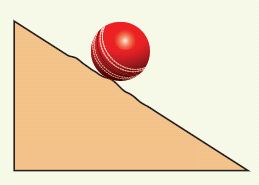
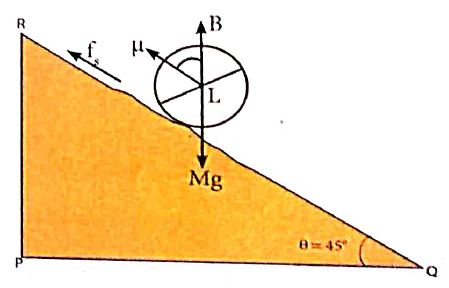
A non - conducting sphere has a mass of 100 g and radius 20 cm. A flat compact coil of wire with turns 5 is wrapped tightly around it with each turns concentric with the sphere. This sphere is placed on an inclined plane such that plane of coil is parallel to the inclined plane. A uniform magnetic field of 0.5 T exists in the region in vertically upward direction. Compute the current I required to rest the sphere in equilibrium.
3.
A bar magnet is placed in a uniform magnetic field whose strength is 0.8 T. If the bar magnet is oriented at an angle 30o with the external field experiences a torque of 0.2 Nm. Calculate
(i) the magnetic moment of the magnet
(ii) the work done by the applied force in moving it from most stable configuration to the most unstable configuration and also compute the work done by the applied magnetic field in this case.
4.
The coil of a moving coil galvanometer has 5 turns and each turn has an effective area of 2 x 10⁻² m2. It is suspended in a magnetic field whose strength is 4 x 10⁻² Wb m–2. If the torsional constant K of the suspension fibre is 4 x 10⁻⁹ N m deg–1.
(a) Find its current sensitivity in division per microampere.
(b) Calculate the voltage sensitivity of the galvanometer for it to have full scale deflection of 50 divisions for 25 mV.
(c) Compute the resistance of the galvanometer
5.
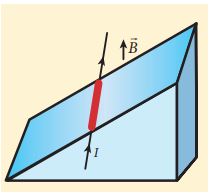
A metallic rod of linear density is 0.25 kg m–1 is lying horizontally on a smooth inclined plane which makes an angle of 45o with the horizontal. The rod is not allowed to slide down by flowing a current through it when a magnetic field of strength 0.25 T is acting on it in the vertical direction. Calculate the electric current flowing in the rod to keep it stationary.
6.
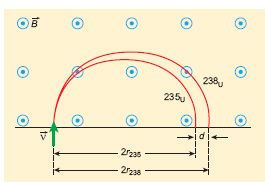
Two singly ionized isotopes of uranium \(_{ 92 }^{ 235 }{ U \ and \ _{ 92 }^{ 238 }{ U } }\) (isotopes have same atomic number but different mass number) are sent with velocity 1.00 x 10⁵ m s–1 into a magnetic field of strength 0.500 T normally. Compute the distance between the two isotopes after they complete a semi-circle. Also, compute the time taken by each isotope to complete one semi-circular path. (Given: masses of the isotopes: m235 = 3.90 x 10⁻²⁵ kg and m238 = 3.95 x 10⁻²⁵ kg)
7.
A proton moves in a uniform magnetic field of strength 0.500 T magnetic field is directed along the x - axis. At initial time, t = 0s, the proton has velocity
\(\hat { v } =(1.95\times { 10 }^{ -5 }\hat { i } +2.00\times { 10 }^{ 5 }\hat { k } )m{ s }^{ -1 }\). Find
(a) At initial time, what is the acceleration of the proton.
(b) Is the path circular or helical? If helical, calculate the radius of helical trajectory and also calculate the pitch of the helix (Note: Pitch of the helix is the distance travelled along the helix axis per revolution).
8.
An electron moving perpendicular to a uniform magnetic field 0.500 T undergoes circular motion of radius 2.50 mm. What is the speed of electron?
9.
Compute the work done and power delivered by the Lorentz force on the particle of charge q moving with velocity \(\vec { v } \). Calculate the angle between Lorentz force and velocity of the charged particle and also interpret the result.
10.
Calculate the magnetic field inside a solenoid, when
(a) the length of the solenoid becomes twice with fixed number of turns
(b) both the length of the solenoid and number of turns are doubled
(c) the number of turns becomes twice for the fixed length of the solenoid.
Compare the results.
11.
Compute the intensity of magnetisation of the bar magnet whose mass, magnetic moment and density are 200 g, 2 A m2 and 8 g cm–3, respectively.
12.
A coil of a tangent galvanometer of diameter 0.24 m has 100 turns. If the horizontal component of Earth’s magnetic field is 25 x 10–6 T then, calculate the current which gives a deflection of 60o .
13.
Consider a magnetic dipole which on switching ON external magnetic field orient only in two possible ways i.e., one along the direction of the magnetic field (parallel to the field) and another anti-parallel to magnetic field. Compute the energy for the possible orientation.
14.
A short bar magnet has a magnetic moment of 0.5 J T–1. Calculate magnitude and direction of the magnetic field produced by the bar magnet which is kept at a distance of 0.1 m from the centre of the bar magnet along
(a) axial line of the bar magnet and
(b) normal bisector of the bar magnet.
15.
How is a galvanometer converted into (i) an ammeter and (ii) a voltmeter?
16.
State Biot-Savart’s law.
17.
1.
The magnetic field at the centre of a square loop due to either arm is
\( \mathrm{B}_{1}=\frac{\mu_{o}}{4 \pi}\left(\frac{I}{L / 2}\right)\left(\sin \phi_{1}+\sin \phi_{2}\right) \)
\(Here, \ \phi_{1}=\phi_{2}=45^{\circ}\)
\(\therefore B_{1} =\frac{\mu_{o}}{4 \pi} \times \frac{2 I}{L}\left[\sin 45^{\circ}+\sin 45^{\circ}\right] \)
\(=\frac{\mu_{o}}{4 \pi} \times \frac{2 I}{L}\left[\frac{1}{\sqrt{2}}+\frac{1}{\sqrt{2}}\right] \)
\(B_{1} =\frac{\mu_{o}}{4 \pi} \times \frac{2 I}{L} \times\left(\frac{2}{\sqrt{2}}\right)=\frac{\mu_{0}}{4 \pi} \times 2 \frac{\sqrt{2} I}{L} \)
\(\therefore B_{1} =\frac{\mu_{o}}{4 \pi L} \times(2 \sqrt{2}) I \) .....(1)
Magnetic field at the centre of a square loop carrying a current I
\({B}=4 B_{1}=4 \times \frac{\mu_{o}}{4 \pi} \times \frac{2 \sqrt{2} I}{L}\)
\({B}=\frac{\mu_{o}}{\pi} \times \frac{2 \sqrt{2} I}{L}\) .........(2)
Substituting I = 1.5 and l = 50 x 10-2 m in the equations (2) we get
\(B =\frac{4 . \pi \times 10^{-7}}{\pi} \times 2 \sqrt{2} \times \frac{1.5}{50 \times 10^{-2}} \)
\(=8 \sqrt{2} \times 10^{-7} \times 0.03 \times 10^{2} \)
\(=8 \sqrt{2} \times 10^{-7} \times 3 \times 10^{-2} \times 10^{2} \)
\(=24 \sqrt{2} \times 10^{-7} \)
\(=24 \times 1.414 \times 10^{-7}=33.936 \times 10^{-7} \mathrm{~T} \)
\(\mathrm{~B} =3.3936 \times 10^{-6} \mathrm{~T} \)
∴ Magnetic field B = 3.4 x 10⁻⁶ T
2.
M = 100 g = 100 x 10-3 kg
M = 0.1 kg
g = 10 m/s2
N = 5
B = 0.5 T
R = 20 cm = 20 x 10-2 m
When, the sphere is in translational equilibrium
\(\mathrm{f}_{\mathrm{s}}-\mathrm{Mg} \sin \theta =0 \ldots(1) \)
\(\mathrm{f}_{\mathrm{s}} =\mathrm{Mg} \sin \theta \)
When, the sphere is in rotational equilibrium,
Torque ፒ = μB sin θ
For Equilibrium, fsR - ፒ = 0
\(f_{s} R-\mu B \sin \theta=0 \ldots(2)\)
eqn (1) subs. eqn (2)
\(M g \sin \theta R-\mu B \sin \theta =0 \)
\(\sin \theta(M g R-\mu B) =0 \)
\(M g R =\mu B \)
\(\text { Now } \mu =N I \pi R^{2} \)
\(\therefore \operatorname{MgR} =N I \pi R^{2} B \)
\(\therefore I =\frac{M g}{N \pi R B} \)
\(I =\frac{0.1 \times 10}{5 \times \pi \times 20 \times 10^{-2}\times 0.5 }\)
\(=\frac{1}{\pi \times 50 \times 10^{-2}}=\frac{1 \times 10^{2}}{\pi \times 50}=\frac{100}{\pi \times 50}\)
\(\mathbf{I} =2 / \pi \mathrm{A} \)
3.
Uniform magnetic field B = 0.8 T
Angle of orientation θ = 30°
Torque, ፒ = 0.2 Nm.
(i) We know that torque ፒ = PmB sinθ
\(0.2=p_\mathrm{m} \times 0.8 \times \sin 30^{\circ} \)
\(0.2=p_\mathrm{m} \times 0.8 \times \frac{1}{2} \)
0.2 = 0.4 pm
\(p_m=\frac{0.2}{0.4}=0.5 \mathrm{Am}^{2}\)
(ii) Work done by the applied force to move the magnet from stable to unstable position.
\(\mathrm{W} =-p_\mathrm{m}B\left[\cos \theta_{2}-\cos \theta_{1}\right] \)
\(\mathrm{W} =-p_\mathrm{m}B\left(\cos 180^{\circ}-\cos 0^{\circ}\right) \)
\(\mathrm{W} =-p_\mathrm{m}B(-1-1)=2 \mathrm{p_mB} \)
\(\mathrm{W} =2 \times 0.5 \times 0.8=\mathbf{0 . 8} \mathbf{J} \)
Work done by the applied magnetic field are in opposite direction
\(\mathbf{W}_{\text {mag }}=-0.8 \mathrm{J}\)
4.
N = 5 turns
A = 2 x 10⁻² m2
B = 4 x 10⁻² Wb m-2
K = 4 x 10⁻⁹ N m deg-1
(a) Current sensitivity
\({ I }_{ s }=\frac { NAB }{ K } =\frac { 5\times 2\times { 10 }^{ -2 }\times 4\times { 10 }^{ -2 } }{ 4\times 10^{ -9 } } \)
= 106 divisions per ampere
\(I\mu A=\) 1microambire =10-6ampere
Therefore,
\({ I }_{ s }={ 10 }^{ 6 }\frac { div }{ A } =1\frac { div }{ { 10 }^{ -6 }A } =1\frac { div }{ \mu A } \)
\({ I }_{ s }=1div{ \left( \mu A \right) }^{ -1 }\)
(b) Voltage sensitivity
\({ V }_{ s }=\frac { \theta }{ V } =\frac { 50div }{ 25mv } =2\times { 10 }^{ 3 }{ div \ V }^{ -1 }\)
(c) The resistance of the galvanometer is
\({ R }_{ g }=\frac { { I }_{ s } }{ { v }_{ s } } =\frac { { 10 }^{ 6 }\frac { div }{ A } }{ { 2\times }10^{ 6 }\frac { div }{ V } } =0.5\times { 10 }^{ 3 }\frac { V }{ A } =0.5k\Omega \)
5.
The linear density of the rod i.e., mass per unit length of the rod is 0.25 kg m-1
\(\Rightarrow \frac { m }{ 1 } =0.25kg \ { m }^{ -1 }\)
Let I will be the current flowing in the metallic rod. The direction of the electric current is in the paper. The direction of magnetic force IBl is given by Fleming’s left-hand rule.
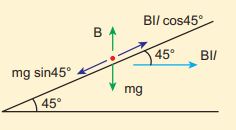
For equilibrium of the rod,
mg sin 45° = IBI cos45°
\(\Rightarrow 1=\frac { 1 }{ B } \frac { m }{ l } g \tan45°\)
\(=\frac { 0.25kg{ m }^{ -1 } }{ 0.25T } \times 1\times 9.8{ ms }^{ -2 }\)
\(\Rightarrow \) 1 = 9.8A
So, we need to supply current of 9.8 A to keep the metallic rod stationary.
6.
Since isotopes are singly ionized, they have equal charge which is equal to the charge of an electron, q = - 1.6 x 10⁻¹⁹ C. Mass of uranium \(_{ 92 }^{ 235 }{ U and _{ 92 }^{ 238 }{ U } }\) are 3.90 x 10⁻²⁵ kg and 3.95 x 10⁻²⁵ kg respectively. Magnetic field applied, B = 0.500 T. Velocity of the electron is 1.00 x 10⁵ m s-1, then
(a) the radius of the path of \(_{ 92 }^{ 235 }{ U }\) is r235
\({ r }_{ 235 }=\frac { { m }_{ 235 }v }{ \left| q \right| B } =\frac { 3.90\times { 10 }^{ -25 }\times 1.00\times { 10 }^{ 5 } }{ 1.6\times { 10 }^{ -19 }\times 0.500 } =48.8\times { 10 }^{ -2 }m\)
r235 = 48.8cm
The diameter of the semi-circle due to \(_{ 92 }^{ 235 }{ U\ \ is \ \ { d }_{ 235 }=2{ r }_{ 235 } }\) = 97.6 cm
The radius of the path of \(_{ 92 }^{ 238 }{ U\ is\ 2{ r }_{ 238 }\ then}\)
\({ r }_{ 238 }=\frac { { m }_{ 238 }v }{ \left| q \right| B } =\frac { 3.90\times { 10 }^{ -25 }\times 1.00\times { 10 }^{ 5 } }{ 1.6\times { 10 }^{ -19 }\times 0.500 } =49.4\times { 10 }^{ -2 }m\)
r238 = 49.4 cm
The diameter of the semi-circle due to \(^{ 238 }_{92}{ U\ is \ 2{ r }_{ 238 } \ =98.8 \ cm}\)
Therefore the separation distance between the isotopes is \(\triangle d={ d }_{ 238 }-{ d }_{ 235 }=1.2 \ cm\)
(b) The time taken by each isotope to complete one semi-circular path are
\({ t }_{ 235 }=\frac { \text{ magnitude of the displacement} }{ velocity } \)
\(=\frac { 97.6\times { 10 }^{ -2 } }{ 1.00\times { 10 }^{ 5 } } =9.76\times { 10 }^{ -6 }s=9.76\mu s\)
\({ t }_{ 238 }=\frac { \text{magnitude of the displacement }}{ velocity } \)
\(=\frac { 98.8\times { 10 }^{ -2 } }{ 1.00\times { 10 }^{ 5 } } =9.88\times { 10 }^{ -6 }s=9.88\mu s\)
7.
Magnetic field \(\overset { \rightarrow }{ B } ={ 0.500\hat { i } T } \)
Velocity of the particle
\(\hat { v } \) = (1.95 x 10⁵\(\hat { i } \) + 2.00 x 10⁵\(\hat { k } \)) ms-1
Charge of the proton q = 1.67 x 10⁻¹⁹ C
Mass of the proton m = 1.67 x 10⁻²⁷kg
(a) The force experienced by the proton is \(\overset { \rightarrow }{ F } \) = q(\(\overset { \rightarrow }{ v } \) x \(\overset { \rightarrow }{ B } \) )
= 160 x 10-19 x ((1.95 x 10⁵\(\hat { i } \) + 2.00 x 10⁵\(\hat { k } \)) x (0.500 \(\hat { i } \)))
\(\overset { \rightarrow }{ F } \)= 1.60 x 10⁻¹⁴ \(\hat { j } \) N
Therefore, from Newton’s second law,
\(\overset { \rightarrow }{ a } =\frac { 1 }{ m } \overset { \rightarrow }{ F } =\frac { 1 }{ 1.67\times { 10 }^{ -27 } } (1.60\times { 10 }^{ -14 })\hat j\)
\(=9.58\times { 10 }^{ 12 }\hat jm{ s }^{ -2 }\)
(b) Trajectory is helical Radius of helical path is
\(R=\frac { { mv }_{ z } }{ \left| q \right| B } =\frac { 1.67\times { 10 }^{ -27 }\times 2.00\times { 10 }^{ 5 } }{ 1.60\times { 10 }^{ -19 }\times 0.500 } \)
= 4.175 x 10⁻³m = 4.18mm
Pitch of the helix is the distance travelled along x-axis in a time T, which is P = vx T
But time, \(T=\frac { 2\pi }{ \omega } =\frac { 2\pi m }{ \left| q \right| B } =\frac { 2\times 3.14\times 1.67\times { 10 }^{ -27 } }{ 1.60\times 1{ 0 }^{ -19 }\times 0.500 } =13.1\times { 10 }^{ -8 }s\)
Hence, pitch of the helix is
\(p={ v }_{ x }T=(1.95\times { 10 }^{ 5 })(13.1\times { 10 }^{ -8 })=25.5\times { 10 }^{ -3 }m=25.5mm\)
The proton experiences appreciable acceleration in the magnetic field, hence the pitch of the helix is almost six times greater than the radius of the helix.
8.
Charge of an electron q = –1.60 × 10⁻¹⁹ C ⇒ |q| = 1 60 x 10-19 C
Magnitude of magnetic field B = 0.500 T
Mass of the electron, m = 9.11 × 10⁻³¹ kg
Radius of the orbit, r = 2.50 mm = 2.50 × 10⁻³ m
Speed of the electron, V = \(q \frac{\mathrm{rB}}{\mathrm{m}}\)
\( v = 1.60 \times 10^{-19} \times\frac{ 2.50 \times 10^{-3} \times 0.500}{9.11 \times 10^{-31}}\)
\(v=2.195 \times 10^8 \mathrm{~m} \mathrm{s} ^{-1}\)
9.
For a charged particle moving on a magnetic field, \(\vec { F } \)= q(\(\vec { v } \)x\(\vec { B } \))
The work done by the magnetic field is
\(W=\int { \overset { \rightarrow }{ F } .{ d \vec r } =\int { \overset { \rightarrow }{ F } .\overset { \rightarrow }{ v } dt } } \)
\(W=q\int { \left( \overset { \rightarrow }{ v } \times \overset { \rightarrow }{ B } \right) } .\overset { \rightarrow }{ v } dt=0\)
Since \(\overset { \rightarrow }{ v } \times \overset { \rightarrow }{ B } \) is perpendicular to \(\vec { v } \) and hence \(\left( \overset { \rightarrow }{ v } \times \overset { \rightarrow }{ B } \right) .\overset { \rightarrow }{ v } =\overset { \rightarrow }{ 0 } \)
This means that Lorentz force does no work on the particle. From work-kinetic energy theorem, (Refer section 4.2.6, XI th standard Volume I)
\(\frac { dw }{ dt } =p=0\)
Since \(\overset { \rightarrow }{ F } .\overset { \rightarrow }{ v } =0\Rightarrow \overset { \rightarrow }{ F } \ and \ \overset { \rightarrow }{ v } \) are perpendicular to each other. The angle between Lorentz force and velocity of the charged particle is 90o. Thus Lorentz force changes the direction of the velocity but not the magnitude of the velocity. Hence Lorentz force does no work and also does not alter kinetic energy of the particle.
10.
The magnetic field of a solenoid (inside) is
\({ B }_{ L,N }=\mu _{ ° }\frac { NI }{ L } \)
(a) length of the solenoid becomes twice and fixed number of turns
L → 2L (length becomes twice)
N → N (number of turns remains constatnt)
The magnetic field is
\({ B }_{ L,N }=\mu _{ ° }\frac { NI }{ 2L } =\frac { 1 }{ 2 } { B }_{ L,N }\)
(b) both the length of the solenoid and number of turns are doubled
L → 2L (length becomes twice)
N → 2N (number of turns becomes twice)
The magnetic field is
\({ B }_{2 L,2N }=\mu _{ ° }\frac { 2NI }{ 2L } ={ B }_{ L,N }\)
(c) the number of turns becomes twice but the fixed length of the solenoid
L → L (length is fixed)
N → 2N (number of turns becomes twice)
The magnetic field is
\({ B }_{ L,2N }=\mu _{ ° }\frac { 2NI }{ L } ={ 2B }_{ L,N }\)
From the above results,
\({ B }_{ L,2N }>{ B }_{ 2L,2N }>{ B }_{ 2L,N }\)
Thus, strength of the magnetic field is increased when we pack more loops into the same length for a given current.
11.
Density of the magnet is
Density = \(\frac { Mass }{ volume } \Rightarrow Volume=\frac { Mass }{ Density } \)
\(Volume=\frac { 200\times 1{ 0 }^{ -3 }kg }{ \left( 8\times 1{ 0 }^{ -3 }kg \right) \times 1{ 0 }^{ 6 }{ m }^{ -3 } } =25\times { 10 }^{ -6 }{ m }^{ 3 }\)
Magnitude of magnetic moment pm = 2A m2
Intensity of magnetization,
\(I=\frac { magnetic\ moment }{ Volume } =\frac { 2 }{ 25\times { 10 }^{ -6 } } \)
M = 0.8 x 10⁵ Am-1
12.
The diameter of the coil is 0.24 m. Therefore, radius of the coil is 0.12 m.
Number of turns is 100 turns. Earth’s magnetic field is 25 x 10-6 T
Deflection is
\(\theta =60°\Rightarrow tan60°=\sqrt { 3 } =1.732\)
\(I=\frac { 2R{ B }_{ H } }{ { \mu }_{ ° }N } tan\theta \)
\(=\frac { 2\times 0.12\times 25\times 1{ 0 }^{ -6 } }{ 4\times 1{ 0 }^{ -7 }\times 3.14\times 100 } \times 1.732=0.82\times 1{ 0 }^{ -1 }A\)
I = 0.082 A
13.
Let \(\vec{p}_m\)be the dipole and before switching ON the external magnetic field, there is no orientation. Therefore, the energy U = 0.
As soon as external magnetic field is switched ON, the magnetic dipole orient parallel (θ = 0o) to the magnetic field with energy,
Uparallel = Uminimum = -pmBcos 0
Uparallel = -pmB
since cos 0o = 1
Otherwise, the magnetic dipole orients anti-parallel (θ = 180o) to the magnetic field with energy,
U anti-parallel = U maximum = -pmBcos 180
\(\Rightarrow \) Uanti-parallel = PmB
since cos 180o = -1
14.
Given magnetic moment 0.5 J T-1 and distance r = 0.1 m
(a) When the point lies on the axial line of the bar magnet, the magnetic field for short magnet is given by
\({ { \vec B }_{ axial } } =\frac { { \mu }_{ ° } }{ 4\pi } \left( \frac { 2{ p }_{ m } }{ { r }^{ 3 } } \right) \hat { i } \)
\({ { \vec B }_{ axial } } =1{ 0 }^{ -7 }\times \left( \frac { 2\times 0.5 }{ { \left( 0.1 \right) }^{ 3 } } \right) =1\times { 10 }^{ -4 }\hat { i } \ T\)
Hence, the magnitude of the magnetic field along axial is Baxial = 1 x 10⁻⁴ T and direction is towards South to North.
(b) When the point lies on the normal bisector (equatorial) line of the bar magnet, the magnetic field for short magnet is given by
\({ {\vec B }_{ equatorial } } =-\frac { { \mu }_{ ° } }{ 4\pi } \frac { { p }_{ m } }{ { r }^{ 3 } } \hat { i } \)
\({ {\vec B }_{ equatorial } } =-1{ 0 }^{ -7 }\left( \frac { 0.5 }{ { \left( 0.1 \right) }^{ 3 } } \right) \hat { i } =-0.5\times 1{ 0 }^{ -4 }\hat { i } \ T \)
Hence, the magnitude of the magnetic field along axial is Bequatorial = 0.5 x 10⁻⁴ T and direction is towards North to South.
Note that magnitude of Baxial is twice that of magnitude of Bequatorial and the direction of Baxial and Bequatorial are opposite.
15.
(i) A galvanometer is converted into an ammeter by connecting a low resistance in parallel with the galvanometer.
(ii) A galvanometer is converted into a volmeter by connecting high resistance Rs in series with the galvanometer.
16.
Biot-Savart's law states that, the magnitude of magnetic field \(d\vec { B } \) at a point P at a distance of r from the small elemental length taken on a conductor carrying current varies
(i) directly as the strength of the current I
(ii) directly as the magnitude of the length of element \(\vec { dl } \)
(iii) directly as the sine of the angle θ between \(\vec { dl } \) and \(\hat { r } \).
(iv) inversely as the square of the distance r between the point P and length of element \(\vec { dl } \).
\(d\vec { B } =\frac { { \mu }_{ 0 } }{ 4\pi } \frac { I\vec { dl } \times \hat { r } }{ { r }^{ 2 } } \)
17.

12th Standard Syllabus & Materials
12th Standard
TN 12th Computer Applications வலையமைப்பு வடமிடல் Sample Question Papers Study Material - QB365 Set A
NEW12th Standard
TN 12th Computer Applications களப்பெயர் முறைமை (DNS) Sample Question Papers Study Material - QB365 Set A
NEW12th Standard
TN 12th Computer Applications வலையமைப்பு எடுத்துக்காட்டுகள் மற்றும் நெறிமுறைகள் Sample Question Papers Study Material - QB365 Set A
NEW12th Standard
TN 12th Computer Applications கணினி வலையமைப்பு ஓர் அறிமுகம் Sample Question Papers Study Material - QB365 Set A



Tamilnadu Stateboard 12th Standard Subjects

Maths

Chemistry
Physics

Biology

Computer Science

Business Maths and Statistics

Economics

Commerce

Accountancy

History

Computer Applications
Biology
Computer Technology
Computer Applications
Computer Science
Business Maths and Statistics
Commerce
Economics
Maths
Chemistry
Physics
Computer Technology
History
Accountancy

Tamil

English

French
Tamilnadu Stateboard Standards

