
 100% FREE ACCESS
12th Standard Syllabus & Materials
12th Standard
TN 12th Computer Applications மின்னணு தரவு பரிமாற்றம் Sample Question Papers Study Material - QB365 Set A
NEW12th Standard
TN 12th Computer Applications மின் - வணிக பாதுகாப்பு அமைப்புகள் Sample Question Papers Study Material - QB365 Set A
NEW12th Standard
TN 12th Computer Applications மின்னணு செலுத்தல் முறைகள் Sample Question Papers Study Material - QB365 Set A
NEW12th Standard
TN 12th Computer Applications மின் - வணிகம் Sample Question Papers Study Material - QB365 Set A
NEW12th Standard
TN 12th Computer Applications திறந்த மூல கருத்துருக்கள் Sample Question Papers Study Material - QB365 Set A
NEW12th Standard
TN 12th Computer Applications வலையமைப்பு வடமிடல் Sample Question Papers Study Material - QB365 Set A

Published on: 02/09/2022
QB365 provides a detailed and simple solution for every Possible Book Back Questions in Class 12 Physics Subject - Retirement and Death of a Partner, English Medium. It will help Students to get more practice questions, Students can Practice these question papers in addition to score best marks.
Download Tamil Nadu 12th Standard Physics question papers, model tests, one-mark questions, important questions, and public exam papers in PDF format. Free study materials and answer keys for TN State Board students.
Questions + Answers key
Take MCQ Physics Test1.
Obtain the equation for lateral magnification of thin lens.
2.
Arrive at lens equation from lens maker’s formula.
3.
What are critical angle and total internal reflection?
4.
5.
A beam of light of wavelength 600 nm from a distance source falls on a single slit 1.00 mm wide and the resulting diffraction pattern is observed on a screen 2 m away, what is the distance between the first dark fringes on either side of the central bright fringe?
6.
Why is yellow light preferred to during fog?
7.
It is possible for two lenses to produce zero power?
8.
Light ray falls at normal incidence on the first face and emerges gracing the second face for an equilateral prism.
(a) What is the angle of deviation produced?
(b) What is the refractive index of the material of the prism?
9.
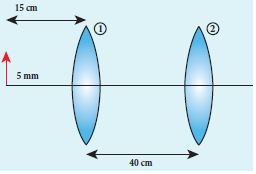
An object of 5 mm height is placed at a distance of 15 cm from a convex lens of focal length 10 cm. A second lens of focal length 5 cm is placed 40 cm from the first lens and 55 cm from the object. Find (a) the position of the final image, (b) its nature and (c) its size.
10.
What is the focal length of the combination if the lenses of focal lengths –70 cm and 150 cm are in contact? What is the power of the combination?
11.
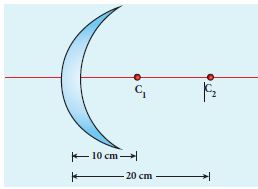
Determine the focal length of the lens made up of a material of refractive index 1.52 as shown in the diagram. (Points C1 and C2 are the centers of curvature of the first and second surfaces respectively.)
12.
A biconvex lens has radii of curvature 20 cm and 15 cm for the two curved surfaces. The refractive index of the material of the lens is 1.5.
(a) What is its focal length?
(b) Will the focal length change if the lens is flipped by the side?
13.
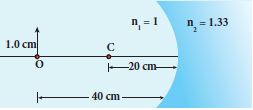
Find the size of the image formed in the given figure
14.
Find the position of the image of a point object O in the two cases given. Take the radius of curvature of the surface R as 15 cm, n1 = 1 and n2 = 2.
Case i) O is located 10 cm to the left of the surface.
Case ii) O is located 30 cm to the left of the surface.
15.
The thickness of a glass slab is 0.25 m. It has a refractive index of 1.5. A ray of light is incident on the surface of the slab at an angle of 60o. Find the lateral displacement of the light when it emerges from the other side of the glass slab.
16.
What is the radius of the illumination when seen above from inside a swimming pool from a depth of 10 m on a sunny day? What is the total angle of view? [Given, refractive index of water is 4/3]
17.
Light travels from air into a glass slab of thickness 50 cm and refractive index 1.5.
(i) What is the speed of light in the glass?
(ii) What is the time taken by the light to travel through the glass slab?
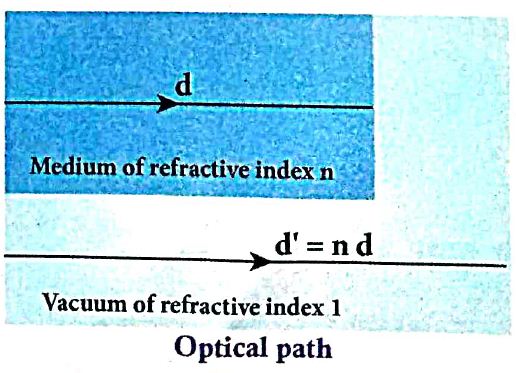
(iii) What is the optical path of the glass slab?
18.
A thin rod of length f /3 is placed along the optical axis of a concave mirror of focal length f such that one end of image which is real and elongated just touches the respective end of the rod. Calculate the longitudinal magnification.
19.
An object is placed at a distance of 20.0 cm from a concave mirror of focal length 15.0 cm.
(a) What distance from the mirror a screen should be placed to get a sharp image?
(b) What is the nature of the image?
20.
In Young's double slit experiment, 62 fringes are seen in visible region for sodium light of wavelength 5893 Å. If violet light of wavelengtlt 4359 Å is used in place of sodium light, then what is the number of fringes seen?
21.
In Young's double-slit experiment, the slits are 2 mm apart and are illuminated with a mixture of two-wavelength λ0 = 750 nm and λ = 900mm. What is the minimum distance from the common central bright fringe on a screen 2 m from the slits where a bright fringe from one interference pattern coincides with a . bright fringe from the other?
22.
If the distance D between an object and screen is greater than 4 times the focal length f of a convex lens, then there are two positions for which the lens forms an enlarged image and a diminished image respectively. This method is called conjugate foci method. If d is the distance between the two positions of the lens, obtain the equation for focal length of the convex lens.
23.
A thin converging lens of refractive index 1.5 has a power of + 5.0 D. When this lens is immersed in a liquid of refractive index n, it acts as a divergent lens of focal length 100 cm. What must be the value of n?
24.
A small bulb is placed at the bottom of a tank containing water to a depth of 80 cm, What is the area of the surface of water through which light from the bulb can emerge out? Refractive index of water is 1.33. (Consider the bulb to be a point source.)
25.
A compound microscope has a magnification of 30. The focal length of eye piece is 5 cm Assuming the final image to be at least distance of distinct vision, find the magnification produced by the objective.
26.
What are resolution and resolving power?
27.
Derive the equation for effective focal length for lenses in contact.
28.
Derive the relation between f and R for a spherical mirror.
29.
What are the chracteristics of the image formed by the plane mirror
30.
Obtain the equation for critical angle.
31.
Obtain the equation for apparent depth.
32.
State the laws of reflection.
33.
Derive the equations for thin lens and for magnification.
1.
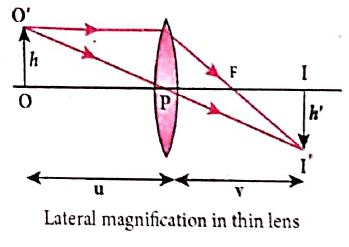
(i) Let us consider an object OO' of height h placed on the principal axis with its height perpendicular to the principal axis, The inverted real image II' is formed which has a height h' as shown in Figure.
(ii) The lateral (or) transverse magnification m is defined as the ratio of the height of the image to height of the object.
\(m=\cfrac { II' }{ OO' } \) ...(i)
(iii) From the two similar triangles ∆POO' and ΔPII', we can write,
\(\cfrac { II' }{ OO' } =\cfrac { PI }{ PO } \) ...(ii)
On applying sign convention,
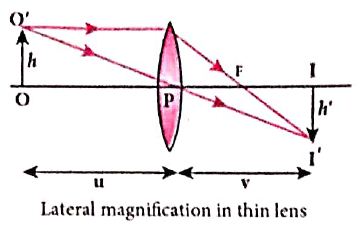
\(\cfrac { -{ h' } }{ { h } } =\cfrac { v }{ -u } \)
(iv) Substituting this in the equation (ii) for magnification,
\(m=\cfrac { -{ h }' }{ { h }} =\cfrac { v }{ -u } \)
After rearranging,
\(m=\cfrac { { h }'}{ h } =\cfrac { v }{ u } \) ...(iii)
(v) The magnification is negative for real image and positive for virtual image. In the case of a concave lens, the magnification is always positive and less than one.
We can also have the other forms of equations for magnification by combining the lens equation as,
\(m=\cfrac { { h }' }{ { h }} =\cfrac { f }{ f+u } (or)m=\cfrac { { h }' }{ { h }} =\cfrac { f-v }{ f } \) ...(iv)
2.
(i) Let us consider a thin lens made up of a medium of refractive index n2 is placed in a medium of refractive index n1. Let R1 and R2 be the radii of curvature of two spherical surfaces (i) and (ii) respectively and P be the pole.
(ii) Consider a point object 'O' on the principal axis. A paraxial ray from 'O' which falls very close to P, after refraction at the surface (i) forms image at I'.
(iii) Before it does so, it is again refracted by the surface (ii). Therefore the final image is formed at I.
(iv) The general equation for the refraction at a single spherical surface is given by the equation is,
\(\cfrac { { n }_{ 2 } }{ v } =\cfrac { { n }_{ 1 } }{ u } =\cfrac { \left( { \quad n }_{ 2 }-{ { n }_{ 1 } } \right) }{ R } \) ....(i)
(v) For the refracting surface (1), the light goes from n1 to n2
\(\cfrac { { { n }_{ 2 } } }{ v' } -\cfrac { { n }_{ 1 } }{ u } =\cfrac { \left( n_{ 2 }-{ n }_{ 1 } \right) }{ { R }_{ 1} } \) ......(ii)
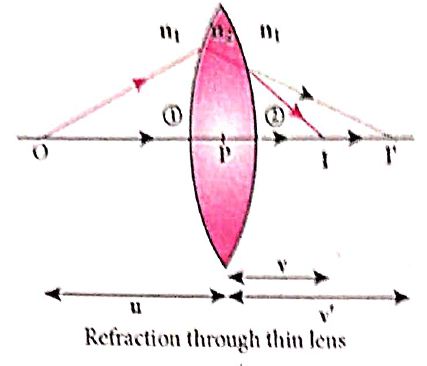
(vi) For the refracting surface (ii), the light goes from medium n2 to n1
\(\cfrac { { { n }_{ 1 } } }{ v' } -\cfrac { { n }_{ 2 } }{ v' } =\cfrac { \left( n_{ 1 }-{ n }_{ 2 } \right) }{ { R }_{ 2 } } \) ....(iii)
(vii) Adding the above two equations (ii) and (iii)
\(\cfrac { { { n }_{ 1 } } }{ v } =\cfrac { { n }_{ 1 } }{ u } =\left( { n }_{ 2 }-{ n }_{ 1 } \right) \left( \cfrac { 1 }{ { R }_{ 1 } } -\cfrac { 1 }{ { R }_{ 2 } } \right) \)
On further simplifying and rearranging
\(\cfrac { 1 }{ v } -\cfrac { 1 }{ u } =\left( \cfrac { { n }_{ 2 }-{ n }_{ 1 } }{ { n }_{ 1 } } \right) \left( \cfrac { 1 }{ { R }_{ 1 } } -\cfrac { 1 }{ { R }_{ 2 } } \right) \)
\(\cfrac { 1 }{ v } -\cfrac { 1 }{ u } =\left( \cfrac { { n }_{ 2 } }{ { n }_{ 1 } } -1 \right) \left( \cfrac { 1 }{ { R }_{ 1 } } -\cfrac { 1 }{ { R }_{ 2 } } \right) \) ....(iv)
If the refractive of the lens is n2 and is placed in air, then n2= n and n1= 1. So the equation (iv) becomes,
\(\cfrac { 1 }{ v } -\cfrac { 1 }{u } =(n-1) \left( \cfrac { 1 }{ { R }_{ 1 } } -\cfrac { 1 }{ { R }_{ 2 } } \right) \) ...(v)
According to lens makers formula
\(\cfrac { 1 }{ f } =(n-1) \left( \cfrac { 1 }{ { R }_{ 1 } } -\cfrac { 1 }{ { R }_{ 2 } } \right) \) ...(vi)
Comparing the two equations (v) and (vi), we find
\(\cfrac { 1 }{ v } -\cfrac { 1 }{ u }=\cfrac { 1 }{ f }\) .....(vii)
This is called lens equation
3.
Critical angle:
The angle of incidence in the denser medium for which the angle reflection is 90o or the reflected ray graces the boundary between the two media is called critical angle.
Total Internal reflection:
For any angle of incidence greater than the critical angle, the center light is reflected back into the denser medium itself. This phenomenon is called Total internal reflection.
4.
5.
\(\mathrm{d} \sin \theta=n \lambda, As \ \theta\ is\ small, \ \theta=\frac{Y}{D} \)
\(d \theta =n \lambda \)
\(d \frac{Y}{D} =n \lambda \)
\(Y =\frac{D n \lambda}{d} \)
\(\mathrm{D}=2 \mathrm{~m}, \mathrm{n}=1, \lambda=600 \mathrm{~nm} \)
\(=6 \times 10^{-7} \mathrm{~m}, \mathrm{~d}=1 \times 10^{-3} \mathrm{~m} \)
\(\mathrm{Y}=\frac{\mathrm{D} \lambda}{\mathrm{d}} \text { (First minimum) } \)
\(\mathrm{Y}=\frac{2 \times 6 \times 10^{-7}}{1 \times 10^{-3}} \)
\(=12 \times 10^{-4} \)
\(Y =12 \times 10^{-4} \mathrm{~m} \)
Distance between first minima on either side of central maxima
\(\Delta \mathrm{y}=2 \mathrm{y}=2 \times 12 \times 10^{-4} \)
\(\Delta \mathrm{y}=24 \times 10^{-4} \mathrm{~m} \)
6.
Yellow light is preferred to during fog because of penetrates deeply due to its longer wave length it is much smaller than fog particles (The scattering effect of fog is independent of wave length).
7.
Yes, It is possible for two lens to produce zero power.
Explanation:
when the two lens (one is concave & another one is convex lens) are combined together, the focal length of the combination of the two lenses is F.
Then
\(\frac{1}{F}=\frac{1}{f_{1}}+\frac{1}{f_{2}} \)
\(\text { if } f_{1}=f_{2}=f \)
\(f_{1}=f(\text { convex }) \)
\(f_{2}=-f(\text { concave) } \)
\(P=\frac{1}{F}=\frac{1}{f}-\frac{1}{f}=0 . \ P \rightarrow \text { power } \)
8.
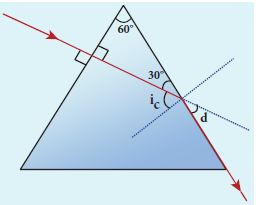
The given situation is shown in the figure
Given, A = 60o ; i1 = 0o; i2 = 90o
(a) Equation for angle of deviation,
d = i1 + i2 - A
Substituting the values
d = 0o + 90o- 60o = 30o
The angle of deviation produced is, d = 30°
(b) The light inside the prism must be falling on the second face at critical angle as it graces the boundary. ic = 90° – 30° = 60°
Equation for critical angle is, \(\sin i_{c}=\frac{1}{n}\)
\(n=\frac{1}{\sin i_{c}} ; \quad n=\frac{1}{\sin 60^{\circ}}=\frac{1}{\sqrt{3} / 2}=\frac{2}{\sqrt{3}}=1.15\)
The refractive index of the material of the prism is, n = 1.15
9.
Given, h = 5 mm = 0.5 cm, u1 = –15 cm,
f1 = 10 cm, f2 = 5 cm, d = 40 cm
For the first lens, the lens equation is,
\(\cfrac { 1 }{ { v }_{ 1 } } -\cfrac { 1 }{ { u }_{ 1 } } =\cfrac { 1 }{ { f }_{ 1 } } \)
Substituting the values,
\(\cfrac { 1 }{ { v }_{ 1 } } -\cfrac { 1 }{ -15 } =\cfrac { 1 }{ 10 } \);\(\cfrac { 1 }{ { v }_{ 1 } } +\cfrac { 1 }{ 15 } =\cfrac { 1 }{ 10 } \)
\(\cfrac { 1 }{ { v }_{ 1 } } =\cfrac { 1 }{ 10 } -\cfrac { 1 }{ 15 } =\cfrac { 15-10 }{ 150 } =\cfrac { 5 }{ 150 } =\cfrac { 1 }{ 30 } \)
v1 = 30 cm
First lens forms image 30 cm to the right of first lens.
Let us find the height of this image.
Equation for magnification is, \(m=\cfrac { { h }' }{ { h } } =\cfrac { v_1 }{ u_1 } \)
Substituting the values,\(\cfrac { { h }' }{ 0.5 } =\cfrac { 30 }{ -15 } \)
\({ h }_{ 2 }=0.5\times \cfrac { 30 }{ -15 } =-1cm\)
As the height of the lens is negative, the image is inverted and real.
This image acts as object for second lens. The object distance for second lenses, (40 – 30 = 10 cm). Hence, u2 = –10 cm
For the second lens, the lens equation is,
\(\cfrac { 1 }{ { v }_{ 1 } } -\cfrac { 1 }{ { u }_{ 2 } } =\cfrac { 1 }{ { f }_{ 2 } } \)
Substituting the values,
\(\cfrac { 1 }{ { v }_{ 2 } } -\cfrac { 1 }{ -10 } =\cfrac { 1 }{ 5 } ;\cfrac { 1 }{ { v }_{ 2 } } +\cfrac { 1 }{ 10 } =\cfrac { 1 }{ 5 } \)
\(\cfrac { 1 }{ { v }_{ 2 } } =\cfrac { 1 }{ 5 } -\cfrac { 1 }{ 10 } =\cfrac { 10-5 }{ 50 } =\cfrac { 5 }{ 50 } =\cfrac { 1 }{ 10 } \)
v2 = 10 cm
The image is formed 10 cm to the right of the second lens.
Let us find the height of the final image. Assume, the final height of the image formed by the second lens is h'′ and the height of the object for the second lens is h'.
Equation for magnification is m' for the
second lens is, \(m'=\cfrac { { h }^{' ' } }{ { h }^{ ' } } =\cfrac { { v }_{ 2 } }{ { u }_{ 2 } } \)
Substituting the values,\(\cfrac { { h }^{ '' } }{ -1 } =\cfrac { 10 }{ -10 } \)
\({ h }^{ '' }=\left( -1 \right) \times \left( \cfrac { 10 }{ -10 } \right) =1cm=10mm\)
As the height of the image is positive, the image is erect and real.
10.
Given, focal length of first lens, f1 = –70 cm,
focal length of second lens, f2 = 150 cm.
Equation for focal length of lenses in contact, \(\cfrac { 1 }{ f } =\cfrac { 1 }{ { f }_{ 1 } } +\cfrac { 1 }{ { f }_{ 2 } } \)
Substituting the values,
\(\cfrac { 1 }{ f } =\cfrac { 1 }{ -70 } +\cfrac { 1 }{ 150 } =\cfrac { 1 }{ 70 } +\cfrac { 1 }{ 150 } \)
\(\cfrac { 1 }{ f } =\cfrac { -150+70 }{ 70\times 150 } =\cfrac { -80 }{ 70\times 150 } =\cfrac { 80 }{ 10500 } \)
\(f=\cfrac { -1050 }{ 8 } =131.25cm\)
As the focal length is negative, the combination of two lenses is a diverging system of lenses
The power of the combination is,
\(P=\cfrac { 1 }{ f } =\cfrac { 1 }{ -1.3125m } =0.76D\)
11.
This lens is called convexo-concave lens
Given, n = 1.52, R1 = 10 cm and R2 = 20 cm
Both R1 and R2 are positive
Lens makers formula,
\(\cfrac { 1 }{ f } =\left( n-1 \right) \left( \cfrac { 1 }{ { R }_{ 1 } } -\cfrac { 1 }{ { R }_{ 2 } } \right) \)
Substituting the values,
\(\cfrac { 1 }{ f } =\left( 1.52-1 \right) \left( \cfrac { 1 }{ 10 } -\cfrac { 1 }{ 20 } \right) \)
\(\cfrac { 1 }{ f } =\left( 0.52 \right) \left( \cfrac { 2-1 }{ 20 } \right) =\left( 0.52 \right) (\frac{1}{20})=\cfrac { 0.52 }{ 20 } \)
\(f=\cfrac { 20 }{ 0.52 } =38.46cm\)
As the focal length is positive, the lens is a converging lens.
12.
For a biconvex lens, radius of curvature of the first surface is positive and that of the second surface is negative as shown in the figure.
.JPG)
Given, n = 1.5, R1 = 20 cm and R2 = –15 cm
(a) Lensmaker’s formula \(\frac{1}{f}=(n-1)\left(\frac{1}{R_{1}}-\frac{1}{R_{2}}\right)\)
Substituting the values,
\(\frac{1}{f}=(1.5-1)\left(\frac{1}{20}-\frac{1}{-15}\right)=(1.5-1)\left(\frac{1}{20}+\frac{1}{15}\right)\)
\(\frac{1}{f}=(0.5)\left(\frac{1}{20}+\frac{1}{15}\right)=(0.5)\left(\frac{3+4}{60}\right)=\left(\frac{1}{2} \times \frac{7}{60}\right)=\frac{7}{120}\)
\(f=\frac{120}{7}\) = 17.14 cm
As the focal length is positive the lens is a converging lens.
(b) When the lens is flipped by the side,
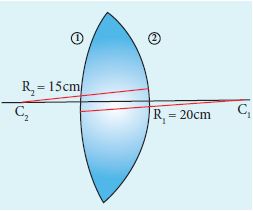
Now, R1= 15 cm and R2 = –20 cm, n = 1.5
Substituting the values in the lens maker's formula,
\(\cfrac { 1 }{ f } =\left( 1.5-1 \right) \left( \cfrac { 1 }{ 15 } -\cfrac { 1 }{-20 } \right) \)
\(\cfrac { 1 }{ f } =\left( 1.5-1 \right) \left( \cfrac { 1 }{ 15 } +\cfrac { 1 }{ 20 } \right) \)
This will also result in, f = 17.14 cm
Thus, it is concluded that the focal length of the lens will not change if it is flipped by the side. This is true for any lens. Students can verify this for any kind of lens.
13.
Given, u = –40 cm, R = –20 cm, n1 = 1 and n2 = 1.33
Equation for single spherical surface is
\(\cfrac { { n }_{ 2 } }{ v } -\cfrac { { n }_{ 1 } }{ u } =\cfrac { \left( { n }_{ 2 }-{ n }_{ 1 } \right) }{ R } \)
Substituting the values
\(\cfrac { 1.33 }{ v } -\cfrac { 1 }{ -40 } =\cfrac { \left( 1.33-1 \right) }{ -20 } ;\cfrac { 1.33 }{ v } +\cfrac { 1 }{ 40 } =\cfrac { \left( 0.33 \right) }{ -20 } \)
\(\cfrac { 1.33 }{ v } =\cfrac { \left( 0.33 \right) }{ 20 } -\cfrac { 1 }{ 40 } ;\)
\(\cfrac { 1.33 }{ v } =\cfrac { 0.66-1 }{ 40 } =\cfrac { 1.66 }{ 40 } \)
\(v=-40\times \cfrac { 1.33 }{ 1.66 } =-32.0cm\)
The equation for magnification is,\(m=\cfrac { { h }_{ 2 } }{ { h }_{ 1 } } =\cfrac { { { n }_{ 1 }v } }{ { n }_{ 2 }u } \)
\(\cfrac { { h }_{ 2 } }{ 1.0 } =\cfrac { \left( 1.0 \right) \times \left( -32 \right) }{ \left( 1.33 \right) \times \left( -40 \right) } =0.6cm\) (or) h2 = 0.6cm
The erect virtual image of height 0.6 cm is formed at 32.0 cm to the left of the single spherical surface.
14.
Case i) \(\cfrac { { n }_{ 2 } }{ v } -\cfrac { { n }_{ 1 } }{ u } =\cfrac { \left( { n }_{ 2 }-{ n }_{ 1 } \right) }{ R } \)
applying sign convention, u = –10 cm, R = 15 cm
\(\cfrac { 2 }{ v } -\cfrac { 1 }{ -10 } =\cfrac { \left( 2-1 \right) }{ 15 } ;\cfrac { 2 }{ v } +\cfrac { 1 }{ 15 } =\cfrac { \left( 1 \right) }{ 10 } \)
∴ =− 60 cm
[a virtual image is formed 60 cm, to the left of the surface]
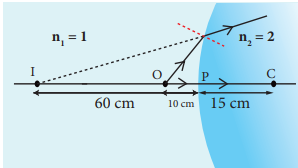
Case ii) \(\cfrac { { n }_{ 2 } }{ v } -\cfrac { { n }_{ 1 } }{ u } =\cfrac { \left( { n }_{ 2 }-{ n }_{ 1 } \right) }{ R } \)
applying sign convention, u = –30 cm, R = 15 cm
\(\cfrac { 2 }{ v } -\cfrac { 1 }{ -30 } =\cfrac { \left( 2-1 \right) }{ 15 } ;\cfrac { 2 }{ v } +\cfrac { 1 }{ 30 } =\cfrac { \left( 1 \right) }{ 15 } \)
∴ = 60 cm [a real image is formed 60 cm, to the right of the surface]
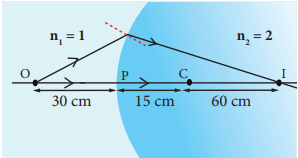
15.
Given, thickness of the slab, t = 0.25 m, refractive index, n = 1.5, angle of incidence, i = 60o.
Using Snell’s law, 1 sin i = n sin r
\(sinr=\cfrac { sini }{ n } =\cfrac { sin60^o }{ 1.5 } =0.58\)
\(r={ sin }^{ -1 }(0.58)=35.25^{ 0 }=35^o15'0''\)
Lateral displacement is, \(L=t\left( \cfrac { sin\left( i-r \right) }{ cos\left( r \right) } \right) \)
\(L=\left( 0.25 \right) \times \left( \cfrac { sin\left( 60-35.25 \right) }{ cos\left( 35.25 \right) } \right) =0.1281m\)
The lateral displacement is, L = 12.81 cm
16.
Given, n = 4/3, d = 10 m.
Radius of illumination, \(R=\cfrac { d }{ \sqrt { { n }^{ 2 }-1 } } \)
\(R=\cfrac { 10 }{ \sqrt { \left( 4/3 \right) ^{ 2 }- } 1 } =\cfrac { 10\times 3 }{ \sqrt { 16-9 } } \)
\(R=\cfrac { 30 }{ \sqrt { 7 } } =11.32cm\)
To find the critical angle,
\({ i }_{ c }={ sin }^{ -1 }\left( \cfrac { 1 }{ n } \right) \)
\({ i }_{ c }={ sin }^{ -1 }\left( \cfrac { 1 }{ 4/3 } \right) ={ sin }^{ -1 }\left( \cfrac { 3 }{ 4 } \right) =48.6^{ o }\)
The total angle of view of the cone is, \({ 2i }_{ c }=2\times { 48.6 }^{ 0 }={ 97.2 }^{ 0 }\)
17.
Given, thickness of glass slab, d = 50 cm = 0.5 m, refractive index, n = 1.5
refractive index, \(n=\cfrac { c }{ v } \)
(a) speed of light in the glass slab is,
\(v=\cfrac { c }{ n } =\cfrac { 3\times { 10 }^{ 8 } }{ 1.5 } =2\times { 10 }^{ 8 }{ ms }^{ -1 }\)
(b) time taken by light to travel through the glass slab is,
\(t=\cfrac { d }{ v } =\cfrac { 0.5 }{ 2\times { 10 }^{ 8 } } =2.5\times { 10 }^{ -9 }{ s }\)
(c) optical path,
d' = nd = 1.5 x 0.5 = 0.75 m = 75 cm
Light would have traveled an additional 25 cm (75 cm – 50 cm) in vacuum at the same time had there been no glass slab in its path.
18.
\(\text{ longitudinal magnifcation}(m_l)=\frac { length\ of\ image\left( l' \right) }{ length\ of\ object\left( l \right) } \)
Given: length of object, \(l=\cfrac { f }{ 3 } \)
For the given condition, the image formation is shown in the figure.
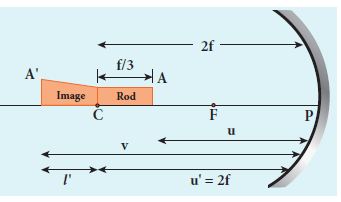
Let, l' be the length of the image, then
\(m=\cfrac { l' }{ l } =\cfrac { l' }{ f/3 } \) (or) \(l=\cfrac { m_lf }{ 3 } \)
Image of one end coincides with the object. Thus, the coinciding end must be at center of curvature.
\(u_B=u_A-\cfrac { f }{ 3 } =2f-\cfrac { f }{ 3 } =\cfrac { 5f }{ 3 } \)
\(v_B=u_B+l+l'\)
\(v_b =\cfrac { 5f }{ 3 } +\cfrac { f }{ 3 } +\cfrac { mf }{ 3 } =\cfrac { f(6+m) }{ 3 } \)
Mirror equation,\(\cfrac { 1 }{ v } +\cfrac { 1 }{ u } =\cfrac { 1 }{ f } \)
\(\cfrac { 1 }{ -\left( \cfrac { f(6+m_l) }{ 3 } \right) } +\cfrac { 1 }{ -\left( \cfrac { 5f }{ 3 } \right) } =\cfrac { 1 }{ -f } \)
After simplifying,
\(\cfrac { 3 }{ f(6+m_l) } +\cfrac { 3 }{ 5f } =\cfrac { 1 }{ f } ;\cfrac { 3 }{ (6+m_l) } =\cfrac { 2 }{ 5 } \)
\(6+m_l=\cfrac { 15 }{ 2 } ;m_l=\cfrac { 15 }{ 2 } -6\)
\(m_l=\cfrac { 3 }{ 2 } =1.5\)
19.
Given, f = –15 cm, u = –20 cm
(a) Mirror equation,\(\frac { 1 }{ v } +\frac { 1 }{ u } =\frac { 1 }{ f } \)
Rewriting to find v,\(\cfrac { 1 }{ v } =\cfrac { 1 }{ f } -\cfrac { 1 }{ u } \)
Substituting for f and u,\(\cfrac { 1 }{ v } =\cfrac { 1 }{ -15 } -\cfrac { 1 }{ -20 } \)
\(\cfrac { 1 }{ v } =\cfrac { \left( -20 \right) -\left( -15 \right) }{ 300 } =\cfrac { -5 }{ 300 } =\cfrac { -1 }{ 60 } \)
v = -60.0cm
The screen is to be placed at distance 60.0 cm to the left of the concave mirror.
(b) Magnification, \(m=\cfrac { h' }{ h } =-\cfrac { v }{ u } \)
\(m=\cfrac { h' }{ h } =\cfrac { \left( -60 \right) }{ \left( -20 \right) } =-3\)
As the sign of magnification is negative, the image is inverted.
As the magnitude of magnification is 3, the image is enlarged three times.
As the image is formed to the left of the concave mirror, the image is real.
20.
\(\mathrm{n}_{1} \lambda_{1}=\mathrm{n}_{2} \lambda_{2} \)
\(\mathrm{n}_{1}=62 \text { fringes } \)
\(\lambda_{1}=5893 \mathrm{~A}^{0} \)
\(\lambda_{2}=4359 \mathrm{~A}^{0} \)
\(\mathrm{n}_{2}=? \)
\(\mathrm{n}_{2}=\frac{\mathrm{n}_{1} \lambda_{1}}{\lambda_{2}} \)
\(=\frac{5893 \times 62}{4359} \)
= 83.81 = 84 fringes.
21.
Given data:
λ = 900 nm = 900 x 10-9 m
λ 2 = 750 nm = 750 x 10-9 m
D = 2 m d = 2 nm = 2 x 10⁻³ m
Let nth order bright fringe of λ1,
Coincides with (n + 1)th order bright fringe of λ 2
\(y_{n}=\frac{n \lambda_{1} D}{d}, Y_{n+1}=\frac{(n+1) \lambda_{2} D}{d} \)
\(\frac{n \lambda_{1} D}{d}=\frac{(n+1) \lambda_{2} D}{d} \)
\(n \lambda_{1}=(n+1) \lambda_{2} \)
\(\frac{n+1}{n}=\frac{\lambda_{1}}{\lambda_{2}}=\frac{900 \times 10^{-9}}{750 \times 10^{-9}}=\frac{18}{15}=\frac{6}{5} \)
\(1+\frac{1}{n} =\frac{6}{5} \)
\(\frac{1}{n} =\frac{6}{5}-1=\frac{6-5}{5} \)
\(\frac{1}{n} =\frac{1}{5} \)
n = 5
n + 1 = 6
5th bright fringe of λ 1 coincides with 6th bright fringe of λ 2 in the least distance of y
\(y =\frac{n \lambda_{1} D}{d}=\frac{5 \times 900 \times 10^{-9} \times 2}{2 \times 10^{-3}} \)
\(=4500 \times 10^{-6}=4.5 \times 10^{-3} \)
y = 4.5 mm
22.
From figure,
D = u + v
d = r - u
D + d = u + v + v - u
D + d = 2v
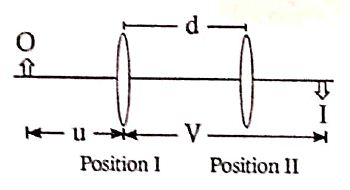
\(v=\frac{D+d}{2}\)
D - d = u + v - v + u = 2u
\(v=\frac{D-d}{2}\)
\(\frac{1}{f}=\frac{1}{v}-\frac{1}{u} \)
\(\frac{1}{f} =\frac{1}{\frac{D+d}{2}}-\frac{1}{\frac{D-d}{2}} \)
\(=\frac{2}{D+d}-\frac{2}{D-d} \)
\(=\frac{2[D-d+D+d]}{D^{2}-d^{2}} \)
\(=\frac{2 \times 2 D}{D^{2}-d^{2}} \)
\(\frac{1}{f} =\frac{4 D}{D^{2}-d^{2}} \quad \therefore f=\frac{D^{2}-d^{2}}{4 D} \)
23.
\(P_{a}=\frac{1}{f_{a}}=\left(\frac{\mu_{g}}{\mu_{a}}-1\right)\left(\frac{1}{R_{1}}-\frac{1}{R_{2}}\right) \) ..(1)
\(P_{w}=\frac{1}{f_{w}}=\left(\frac{\mu_{g}}{\mu_{w}}-1\right)\left(\frac{1}{R_{1}}-\frac{1}{R_{2}}\right) \) ...(2)
\(p_{a}=5 D, f_{w}=-100 \text { (Diverging lens) } \)
\(\mu_{\mathrm{g}}=1.5, \mu_{\mathrm{a}}=1 \)
\(5=(1.5-1)\left(\frac{1}{R_{1}}-\frac{1}{R_{2}}\right) \) ...(3)
\(\left(\frac{1}{R_{1}}-\frac{1}{R_{2}}\right)=\frac{5}{0.5}=\frac{50}{5}=10 \)
\(\frac{1}{f_{w}}=\left(\frac{1.5}{n_{w}}-1\right)\left(\frac{1}{R_{1}}-\frac{1}{R_{2}}\right) \) ...(4)
\(\frac{-1}{100 \times 10^{-2}}=\left(\frac{1.5}{n_{w}}-1\right)\left(\frac{1}{R_{1}}-\frac{1}{R_{2}}\right) \)
\(-1=\left(\frac{1.5}{n_{w}}-1\right)(10) \Rightarrow \frac{-1}{10}=\frac{1.5}{n_{w}}-1 \)
\(\frac{1.5}{n_{w}}=\frac{-1}{10}+1 \)
\(\frac{1.5}{n_{w}}=\frac{9}{10} \)
\(n_{w}=\frac{1.5 \times 10}{9}=\frac{15}{9}=\frac{5}{3} \)
\(n_{w}=\frac{5}{3} \)
24.
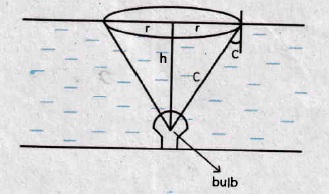
r - Radius of surface of water
h - Depth of the water
\(\sin c=\frac{1}{n} \)
\(n=\frac{4}{3} \)
h = 80 cm = 0.80 m
\(\sin c =\frac{1}{\frac{4}{3}}=\frac{3}{4} n=\frac{1}{\sin c} \)
\(\tan c =\frac{\sin c}{\cos c} \)
\(=\frac{\sin c}{\sqrt{1-\sin ^{2} c}} \)
\(=\frac{1}{n \sqrt{1-\frac{1}{n^{2}}}} \)
\(\tan c =\frac{1}{\sqrt{n^{2}-1}} \)
\(\frac{r}{h} =\frac{1}{\sqrt{n^{2}-1}} ; r=\frac{h}{\sqrt{n^{2}-1}} \)
\(=\frac{0.80}{\sqrt{\left(\frac{4}{3}\right)^{2}}-1} \)
\(=\frac{0.80}{\sqrt{\frac{16}{9}-1}}=\frac{0.80 \times 3}{\sqrt{7}} \)
\(=\pi r^{2}=\frac{22}{7} \times \frac{0.80 \times 3}{\sqrt{7}} \times \frac{0.80 \times 3}{\sqrt{7}} \)
\(=\frac{22}{49} \times 2.4 \times 2.4 \)
\(=\frac{22 \times 5.76}{49}=\frac{126.72}{49}=2.586 \)
A = 2.6 m2
25.
Given data :
Magnification of compound microscope m = 30
Focal length of eye piece f. = 5 cm
Image distance D = 25 cm
To find:
Magnification of objective mo = ?
Formula :
Magnification m = mome
\(m={ m }_{ 0 }\left( 1+\cfrac { D }{ { f }_{ e } } \right) \)
\(30={ m }_{ 0 }\left( 1+\cfrac { 25 }{ 5 } \right) \)
⇒ mo = 5
26.
(i) Resolution: Resolution is the quality of image which is decided by diffraction effect and Rayleigh criterion.
(ii) Resolving power: The ability of an optical instrument to separate or distinguish small or closely adjacent objects through the image formation is said to be resolving power of the instrument.
27.
Consider two lenses 1 and 2 of focal length f1 and f2 are placed coaxially in contact with each other so that they have a common principal axis.
O be the object which is placed beyond the focus of the first lens on the principal axis. I' is the image of object O which is formed beyond the lens 2. Then, I' acts as an object for the lens 'P' is the common optical centre of the two lenses.
From the figure, PO =u, PI' = v' for lens I
PI' = v' (object distance) PI = v (image distance) for lens 2
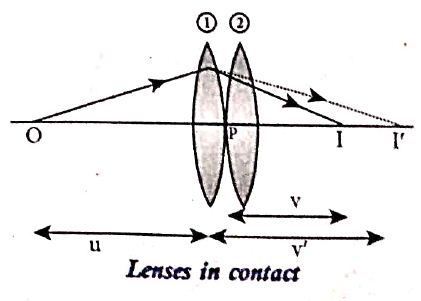
For lens 1,
\(\cfrac { 1 }{ v' } -\cfrac { 1 }{ u } =\cfrac { 1 }{ { f }_{ 1 } } \) .........(1)
For lens 2,
\(\cfrac { 1 }{ v } -\cfrac { 1 }{ u' } =\cfrac { 1 }{ { f }_{ 2 } } \) .........(2)
Adding (1) of (2)
\(\cfrac { 1 }{ v } -\cfrac { 1 }{ u } =\cfrac { 1 }{ f_1 }+\cfrac{1}{f_2} \) .........(3)
(vi) If the combination acts as a single lens of focal length f so that for an object at the position O it forms the image at I,
Then,
\(\cfrac { 1 }{ v } -\cfrac { 1 }{ u } =\cfrac { 1 }{ f } \) .........(4)
Comparing equations (3) and (4) we can write,
\(\cfrac { 1 }{ F } =\cfrac { 1 }{ { f }_{ 1 } } +\cfrac { 1 }{ { f }_{ 2 } } \) .........(5)
The above equation can be extended for any number of lenses in contact as,
\(\cfrac { 1 }{ f } =\cfrac { 1 }{ { f }_{ 1 } } +\cfrac { 1 }{ { f }_{ 2 } } +\cfrac { 1 }{ { f }_{ 3 } }+\cfrac { 1 }{ { f }_{ 4 } } +..........\)
28.
Relation between f and R:
C ⇒ Center of curvature
F ⇒ Principal focus
i ⇒ Angle of incidence
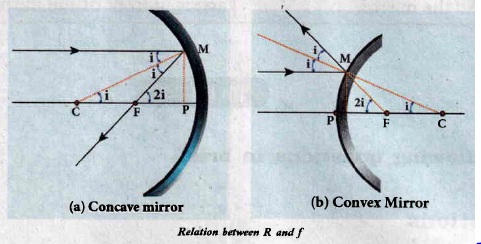
The angles
\(\tan i=\frac{P M}{P C} \text { and } \tan 2 i=\frac{P M}{P F}\)
As the angles are small, tan i = i and tan 2i = 2i.
\(\mathrm{i}=\frac{\mathrm{PM}}{\mathrm{PC}} \text { and } 2 \mathrm{i}=\frac{\mathrm{PM}}{\mathrm{PF}}\)
Simplifying further,
\(2 \frac{\mathrm{PM}}{\mathrm{PC}}=\frac{\mathrm{PM}}{\mathrm{PF}} ; 2 \mathrm{PF}=\mathrm{PC}, \mathrm{R}=2 \mathrm{f}\)
PF is focal length f and PC is the radius of curvature R.
R = 2f (or) f = R/2
29.
(i) The image formed by a plane mirror is virtual, erect, and laterally inverted.
(ii) The size of the image is equal to the size of the object.
(iii) The image distance behind the mirror is equal to the object distance in front of the mirror.
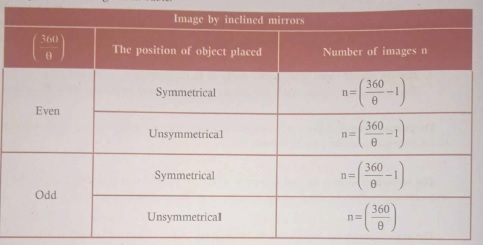
(iv) If an object is placed between two plane mirrors inclined at an angle 0, then the number or
images n formed is given in Table.
30.
Snell's law in the product form for critical angle incidence becomes,
\(n_{1} \sin i_{c}=n_{2} \sin 90^{\circ} \)
\(n_{1} \sin i_{c}=n_{2} \)
\(\sin i_{c}=\frac{n_{2}}{n_{1}} \)
\(Here, \mathrm{n}_{1}>\mathrm{n}_{2}\)
n1 - refractive index of denser medium = n
n2 - refractive index of rarer medium = 1 (for air)
\(\sin i_{c}=\frac{1}{n}(o r) i_{c}=\sin ^{-1}\left[\frac{1}{n}\right]\)
Critical angle ic depends on the refractive index n of the mediunm.
31.
(i) Light from the object O at the bottom of the tank passes from denser medium (water) to rarer medium (air) to reach our eyes for viewing the object.
(ii) It deviates away from the normal in the rarer medium at the point of incidence B as shown in Figure.
(iii) The refractive index of the denser medium is n1 and that of rarer medium is n2. Here, n1 > n2.
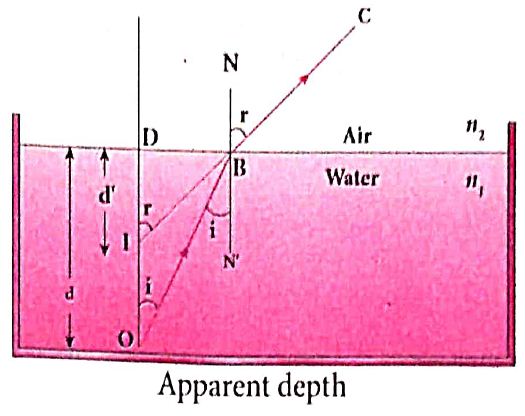
The angle of incidence in the denser medium is i and the angle of refraction in the rarer medium is r. The lines NN'and OD are parallel. Thus, the angle ∠DIB is also r. The angles i and r are very small as the diverging light from O entering the eye is very narrow. The Snell's law in product form for this refraction from equation is,
n1 sin i = n2 sin r
As the angles i and r are small, we can approximate, sin i = tan i and sin r tan r.
n1 tan i = n2 tan r
In triangles ∆DOB and ∆DIB,
\(tan \ i=\frac{DB}{DO}and \ tan \ r=\frac{DB}{DI}\)
\(n_1\frac{DB}{DO}=n_2\frac{DB}{DI}\)
DB is cancelled both sides. Now, DO is the actual depth d and DI is the apparent depth d'.
\(n_1\frac{1}{d}=n_2\frac{1}{d'}\)
After rearranging, \(\frac{d'}{d}=\frac{n_2}{n_1}\)
Rewriting the above equation for the apparent depth d', d' = \(=\frac{n_2}{n_1}d\)
As the rarer medium is air, its refractive index n, can be taken as 1, (n2 = 1) and the refractive index n1 of denser medium could then be taken as n itself, (n1 = n). Now, the equation for apparent depth becomes,
\(d'=\frac{d}{n}\)
The bottom appears to be elevated by d-d',
\(d-d'=d-\frac{d}{n}(or)d-d'=d(1-\frac{1}{n})\)
32.
The law of reflection states that the incident ray, the reflected ray, and the normal to the surface of the mirror all lie in the same plane. The angle of reflection is equal to the angle of incidence.
33.
(i) Let us Consider an object OO' of height h placed on the principal axis with its height perpendicular to the principal axis. The inverted real image Il' is formed which has a height h' as shown in Figure.
(ii)The lateral (or) transverse magnification m is defined as the ratio of the height of the image to height of the object.
\(m=\cfrac { II' }{ OO' } \) .......(1)
From the two similar triangles ΔPOO' and ΔlPII'', we can write,
\(\cfrac { II' }{ OO' } =\cfrac { PI }{ PO } \) ......(2)
On applying sign convention,
\(\cfrac { -{ h }{ ' } }{ { h } } =\cfrac { v }{ -u } \)
Substituting this in the equation (2) for magnification,
\(m=\cfrac { -{ h }{ ' } }{ { h } } =\cfrac { v }{ -u } \)
After rearranging
\(m=\cfrac { { h }' }{ { h } } =\cfrac { v }{ u } \) ......(3)
(iii) The magnification is negative for real image and positive for virtual image. In the case of a concave lens, the magnification is always positive and less than one.
(iv) The equations for magnification by combining the lens equation with the formula for magnification as,
\(m=\cfrac { { h }' }{ { h } } =\cfrac { f }{ f+u } \quad m=\cfrac { { h }' }{ h } =\cfrac { f-v }{ f } \) ......(4)

12th Standard Syllabus & Materials
12th Standard
TN 12th Computer Applications களப்பெயர் முறைமை (DNS) Sample Question Papers Study Material - QB365 Set A
NEW12th Standard
TN 12th Computer Applications வலையமைப்பு எடுத்துக்காட்டுகள் மற்றும் நெறிமுறைகள் Sample Question Papers Study Material - QB365 Set A
NEW12th Standard
TN 12th Computer Applications கணினி வலையமைப்பு ஓர் அறிமுகம் Sample Question Papers Study Material - QB365 Set A
NEW12th Standard
TN 12th Computer Applications PHP-உடன் MySQL-ஐ இணைத்தல் Sample Question Papers Study Material - QB365 Set A



Tamilnadu Stateboard 12th Standard Subjects

Maths

Chemistry
Physics

Biology

Computer Science

Business Maths and Statistics

Economics

Commerce

Accountancy

History

Computer Applications
Biology
Computer Technology
Computer Applications
Computer Science
Business Maths and Statistics
Commerce
Economics
Maths
Chemistry
Physics
Computer Technology
History
Accountancy

Tamil

English

French
Tamilnadu Stateboard Standards

