
 100% FREE ACCESS
12th Standard Syllabus & Materials
12th Standard
TN 12th Computer Applications மின்னணு தரவு பரிமாற்றம் Sample Question Papers Study Material - QB365 Set A
NEW12th Standard
TN 12th Computer Applications மின் - வணிக பாதுகாப்பு அமைப்புகள் Sample Question Papers Study Material - QB365 Set A
NEW12th Standard
TN 12th Computer Applications மின்னணு செலுத்தல் முறைகள் Sample Question Papers Study Material - QB365 Set A
NEW12th Standard
TN 12th Computer Applications மின் - வணிகம் Sample Question Papers Study Material - QB365 Set A
NEW12th Standard
TN 12th Computer Applications திறந்த மூல கருத்துருக்கள் Sample Question Papers Study Material - QB365 Set A
NEW12th Standard
TN 12th Computer Applications வலையமைப்பு வடமிடல் Sample Question Papers Study Material - QB365 Set A

Published on: 02/09/2022
QB365 provides a detailed and simple solution for every Possible Book Back Questions in Class 12 Physics Subject - Retirement and Death of a Partner, English Medium. It will help Students to get more practice questions, Students can Practice these question papers in addition to score best marks.
Download Tamil Nadu 12th Standard Physics question papers, model tests, one-mark questions, important questions, and public exam papers in PDF format. Free study materials and answer keys for TN State Board students.
Questions + Answers key
Take MCQ Physics Test1.
2.
What are polariser and analyser?
3.
Discuss polarisation by selective absorption.
4.
Mention the differences between interference and diffraction.
5.
Differentiate between Fresnel and Fraunhofer diffraction.
6.
7.
A small telescope has an objective lens of focal length 125 cm and an eyepiece of focal length 2 cm.
(a) What is the magnification of the telescope?
(b) What is the separation between the objective and the eyepiece?
(c) What is the angular separation between two stars when viewed through this telescope if they subtend 1' for bare eye?
8.
A man with a near point of 25 cm reads a book which has small print using a magnifying lens of focal length 5 cm.
(a) What are the closest and the farthest distances at which he should keep the lens from the book?
(b) What are the maximum and the minimum magnification possible?
9.
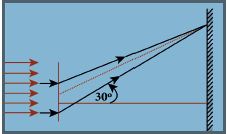
A monochromatic light of wavelength 5000 Å passes through a single slit producing diffraction pattern for the central maximum as shown in the figure. Determine the width of the slit.
10.
Light of wavelength 500 nm passes through a slit of 0.2 mm wide. The diffraction pattern is formed on a screen 60 cm away. Determine the,
(a) angular spread of central maximum
(b) the distance between the central maximum and the second minimum.
11.
Find the minimum thickness of a film of refractive index 1.25, which will strongly reflect the light of wavelength 589 nm. Also find the minimum thickness of the film to be anti-reflecting.
12.
Lights of two wavelengths 560 nm and 420 nm are used in Young’s double slit experiment. Find the least distance from the central fringe where the bright fringes of the two wavelengths coincide. Given D = 1 m and d = 3 mm.
13.
In Young’s double slit experiment, the two slits are 0.15 mm apart. The light source has a wavelength of 450 nm. The screen is 2 m away from the slits.
(a) Find the distance of the second bright fringe and also third dark fringe from the central maximum.
(b) Find the fringe width.
(c) How will the fringe pattern change if the screen is moved away from the slits?
(d) What will happen to the fringe width if the whole setup is immersed in water of refractive index 4/3.
14.
Two light sources with amplitudes 5 units and 3 units respectively interfere with each other. Calculate the ratio of maximum and minimum intensities.
15.
A compound microscope has a magnifying power of 100 when the image is formed at infinity. The objective has a focal length of 0.5 cm and the tube length is 6.5 cm. What is the focal length of the eyepiece.
16.
What are the advantages and disadvantages of a reflecting telescope?
17.
List the uses of polaroids.
18.
State and obtain Malus’ law. (or) State Malus' Law.
19.
What are plane polarised, unpolarized and partially polarised light?
20.
Differentiate between polarised and unpolarised light.
21.
What is Fresnel’s distance? Obtain the equation for Fresnel’s distance.
22.
Obtain the equation for bandwidth in Young’s double slit experiment.
1.
2.
(i) The polaroid which polarises the light passing through it is called a polariser.
(ii) The polaroid which is used to examine whether a beam of light is polarised or not is called an analyser.
3.
Polarisation by selective absorption
Selective absorption is the property of a material which transmits waves whose electric fields vibrate in a plane parallel to a certain direction of orientation and absorbs all other waves.
4.
| S.No |
Interference |
Diffraction |
|---|---|---|
| (i) | Superposition of two waves | Bending of waves around edges |
| (ii) | Superposition of waves from two coherent sources | Superposition wavefronts emitted from various points of the same wavefront. |
| (iii) | Equally spaced bright and dark fringes. | Central bright is double other the size of fringes. |
| (iv) | Equal intensity for all the bright fringes. | Intensity falls rapidly for higher order fringes. |
| (v) | Large number of fringes are obtained. | Less number of fringes are obtained. |
5.
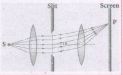
| S.No | Fresnel diffraction | Fraunhofer diffraction |
| (i) | Spherical or cylindrical wave front undergoes diffraction. | Plane wavefront undergoes diffraction. |
| (ii) | Light wave is from a source at finite distance. | Light wave is from a source at infinity. |
| (iii) | For laboratory conditions, convex lenses need not be used. | In laboratory conditions, convex lenses are to be used. |
| (iv) | Difficult to observe and analyse. | Easy to observe and analyse. |
| (v) | 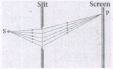 |
 |
6.
7.
fo = 125 cm; fe = 2 cm; m = ? L = ?; θi = ?
(a) Equation for magnification of telescope,
\(m=\cfrac { { f }_{ o } }{ { f }_{ e } } \)
Substituting, \(m=\cfrac { 125 }{ 2 } =62.5\)
(b) Equation for approximate length of telescope, L = fo+ fe
Substituting, L = 125 + 2 = 127 cm = 1.27 m
(c) Equation for angular magnification,\(m=\cfrac { { \theta }_{ 1 } }{ { \theta }_{ 0 } } \)
Rewriting, \({ \theta }_{ 1 }=m\times { \theta }_{ 0 }\)
Substituting,
\({ \theta }_{ i }=62.5\times 1'=62.5'=\cfrac { 62.5 }{ 60 } =1.04^{ o }\) = 1o2'30''
8.
D = 25 cm;
The magnifying lens must be a convex lens of positive focal length
f = 5 cm;
For closest object distance u', the image distance, v is, –25 cm. (near point, v = –D)
For farthest object distance u', the corresponding image distance, v' is infinity.
(a) To find closest distance between lens and book, we can use lens equation,\(\cfrac { 1 }{ v } -\cfrac { 1 }{ u } =\cfrac { 1 }{ f } \)
Rewriting for closest object distance \(\cfrac { 1 }{ u } =\cfrac { 1 }{ v } -\cfrac { 1 }{ f } \)
Substituting,
\(\cfrac { 1 }{ u } =\cfrac { 1 }{ -25 } -\cfrac { 1 }{ 5 } =\cfrac { 1 }{ 25 } =\cfrac { 1 }{ 5 } \left( \cfrac { -1-5 }{ 25 } \right) =-\cfrac { 6 }{ 25 } \)
\(u=-\cfrac { 25 }{ 6 } =4.167cm\)
The closest distance between the lens and the book is, u = –4.167 cm
To find farthest object distance, lens equation is, \(\cfrac { 1 }{ v' } -\cfrac { 1 }{ u' } =\cfrac { 1 }{ f' } \)
Rewriting for farthest object distance,\(\cfrac { 1 }{ u' } =\cfrac { 1 }{ v' } -\cfrac { 1 }{ f' } \)
Substituting,\(\cfrac { 1 }{ u' } =\cfrac { 1 }{ \infty } -\cfrac { 1 }{ 5 } ;u=-5cm\)
The farthest distance at which the person can keep the book is, u' = -5 cm.
(b) To find magnification in near point focusing, \(m=1+\cfrac { D }{ f } =1+\cfrac { 25 }{ 5 } =6\)
To find magnification in normal focusing, \(m=\cfrac { D }{ f } =\cfrac { 25 }{ 5 } =5\)
9.
λ = 5000 Å = 5000 x 10 -10 m; sin 30o = 0.5; n = 1; a =?
Equation for diffraction minimum is,
asin θ = nλ
The central maximum is spread up to the first minimum. Hence, n = 1
Rewriting, \(a=\cfrac { \lambda }{ sin\theta } \)
Substituting, \(a=\cfrac { 5000\times { 10 }^{ -10 } }{ 0.5 } \)
a = 1 x 10⁻⁶m = 0.001 x 10⁻³ m = 0.001 mm.
10.
λ = 500 nm = 500 x 10-9 m;
a = 0.2 mm = 0.2 x 10⁻³ m;
D = 60 cm = 60 x 10-2 m
(i) Equation for diffraction minimum is, a sin θ = nλ
The central maximum is spread up to the first minimum. Hence, n = 1
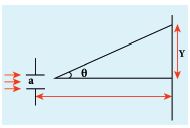
Rewriting, \(sin\theta =\cfrac { \lambda }{ a } \) (or) \(\theta =sin^{ -1 }\left( \cfrac { \lambda }{ a } \right) \)
Substituting,
\(\theta ={ sin }^{ -1 }\left( \cfrac { 500\times { 10 }^{ -9 } }{ 0.2\times { 10 }^{ -3 } } \right) ={ sin }^{ -1 }\left( 2.5\times { 10 }^{ -3 } \right) \)
\(\\ \theta =0.0025rad\)
(ii) To find the value of y1 for central maximum, which is spread up to first minimum with (n = 1) is, a sin θ = λ
As θ is very small, \(sin\theta \approx tan\theta =\cfrac { { y }_{ 1 } }{ D } \)
\(a\cfrac { { y }_{ 1 } }{ D } =\lambda \) rewriting, \({ y }_{ 1 }=\cfrac { \lambda D }{ a } \)
Substituting,
\({ y }_{ 1 }=\cfrac { 500\times { 10 }^{ -9 }\times { 10 }^{ -2 } }{ 0.2\times { 10 }^{ -3 } } =1.5\times { 10 }^{ -3 }=1.5mm\)
To find the value of y2 for second minimum with (n = 2) is, a sin θ = 2λ
\(a\cfrac { { y }_{ 2 } }{ D } =2\lambda \) rewriting ,\({ y }_{ 2 }=\cfrac { 2\lambda D }{ a } \)
Substituting,
\({ y }_{ 2 }=\cfrac { 2\times 500\times { 10 }^{ -9 }\times 60\times { 10 }^{ -2 } }{ 0.2\times { 10 }^{ -3 } } =3 \times 10^{-3}=3mm\)
The distance between the central maximum and second minimum is, y2 – y1
y2 – y1 = 3 mm – 1.5 mm = 1.5 mm
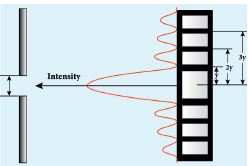
Note: The above calculation shows that in the diffraction pattern caused by single slit, the width of each maximum is equal with central maximum as the double that of others. But the bright and dark fringes are not of equal width.
11.
λ = 589 nm = 589 x 10−9 m
For the film to have strong reflection, the reflected waves should interfere constructively. The least optical path difference introduced by the film should be λ/2. The optical path difference between the waves reflected from the two surfaces of the film is 2μd. Thus, for strong reflection, 2μd = λ/2 [As given in equation 6.145. with n = 1]
Rewriting, \(d=\frac{\lambda}{4 \mu}\)
Substituting, \(d=\frac{589 \times 10^{9}}{4 \times 1.25}=117.8 \times 10^{-9}\)
d = 117.8 x 10-9 = 117.8 nm
For the film to be anti-reflecting, the reflected rays should interfere destructively. The least optical path difference introduced by the film should be λ. The optical path difference between the waves reflected from the two surfaces of the film is 2μd. For strong reflection, 2μd = λ [As given in equation 6.146. with n = 1]
Rewriting, \(d=\cfrac { \lambda }{ 2\mu } \)
Substituting, \(d=\cfrac { 589\times { 10 }^{ 9 } }{ 2\times 1.25 } =235.6\times { 10 }^{ -9 }\)
d = 235.6 x 10-9 = 235.6 nm
12.
λ1 = 560 nm = 560 x 10-9m;
λ1 = 420 nm = 420 x 10-9m;
D = 1 m; d = 3 mm = 3 x 10⁻³m
Here, n and λ are inversely proportional for a given y.
Here, nth order bright fringe of longer wavelength λ1 coincides with (n+1)th order bright fringe of shorter wavelength λ2.
Equation for nth bright fringe is, \({ y }_{ n }=n\cfrac { \lambda D }{ d } \)
Here, \(n\cfrac { { \lambda }_{ 1 }D }{ d } =(n+1)\cfrac { { \lambda }_{ 2 }D }{ d } \) (as λ1>λ2)
\({ n\lambda }_{ 1 }=\left( n+1 \right) { \lambda }_{ 2 }\) (or) \(\cfrac { { \lambda }_{ 1 } }{ { \lambda }_{ 2 } } =\cfrac { (n+1) }{ n } ;1+\frac{1}{n}=\frac{\lambda_1}{\lambda_2}\)
\(1+\cfrac { 1 }{ n } =\cfrac { 560\times { 10 }^{ -9 } }{ 420\times { 10 }^{ -9 } } \) (or) \(1+\cfrac { 1 }{ n } =\cfrac { 4 }{ 3 } \)
\(\frac{1}{n}=\frac{1}{3}\) (or) n = 3
Thus, the 3rd bright fringe of λ1 and the 4th bright fringe of λ2 coincide at the least distance y.
The least distance from the central fringe where the bright fringes of the two wavelengths coincide is, \(y_{n}=n \frac{\lambda D}{d}\)
\(y_{n}=3 \times \frac{560 \times 10^{-9} \times 1}{3 \times 10^{-3}}=560 \times 10^{-6} \mathrm{~m}\)
\(y_{n}=0.560 \times 10^{-3} \mathrm{~m}=0.560 \mathrm{~mm}\)
13.
d = 0.15 mm = 0.15 x 10⁻³ m; D = 2 m;
λ = 450 nm = 450 x 10-9 m; RI = 4/3
(a) Equation for nth bright fringe,
\({ y }_{ n }=n\cfrac { \lambda D }{ d } \)
Distance of 2nd bright fringe,
\({ y }_{ 2 }=2\times \cfrac { 450\times { 10 }^{ -9 }\times 2 }{ 0.15\times { 10 }^{ -3 } } \)
y2 = 12 x 10-3m = 12 mm
Equation for nth dark fringe,
\({ y }_{ n }=\cfrac { \left( 2n-1 \right) }{ 2 } \cfrac { \lambda D }{ d } \)
Distance of 3rd dark fringe,
\({ y }_{ 2 }=\cfrac { 5 }{ 2 } \times \cfrac { 450\times { 10 }^{ -9 }\times 2 }{ 0.15\times { 10 }^{ -3 } } \)
y2 = 15 x 10-3 m = 15 mm
(b) Equation for fringe width, \(\beta =\cfrac { \lambda D }{ d } \)
Substituting, \(\beta =\cfrac { 450\times { 10 }^{ -9 }\times 2 }{ 0.15\times { 10 }^{ -3 } } \)
\(\beta =6\times { 10 }^{ -3 }m=6mm\)
(iii) The fringe width will increase as D is increased,
\(\beta =\cfrac { \lambda D }{ d } \) (or) \(\beta \propto D\)
(iv) The fringe width will decrease as the setup is immersed in water of refractive index 4/3
\(\beta =\cfrac { \lambda D }{ d } \) (or) \(\beta \propto \lambda\)
We know that, \(\lambda '=\cfrac { \lambda }{ n } \)
\(\cfrac { \beta ' }{ \beta } =\cfrac { \lambda ' }{ \lambda } =\cfrac { \lambda /RI}{ \lambda } =\cfrac { 1 }{ RI } \) (or) \(\beta '=\cfrac { \beta }{ RI } =\cfrac { 6\times { 10 }^{ -3 } }{ 4/3 } \)
\(\beta '=4.5\times { 10 }^{ -3 }m=4.5mm\)
14.
Amplitudes, a1 = 5, a2 = 3
Resultant amplitude,
\(A=\sqrt { { a }_{ 1 }^{ 2 }+{ a }_{ 2 }^{ 2 }+2{ a }_{ 1 }{ a }_{ 2 }cos\varphi } \)
Resultant amplitude is maximum when,
\(\phi =0,cos0=1,{ A }_{ max }=\sqrt { { a }_{ 1 }^{ 2 }+{ a }_{ 2 }^{ 2 }+{ 2a }_{ 1 }{ a }_{ 2 } } \)
\(\\ { A }_{ max }=\sqrt { \left( { a }_{ 1 }+{ a }_{ 2 } \right) ^{ 2 } } =\sqrt { \left( 5+3 \right) ^{ 2 } } =\sqrt { \left( 8 \right) ^{ 2 } } \)
= 8 units
Resultant amplitude is minimum when
\(\phi =\pi,cos\pi=1,{ A }_{ max }=\sqrt { { a }_{ 1 }^{ 2 }+{ a }_{ 2 }^{ 2 }+{ 2a }_{ 1 }{ a }_{ 2 } } \)
\({ A }_{ max }=\sqrt { \left( { a }_{ 1 }-{ a }_{ 2 } \right) ^{ 2 } } =\sqrt { \left( 5-3 \right) ^{ 2 } } =\sqrt { \left( 2 \right) ^{ 2 } } \)
= 2units
\(I\infty { A }^{ 2 }\)
\(\cfrac { { I }_{ max } }{ { I }_{ min } } =\cfrac { \left( { A }_{ max } \right) ^{ 2 } }{ \left( { { A }_{ min } } \right) ^{ 2 } } \)
Substituting,
\(\cfrac { { I }_{ max } }{ { I }_{ min } } =\cfrac { \left( 8 \right) ^{ 2 } }{ \left( 2 \right) ^{ 2 } } =\cfrac { 64 }{ 4 } 16\) (or)
\({ I }_{ max }:{ I }_{ min }=16:1\)
15.
\(\mathrm{m}_{\alpha}=100 ; \mathrm{f}_{o}=0.5 \mathrm{~cm} ; \mathrm{f}_{\mathrm{e}}=? \)
\(\mathrm{~L}_{\alpha}=6.5 \mathrm{~cm}, \mathrm{D}=25 \mathrm{~cm} \)
When the image is formed at infinity,
\(\mathrm{m}_{\alpha}=\frac{\left(\mathrm{L}_{\alpha}-\mathrm{f}_{0}-\mathrm{f}_{\mathrm{c}}\right) \mathrm{D}}{\mathrm{f}_{0} \mathrm{f}_{\mathrm{e}}} \)
\(100 =\left(\frac{6.5-0.5-f_{e}}{0.5 \times f_{e}}\right) \times 25 \)
\(=\left(\frac{6-f_{e}}{0.5 f_{e}}\right) \times 25 \)
\(100 \times 0.5 f_{e} =150-25 f_{e} \)
\(50 f_{e} =150-25 f_{e} \)
\(75 f_{e} =150 \)
\(f_{e} =150 / 75=2 \mathrm{~cm} \)
16.
Advantages:
Only one surface it to be polished and maintained. Support can be given from the entire back of the miror rather than only at the rim for lens. Mirrors weigh much less compared to lens.
Disadvantages:
The objective mirror would focus the light inside the telescope tube.
17.
(i) Polaroids are used in goggles and cameras to avoid glare of light.
(ii) Polaroids are useful in 3D pictures i.e., in holography.
(iii) Polaroids are used to improve contrast in old oil paintings.
(iv) Polaroids are used in optical stress analysis.
(v) Polaroids are used as window glasses to control the intensity of incoming light.
(vi) Polarised laser beam acts as needle to read/ write in compact discs (CDs).
(vii) Polarised lights is used in liquid crystal display (LCD).
18.
When a beam of plane polarised light of intensity (Io) is incident on an analyser, the intensity of light (I) transmitted from the analyser varies directly as the square of the cosine of angle between the transmission axes of polariser and analyser.
\(I={ I }_{ o }cos^{ 2 }\theta \)
Consider the plane of polariser and analyser are inclined to each other at an angle ፀ. Let Io be the intensity and 'a' be the amplitude of the electric vector transmitted by the polariser. The amplitude 'a' of the incident light has two rectangular components, (acosθ) and (asinθ) which are the parallel and perpendicular components to the axis of transmission of the analyser. Only the component (acosθ) will be transmitted by the analyzer.
According to Malus's law
\(I\propto \left( acos\theta \right) ^{ 2 }\)
\(I=k\left( acos\theta \right) ^{ 2 }\)
Where k is constant of proportionality,
I = ka2 cos2 θ
I = Io = cos2 θ
Where Io = ka2 is the maximum intensity of light transmitted from the analyser.
19.
Plane Polarised Light:
In plane polarised light the intensity varies from maximum to zero for every rotation of 90° of the analyser.
Partially Polarised Light:
If the intensity of light varies between maximum and minimum for every rotation of 90° of the analyser, the light is said to be partially polarised light.
Unpolarise Light:
The light is coming out from the source before entering a polarised is called unpolarized light.
20.
| S.No |
Polarised Light |
Unpolarised Light |
|---|---|---|
| (i) | It consists of waves having their electric field vibrations in a single plane normal to the direction of ray. | It consists of waves having their electric field and magnetic field vibrations in all directions normal to the direction of ray. |
| (ii) | Asymmetrical about the ray direction | Symmetrical about the ray direction. |
| (iii) | |It is obtained by converting unpolarised light using polaroids. | Produced by conventional light sources. |
21.
Fresnel's distance is the distance upto which the ray optics is valid in terms of rectilinear propagation of light.
(or)
Fresnel's distance is the distance upto which ray optics is obeyed and beyond which ray optics is not obeyed but, wave optics becomes significant,
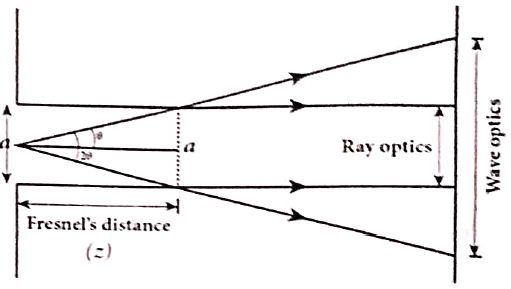
The diffraction equation for first minimum is, sinθ \(=\frac{ \lambda}{2};\)
When θ is small, θ \(=\frac{ \lambda}{2}\)
From the definition of Fresnel's distance, 2θ\(=\frac{a}{z}\) (or) θ \(=\frac{a}{2z}\)
Equating the above two equation for θ gives, \(\frac{\lambda}{a}=\frac{a}{2z}\)
After rearranging, we get Fresnel's distance z as,
\(z=\cfrac { { a }^{ 2 } }{ 2\lambda } \)
22.
Condition for bright fringe (or) maxima :
The condition for the point P to have a constructive interference (or) be a bright fringe Is,
Path diference, δ = nλ Where, n = 0, 1, 2,....
\(\therefore\frac{dy}{D}=n\lambda\)
\(y=n\frac{\lambda D}{d}(or)y_n=n\frac{\lambda D}{d}\) .....(4)
This is the condition for the point P to have a bright fringe. The distance yn is the distance or the nth bright fringe from the point O.
Condition for dark fringe (or) minima:
The condition for the point P to have a destructive interference (or) be a dark fringe is,
Path difference, δ = \((2n-1)\frac{\lambda}{2}\) Where, n = 1, 2, 3....
\(\therefore\frac{dy}{D}=(2n-1)\frac{\lambda}{2}\)
\(y=\left(\frac{(2n-1)}{2} \frac{\lambda D}{d}\right)(or)\left(\frac{(2 n-1)}{2} \frac{\lambda D}{d}\right) \) .....(5)
This is the condition for the point P to have a dark fringe. The distance yn is the distance of the nth dark fringe from the point O
Bandwidth:
The bandwidth \((\beta)\) is defined as the distance between any two consecutive bright or dark fringes.
\(\beta=y_{(n+1)}-y_{n}=\left((n+1) \frac{\lambda D}{d}\right)-\left(n \frac{\lambda D}{d}\right) \)
\(\beta=\frac{\lambda D}{d} \) .....(6)
Bright and Dark tinges are of same width equally spaced on either side of the central bright fringe.

12th Standard Syllabus & Materials
12th Standard
TN 12th Computer Applications களப்பெயர் முறைமை (DNS) Sample Question Papers Study Material - QB365 Set A
NEW12th Standard
TN 12th Computer Applications வலையமைப்பு எடுத்துக்காட்டுகள் மற்றும் நெறிமுறைகள் Sample Question Papers Study Material - QB365 Set A
NEW12th Standard
TN 12th Computer Applications கணினி வலையமைப்பு ஓர் அறிமுகம் Sample Question Papers Study Material - QB365 Set A
NEW12th Standard
TN 12th Computer Applications PHP-உடன் MySQL-ஐ இணைத்தல் Sample Question Papers Study Material - QB365 Set A



Tamilnadu Stateboard 12th Standard Subjects

Maths

Chemistry
Physics

Biology

Computer Science

Business Maths and Statistics

Economics

Commerce

Accountancy

History

Computer Applications
Biology
Computer Technology
Computer Applications
Computer Science
Business Maths and Statistics
Commerce
Economics
Maths
Chemistry
Physics
Computer Technology
History
Accountancy

Tamil

English

French
Tamilnadu Stateboard Standards

