
 100% FREE ACCESS
12th Standard Syllabus & Materials
12th Standard
TN 12th Maths Applications of Matrices and Determinants Sample Question Papers Study Material - QB365 Set A
NEW12th Standard
TN 12th Computer Applications மின்னணு தரவு பரிமாற்றம் Sample Question Papers Study Material - QB365 Set A
NEW12th Standard
TN 12th Computer Applications மின் - வணிக பாதுகாப்பு அமைப்புகள் Sample Question Papers Study Material - QB365 Set A
NEW12th Standard
TN 12th Computer Applications மின்னணு செலுத்தல் முறைகள் Sample Question Papers Study Material - QB365 Set A
NEW12th Standard
TN 12th Computer Applications மின் - வணிகம் Sample Question Papers Study Material - QB365 Set A
NEW12th Standard
TN 12th Computer Applications திறந்த மூல கருத்துருக்கள் Sample Question Papers Study Material - QB365 Set A

Published on: 02/09/2022
QB365 provides a detailed and simple solution for every Possible Book Back Questions in Class 12 Physics Subject - Retirement and Death of a Partner, English Medium. It will help Students to get more practice questions, Students can Practice these question papers in addition to score best marks.
Download Tamil Nadu 12th Standard Physics question papers, model tests, one-mark questions, important questions, and public exam papers in PDF format. Free study materials and answer keys for TN State Board students.
Questions + Answers key
Take MCQ Physics Test1.
State Snell’s law/law of refraction.
2.
When a wave undergoes reflection at a denser medium, what happens to its phase?
3.
A small disc is placed in the path-of the light from distance source. Will the center of the shadow be bright or dark?
4.
Is there any difference between coloured light obtained from prism and colours of soap bubble?
5.
Does diffraction take place at the Young's double slit?
6.
Two independent monochromatic sources cannot act as coherent sources, why?
7.
Why does sky look blue and clouds look white?
8.
What type of lens is formed by a bubble inside water?
9.
Why are dish antennas curved?
10.
Find the dispersive power of a prism if the refractive indices of flint glass for red, green and violet colours are 1.613, 1.620 and 1.632 respectively.
11.
The angle of minimum deviation for an equilateral prism is 37o . Find the refractive index of the material of the prism.
12.
A monochromatic light is incident on an equilateral prism at an angle 30o and is emergent at an angle of 75o . What is the angle of deviation produced by the prism?
13.
If the focal length is 150 cm for a lens, what is the power of the lens?
14.
A optical fibre is made up of a core material with refractive index 1.68 and a cladding material of refractive index 1.44. What is the acceptance angle of the fibre if it is kept in air medium without any cladding?
15.
A coin is at the bottom of a trough containing three immiscible liquids of refractive indices 1.3, 1.4 and 1.5 poured one above the other of heights 30 cm, 16 cm, and 20 cm respectively. What is the apparent depth at which the coin appears to be when seen from air medium outside? In which medium the coin will appear?
16.
Light travelling through transparent oil enters in to glass of refractive index 1.5. If the refractive index of glass with respect to the oil is 1.25, what is the refractive index of the oil?
17.
Pure water has refractive index 1.33. What is the speed of light through it?
18.
What is the height of the mirror needed for a person to see his/her image fully on the mirror?
19.
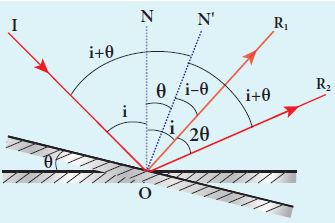
Prove that for the same incident light when a reflecting surface is tilted by an angle θ, the reflected light will be tilted by an angle 2θ.
20.
An object is placed in front of a concave mirror of focal length 20 cm. The image formed is three times the size of the object. Calculate two possible distances of the object from the mirror.
21.
An object is placed at a certain distance from a convex lens of focal length 20 cm. Find the object distance if the image obtained is magnified 4 times.
22.
Discuss about simple microscope and obtain the equations for magnification for near point focusing and normal focusing.
23.
What is Rayleigh’s scattering?
24.
Why do clouds appear white?
25.
What is the reason for reddish appearance of sky during sunset and sunrise?
26.
Why does sky appear blue?
27.
How are rainbows formed?
28.
What is dispersion?
29.
What is angle of minimum deviation?
30.
What is power of a lens?
31.
What are the sign conventions followed for lenses?
32.
What are primary focus and secondary focus of a lens?
33.
How does an endoscope work?
34.
What are the Cartesian sign conventions for spherical mirrors?
35.
Write a note on optical fibre.
36.
What is Snell’s window?
37.
Write a short note on the prisms making use of total internal reflections.
38.
What are mirage and looming?
39.
Explain the reason for the glittering of diamond.
40.
Why do stars twinkle?
41.
What is relative refractive index?
42.
What is principle of reversibility?
43.
What is angle of deviation due to refraction?
1.
(i) The incident ray, refracted ray and normal to the refracting surface are all coplanar (ie. lie in the same plane).
(ii) The ratio of sine of angle of incident i in the first medium to the sine of angle of refraction r in the second medium is equal to the ratio of refractive index of the second medium n2 to that of the refractive index of the first medium n1.
\(\frac{sin \ i}{sin \ r}=\frac{n_2}{n_1}(Snell's \ law)\)
n1 sin i = n2 sin r
2.
When a wave undergoes reflection at a denser mediums, Its phase changes at 180o.
3.
The centre of the shadow will be bright.
4.
Yes, there is a difference between coloured light obtained from prism and soap bubble Dispenion takes place in prism. Interference takes place in soap bubbles.
5.
No, Diffraction does not take place at the young's double slit. Interference takes place in young's double slit.
6.
Two independent monochromatic sources cannot act as coherent sources because they emit wanes of same frequency, same amplitude but not with same phase.
7.
Sky appears blue :
when white light from the sun enters the earth's atmosphere scattering takes place.
According to Ray light's scattering
\(\text { Law, } \operatorname{S\alpha } \frac{1}{\lambda_{4}}\)
8.
Concave Lens:
1. It is a lens that diverges a light beam that falls on it.
2. It has at least one surface that is curved inside.

Air Bubble:
1. These are circular spheres made up of thin water films and contain air.
2. The surface of an air bubble in water bulges outwards due to the air pressure inside the bubble.
How does an air bubble act like a concave lens:
1. The refractive index of water is greater than that of air, ηwater>ηair. This implies that, water is a denser medium than air.
2. Let us consider that a light ray passes through water and enters an air bubble. So, the light ray enters from a denser to rarer medium. So, a ray diagram can be drawn as given below.
3. The ray of light entering the air bubble will diverge, since the ray of light entering from a denser to rarer medium bends away from the normal.
4. Hence, it behaves like a concave lens.

Hence, the air bubble inside water behaves like a concave lens.
9.
(i) Dish antennas are curved because it receives parallel signal rays coming from the same direction.
(ii) These rays are reflected by parabolic dish and gathered at maintained antenna part which increases directivity of antenna and gives sufficient amplitude signal.
10.
Given, nv = 1.632; nR = 1.613; nG = 1.620
Equation for dispersive power is,
\(\omega =\cfrac { \left( { n }_{ v }-{ n }_{ g } \right) }{ \left( { n }_{ G }-1 \right) } \)
Substituting the values,
\(\omega =\cfrac { 1.632-1.613 }{ 1.620-1 } =\cfrac { 0.019 }{ 0.620 } =0.0306\)
The dispersive power of the prism is,\(\\ \omega =0.0306\)
11.
Given, A = 60°; D = 37°
Equation for refractive index is,
\(n=\cfrac { \sin\left( \frac { A+D }{ 2 } \right) }{ \sin\left( \frac { A }{ 2 } \right) } \)
Substituting the values,
\(n=\cfrac { \sin\left( \frac { 60^{ o }+37^{ o } }{ 2 } \right) }{ \sin\left( \cfrac { { 60 }^{ o } }{ 2 } \right) } =\cfrac { \sin\left( 48.5^{ o } \right) }{ \sin\left( { 30 }^{ o } \right) } =1.5\)
The refractive index of the material of the prism is, n = 1.5
12.
Since, the prism is equilateral, A = 60o;
Given, i1 = 30o;i2 = 75o
Equation for angle of deviation, d = i1 + i2 – A
Substituting the values, d = 30°+ 75°– 60°= 45°
The angle of deviation produced d = 45o
13.
Given, focal length, f = 150 cm = 1.5 m
Equation for power of lens is, \(p=\cfrac { 1 }{ f } \)
Substituting the values,
\(p=\cfrac { 1 }{ 1.5 } =0.67 D\)
As the power is positive, it is a converging lens.
14.
Given, n1 = 1.68, n2 = 1.44, n3 = 1
Acceptance angle, \(\\ { i }_{ a }={ sin }^{ -1 }\left( \sqrt { { n }_{ 1 }^{ 2 }-{ n }_{ 2 }^{ 2 } } \right) \)
\({ i }_{ a }={ sin }^{ -1 }\left( \sqrt { \left( 1.68 \right)^2 -\left( 1.44 \right) ^{ 2 } } \right) ={ sin }^{ -1 }\left( 0.865 \right) \)
\({ i }_{ a }\simeq { 60 }^{ o }\)
If there is no cladding then, n2 = 1
Acceptance angle, \({ i }_{ a }={ sin }^{ -1 }\left( \sqrt { { n }_{ 1 }^{ 2 }-1 } \right) \)
\({ i }_{ a }={ sin }^{ -1 }\left( \sqrt { \left( 1.68 \right) ^{ 2 }-1 } \right) ={ sin }^{ -1 }\left( 1.35 \right) \)
sin−1(more than 1) is not possible. But, this includes the range 0o to 90o. Hence, all the rays entering the core from flat surface will undergo total internal reflection.
Note: If there is no cladding then there is a condition on the refractive index (n1) of the core
\({ i }_{ a }={ sin }^{ -1 }\left( \sqrt { { n }_{ 1 }^{ 2 }-1 } \right) \)
Here, as per mathematical rule,
\(\left( { n }_{ 1 }^{ 2 }-1 \right) \le 1\) or \(\left( { n }_{ 1 }^{ 2 } \right) \le 2\) or \({ n }_{ 1 }\le \sqrt { 2 } \)
Hence, in air (no cladding) the refractive index n1 of the core should be,\({ n }_{ 1 }\le 1.414\)
15.
When seen from (air medium) on top, the coin will still appear to be at the bottom with each medium appearing to have shrunk with respect to the air medium outside. This situation is illustrated below.
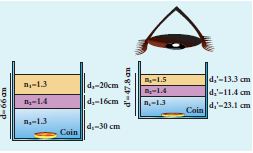
The equations for apparent depth for each medium is,
\({ d' }_{ 1 }=\cfrac { { d }_{ 1 } }{ { n }_{ 1 } } ;{ d }_{ 2 }^{ ' }=\cfrac { { d }_{ 2 } }{ { n }_{ 2 } } ;{ d }_{ 3 }^{ ' }=\cfrac { { d }_{ 3 } }{ { n }_{ 3 } } \)
\({ d }^{ ' }={ d }_{ 1 }^{ ' }+{ d }_{ 2 }^{ ' }+{ d }_{ 3 }^{ ' }=\cfrac { { d }_{ 1 } }{ n_{ 1 } } +\cfrac { { d }_{ 2 } }{ { n }_{ 2 } } +\cfrac { { d }_{ 3 } }{ n_{ 3 } } \)
\(d'=\cfrac { 30 }{ 1.3 } +\cfrac { 1.6 }{ 1.4 } +\cfrac { 30 }{ 1.5 } =23.1+11.4+13.3\)
d' = 47.8 cm
16.
Given, ngo = 1.25 and ng = 1.5
Refractive index of glass with respect to oil,
\({ n }_{ go }=\cfrac { { n }_{ g } }{ { n }_{ 0 } } \)
Rewriting for refractive index of oil,
\({ n }_{ p }=\cfrac { { n }_{ g } }{ { n }_{ go } } =\cfrac { 1.5 }{ 1.25 } =1.2\)
The refractive index of oil is, no = 1.2
17.
\(n=\cfrac { c }{ v } ;\quad v=\cfrac { c }{ n } \)
\(v=\cfrac { 3\times { 10 }^{ 8 } }{ 1.33 } =2.26\times { 10 }^{ 8 }{ ms }^{ -1 }\)
Light travels with a speed of 2.26 x 10⁸ m s-1 through pure water.
18.
Let us assume a person of height h is standing in front of a vertical plane mirror. The person could see his/her head when light from the head falls on the mirror and gets reflected to the eyes. Same way, light from the feet falls on the mirror and gets reflected to the eyes.
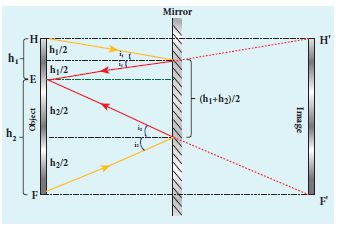
If the distance between his head H and eye E is h1 and distance between his feet F and eye E is h2. The person’s total height is, h Here it is, h = h1 + h2
By the law of reflection, the angle of incidence and angle of reflection are the same in the two extreme reflections. The normals are now the bisectors of angles between incident and reflected rays in the two points. By geometry, the height of the mirror needed is only half of the height of the person. \( \frac { { h }_{ 1 }+{ h }_{ 2 } }{ 2 } =\frac { h }{ 2 } \).
Does the height depend on the distance between the person and the mirror?
19.
AB is the reflecting surface as shown in the Figure. Both the incident ray IO and the reflected ray OR1 subtend angle i with the normal N as the angle of incidence is equal to angle of reflection. When the surface AB is tilted to A'B' by an angle θ, the normal N is also is tilted to N' by the same angle θ.Remember that the position of the incident ray IO remains unaltered. But the reflected ray now is OR2.
Now, in the tilted system, the angle of incidence, ∠N'OI = i + θ and the angle of reflection, ∠N'OR2 = i + θ are the same. The angle between ON' and OR1 is, ∠N'OR1 = i – θ. The angle tilted on the reflected light is the angle between OR1 and OR2 which is ∠R1OR2. From the geometry we can write,
\(\angle { R }_{ 1 }O{ R }_{ 2 }=\angle N'{ { OR }_{ 2 } }-\angle { NOR }_{ 1 }\) \(=\left( i+\theta \right) -\left( i-\theta \right) =2\)
∠R1 OR2 = 2θ.
20.
\(v=\pm 3u, f=\mp 20 cm\)
Case i :
V = -3u,
\(\frac{1}{f} =\frac{1}{u}+\frac{1}{v} =\frac{1}{u}-\frac{1}{3 u} =\frac{2}{3 u} \)
\(\)3u = 2f
\(u=\frac{2 f}{3}=\frac{2 \times(-20)}{3} \)
\(u=\frac{-40}{3} \mathrm{~cm} \)
Case ii :
v = 3u
\(\frac{1}{f} =\frac{1}{u}+\frac{1}{3 u} \)
\(=\frac{4}{3 u} \)
3u = 4f = -4 x 20
\(u=\frac{-4 \times 20}{3} \)
\(u=\frac{-80}{3} \mathrm{~cm} \)
21.
\(\frac{1}{f}=\frac{1}{v}-\frac{1}{u} \)
\(m=\frac{-v}{u}=-4, f=20 \mathrm{~cm} \text { (Given) } \)
V = 4u
\(\frac{1}{f} =\frac{1}{4 u}-\frac{1}{u} \)
\(=\frac{1-4}{4 u}=\frac{-3}{4 u} \)
\(\frac{1}{f} =\frac{-3}{4 u} \)
4u = -3 x f
\(u=\frac{-3}{4} \times 20=-15 \mathrm{~cm}\)
22.
(i) A simple microscope is a single magnifying (converging) lens of a small focal length.
(ii) To get an erect, magnified, and virtual image of the object, the object is placed between F and P on one side of the Jens and viewed from another side of the lens.
(iii) There are two magnifications for two kinds of focusing.
(iv) The image is formed at infinity.
(v) The angular magnification is defined as the ratio of angle e, subtended by the image with an aided eye to the angle 80 subtended by the object with the unaided eye.
(vi) This is the magnification for normal focusing.
(vii) The magnification for normal focusing is one less than that for near point focusing.
23.
If the scattering of light is by atoms and molecules which have size a yery less than that of the wavelength \({\lambda}\) of light a << \({\lambda}\) the scattering is called Rayleigh's scattering.
The intensity of Rayleigh's scattering is inversely proportional to fourth power of wavelength
\(\mathrm{I} ∝ \frac{1}{\lambda^{4}}\)
24.
(i) If light is scattered by large particles like dust and water droplets present in the atmosphere which have size a greater than the wavelength \(\lambda\) of light, a > > \(\lambda\), the intensity of scattering is equal for all the wavelengths.
(ii) It is happening in clouds which contains large amount of dust and water droplets. Thus, in clouds all the colours get equally scattered irrespective of wavelength. so, the clouds appears white.
25.
(i) During sunrise and sunset, the light from sun travels a greater distance through the atmosphere.
(ii) Hence, the blue light which has shorter wavelength is scattered away and the less scattered red light of longer wavelength manages to reach our eye.
(iii) This is the reason for the reddish appearance of sky during sunrise and sunset.
26.
\(\mathrm{I} ∝ \frac{1}{\lambda^{4}}\)
According to Rayleigh's scattering equation, violet colour which has the shortest wavelength gets much scattered during day time. The next scattered colour is blue. As our eyes are more sensitive to blue colour than violet colour the sky appears blue during day time.
27.
Rainbows is an example of dispersion of sunlight through droplets of water during rainy days. Rainbow is formed, where sunlight falls on the water drop of rainfall suspended in air. It splits into its constituent seven colours. Primary rainbow is formed when light entering the drop undergoes arc total internal reflection.
28.
Dispersion is splitting of white light into its constituent colours. This band of Colours of light is called its spectrum.
29.
Angle of minimum deviation:
(i) The angle between the direction of incident ray and the emergent of a prism called the 'Angle of deviation' 'd'.
(ii) The minimum value of angle of deviation is called 'Angle of minimum deviation' 'D'.
At 'D' i1 = i2 , r1 = r2
30.
The power of a lens P is defined as the reciprocal of its focal length (in metre).
\(P=\frac{1}{f}\)
31.
Sign conventions for lens
(i) The sign of focal length is not decided on the direction of measurement of the focal length from the pole of the lens as they have two focal lengths, one to the left and another to the right.
(ii) The focal length of the thin lens is taken as positive for a converging lens and negative for a diverging lens.
(iii) The other sign conventions for object. distance, image distance, radius of curvature, object height and image height remain the same for thin lenses as that of spherical mirrors.
32.
Primary focus:
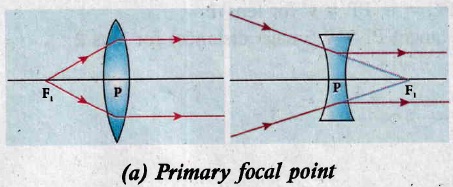
(i) The primary focus FI is defined as a point where an object should be placed to give parallel emergent rays to the principal axis after passing through lens.
Secondary focus:
.jpg)
(ii) The secondary focus F2 is defined as a point where all the parallel rays travelling close to the principal axis converge to form an image on the principal axis after passing through lens.
33.
An endoscope is an instrument used by doctors which has a bundle of optical fibres that are used to see inside a patient's body. Endoscopes work on the phenomenon of total internal reflection. The optical fibres are inserted in to the body through mouth, nose or a special hole made in the body.
34.
Cartesian sign conventions for a spherical mirror
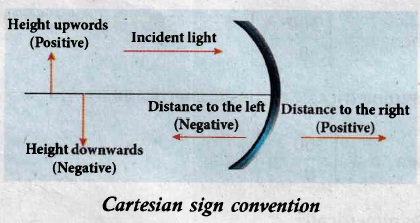
(i) The incident light is taken as if it is travelling from left to right (i.e. object on the left of mirror).
(ii) All the distances are measured from the pole of the mirror (pole is taken as origin).
(iii) The distances measured to the right of pole along the principal axis are taken as positive.
(iv) The distances measured to the left of pole along the principal axis are taken as negative.
(v) Heights measured upwards perpendicular to the principal axis are taken as positive.
(vi) Heights measured downwards perpendicular to the principal axis are taken as negative.
35.
(i) Optical fibers consist of the inner part called core and the outer part called cladding (or) sleeving. The refractive index of core is higher than that of cladding.
(ii) Signal in the form of light is made to incident inside the core-cladding boundary at an angle greater than the critical angle. So, that total internal reflection happens without undergoing any refraction. The light travels without appreciable loss of intensity.
36.
When light entering the water from outside is seen from inside the water, the view is restricted to a particular angle equal to the critical angle ic. The restricted illuminated circular area is called Snell's window
37.
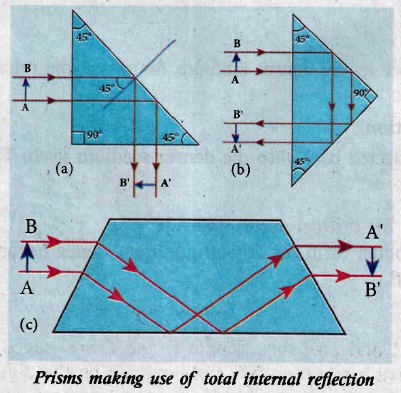
Prisms can be designed to reflect light by 90o or by 180o by making use of total internal reflection from the Figures (a) and (b). In the first two cases, the critical angle ic for the material of the prism must be less than 45o. Prisms are also used to invert images without changing their size as shown in Figure(c).
38.
Mirage:
Mirage is an optical illusion caused by atmospheric conditions especially the appearance of sheet of water in a desert caused by total internal reflection (or) refraction of light from the sky by heated air.
Looming:
Looming is an optical illusion caused by bending of light which appear an object floating high above its actual position specially in polar region.
39.
Diamond appears glittering because the total internal reflection of light.
Inside the diamond the refractive index of diamond is about 2.417 which is greater than the refractive index of glass. (μg =1.5). The critical angle of diamond is 24.4d which is much less than that of glass (gcrown = 40.5°, gflint 31.9°).
So, when the light enters the diamond, the total internal reflection of light happens inside the diamond before getting out. This gives a sparkling effect for diamond.
40.
Stars appear twinkling because of the movement of the atmospheric layer with varying refractive indices due to refraction.
41.
\(\cfrac { sini }{ sinr } =\cfrac { { n }_{ 1 } }{ { n }_{ 2 } } \) (Snell's law)
The term \(\left( \cfrac { { n }_{ 2 } }{ { n }_{ 1 } } \right) \) is called relative refractive index of second medium with respect to the first medium \(n_{21}=\left( \cfrac { { n }_{ 2 } }{ { n }_{ 1 } } \right) \)
(i) Inverse rule: \(n_{21}=\frac{1}{n_{21}}(or)\cfrac { { n }_{ 1 } }{ { n }_{ 2 } }=\frac{1}{(n_2/n_1)}\)
(ii) Chain rule: \(n_{32}=n_{31} \times n_{21}(or)\frac{n_3}{n_2}=\frac{n_3}{n_1}\times\frac{n_1}{n_2}\)
42.
The principle of reversibility states that light will follow exactly the same path if its direction of travel is reversed.
43.
The angle between the incident and deviated light is called Angle of deviation due to refraction. When light travels from
(i) rarer to denser medium, d = i - r
(ii) denser to rarer medium, d = r - i

12th Standard Syllabus & Materials
12th Standard
TN 12th Computer Applications வலையமைப்பு வடமிடல் Sample Question Papers Study Material - QB365 Set A
NEW12th Standard
TN 12th Computer Applications களப்பெயர் முறைமை (DNS) Sample Question Papers Study Material - QB365 Set A
NEW12th Standard
TN 12th Computer Applications வலையமைப்பு எடுத்துக்காட்டுகள் மற்றும் நெறிமுறைகள் Sample Question Papers Study Material - QB365 Set A
NEW12th Standard
TN 12th Computer Applications கணினி வலையமைப்பு ஓர் அறிமுகம் Sample Question Papers Study Material - QB365 Set A



Tamilnadu Stateboard 12th Standard Subjects

Maths

Chemistry
Physics

Biology

Computer Science

Business Maths and Statistics

Economics

Commerce

Accountancy

History

Computer Applications
Biology
Computer Technology
Computer Applications
Computer Science
Business Maths and Statistics
Commerce
Economics
Maths
Chemistry
Physics
Computer Technology
History
Accountancy

Tamil

English

French
Tamilnadu Stateboard Standards

