
 100% FREE ACCESS
12th Standard Syllabus & Materials
12th Standard
TN 12th Maths Applications of Matrices and Determinants Sample Question Papers Study Material - QB365 Set A
NEW12th Standard
TN 12th Computer Applications மின்னணு தரவு பரிமாற்றம் Sample Question Papers Study Material - QB365 Set A
NEW12th Standard
TN 12th Computer Applications மின் - வணிக பாதுகாப்பு அமைப்புகள் Sample Question Papers Study Material - QB365 Set A
NEW12th Standard
TN 12th Computer Applications மின்னணு செலுத்தல் முறைகள் Sample Question Papers Study Material - QB365 Set A
NEW12th Standard
TN 12th Computer Applications மின் - வணிகம் Sample Question Papers Study Material - QB365 Set A
NEW12th Standard
TN 12th Computer Applications திறந்த மூல கருத்துருக்கள் Sample Question Papers Study Material - QB365 Set A

Published on: 02/09/2022
QB365 provides a detailed and simple solution for every Possible Creative Questions in Class 12 Physics Subject - Retirement and Death of a Partner, English Medium. It will help Students to get more practice questions, Students can Practice these question papers in addition to score best marks.
Download Tamil Nadu 12th Standard Physics question papers, model tests, one-mark questions, important questions, and public exam papers in PDF format. Free study materials and answer keys for TN State Board students.
Questions + Answers key
Take MCQ Physics Test1.
Obtain the lens maker’s formula for a lens of refractive index n2 which is separating two media of refractive indices n1 and n3 on the left and right respectively.
2.
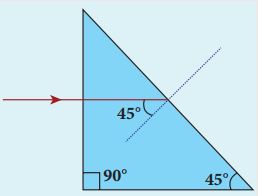
A beam of light consisting of red, green and blue is incident on a right-angled prism as shown in figure. The refractive index of the material of the prism for the above red, green and blue colours are 1.39, 1.44 and 1.47 respectively. What are the colours suffer total internal reflection?
3.
A thin biconvex lens is made up of a glass of refractive index 1.5. The two surfaces have equal radii of curvature of 30 cm each. One of its surfaces is made reflecting by silvering it from outside. (a) What is the focal length and power of this silvered lens? (b) Where should an object be placed in front of this lens so that the image is formed on the object itself?
4.
The image of a candle is formed by a convex lens on a screen. The lower half of the lens is painted black to make it completely opaque. Draw the ray diagram to show the image formation. How will this image be different from the one obtained when the lens is not painted black?
5.
Use the lens equation to deduce algebraically the following:
"An object placed within the focus of a convex lens produces a virtual and enlarged image".
6.
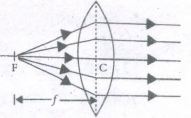
An object is placed at the principal focus of a convex lens. Determine the position of the image making use of the lens equation.
7.
What is thin lens?
8.
Define refractive index of a medium.
9.
Write the difference between paraxial rays and marginal rays.
10.
What is focus (or) focal point of a mirror?
11.
What is principal axis of the mirror?
12.
Write the conditions for nature of objects and images.
13.
Obtain the equation for of microscope.
14.
What is intensity division?
15.
State the laws of reflection
1.
(i) Consider a thin lens made up of a medium of refractive index n2 placed in a medium of refractive. index n1 on its left and medium of refractive index n3 on its right. Let R1 and R2 be the radii of curvature of two spherical surfaces (1) and (2) respectively and P be the pole.
(ii) A paraxial ray from O forms image at I' after refraction at surface (1). Before that it is again refracted by the surface (2) due to which final image is formed at I.
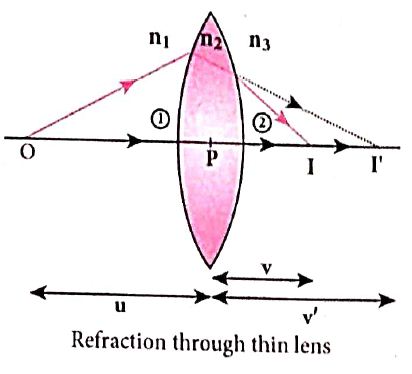
For the refracting surface (1), the light goes from n1 to n2.
\(\frac{\mathrm{n}_{2}}{\mathrm{v}^{\prime}}-\frac{\mathrm{n}_{1}}{\mathrm{u}}=\frac{\mathrm{n}_{2}-\mathrm{n}_{1}}{\mathrm{R}_{1}}\) ...(1)
For the refracting surface (2), the light goes from n2 to n3.
Then, \(\frac{\mathrm{n}_{3}}{\mathrm{v}}-\frac{\mathrm{n}_{2}}{\mathrm{v}^{\prime}}=\frac{\mathrm{n}_{3}-\mathrm{n}_{2}}{\mathrm{R}_{2}}\) ......(2)
Add equations (1) and (2)
\(\frac{n_{3}}{v}-\frac{n_{1}}{u}=\frac{n_{2}-n_{1}}{R_{1}}+\frac{n_{3}-n_{2}}{R_{2}}\) ....(3)
2.
\(n =\frac{1}{\sin c} \)
\(=\frac{1}{\sin 45^{0}}=\frac{1}{\frac{1}{\sqrt{2}}}=\sqrt{2}=1.414 \)
nR = 1.39
nG = 1.44
n = 1.47
Here nR < n
Since nR < n, Red colour only will emerge out of prism.
Since \(n_{G}>n \ \& \ n_{B}>n\) Blue and green undergo total internal reflection.
3.
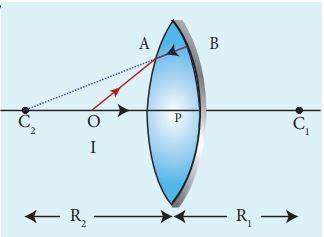
Given, n = 1.5; R1 = 30 cm; R2 = –30 cm;
(a) Let us find fl and fm separately.
Using lens maker’s formula we can find fl .
\(\frac{1}{f_{l}}=(n-1)\left(\frac{1}{R_{1}}-\frac{1}{R_{2}}\right)\)
Substituting the values, \(\frac{1}{f_{l}}=(1.5-1)\left(\frac{1}{30}-\frac{1}{-30}\right)\)
\(\frac{1}{f_{l}}=(0.5)\left(\frac{1}{30}+\frac{1}{-30}\right)=\left(\frac{1}{2}\right)\left(\frac{2}{30}\right)=\frac{1}{30 \mathrm{~cm}}\)
f l = 30 cm = 0.3 m
Focal length of mirror is, \(f_{m}=\frac{R_{2}}{2}\)
Substituting the values, \(f_{m}=\frac{-30}{2}=-15 \mathrm{~cm}\)
f m = 15 cm = –0.15 m
Now the focal length of the slivered lens is,
\(\frac{1}{-f}=\frac{2}{f_{l}}+\frac{1}{-f_{m}}=\frac{2}{30}+\frac{1}{15}=\frac{2}{15}=\frac{1}{7.5}\)
f = – 7.5 cm = –0.075 m
The silvered mirror behaves as a concave mirror with its focal length on left side.
To find the power of the silvered lens,
P = 2Pl + Pm
\(P=\frac{2}{f_{l}}+\frac{1}{-f_{m}}=\frac{2}{0.3}+\frac{1}{-(-0.15)}\)
\(=\frac{2}{0.3}+\frac{1}{0.15}=\frac{4}{0.3}=13.33 D\)
As the power is positive it is a converging system.
[Note: Here, we come across a silvered lens which has negative focal length and positive power. Which implies that the focal length is to the left and the system is a converging one. Such situations are possible in silvered lenses because a silvered lens is basically a modified mirror.]
(b) Writing the mirror formula,
\(\frac{1}{f}=\frac{1}{v}+\frac{1}{u}\)
Here, both u and v are same (v = u) as the image coincides with the object.
\(\frac{1}{-7.5 \mathrm{~cm}}=\frac{1}{u}+\frac{1}{u}=\frac{2}{u} ; \mathrm{u}=-2 \times 7.5 \mathrm{~cm}\)
u = –15 cm = –0.15 m
The object is to be placed 15 cm to the left of the silvered lens.
4.
The full size of the image will be obtained. But the intensity of image will be reduced. This is because the number of rays of light refracted through different parts of the lens will be reduced.
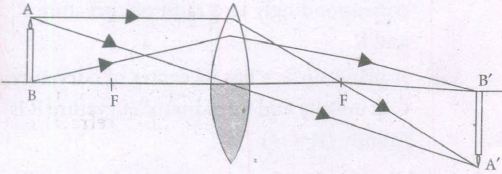 .
.
5.
\(\cfrac { 1 }{ v } -\cfrac { 1 }{ u } =\cfrac { 1 }{ f } \) or \(\cfrac { 1 }{ v } =\cfrac { 1 }{ f } +\cfrac { 1 }{ u } \)
convex lens : f > 0 ; u < 0 (object on the left)
For 0 < I u I
Also for this case, \(\cfrac { 1 }{ \left| v \right| } <\cfrac { 1 }{ |u| } .i.e.\left| u \right| <\left| v \right| \) (image enlarged)
6.
From the lens equation
\(\cfrac { 1 }{ v } -\cfrac { 1 }{ -f } =\cfrac { 1 }{ f } \)
or \(\cfrac { 1 }{ v } =0\)
∴v = ∞
So, the image is formed at infinity.
7.
(i) A lens is formed by a transparent material bounded between two spherical surfaces or one plane and another spherical surface.
(ii) In a thin lens, the distance between the surfaces is very small. If there are two spherical surfaces, then there will be two centers of curvature C1 and C2 and correspondingly two radii of curvature R1 and R2.
(iii) A plane surface has its center of curvature C at infinity and its radius of curvature R is infinity (R = ∞).
8.
Refractive index of a transparent medium is defined as the ratio of speed of light in vacuum (or air) to the speed of light in that medium refractive index n of a medium.
= \(\cfrac { speed\ of lightin\ vacuum\left( c \right) }{ speed\ of \ light\ inmedium\left( v \right) } \)
9.
|
Paraxial Rays |
Marginal Rays |
|---|---|
| The rays traveling very close to the principal axis and make small angles with it are called paraxial rays. | the rays traveling far away from the principal axis and fall on the mirror far away from the pole are called marginal rays. |
10.
(i) When light rays incident on a spherical mirror, after reflection, the rays converge at a point on the principal axis for concave mirror or appear to diverse from a point for convex Mirror.
(ii) This point is called the focus or focal point (F) of the mirror.
11.
(i) The line joining the pole and the centre of curyature is called the principal axis of the mirror.
(ii) The light ray travelling along the principal axis towards the mirror after reflection travels back along the same principal axis. It is also called optical axis.
12.
| Nature of object image | Condition | |
| (i) | Real Image | Rays actually converge at the image. |
| (ii) | Virtual Image | Rays appear to diverge from the image |
| (iii) | Real Object | Rays actually diverge from the object |
| (iv) | Virtual Object | Rays appear to converge at the object. |
13.
(i) A microscope is used to see the details of the object under observation.'
(ii) The ability of microscope depends not only on magnifying the object but also on resolving two points on the object separated by a small distance d .. nun
(iii) Smaller the value of dmin better will be the resolving power of the microscope.
(iv) The radius of central maxima is already derived as equation (1),
\(N=\cfrac { 1 }{ a+b } \)
\({ r }_{ 0 }=\cfrac { 1.22\lambda f }{ a } \)
(v) In the place of focal length f we have the image distance v. If the difference between the two points on the object to be resolved is dmin, then the magnification m is
\(m=\cfrac { { r }_{ 0 } }{ d_{ min } } \)
\({ d }_{ min }=\cfrac { { 1.22 }\lambda v }{ m } =\cfrac { 1.22\lambda v }{ a\left( \cfrac { v }{ u } \right) } =\cfrac { 1.22 }{ \lambda v } =\cfrac { 1.22\lambda u }{ a } \) \(\left[ \therefore m=\cfrac { v }{ u } \right] \)
\({ d }_{ min }=\cfrac { 1.22\lambda f }{ a } \) \(\left[ \therefore u=f \right] \)
On the object side,
\(2tan\beta =2sin\beta =\cfrac { a }{ f } \) \(\left[ \therefore a=f2sin\beta \right] \)
\({ d }_{ min }=\cfrac { 1.22\lambda }{ 2sin\beta } \)
(vi) To reduce the value of dmin the optical path of the light is increased by immersing the objective of the microscope into a bath containing oil of refractive index n.
14.
(i) Light is allowed to pass through a partially silvered mirror (beam splitter), both reflection and refraction take place simultaneously.
(ii) As the two light beams are obtained from the same light source, the two divided light beams will be coherent beams.
(iii) They will be differences in either in-phase or at constant phase. Instruments like Michelson's interferometer, Fabray- Perrot etalon work on this principle.
15.
According to law of reflection,
(i) The incident ray, reflected ray and normal to the reflecting surface all are coplanar (ie. lie in the same plane).
(ii) The angle of incidence i is equal to the angle of reflection r.
i = r

12th Standard Syllabus & Materials
12th Standard
TN 12th Computer Applications வலையமைப்பு வடமிடல் Sample Question Papers Study Material - QB365 Set A
NEW12th Standard
TN 12th Computer Applications களப்பெயர் முறைமை (DNS) Sample Question Papers Study Material - QB365 Set A
NEW12th Standard
TN 12th Computer Applications வலையமைப்பு எடுத்துக்காட்டுகள் மற்றும் நெறிமுறைகள் Sample Question Papers Study Material - QB365 Set A
NEW12th Standard
TN 12th Computer Applications கணினி வலையமைப்பு ஓர் அறிமுகம் Sample Question Papers Study Material - QB365 Set A



Tamilnadu Stateboard 12th Standard Subjects

Maths

Chemistry
Physics

Biology

Computer Science

Business Maths and Statistics

Economics

Commerce

Accountancy

History

Computer Applications
Biology
Computer Technology
Computer Applications
Computer Science
Business Maths and Statistics
Commerce
Economics
Maths
Chemistry
Physics
Computer Technology
History
Accountancy

Tamil

English

French
Tamilnadu Stateboard Standards

