
 100% FREE ACCESS
12th Standard Syllabus & Materials
12th Standard
TN 12th Computer Applications மின்னணு தரவு பரிமாற்றம் Sample Question Papers Study Material - QB365 Set A
NEW12th Standard
TN 12th Computer Applications மின் - வணிக பாதுகாப்பு அமைப்புகள் Sample Question Papers Study Material - QB365 Set A
NEW12th Standard
TN 12th Computer Applications மின்னணு செலுத்தல் முறைகள் Sample Question Papers Study Material - QB365 Set A
NEW12th Standard
TN 12th Computer Applications மின் - வணிகம் Sample Question Papers Study Material - QB365 Set A
NEW12th Standard
TN 12th Computer Applications திறந்த மூல கருத்துருக்கள் Sample Question Papers Study Material - QB365 Set A
NEW12th Standard
TN 12th Computer Applications வலையமைப்பு வடமிடல் Sample Question Papers Study Material - QB365 Set A

Published on: 02/09/2022
QB365 provides a detailed and simple solution for every Possible Creative Questions in Class 12 Physics Subject - Retirement and Death of a Partner, English Medium. It will help Students to get more practice questions, Students can Practice these question papers in addition to score best marks.
Download Tamil Nadu 12th Standard Physics question papers, model tests, one-mark questions, important questions, and public exam papers in PDF format. Free study materials and answer keys for TN State Board students.
Questions + Answers key
Take MCQ Physics Test1.
A concave lens is kept in contact with a convex lens of focal length 20 cm. The combination behaves as a convex lens of focal length 50 cm. Find the power of concave lens.
2.
Two thin lines of powers -4D and 2D are placed in contact coaxially. Find the focal length of the combination.
3.
Draw a plot showing the variation of power of a lens with the wavelength of the incident light.
4.
A double convex lens, made from a material of refractive index μ1 is immersed in a liquid of refractive index μ2 where μ2 > μ1 What change, if any, would occur in the nature of the lens?
5.
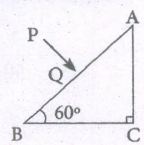
A ray PQ incident normally on the refracting face BA is refracted in the prism BAC made of material of refractive index 1.5. Complete the path of the ray through the prism. From which face will the ray emerge? Justify your answer.
6.
(i) A ray of light incident on face AB of an equilateral glass prism, shows minimum deviation of 30o. Calculate the speed of light through the prism.
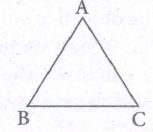
(ii) Find the angle of incidence at face AB is that the emergent ray grazes along the face AC.
7.
An object is placed 40 cm from a convex lens of focal length 30 cm, If a concave lens of focal length 50 cm is introduced between the convex lens and the image formed such that it is 20 cm from the convex lens, find the change in the position of the image.
8.
(i) For a glass ( \(\mu =\sqrt { 5 } \)) the angle of minimum deviation is equal to the angle of the prism. Find the angle of the prism.
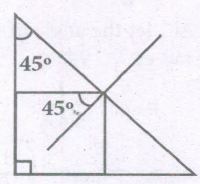
(ii) Draw ray diagram when incident ray falls normally on one of the two equal sides of a right-angled isosceles prism having refractive indeed \(\mu =\sqrt { 3 } \).
9.
(I) Calculate the distance of an object of height h from a concave mirror of radius of curvature 20 cm, so as to obtain a real image of magnification 2. Find the location of image also.
(ii) Using mirror formula, explain why does a convex mirror always produce a virtual image.
10.
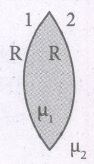
A biconvex lens with its two faces of the equal radius of curvature R is made of a transparent medium of refractive index ~2 as shown in the figure.
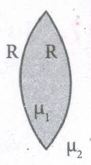
(i) Find the equivalent focal length of the combination.
(ii) Obtain the condition when this combination acts as a diverging lens.
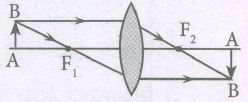
(iii) Draw the ray diagram for the case (\({ \mu }_{ 1 }>({ \mu }_{ 2 }+1)\) + 1) / 2 when the object is kept far away from the lens. Point out the nature of the image formed by the system.
11.
For the same angle of incidence, the angle of refraction in two media A and Bare 25° and 35° respectively. In which one of the two media is the speed of light lesser?
12.
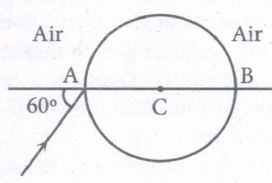
A ray of light falls on a transparent sphere with centre C as shown in the figure. The ray emerges from the sphere paralled to the line AB. Find the angle of refraction at A if refraction index of the material of the sphere is \(\sqrt { 3 } \).
13.
The focal length of an equiconvex lens is equal to the radius of curvature of either face. What is the value of refractive index of the material of the lens?
14.
Derive the equation for effective focal length for lenses in out of contact
15.
Obtain lens maker’s formula and mention its significance.
1.
\(\cfrac { 1 }{ F } =\cfrac { 1 }{ { f }_{ 1 } } +\cfrac { 1 }{ { f }_{ 2 } } \)
\(\cfrac { 1 }{ 50 } =\cfrac { 1 }{ 20 } +\cfrac { 1 }{ { { f }_{ 2 } } } \quad f=-\cfrac { 100 }{ 3 } cm\)
\({ P }_{ 2 }=\cfrac { 100 }{ -\frac { 100 }{ 3 } } \)
D = -3D.
2.
Net power, P = P1 + P2
or P = -4D + 2D = -2D
Focal length,\(f=\cfrac { 1 }{ P } =\cfrac { 1 }{ -2 } =-50cm\)
3.
Formula:
Refractive index = \(A+\cfrac { B }{ { \lambda }^{ 2 } } \)
where λ is the wavelength.
Power of a lens \(P=\cfrac { 1 }{ f } =\left( { n }_{ g }-1 \right) \left( \cfrac { 1 }{ { { R }_{ 1 } } } -\cfrac { 1 }{ { R }_{ 2 } } \right) \)
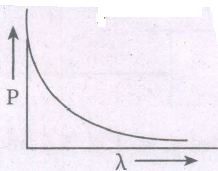
Clearly, the power of a lens (ng - 1). This implies that the power of a lens decreases with the increase in wavelength \(\left( P\infty \cfrac { 1 }{ { \lambda }^{ 2 } } nearly \right) \) The plot is shown in the figure alongside.
4.
The focal length of the lens (refractive index μ1) in a liquid of refractive index μ2 is
Formula:
\({ f }_{ 1 }=\cfrac { { \mu }_{ 1 }-1 }{ \frac { { \mu }_{ 1 } }{ { \mu }_{ 2 } } } \times { f }_{ a }\)
Given :
\({ \mu }_{ 2 }>{ \mu }_{ 1 },i.e,\cfrac { { \mu }_{ 1 } }{ { \mu }_{ 2 } } <1\)
So,\({ \quad f }_{ 1 }=\cfrac { { \mu }_{ 1 }-1 }{ 1-\frac { { \mu }_{ 1 } }{ { \mu }_{ 2 } } } { f }_{ a }\)
So the focal length of the lens in the liquid will be of the opposite sign of the focal length of the lens in air, i.e., the nature of the lens will change. Hence, the lens would now behave like a diverging (concave) lens.
5.
For face AB, ∠i = 0°,∠r = ·0° the ray will pass through AB undeflected
Now, at face AC
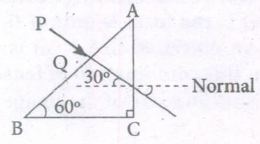
Formula.
Here,\({ \quad i }_{ c }={ sin }^{ -1 }\left( \cfrac { 1 }{ \mu } \right) \)
= \({ sin }^{ -1 }\left( \cfrac { 2 }{ 3 } \right) ={ sin }^{ -1 }\left( 0.66 \right) \)
∠i on face AC is 30o which is less than ∠ie.
Hence, the ray get refracted.
And, applying Snell's law at face AC
\({ sin30 }^{ o }\times \cfrac { 3 }{ 2 } =sinr\times 1\)
\(\Rightarrow sinr=\cfrac { 1 }{ 2 } \times \cfrac { 3 }{ 2 } \)
\(\Rightarrow r={ sin }^{ -1 }\left( \cfrac { 3 }{ 4 } \right) ={ sin }^{ -1 }(0.75)\)
And, dearly r > i, as ray passes from denser to rarer medium.
6.
Here A = 60o,\({ \delta }_{ m }=30^{ o }\)
We know that
Formula:
\(\mu =\cfrac { sin\left( \frac { A+{ \delta }_{ m } }{ 2 } \right) }{ sin\left( \frac { A }{ 2 } \right) } \)
= \(\cfrac { sin\left( \frac { { 60 }^{ o }+{ 30 }^{ 0 } }{ 2 } \right) }{ sin\left( \cfrac { { 60 }^{ o } }{ 2 } \right) } \)
= \(\cfrac { sin{ 45 }^{ o } }{ sin{ 30 }^{ o } } =\sqrt { 2 } \)
Also \(\mu =\cfrac { c }{ v } \Rightarrow \cfrac { 3\times { 10 }^{ 8 } }{ \sqrt { 2 } } m/s\)
= 2.122 x 10⁸ m/s
(ii)
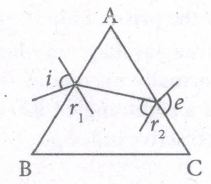
At face AC, let the angle of incidence be r2. For grazing ray, e = 90°
\(\mu =\cfrac { 1 }{ sin{ r }_{ 2 } } \)
\(\Rightarrow { r }_{ 2 }={ sin }^{ -1 }\left( \cfrac { 1 }{ \sqrt { 2 } } \right) ={ 45 }^{ o }\)
Let angle of refraction at face AB be r1
Now r1 + r2 = A
ஃr1 = A - r2 = 60o- 45o = 15o
Let Angle of incidence at this face be i
\(\mu =\cfrac { sini }{ sin{ r }_{ 1 } } \Rightarrow \sqrt { 2 } =\cfrac { sini }{ sin15^{ o } } \)
\(\therefore i={ sin }^{ -1 }\left( \sqrt { 2 } .sin{ 15 }^{ o } \right) \)
7.
For the convex lens
Formula :\(\cfrac { 1 }{ { f }_{ 1 } } =\cfrac { 1 }{ { v }_{ 1 } } -\cfrac { 1 }{ { u }_{ 1 } } \)
\(\cfrac { 1 }{ +30 } =\cfrac { 1 }{ { v }_{ 1 } } -\cfrac { 1 }{ { u }_{ 1 } } \)
\(\cfrac { 1 }{ { v }_{ 1 } } =\cfrac { 1 }{ 30 } -\cfrac { 1 }{ 40 } =\cfrac { 1 }{ 120 } \)
vI = 120 cm a real image is formed.
On introducing a concave lens
f2 = 50cm and u2 = 120 - 20 = +100 cm from the concave lens
\(\cfrac { 1 }{ { f }_{ 2 } } =\cfrac { 1 }{ { v }_{ 2 } } -\cfrac { 1 }{ { u }_{ 2 } } \)
\(\cfrac { 1 }{ -50 } =\cfrac { 1 }{ { v }_{ 2 } } -\cfrac { 1 }{ +100 } \)
\(\therefore \cfrac { 1 }{ { v }_{ 2 } } =\cfrac { 1 }{ 580 } +\cfrac { 1 }{ 100 } =\cfrac { 1 }{ 100 } \)
v2 = -100cm
8.
(i) At a minimum deviation \(\mu =\cfrac { sin\left( \frac { A+{ \delta }_{ m } }{ 2 } \right) }{ sin\left( \cfrac { A }{ 2 } \right) } \)
Given \({ \delta }_{ m }=A\)
\(\mu =\cfrac { sinA }{ sin\cfrac { A }{ 2 } } =\cfrac { 2sin\cfrac { A }{ 2 } cos\cfrac { A }{ 2 } }{ sin\cfrac { A }{ 2 } } \)
= \(2cos\cfrac { A }{ 2 } \)
\(\therefore cos\cfrac { A }{ 2 } =\cfrac { \sqrt { 3 } }{ 2 } \cfrac { A }{ 2 } =30\) A = 6o
(iii) \(\mu =\sqrt { 3 } \cfrac { 1 }{ { sini }_{ c } } \Rightarrow { sini }_{ c }=\cfrac { 1 }{ \sqrt { 3 } } \)
ஃ Angle of incidence > ic
Total internal reflection takes place.
9.
R = -20 cm and M = -2
Focal length \(f=\cfrac { R }{ 2 } =-10cm\)
Magnification \(M=\cfrac { -v }{ u } =-2\)
\(\therefore v=2u\)
Using mirror formula
\(\cfrac { 1 }{ v } +\cfrac { 1 }{ u } =\cfrac { 1 }{ f } \Rightarrow \cfrac { 1 }{ 2u } +\cfrac { 1 }{ u } =-\cfrac { 1 }{ 10 } \)
\(\cfrac { 3 }{ 2u } =-\cfrac { 1 }{ 10 } \Rightarrow u=-15\)
v = 2 (-15) = -30 cm
(iii) \(\cfrac { 1 }{ v } +\cfrac { 1 }{ u } =\cfrac { 1 }{ f } \)
Using sign convention for convex mirror we get
f > 0, U < 0
ஃFrom the formula:
\(\cfrac { 1 }{ v } =\cfrac { 1 }{ f } -\cfrac { 1 }{ u } \)
As f is positive and u is negative, v is always positive, hence the image is always virtual.
10.
(i) If refraction occurs at the first surface
\(\cfrac { { \mu }_{ 1 } }{ { v }_{ 1 } } -\cfrac { 1 }{ u } =\left( \cfrac { { \mu }_{ 1 }-1 }{ R } \right) \)
If refraction occurs at the second surface, and the image of the first surface acts as an object.
\(\cfrac { { \mu }_{ 2 } }{ v } -\cfrac { { u }_{ 1 } }{ { v }_{ 1 } } =\cfrac { { \mu }_{ 2 }-{ \mu }_{ 1 } }{ -R } \)
On adding equations (1) and (2), we get
\(\cfrac { { \mu }_{ 2 } }{ v } -\cfrac { 1 }{ u } =\cfrac { 2{ \mu }_{ 1 }-{ \mu }_{ 2 }-1 }{ R } \)
If rays are coming from infinity, i.e., u = -∞ then v = f
\(\cfrac { { \mu }_{ 2 } }{ f } +\cfrac { 1 }{ \infty } =\cfrac { { 2\mu }_{ 1 }-{ \mu }_{ 2 } }{ R } \)
\(f=\cfrac { { \mu }_{ 2 }R }{ { 2{ \mu }_{ 1 }-{ \mu }_{ 2 }-1 } } \)
(ii) If the combination behaves as a diverging system then f <: O. This is possible only when
\(\Rightarrow 2{ \mu }_{ 1 }-{ \mu }_{ 2 }-1<0\)
\(2{ \mu }_{ 1 }-{ \mu }_{ 2 }+1\)
\(\Rightarrow { \mu }_{ 1 }<\cfrac { \left( { { \mu }_{ 2 }+1 } \right) }{ 2 } \)
(iii) If the combination behaves as a converging lens then> 0. It is possible only when
\(\Rightarrow { 2\mu }_{ 1 }-{ \mu }_{ 2 }-1>0\)
\(\Rightarrow 2{ \mu }_{ 1 }->{ \mu }_{ 2 }+1\)
\({ \mu }_{ 1 }>\cfrac { \left( { \mu }_{ 2 }+1 \right) }{ 2 } \)
The nature of the image formed is real.
11.
Formula.
\(\mu =\cfrac { sini }{ sinr } =\cfrac { { v }_{ 1 } }{ { v }_{ 2 } } \)
\(\cfrac { { \mu }_{ A } }{ { \mu }_{ B } } =\cfrac { \frac { sini }{ { sinr }_{ A } } }{ \frac { sini }{ { sinr }_{ B } } } =\cfrac { { sinr }_{ B } }{ { sinr }_{ A } } =\cfrac { \frac { { v }_{ 1 } }{ { v }_{ 2 } } }{ \frac { { v }_{ 1 } }{ { v }_{ B } } } \)
\(\cfrac { { sinr }_{ B } }{ { sinr }_{ A } } =\cfrac { { v }_{ B } }{ { v }_{ A } } \)
\(r_{\mathrm{A}}<r_{\mathrm{B}} \sin r_{\mathrm{A}}<\sin r_{\mathrm{B}} \Rightarrow v_{\mathrm{A}}<v_{\mathrm{B}}\)
Speed of light in A is lesser.
12.
Formula:
Refractive index,\(\mu =\cfrac { sini }{ sinr } \)
\(\sqrt { 3 } =\cfrac { sin{ 60 }^{ o } }{ sinr } \)
\(sinr=\cfrac { \sqrt { 3 } }{ 2 } \times \cfrac { 1 }{ \sqrt { 3 } } =\cfrac { 1 }{ 2 } \)
sin r = sin30o
⇒ Angle of refraction = 30o
13.
\(\cfrac { 1 }{ f } =\left( \mu -1 \right) \left( \cfrac { 1 }{ { R }_{ 1 } } -\cfrac { 1 }{ { R }_{ 2 } } \right) \)
\(\cfrac { 1 }{ f } =\left( \mu -1 \right) \left( \cfrac { 2 }{ f } \right) \)
\(\cfrac { 1 }{ 2 } =\left( \mu -1 \right) \)
\(\mu =1.5\)
14.
When two thin lenses are separated by a distance d.
(i) Let 0 be a point object on the principal axis of a lens. OA is the incident rayon the lens at a point A at a height h above the optical center.
(ii) The ray is deviated through an angle ઠ and forms the image at me on the principal axis.
(iii) The incident and refracted rays subtend the angles, ∠AOP = α and ∠AIP = β with the principal axis respectively.
In the triangle ∠AOP, the angle of deviation o can be written as,
\(\delta =\alpha +\beta \) ...(1)
If the height is small as compared to PO and PI, the angles \(\alpha ,\beta \) and 0 are also small. Then,
\(\alpha \approx tan\alpha =\cfrac { PA }{ PO } ;\) and ...(2)
Then,\(\delta =\cfrac { PA }{ PO } +\cfrac { PA }{ PI } \)
Here, PA = h, PO = -u and PI = v
\(\delta =\cfrac { h }{ -u } +\cfrac { h }{ v } =h\left( \cfrac { 1 }{ -u } +\cfrac { 1 }{ v } \right) \)
After rearranging
\(\delta -h\left( \cfrac { 1 }{ v } -\cfrac { 1 }{ u } \right) =\cfrac { h }{ f } \)
\(\delta =\cfrac { h }{ f } \)
(iv) The above equation tells that the angle of deviation is the ratio of height to the focal length. Now, the case of two lenses of focal length it and 12 arranged coaxially but separated by a distance d can be considered as shown in the below Figure
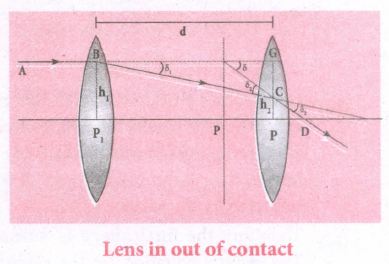
\(\delta ={ \delta }_{ 1 }+{ \delta }_{ 2 }\)
From Equation (5),
\({ \delta }_{ 1 }=\cfrac { { h }_{ 1 } }{ { f }_{ 1 } } ;{ \delta }_{ 2 }=\cfrac { { h }_{ 2 } }{ { f }_{ 2 } } \) and \(\delta =\cfrac { { h }_{ 1 } }{ f } \)
The equation (6) becomes,
\(\cfrac { { h }_{ 1 } }{ f } +\cfrac { { h }_{ 1 } }{ { f }_{ 1 } } +\cfrac { { h }_{ 2 } }{ { f }_{ 2 } } \)
From the geometry,
h2 - h1 = P2G - P2 C = CG
h2 - h1 = BG tan ઠ1≈ BGઠ1
\({ h }_{ 2- }{ h }_{ 1 }={ h }_{ 1 }d\cfrac { { h }_{ 1 } }{ { h }_{ 2 } } \)
\({ h }_{ 2 }={ h }_{ 1 }d\cfrac { { h }_{ 1 } }{ { h }_{ 2 } } \)
Substituting the above equation in Equation (8)
\(\cfrac { 1 }{ f } =\cfrac { 1 }{ { f }_{ 1 } } +\cfrac { 1 }{ { f }_{ 2 } } +\cfrac { 1 }{ { f }_{ 1 }{ f }_{ 2 } } \)
(vi) The above equation could be used to find I the equivalent focal length. To find the position of the equivalent lens, we can further write from the geometry,
\({ PP }_{ 2 }=EG=\cfrac { GC }{ tan\delta } \)
\({ PP }_{ 2 }=EG=\cfrac { GC }{ tan\delta } \)
\({ PP }_{ 2 }=EG=\cfrac { GC }{ tan\delta } =\cfrac { { h }_{ 1 }-{ h }_{ 2 } }{ tan\delta } =\cfrac { { h }_{ 1 }-{ h }_{ 2 } }{ \delta } \)
From equations (7) and (9)
\({ h }_{ 2 }-{ h }_{ 1 }=d\cfrac { { h }_{ 1 } }{ { \quad f }_{ 1 } } \) and \(\delta =\cfrac { { h }_{ 1 } }{ f } \)
\({ PP }_{ 2 }=\left( d\cfrac { { h }_{ 1 } }{ { f }_{ 1 } } \right) \times \left( \cfrac { f }{ { h }_{ 1 } } \right) \)
\({ PP }_{ 2 }=\left( d\cfrac { f }{ { f }_{ 1 } } \right) \)
15.
(i) Let us consider a thin lens made up of a medium of refractive index n2 is placed in a medium of refractive index n1. Let R1 and R2 be the radii of curvature of two spherical surfaces (1) and (2) respectively and P be the pole.
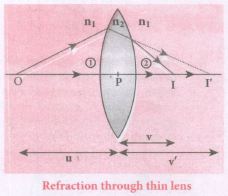
(ii) Consider a point object 'O' on the principal axis. A paraxial ray from 'O' which falls very close to P, after refraction at the surface (1) forms image at 1'.
(iii) Before it does so, it is again refracted by the surface (2). Therefore the final image is formed at I.
(iv) The general equation for the refraction at a single spherical surface is given from Equation,
\(\cfrac { { n }_{ 2 } }{ v } -\cfrac { { n }_{ 1 } }{ v} =\cfrac { \left( { n }_{ 2 }-{ n }_{ 1 } \right) }{ { R } } \)
For the refracting surface (1), the light goes from n1 to n2
\(\cfrac { { n }_{ 2 } }{ v' } -\cfrac { { n }_{ 1 } }{ u } =\cfrac { \left( { n }_{ 2 }-{ n }_{ 1 } \right) }{ { R }_{ 1 } } \) .....(1)
For the refracting surface (2), the light goes from n2 to n1
\(\frac{n_{1}}{v}+\frac{n_{2}}{v^{\prime}}=\frac{\left(n_{1}-n_{2}\right)}{R_{2}}\) ......(2)
For surface (2) I' acts as virtual object.
Adding the above two equations (1) and (2)
\(\cfrac { { n }_{ 1 } }{ v } -\cfrac { { n }_{ 1 } }{ u } =\left( { n }_{ 2 }-{ n }_{ 1 } \right) \left( \cfrac { 1 }{ { R }_{ 1 } } -\cfrac { 1 }{ { R }_{ 2 } } \right) \)
on further simplifying and rearranging,
\(\cfrac { 1 }{ v } -\cfrac { 1 }{ u } =\left( \cfrac { { n }_{ 2 }-{ n }_{ 1 } }{ { n }_{ 1 } } \right) \left( \cfrac { 1 }{ { R }_{ 1 } } -\cfrac { 1 }{ { R }_{ 2 } } \right) \)
\(\cfrac { 1 }{ v } -\cfrac { 1 }{ u } =\left( \cfrac { { n }_{ 2 } }{ n_{ 1 } } -1 \right) \left( \cfrac { 1 }{ { R }_{ 1 } } -\cfrac { 1 }{ { R }_{ 2 } } \right) \) ....(3)
If the object is at infinity, the image is formed at the focus of the lens. Thus, for u = \(\infty\), v = f. Then the equation becomes.
\(\cfrac { 1 }{ f } -\cfrac { 1 }{ \infty } =\left( \cfrac { { n }_{ 2 } }{ { { n }_{ 1 } } } -1 \right) \left( \cfrac { 1 }{ { R }_{ 1 } } -\cfrac { 1 }{ { R }_{ 2 } } \right) \)
\(\cfrac { 1 }{ f } =\left( \cfrac { { n }_{ 2 } }{ { n }_{ 1 } } -1 \right) \left( \cfrac { 1 }{ { R }_{ 1 } } -\cfrac { 1 }{ { R }_{ 2 } } \right) \) ......(4)
If the lens is kept in air, then we can take n2 = n and n1 = 1. So the equation (4) becomes,
\(\\ \cfrac { 1 }{ f } =\left( n-1 \right) \left( \cfrac { 1 }{ { R }_{ 1 } } -\cfrac { 1 }{ { R }_{ 2 } } \right) \) ..(5)
The above equation is called the lens maker's formula.
Significance:
It tells the lens manufacturers what curvature is needed to make a lens of desired focal length with a material of particular refractive index to make a lens of desired focal length. This formula holds good also for a concave lens.

12th Standard Syllabus & Materials
12th Standard
TN 12th Computer Applications களப்பெயர் முறைமை (DNS) Sample Question Papers Study Material - QB365 Set A
NEW12th Standard
TN 12th Computer Applications வலையமைப்பு எடுத்துக்காட்டுகள் மற்றும் நெறிமுறைகள் Sample Question Papers Study Material - QB365 Set A
NEW12th Standard
TN 12th Computer Applications கணினி வலையமைப்பு ஓர் அறிமுகம் Sample Question Papers Study Material - QB365 Set A
NEW12th Standard
TN 12th Computer Applications PHP-உடன் MySQL-ஐ இணைத்தல் Sample Question Papers Study Material - QB365 Set A



Tamilnadu Stateboard 12th Standard Subjects

Maths

Chemistry
Physics

Biology

Computer Science

Business Maths and Statistics

Economics

Commerce

Accountancy

History

Computer Applications
Biology
Computer Technology
Computer Applications
Computer Science
Business Maths and Statistics
Commerce
Economics
Maths
Chemistry
Physics
Computer Technology
History
Accountancy

Tamil

English

French
Tamilnadu Stateboard Standards

