
 100% FREE ACCESS
12th Standard Syllabus & Materials
12th Standard
TN 12th Computer Applications மின்னணு தரவு பரிமாற்றம் Sample Question Papers Study Material - QB365 Set A
NEW12th Standard
TN 12th Computer Applications மின் - வணிக பாதுகாப்பு அமைப்புகள் Sample Question Papers Study Material - QB365 Set A
NEW12th Standard
TN 12th Computer Applications மின்னணு செலுத்தல் முறைகள் Sample Question Papers Study Material - QB365 Set A
NEW12th Standard
TN 12th Computer Applications மின் - வணிகம் Sample Question Papers Study Material - QB365 Set A
NEW12th Standard
TN 12th Computer Applications திறந்த மூல கருத்துருக்கள் Sample Question Papers Study Material - QB365 Set A
NEW12th Standard
TN 12th Computer Applications வலையமைப்பு வடமிடல் Sample Question Papers Study Material - QB365 Set A

Published on: 27/01/2021
12th Standard Physics English Medium Ray Optics Reduced Syllabus Important Questions 2021
Download Tamil Nadu 12th Standard Physics question papers, model tests, one-mark questions, important questions, and public exam papers in PDF format. Free study materials and answer keys for TN State Board students.
Questions + Answers key
Take MCQ Physics Test1.
A concave mirror forms an image of sun at a distance of 12 cm from it __________.
The radius of curvature of this mirror is 6 cm
To use it as a shaving mirror, it must be held at a distance of 8 - 10 cm from the face
If an object is kept at a distance of 12 cm from it, the image formed will be same size as the object
All the above
2.
A cube of side 2m is placed in front of a concave mirror focal length 1m with its face P at a distance of 3m and face Q at a distance of 5m from the mirror. The distance between the images of face P and Q and height of images P and Q are ________________.
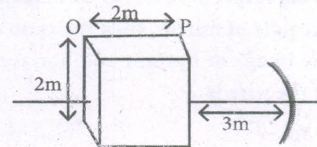
1m, O.5m,0.25m
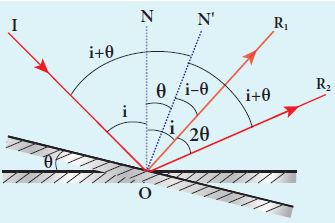
0.5m, 1m, 0.25m
0.5 m, 0.25m, 1m
0.025m, 1m, 0.5m
3.
Aluminous object is placed 20 cm from the surface of a convex mirror and a plane mirror is set so that virtual images formed in two mirrors coincide. If plane mirror is at a distance of 12 cm from the object. Then the focal length of convex mirror is _____________.
5 cm.
10 cm
20 cm
40 cm
4.
A dice is placed with its one edge parallel to the principal axis between the principal focus and the centre to the curvature of a concave mirror. Then the image has the shape of _____________.
Cube
Cuboid
Barrel shaped
Spherical
5.
A virtual image three times the size of the object is obtained with a concave mirror of radius of curvature 36 cm, The distance of the object from the mirror is _____________.
5 cm
12 cm
10 cm
20 cm
6.
All of the following statement are correct except _____________.
The magnification produced by a convex mirror is always less than one
A virtual, erect same sized image can be obtained using a plane mirror
A virtual, erect magnified image can be formed using a concave mirror
A real, inverted, same-sized image can be formed using a convex mirror
7.
A convex mirror has a focal length f. A real object is placed at a distance Jin front the pole produces an image at ____________.
infinity
f
\(\cfrac { f }{ 2 } \)
2f
8.
A concave mirror of focal length 15 cm forms an image having twice the linear dimensions of the object. The position of the object when the image is virtual will be ______________.
22.5 cm
7.5 cm
7.5 cm
45 cm
9.
A point object is placed at a distance of 30 cm from a convex mirror of focal length 30 cm, The image will from at ______________.
Infinity behind the mirror
Focus
Pole
15 cm
10.
A man having a height of 6 m, wants to see full height in the mirror. They observe the image of 2 m height erect, then used mirror is ____________.
Concave
convex
plane
none of these
11.
Ray optics is valid, when characteristic dimensions are ______________.
of the same order as the wave length of light
much smaller then the wavelength of light
of the order of one millimeter
much larger than the wavelength of light
12.
The light reflected by plane mirror may form a real images ____________.
If the rays incident on the mirror are diverging
If the rays incident on the mirror are converging
If the object is placed very close to mirror
Under no circumstance
13.
A ray of light travelling in a transparent medium of refractive index n falls, on a surface separating the medium from air at an angle of incidents of 45o . The ray can undergo total internal reflection for the following n, ______.
n = 1.25
n = 1.33
n = 1.4
n = 1.5
14.
When a biconvex lens of glass having refractive index 1.47 is dipped in a liquid, it acts as plane sheet of glass. This implies that the liquid must have refractive index, ______.
less than one
less than that of glass
greater than that of glass
equal to that of glass
15.
The speed of light in an isotropic medium depends on, ______.
its intensity
its wavelength
the nature of propagation
the motion of the source w.r.t medium
16.
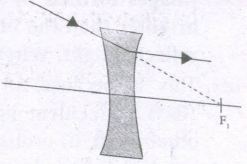
A ray of light incident on a concave lens becomes parallel to the principal axis after refraction. Show this situation with the help of a ray diagram.
17.
A convex lens (n = 1.5) of focal length fs immersed
(I) In water n = 1.33 and
(ii) In carbon disulphide n = 1.6, how does the lens behave in the two cases?
18.
Define angle of deviation d.
19.
What is simultaneous reflection?
20.
What is meant by focal plane?
21.
When a wave undergoes reflection at a denser medium, what happens to its phase?
22.
What type of lens is formed by a bubble inside water?
23.
24.
A diffraction grating consists of 4000 slits per centimeter. It is illuminated by a monochromatic light. The second order diffraction maximum is produced at an angle of 30°. What is the wavelength of the light used?
25.
26.
If the focal length is 150 cm for a lens, what is the power of the lens?
27.
Prove that for the same incident light when a reflecting surface is tilted by an angle θ, the reflected light will be tilted by an angle 2θ.
28.
What is Rayleigh’s scattering?
29.
Arrive at lens equation from lens maker’s formula.
30.
What are critical angle and total internal reflection?
31.
A convex lens, of focal length 20 cm, has a point object placed on its principal axis at distance of 40 cm from it. A plane mirror is placed 30 cm behind the convex lens. Locate the position of image formed by this combination.
32.
Calculate the angle of dispersion between red and violet colours produced by a flint glass prism of refracting angle of 600. Given μv = 1.633 and = μr 1.622.
33.
A ray of light passes through an equilateral glass prism such that the angle of incidence is equal to the angle of emergence. The angle of emergence is \(\frac { 3 }{ 4 } \) times the angle of prism. Calculate the refractive index of the glass prism.
34.
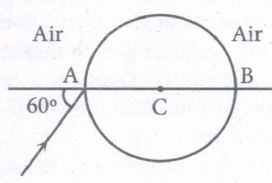
A ray of light falls on a transparent sphere with centre C as shown in the figure. The ray emerges from the sphere paralled to the line AB. Find the angle of refraction at A if refraction index of the material of the sphere is \(\sqrt { 3 } \).
35.
Derive the equation for angle of deviation produced by a prism and thus obtain the equation for refractive index of material of the prism.
36.
Obtain the equation for radius of illumination (or) Snell’s window.
37.
38.
What is focus (or) focal point of a mirror?
39.
Light ray falls at normal incidence on the first face and emerges gracing the second face for an equilateral prism.
(a) What is the angle of deviation produced?
(b) What is the refractive index of the material of the prism?
40.
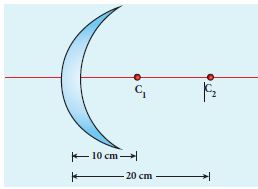
Determine the focal length of the lens made up of a material of refractive index 1.52 as shown in the diagram. (Points C1 and C2 are the centers of curvature of the first and second surfaces respectively.)
41.
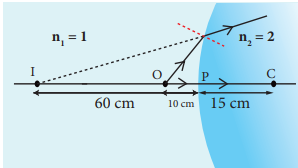
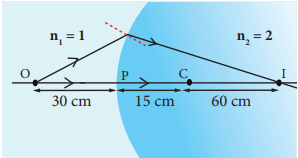
Find the position of the image of a point object O in the two cases given. Take the radius of curvature of the surface R as 15 cm, n1 = 1 and n2 = 2.
Case i) O is located 10 cm to the left of the surface.
Case ii) O is located 30 cm to the left of the surface.
42.
Light travels from air into a glass slab of thickness 50 cm and refractive index 1.5.
(i) What is the speed of light in the glass?
(ii) What is the time taken by the light to travel through the glass slab?
(iii) What is the optical path of the glass slab?
43.
A thin converging lens of refractive index 1.5 has a power of + 5.0 D. When this lens is immersed in a liquid of refractive index n, it acts as a divergent lens of focal length 100 cm. What must be the value of n?
1.
(d)
All the above
2.
(d)
0.025m, 1m, 0.5m
3.
(a)
5 cm.
4.
(b)
Cuboid
5.
(b)
12 cm
6.
(d)
A real, inverted, same-sized image can be formed using a convex mirror
7.
(c)
\(\cfrac { f }{ 2 } \)
8.
(d)
45 cm
9.
(d)
15 cm
10.
(b)
convex
11.
(d)
much larger than the wavelength of light
12.
(b)
If the rays incident on the mirror are converging
13.
For total internal reflection,
sin i > sin c
\(n=\frac{1}{sin \ c}\)
\(sin \ c=\frac{1}{n}\)
\(sin \ i>\frac{1}{n}\)
\(n>\frac{1}{sin \ i}\)
n >\(\sqrt{2}\)
n >1.414 = 1.5
14.
\(\frac{I}{f}=\left(\frac{\mu_{\mathrm{L}}}{\mu_L}-1\right)\left(\frac{1}{R_1}-\frac{1}{R_2}\right)\)
When the biconvex lens of glass dipped in liquid, it acts as a plane sheet of glass.
\(\therefore \mathrm{f}=\infty, \frac{1}{\mathrm{f}}=0 \quad \frac{\mu_g}{\mu_{\mathrm{L}}}-1=0 ; \frac{\mu_{\mathrm{s}}}{\mu_{\mathrm{L}}}=1, \mu_{\mathrm{s}}=\mu_{\mathrm{L}}\)
15.
v = nג
In an isotropic medium, there is no change in the frequency of the light. So, the speed of light depends on wavelength of light.
16.
In the ray diagram, the incident ray is directed towards the first principal focus of the concave lens. After refraction, this ray becomes parallel to the principal axis.
17.
(i) When lens is immersed in water, it behaves as a convex lens but its focal length will increase.
(ii) When convex lens is immersed in carbon - disulphide, it will behave as a concave lens.
18.
The angle between the direction of the incident ray PQ and the emergent ray RS is called the angle of deviation d.
19.
The phenomenon in which a part of light from a source undergoing reflection and the other part of light from the same source undergoing refraction at the same surface is called simultaneous reflection or simultaneous refraction.
20.
The plane through the focus and perpendicular to the principal axis is called the focal plane of the mirror.
21.
When a wave undergoes reflection at a denser mediums, Its phase changes at 180o.
22.
Concave Lens:
1. It is a lens that diverges a light beam that falls on it.
2. It has at least one surface that is curved inside.

Air Bubble:
1. These are circular spheres made up of thin water films and contain air.
2. The surface of an air bubble in water bulges outwards due to the air pressure inside the bubble.
How does an air bubble act like a concave lens:
1. The refractive index of water is greater than that of air, ηwater>ηair. This implies that, water is a denser medium than air.
2. Let us consider that a light ray passes through water and enters an air bubble. So, the light ray enters from a denser to rarer medium. So, a ray diagram can be drawn as given below.
3. The ray of light entering the air bubble will diverge, since the ray of light entering from a denser to rarer medium bends away from the normal.
4. Hence, it behaves like a concave lens.

Hence, the air bubble inside water behaves like a concave lens.
23.
24.
Number of lines per cm = 4000 cm-1; m = 2; θ = 30°; λ = ?
Number of lines per unit length
\(N=\cfrac { 4000 }{ 1\times { 10 }^{ -2 } } =4\times { 10 }^{ 5 }\)
Equation for diffraction maximum in grating is, sinθ = Nmλ
After Rewriting, \(\lambda =\cfrac { sin\theta }{ Nm } \)
Substituting,
\(\lambda =\cfrac { { \sin30 }^{ o } }{ 4\times { 10 }^{ 5 }\times 2 } =\cfrac { 0.5 }{ 4\times { 10 }^{ 5 }\times 2 } \)
= \(\cfrac { 1 }{ 2\times 4\times { 10 }^{ 5 }\times 2 } =\cfrac { 1 }{ 16 \times 10^5} \)
λ = 6250 x 10-10 m = 6205 Å
25.
26.
Given, focal length, f = 150 cm = 1.5 m
Equation for power of lens is, \(p=\cfrac { 1 }{ f } \)
Substituting the values,
\(p=\cfrac { 1 }{ 1.5 } =0.67 D\)
As the power is positive, it is a converging lens.
27.
AB is the reflecting surface as shown in the Figure. Both the incident ray IO and the reflected ray OR1 subtend angle i with the normal N as the angle of incidence is equal to angle of reflection. When the surface AB is tilted to A'B' by an angle θ, the normal N is also is tilted to N' by the same angle θ.Remember that the position of the incident ray IO remains unaltered. But the reflected ray now is OR2.
Now, in the tilted system, the angle of incidence, ∠N'OI = i + θ and the angle of reflection, ∠N'OR2 = i + θ are the same. The angle between ON' and OR1 is, ∠N'OR1 = i – θ. The angle tilted on the reflected light is the angle between OR1 and OR2 which is ∠R1OR2. From the geometry we can write,
\(\angle { R }_{ 1 }O{ R }_{ 2 }=\angle N'{ { OR }_{ 2 } }-\angle { NOR }_{ 1 }\) \(=\left( i+\theta \right) -\left( i-\theta \right) =2\)
∠R1 OR2 = 2θ.
28.
If the scattering of light is by atoms and molecules which have size a yery less than that of the wavelength \({\lambda}\) of light a << \({\lambda}\) the scattering is called Rayleigh's scattering.
The intensity of Rayleigh's scattering is inversely proportional to fourth power of wavelength
\(\mathrm{I} ∝ \frac{1}{\lambda^{4}}\)
29.
(i) Let us consider a thin lens made up of a medium of refractive index n2 is placed in a medium of refractive index n1. Let R1 and R2 be the radii of curvature of two spherical surfaces (i) and (ii) respectively and P be the pole.
(ii) Consider a point object 'O' on the principal axis. A paraxial ray from 'O' which falls very close to P, after refraction at the surface (i) forms image at I'.
(iii) Before it does so, it is again refracted by the surface (ii). Therefore the final image is formed at I.
(iv) The general equation for the refraction at a single spherical surface is given by the equation is,
\(\cfrac { { n }_{ 2 } }{ v } =\cfrac { { n }_{ 1 } }{ u } =\cfrac { \left( { \quad n }_{ 2 }-{ { n }_{ 1 } } \right) }{ R } \) ....(i)
(v) For the refracting surface (1), the light goes from n1 to n2
\(\cfrac { { { n }_{ 2 } } }{ v' } -\cfrac { { n }_{ 1 } }{ u } =\cfrac { \left( n_{ 2 }-{ n }_{ 1 } \right) }{ { R }_{ 1} } \) ......(ii)
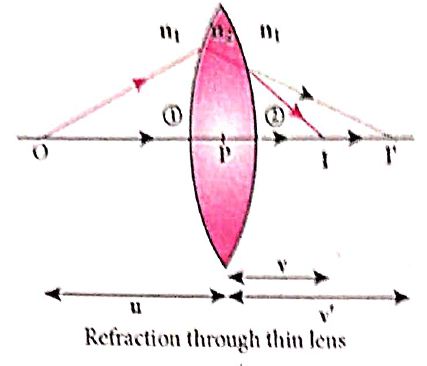
(vi) For the refracting surface (ii), the light goes from medium n2 to n1
\(\cfrac { { { n }_{ 1 } } }{ v' } -\cfrac { { n }_{ 2 } }{ v' } =\cfrac { \left( n_{ 1 }-{ n }_{ 2 } \right) }{ { R }_{ 2 } } \) ....(iii)
(vii) Adding the above two equations (ii) and (iii)
\(\cfrac { { { n }_{ 1 } } }{ v } =\cfrac { { n }_{ 1 } }{ u } =\left( { n }_{ 2 }-{ n }_{ 1 } \right) \left( \cfrac { 1 }{ { R }_{ 1 } } -\cfrac { 1 }{ { R }_{ 2 } } \right) \)
On further simplifying and rearranging
\(\cfrac { 1 }{ v } -\cfrac { 1 }{ u } =\left( \cfrac { { n }_{ 2 }-{ n }_{ 1 } }{ { n }_{ 1 } } \right) \left( \cfrac { 1 }{ { R }_{ 1 } } -\cfrac { 1 }{ { R }_{ 2 } } \right) \)
\(\cfrac { 1 }{ v } -\cfrac { 1 }{ u } =\left( \cfrac { { n }_{ 2 } }{ { n }_{ 1 } } -1 \right) \left( \cfrac { 1 }{ { R }_{ 1 } } -\cfrac { 1 }{ { R }_{ 2 } } \right) \) ....(iv)
If the refractive of the lens is n2 and is placed in air, then n2= n and n1= 1. So the equation (iv) becomes,
\(\cfrac { 1 }{ v } -\cfrac { 1 }{u } =(n-1) \left( \cfrac { 1 }{ { R }_{ 1 } } -\cfrac { 1 }{ { R }_{ 2 } } \right) \) ...(v)
According to lens makers formula
\(\cfrac { 1 }{ f } =(n-1) \left( \cfrac { 1 }{ { R }_{ 1 } } -\cfrac { 1 }{ { R }_{ 2 } } \right) \) ...(vi)
Comparing the two equations (v) and (vi), we find
\(\cfrac { 1 }{ v } -\cfrac { 1 }{ u }=\cfrac { 1 }{ f }\) .....(vii)
This is called lens equation
30.
Critical angle:
The angle of incidence in the denser medium for which the angle reflection is 90o or the reflected ray graces the boundary between the two media is called critical angle.
Total Internal reflection:
For any angle of incidence greater than the critical angle, the center light is reflected back into the denser medium itself. This phenomenon is called Total internal reflection.
31.
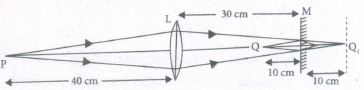
We first consider the effect of the lens. For the
lens, we have
u = - 40 cm and f = + 20 cm
Using the lens formula, we get
\(\cfrac { 1 }{ { v }_{ 1 } } -\cfrac { 1 }{ \left( -40 \right) } =\cfrac { 1 }{ 20 } \) ஃv1 = + 40 cm
Had there been the lens only the image would have been formed at Q1. The plane mirror M is at a distance of 30 cm from lens 1. We can, therefore, think of Q1, as a virtual object, located at a distance of 10cm, behind the plane mirror M. The plane mirror, therefore, forms a real image (of this virtual object Q1) at Q, 10 cm in front of it.
32.
For minimum deviation position
\({ \mu }_{ red }=\cfrac { sin\left( \frac { A+{ \delta }_{ red } }{ 2 } \right) }{ sin\frac { A }{ 2 } } \)
or \(sin\left( \cfrac { A+{ { \delta }_{ red } } }{ 2 } \right) ={ n }_{ red }\)
\(sin\cfrac { 2 }{ A } =1.622\times 0.5=0.811\)
\(\therefore \cfrac { 60+{ \lambda }_{ red } }{ 2 } ={ 54 }^{ o }12'\)
\({ \delta }_{ red }={ 108 }^{ o }24'-{ 60 }^{ o }={ 48 }^{ o }24'\)
Similarly, \(sin\left( \cfrac { A+{ \delta }_{ viloet } }{ 2 } \right) =1.663\times 0.5'\)
= 0.8315 or \(\cfrac { { 60 }^{ o }+{ \delta }_{ viloet } }{ 2 } =56^{ o }15'\)
\({ \delta }_{ viloet }=112^{ o }30'-{ 60 }^{ ' }={ 52 }^{ o }30'\)
\(\therefore { \delta }_{ violet }-{ \delta }_{ red }=\left( 52-30' \right) -\left( 48^{ o }24' \right) ={ 4 }^{ o }6'\)
It is not advisable to use the formula,
\({ \delta }_{ v }-{ \delta }_{ r }=\left( { \mu }_{ v }-{ \mu }_{ r } \right) \) in the above solution.
33.
Since the angle of incidence is equal to the angle of emergence, therefore, the ray of light passes symmetrically through the prism. So, the prism is in a minimum deviation position
Now,\(\\ \\ A+{ \delta }_{ m }=i+e\)
or \({ \delta }_{ m }=e+e-A=2e-A=-2\left( \cfrac { 3 }{ 2 } A \right) -A\)
= \(\cfrac { 3 }{ 2 } A-A=\cfrac { A }{ 2 } =\cfrac { { 60 }^{ o } }{ 2 } ={ 30 }^{ o }\)
\({ n }_{ 21 }=\cfrac { sin\left( \frac { A+{ \delta }_{ m } }{ 2 } \right) }{ sin\left( \frac { A }{ 2 } \right) } =\cfrac { sin\left( \cfrac { { 60 }^{ o }+30^{ o } }{ 2 } \right) }{ sin\cfrac { { 60 }^{ o } }{ 2 } } \)
= \(\cfrac { sin{ 45 }^{ o } }{ sin{ 30 }^{ o } } -\cfrac { 1 }{ \sqrt { 2 } } \times \cfrac { 2 }{ 1 } =\sqrt { 2 } =1.414\)
34.
Formula:
Refractive index,\(\mu =\cfrac { sini }{ sinr } \)
\(\sqrt { 3 } =\cfrac { sin{ 60 }^{ o } }{ sinr } \)
\(sinr=\cfrac { \sqrt { 3 } }{ 2 } \times \cfrac { 1 }{ \sqrt { 3 } } =\cfrac { 1 }{ 2 } \)
sin r = sin30o
⇒ Angle of refraction = 30o
35.
Angle of deviation Produced by Prism:
(i) Let light ray PQ is incident on one of the refracting faces of the prism.
(ii) The angles of incidence and refraction at the first face AB are i1 and rl. The path of the light inside the prism is QR.
(iii) The angle of incidence and refraction at the second face AC is r2 and i2 respectively.
(iv) RS is the ray emerging from the second face. Angle i2 is also caned angle of emergence.
(v) The angle between the direction of the incident ray PQ and the emergent ray RS is called the angle of deviation d.
(vi) The two normals drawn at the point of incidence Q and emergence R meet at point N. They meet at point N.
(vii) The extended incident ray and the emergent ray meet at a point M.
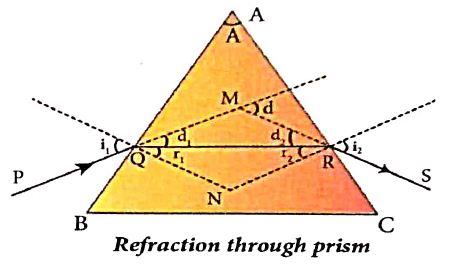
The angle of deviation d1 at the surface AB is,
ㄥRQM = d = i1 - r1 ...(1)
The angle of deviation d2 at the surface AC is
ㄥQRM = d2 = i2 - r2 .......(2)
Total angle of deviation d produced is,
d = d1 + d2 .....(3)
Substituting for d1 and d2 in equation (3)
d = (i1 - r1) + (i2 - r2)
After rearranging,
d = (i1 - r1) + (i2 - r2) ........(4)
In the quadrilateral AQNR, two of the angles (at the vertices Q and R) are right angles. Therefore, the sum of the other angles of the quadrilateral is 180°.
\(\angle A+\angle QNR={ 180 }^{ 0 }\) .........(5)
From the triangle ΔQNR
\({ r }_{ 1 }+{ r }_{ 2 }+\angle QNR={ 180 }^{ o }\) ......(6)
Comparing these two equations (5) and (6) we get,
r1 + r2 = A .......(7)
Substituting this in equation (4) for angle of deviation,
d = i1+ i2 - A .............(8)
(viii) Thus, the angle of deviation depends on the angle of incidence i1, angle of emergence i2 and the angle for the prism A.
(ix) For a given angle of incidence the angle of emergence is decided by the refractive index of the material of the prism. Hence the angle of deviation depends on these following factors.
(i) the angle of incidence
(ii) the angle of the prism.
(iii) the refractive index of the material of the prism (which decides the angle of emergence).
Refractive index of the material of the prism:
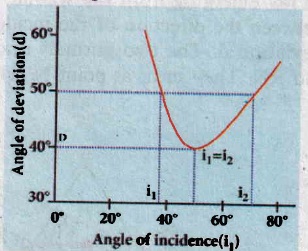
At minimum deviation, i1 = i2 = i and r1 = r2 = r
Now, the equation (8) becomes,
D - i1 + i2 - A = 2i - A (or) \(i=\cfrac { \left( A+D \right) }{ 2 } \)
The equation (7) becomes
r1 + r2 = A ⇒ 2r = A (or) \(r=\cfrac { A }{ 2 } \)
Substituting i and r in Snell's law
\(n=\cfrac { sini }{ sinr } \)
\(n=\cfrac{\cfrac{sin(A+D)}{2}}{sin(A/2)}\)
36.
(i) The angle of view for water animals is restricted to twice the critical angle 2ic. The critical angle for water is 48.6°. Thus the angle of view is 97.2°.
(ii) The radius R of the circular area depends on the depth d from which it is seen and also the refractive indices of the media.
(iii) The radius R of Snell's window can be deduced with the illustration as shown in Figure.
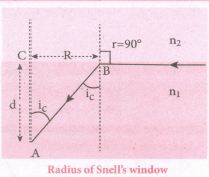
(iv) Light is seen from a point A at a depth 'd'.
(v) From the Snell's law in product form, n1 sini = n2 sinr
(vi) The equation for the refraction happening at the point B on the boundary between the two media is,
n1 sin ic = n2 sin90o ..(1)
n1sinic = n2 (∵ sin90o = 1)
\(sin{ i }_{ c }=\cfrac { { n }_{ 2 } }{ { n }_{ 1 } } \) ...(2)
From the right angle triangle ΔABC,
\({ sini }_{ c }=\cfrac { CB }{ AB } =\cfrac { R }{ \sqrt { { d }^{ 2 }+{ R }^{ 2 } } } \) ....(3)
Equating the above two equation
\(\cfrac { R }{ \sqrt { { d }^{ 2 }+{ R }_{ 2 } } } =\cfrac { { n }_{ 2 } }{ { n }_{ 1 } } \)
Squaring on both sides
\(\cfrac { { R }^{ 2 } }{ { R }^{ 2 }+d^{ 2 } } \left( \cfrac { { n }_{ 2 } }{ { n }_{ 1 } } \right) ^{ 2 }\)
Taking reciprocal,
\(\cfrac { { R }^{ 2 }+{ d }^{ 2 } }{ { R }^{ 2 } } =\left( \cfrac { { n }_{ 1 } }{ { n }_{ 2 } } \right) ^{ 2 }\)
On further simplifying
\(1+\cfrac { { d }^{ 2 } }{ { R }^{ 2 } } =\left( \cfrac { { n }_{ 1 } }{ { n }_{ 2 } } \right) ^{ 2 };\cfrac { { d }^{ 2 } }{ { R }^{ 2 } } =\left( \cfrac { { n }_{ 1 } }{ { n }_{ 2 } } \right) ^{ 2 }-1;\)
\(\cfrac { { d }^{ 2 } }{ { R }^{ 2 } } =\cfrac { { n }_{ 1 }^{ 2 } }{ { n }_{ 1 }^{ 2 } } -1=\cfrac { { n }_{ 1 }^{ 2 }-{ n }_{ 2 }^{ 2 } }{ { n }_{ 2 }^{ 2 } } \)
Again taking reciprocal and rearranging
\(\cfrac { { R }^{ 2 } }{ { d }^{ 2 } } =\cfrac { { { n }_{ 2 }^{ 2 } } }{ { n }_{ 1 }^{ 2 }-{ n }_{ 2 }^{ 2 } } { R }^{ 2 }={ d }^{ 2 }\left( \cfrac { { n }_{ 2 }^{ 2 } }{ { n }_{ 1 }^{ 2 }-{ n }_{ 2 }^{ 2 } } \right) \)
∴ The radius of illumination is,
\(R=d\sqrt { \cfrac { { n }_{ 2 }^{ 2 } }{ \left( n_{ 1 }^{ 2 }-{ n }_{ 2 }^{ 2 } \right) } } \) ...(4)
If the rarer medium outside is air, then, n2 = 1, and we can take n1 = n
\(R=d\left( \cfrac { 1 }{ \sqrt { { n }^{ 2 }-1 } } \right) \) or \(R=\cfrac { d }{ \sqrt { { n }^{ 2 }-1 } } \) ....(5)
37.
38.
(i) When light rays incident on a spherical mirror, after reflection, the rays converge at a point on the principal axis for concave mirror or appear to diverse from a point for convex Mirror.
(ii) This point is called the focus or focal point (F) of the mirror.
39.
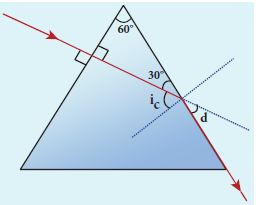
The given situation is shown in the figure
Given, A = 60o ; i1 = 0o; i2 = 90o
(a) Equation for angle of deviation,
d = i1 + i2 - A
Substituting the values
d = 0o + 90o- 60o = 30o
The angle of deviation produced is, d = 30°
(b) The light inside the prism must be falling on the second face at critical angle as it graces the boundary. ic = 90° – 30° = 60°
Equation for critical angle is, \(\sin i_{c}=\frac{1}{n}\)
\(n=\frac{1}{\sin i_{c}} ; \quad n=\frac{1}{\sin 60^{\circ}}=\frac{1}{\sqrt{3} / 2}=\frac{2}{\sqrt{3}}=1.15\)
The refractive index of the material of the prism is, n = 1.15
40.
This lens is called convexo-concave lens
Given, n = 1.52, R1 = 10 cm and R2 = 20 cm
Both R1 and R2 are positive
Lens makers formula,
\(\cfrac { 1 }{ f } =\left( n-1 \right) \left( \cfrac { 1 }{ { R }_{ 1 } } -\cfrac { 1 }{ { R }_{ 2 } } \right) \)
Substituting the values,
\(\cfrac { 1 }{ f } =\left( 1.52-1 \right) \left( \cfrac { 1 }{ 10 } -\cfrac { 1 }{ 20 } \right) \)
\(\cfrac { 1 }{ f } =\left( 0.52 \right) \left( \cfrac { 2-1 }{ 20 } \right) =\left( 0.52 \right) (\frac{1}{20})=\cfrac { 0.52 }{ 20 } \)
\(f=\cfrac { 20 }{ 0.52 } =38.46cm\)
As the focal length is positive, the lens is a converging lens.
41.
Case i) \(\cfrac { { n }_{ 2 } }{ v } -\cfrac { { n }_{ 1 } }{ u } =\cfrac { \left( { n }_{ 2 }-{ n }_{ 1 } \right) }{ R } \)
applying sign convention, u = –10 cm, R = 15 cm
\(\cfrac { 2 }{ v } -\cfrac { 1 }{ -10 } =\cfrac { \left( 2-1 \right) }{ 15 } ;\cfrac { 2 }{ v } +\cfrac { 1 }{ 15 } =\cfrac { \left( 1 \right) }{ 10 } \)
∴ =− 60 cm
[a virtual image is formed 60 cm, to the left of the surface]
Case ii) \(\cfrac { { n }_{ 2 } }{ v } -\cfrac { { n }_{ 1 } }{ u } =\cfrac { \left( { n }_{ 2 }-{ n }_{ 1 } \right) }{ R } \)
applying sign convention, u = –30 cm, R = 15 cm
\(\cfrac { 2 }{ v } -\cfrac { 1 }{ -30 } =\cfrac { \left( 2-1 \right) }{ 15 } ;\cfrac { 2 }{ v } +\cfrac { 1 }{ 30 } =\cfrac { \left( 1 \right) }{ 15 } \)
∴ = 60 cm [a real image is formed 60 cm, to the right of the surface]
42.
Given, thickness of glass slab, d = 50 cm = 0.5 m, refractive index, n = 1.5
refractive index, \(n=\cfrac { c }{ v } \)
(a) speed of light in the glass slab is,
\(v=\cfrac { c }{ n } =\cfrac { 3\times { 10 }^{ 8 } }{ 1.5 } =2\times { 10 }^{ 8 }{ ms }^{ -1 }\)
(b) time taken by light to travel through the glass slab is,
\(t=\cfrac { d }{ v } =\cfrac { 0.5 }{ 2\times { 10 }^{ 8 } } =2.5\times { 10 }^{ -9 }{ s }\)
(c) optical path,
d' = nd = 1.5 x 0.5 = 0.75 m = 75 cm
Light would have traveled an additional 25 cm (75 cm – 50 cm) in vacuum at the same time had there been no glass slab in its path.
43.
\(P_{a}=\frac{1}{f_{a}}=\left(\frac{\mu_{g}}{\mu_{a}}-1\right)\left(\frac{1}{R_{1}}-\frac{1}{R_{2}}\right) \) ..(1)
\(P_{w}=\frac{1}{f_{w}}=\left(\frac{\mu_{g}}{\mu_{w}}-1\right)\left(\frac{1}{R_{1}}-\frac{1}{R_{2}}\right) \) ...(2)
\(p_{a}=5 D, f_{w}=-100 \text { (Diverging lens) } \)
\(\mu_{\mathrm{g}}=1.5, \mu_{\mathrm{a}}=1 \)
\(5=(1.5-1)\left(\frac{1}{R_{1}}-\frac{1}{R_{2}}\right) \) ...(3)
\(\left(\frac{1}{R_{1}}-\frac{1}{R_{2}}\right)=\frac{5}{0.5}=\frac{50}{5}=10 \)
\(\frac{1}{f_{w}}=\left(\frac{1.5}{n_{w}}-1\right)\left(\frac{1}{R_{1}}-\frac{1}{R_{2}}\right) \) ...(4)
\(\frac{-1}{100 \times 10^{-2}}=\left(\frac{1.5}{n_{w}}-1\right)\left(\frac{1}{R_{1}}-\frac{1}{R_{2}}\right) \)
\(-1=\left(\frac{1.5}{n_{w}}-1\right)(10) \Rightarrow \frac{-1}{10}=\frac{1.5}{n_{w}}-1 \)
\(\frac{1.5}{n_{w}}=\frac{-1}{10}+1 \)
\(\frac{1.5}{n_{w}}=\frac{9}{10} \)
\(n_{w}=\frac{1.5 \times 10}{9}=\frac{15}{9}=\frac{5}{3} \)
\(n_{w}=\frac{5}{3} \)

12th Standard Syllabus & Materials
12th Standard
TN 12th Computer Applications களப்பெயர் முறைமை (DNS) Sample Question Papers Study Material - QB365 Set A
NEW12th Standard
TN 12th Computer Applications வலையமைப்பு எடுத்துக்காட்டுகள் மற்றும் நெறிமுறைகள் Sample Question Papers Study Material - QB365 Set A
NEW12th Standard
TN 12th Computer Applications கணினி வலையமைப்பு ஓர் அறிமுகம் Sample Question Papers Study Material - QB365 Set A
NEW12th Standard
TN 12th Computer Applications PHP-உடன் MySQL-ஐ இணைத்தல் Sample Question Papers Study Material - QB365 Set A



Tamilnadu Stateboard 12th Standard Subjects

Maths

Chemistry
Physics

Biology

Computer Science

Business Maths and Statistics

Economics

Commerce

Accountancy

History

Computer Applications
Biology
Computer Technology
Computer Applications
Computer Science
Business Maths and Statistics
Commerce
Economics
Maths
Chemistry
Physics
Computer Technology
History
Accountancy

Tamil

English

French
Tamilnadu Stateboard Standards

