
 100% FREE ACCESS
12th Standard Syllabus & Materials
12th Standard
TN 12th Computer Applications மின்னணு தரவு பரிமாற்றம் Sample Question Papers Study Material - QB365 Set A
NEW12th Standard
TN 12th Computer Applications மின் - வணிக பாதுகாப்பு அமைப்புகள் Sample Question Papers Study Material - QB365 Set A
NEW12th Standard
TN 12th Computer Applications மின்னணு செலுத்தல் முறைகள் Sample Question Papers Study Material - QB365 Set A
NEW12th Standard
TN 12th Computer Applications மின் - வணிகம் Sample Question Papers Study Material - QB365 Set A
NEW12th Standard
TN 12th Computer Applications திறந்த மூல கருத்துருக்கள் Sample Question Papers Study Material - QB365 Set A
NEW12th Standard
TN 12th Computer Applications வலையமைப்பு வடமிடல் Sample Question Papers Study Material - QB365 Set A

Published on: 27/01/2021
12th Standard Physics English Medium Ray Optics Reduced Syllabus Important Questions With Answer Key 2021
Download Tamil Nadu 12th Standard Physics question papers, model tests, one-mark questions, important questions, and public exam papers in PDF format. Free study materials and answer keys for TN State Board students.
Questions + Answers key
Take MCQ Physics Test1.
A small piece of wire bent into an L shape with an upright and horizontal portion of equal length, is placed with the horizontal portion along the axis of the concave mirror whose radius of curvature is 10 cm. If the bend is 20 cm from the pole of the mirror, then the ratio of lengths of the image of the upright and horizontal position of the wire is _____________.
1: 2
3: 1
1: 3
2: 1
2.
Aluminous object is placed 20 cm from the surface of a convex mirror and a plane mirror is set so that virtual images formed in two mirrors coincide. If plane mirror is at a distance of 12 cm from the object. Then the focal length of convex mirror is _____________.
5 cm.
10 cm
20 cm
40 cm
3.
Given a point source of light, which of the following can produce a parallel beam of light ______________.
Convex mirror
Concave mirror
Concave lens
Two plane mirrors inclined at an angle of 90°
4.
In a concave mirror experiment, an object is placed at a distance x, from, the focus and the image is formed at a distance x2 from the focus. The focal length of the mirror would be ______________.
xI x2
\(\sqrt { { x }_{ 1 }{ x }_{ 2 } } \)
\(\cfrac { { x }_{ 1 }+{ x }_{ 2 } }{ 2 } \)
\(\sqrt { \cfrac { { x }_{ 1 } }{ { x }_{ 2 } } } \)
5.
A concave mirror of focal length 15 cm forms an image having twice the linear dimensions of the object. The position of the object when the image is virtual will be ______________.
22.5 cm
7.5 cm
7.5 cm
45 cm
6.
One side of a glass slab is silvered as shown. A ray of light is incident on the other side at an angle of incidence i = 45°. The Refractive index of glass is given as 1.5. The deviation of the ray of light from its initial path when it comes out of the slab is ______________.
90°
180°
120°
45°
7.
Two plane mirrors A and B are aligned parallel to each other, as shown in the figure. A light ray is an incident at an angle of 30° at a point just inside one end of A. The plane of incidence coincides with the plane of the figure. The maximum number of times the ray undergoes reflections (including the first one) before it emerges out is_______________.
28
30
32
34
8.
What should be the angle between two plane mirror so that whatever be the angle of incidence, the incident ray and the reflected ray from the two mirrors be parallel to each other _____________.
60°
90°
120°
175°
9.
A ray of light is incident normally on a lane mirror. The angle of reflection will be _____________.
0°
90°
will not be reflected
None of these
10.
Two plane mirrors are at right angles to each other. A man stands between them and combs hair with his right hand. In how many of the images will he be seen using his right-hand __________.
None
1
2
3
11.
A man of length h requires a mirror of length at least equal to, to see his own complete image is _______________.
\(\cfrac { h }{ 4 } \)
\(\cfrac { h }{ 2 } \)
\(\cfrac { h }{ 2 } \)
h
12.
A light bulb is placed between two mirrors (plane) inclined at an angle of 60°. Number of images formed are ________________.
2
4
5
6
13.
Two point white dots are 1 mm apart on a black paper. They are viewed by eye of pupil diameter 3 mm approximately. The maximum distance at which these dots can be resolved by the eye is_____. [take wavelength of light, λ = 500 nm]
1 m
5 m
3 m
6 m
14.
15.
An object is placed in front of a convex mirror of focal length off and the maximum and minimum distance of an object from the mirror such that the image formed is real and magnified.
2f and c
c and \(\infty\)
f and O
None of these
16.
For the same angle of incidence, the angles of refraction in media P, Q and R are 35°, 25°, 15° respectively. In which medium will the velocity of light be minimum?
17.
A polaroid (I) is placed in front of a monochromatic source. Another polaroid (II) is placed in front of this polaroid (I) and rotated till no light passes. A third polaroid (III) is now placed in between (I) and (II). In this case, will light emerge from (II)? Explain
18.
What is meant by angular dispersion?
19.
Is there any difference between coloured light obtained from prism and colours of soap bubble?
20.
21.
The wavelength of light from sodium source in vacuum is 5893Å. What are its
(a) wavelength,
(b) speed and
(c) frequency when this light travels in water which has a refractive index of 1.33.
22.
A monochromatic light is incident on an equilateral prism at an angle 30o and is emergent at an angle of 75o . What is the angle of deviation produced by the prism?
23.
What is the height of the mirror needed for a person to see his/her image fully on the mirror?
24.
What is angle of deviation due to reflection?
25.
What is Snell’s window?
26.
What are mirage and looming?
27.
Why do stars twinkle?
28.
What is angle of deviation due to refraction?
29.
Lightly falls from glass (μ = 1.5) to air. Find the angle of incidence for which the angle of deviation is 90o.
30.
Calculate the angle of dispersion between red and violet colours produced by a flint glass prism of refracting angle of 600. Given μv = 1.633 and = μr 1.622.
31.
Two lenses of power +15 and - 5D are in contact with each otherforming a combination lens.
(a) What is the focal length of this combination?
(b) An object of size 3 cm is placed at 30 cm from this combination of lenses. Calculate the position and size of the image formed.
32.
A ray PQ incident normally on the refracting face BA is refracted in the prism BAC made of material of refractive index 1.5. Complete the path of the ray through the prism. From which face will the ray emerge? Justify your answer.
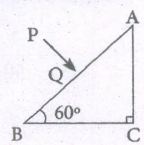
33.
(i) For a glass ( \(\mu =\sqrt { 5 } \)) the angle of minimum deviation is equal to the angle of the prism. Find the angle of the prism.
(ii) Draw ray diagram when incident ray falls normally on one of the two equal sides of a right-angled isosceles prism having refractive indeed \(\mu =\sqrt { 3 } \).
34.
What is dispersion? Obtain the equation for dispersive power of a medium.
35.
Derive the equation for angle of deviation produced by a prism and thus obtain the equation for refractive index of material of the prism.
36.
Obtain lens maker’s formula and mention its significance.
37.
38.
It is possible for two lenses to produce zero power?
39.
Find the minimum thickness of a film of refractive index 1.25, which will strongly reflect the light of wavelength 589 nm. Also find the minimum thickness of the film to be anti-reflecting.
40.
Two light sources with amplitudes 5 units and 3 units respectively interfere with each other. Calculate the ratio of maximum and minimum intensities.
41.
Light ray falls at normal incidence on the first face and emerges gracing the second face for an equilateral prism.
(a) What is the angle of deviation produced?
(b) What is the refractive index of the material of the prism?
42.
A biconvex lens has radii of curvature 20 cm and 15 cm for the two curved surfaces. The refractive index of the material of the lens is 1.5.
(a) What is its focal length?
(b) Will the focal length change if the lens is flipped by the side?
43.
What is the radius of the illumination when seen above from inside a swimming pool from a depth of 10 m on a sunny day? What is the total angle of view? [Given, refractive index of water is 4/3]
1.
(b)
3: 1
2.
(a)
5 cm.
3.
(b)
Concave mirror
4.
(b)
\(\sqrt { { x }_{ 1 }{ x }_{ 2 } } \)
5.
(d)
45 cm
6.
(a)
90°
7.
(b)
30
8.
(b)
90°
9.
(a)
0°
10.
(a)
None
11.
(a)
\(\cfrac { h }{ 4 } \)
12.
(c)
5
13.
λ = 500 nm = 500 x 10-9 m
x = 3 mm = 3 x 10⁻³ m
a = 1 mm = 1 x 10⁻³ m
\(d=\frac{xa}{1.22 \lambda}\)
\(d=\frac{3 \times1\times10^{-6}}{1.22 \times500\times10^{-9}}\)
\(=\frac{3 \times1\times10^{-6}}{6.10 \times 10^{-7}}\)
\(d=\frac{30}{6.1}=5 m\)
14.
(a)
15.
Convex Mirror is diverging in nature and for all positions of objects, convex mirror forms virtual and erect image.
16.
\(\\ \mu =\cfrac { c }{ v } =\cfrac { sini }{ sinr } \)
It follows that: v of sin r Since r is minimum in medium R, therefore, sin r and hence the velocity of light is minimum in medium R.
17.
(i) Only in the special cases when the pass axis of (III) is parallel to (I) or (II) there shall be no light emerging.
(ii) In all other cases there shall be light emerging because the pass axis of (II) is no longer perpendicular to the pass axis of (III).
18.
The angular separation between the two extreme colours (violet and red) in the spectrum is called the angular dispersion.
19.
Yes, there is a difference between coloured light obtained from prism and soap bubble Dispenion takes place in prism. Interference takes place in soap bubbles.
20.
21.
The refractive index of vacuum, n1 = 1
The wavelength in vacuum, λ1 = 5893 Å.
The speed in vacuum, c = v1 = 3 x 10⁸ m s–1
The refractive index of water, n2 = 1.33
The wavelength of light in water, λ2
The speed of light in water, v2
(a) The equation relating the wavelength and refractive index is,
\(\cfrac { { \lambda }_{ 1 } }{ \lambda _{ 2 } } =\cfrac { { n }_{ 2 } }{ { n }_{ 1 } } \)
Rewriting, \({ \lambda }_{ 2 }=\cfrac { { n }_{ 1 } }{ { n }_{ 2 } } \times { \lambda }_{ 1 }\)
Substituting the values,
\({ \lambda }_{ 2 }=\cfrac { 1 }{ 1.33 } \times 5893\overset { o }{ A } =4431\overset { o }{ A } \)
\({ \lambda }_{ 2 }=4431\overset { o }{ A } \)
(b) The equation relating the speed and refractive index is,
\(\cfrac { { v }_{ 1 } }{ { v }_{ 2 } } =\cfrac { { n }_{ 2 } }{ { n }_{ 1 } } \)
Rewriting, \({ v }_{ 2 }=\cfrac { { n }_{ 1 } }{ { n }_{ 2 } } \times { v }_{ 1 }\)
Substituting the values,
\({ v }_{ 2 }=\cfrac { 1 }{ 1.33 } \times 3\times { 10 }^{ 8 }=2.256\times { 10 }^{ 8 }\)
v2 = 2.256 x 10⁸ ms-1
(c) Frequency of light in vacuum is,
\({ v }_{ 1 }=\cfrac { c }{ { \lambda }_{ 1 } } \)
Substituting the values,
\({ v }_{ 1 }=\cfrac { 3\times { 10 }^{ 8 } }{ 5893\times { 10 }^{ -10 } } =5.091\times { 10 }^{ 14 }Hz\)
Frequency of light in water is, \({ v }_{ 2 }=\cfrac { v }{ { \lambda }_{ 2 } } \)
Substituting the values,
\(\\ { v }_{ 2 }=\cfrac { 2.256\times { 10 }^{ 8 }{ ms }^{ -1 } }{ 4431\times { 10 }^{ -10 } } =5.091\times { 10 }^{ 14 }Hz\)
The results show that the frequency remains same in all media.
22.
Since, the prism is equilateral, A = 60o;
Given, i1 = 30o;i2 = 75o
Equation for angle of deviation, d = i1 + i2 – A
Substituting the values, d = 30°+ 75°– 60°= 45°
The angle of deviation produced d = 45o
23.
Let us assume a person of height h is standing in front of a vertical plane mirror. The person could see his/her head when light from the head falls on the mirror and gets reflected to the eyes. Same way, light from the feet falls on the mirror and gets reflected to the eyes.
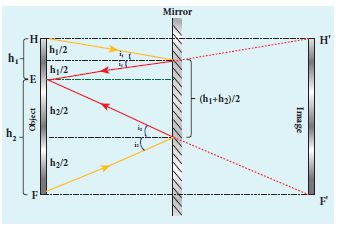
If the distance between his head H and eye E is h1 and distance between his feet F and eye E is h2. The person’s total height is, h Here it is, h = h1 + h2
By the law of reflection, the angle of incidence and angle of reflection are the same in the two extreme reflections. The normals are now the bisectors of angles between incident and reflected rays in the two points. By geometry, the height of the mirror needed is only half of the height of the person. \( \frac { { h }_{ 1 }+{ h }_{ 2 } }{ 2 } =\frac { h }{ 2 } \).
Does the height depend on the distance between the person and the mirror?
24.
The angle between the incident ray and deviated ray of light ray is called Angle of deviation due to reflection. d = 180 - 2i
25.
When light entering the water from outside is seen from inside the water, the view is restricted to a particular angle equal to the critical angle ic. The restricted illuminated circular area is called Snell's window
26.
Mirage:
Mirage is an optical illusion caused by atmospheric conditions especially the appearance of sheet of water in a desert caused by total internal reflection (or) refraction of light from the sky by heated air.
Looming:
Looming is an optical illusion caused by bending of light which appear an object floating high above its actual position specially in polar region.
27.
Stars appear twinkling because of the movement of the atmospheric layer with varying refractive indices due to refraction.
28.
The angle between the incident and deviated light is called Angle of deviation due to refraction. When light travels from
(i) rarer to denser medium, d = i - r
(ii) denser to rarer medium, d = r - i
29.
\(sin{ i }_{ c }=\cfrac { 1 }{ \mu } =\cfrac { 1 }{ 1.5 } =0.667\\ \)
or ic= 41.8o
Deviation = 90o - i = 90o - 41.8o = 48.2o
This si the maximum attainable deviation in refraction. So, the given data favours total internal reflection.
In reflection, deviation = 180o - 2i
or 90o = 180o - 2i or 2i = 90o or i = 45o
or i = 45o
30.
For minimum deviation position
\({ \mu }_{ red }=\cfrac { sin\left( \frac { A+{ \delta }_{ red } }{ 2 } \right) }{ sin\frac { A }{ 2 } } \)
or \(sin\left( \cfrac { A+{ { \delta }_{ red } } }{ 2 } \right) ={ n }_{ red }\)
\(sin\cfrac { 2 }{ A } =1.622\times 0.5=0.811\)
\(\therefore \cfrac { 60+{ \lambda }_{ red } }{ 2 } ={ 54 }^{ o }12'\)
\({ \delta }_{ red }={ 108 }^{ o }24'-{ 60 }^{ o }={ 48 }^{ o }24'\)
Similarly, \(sin\left( \cfrac { A+{ \delta }_{ viloet } }{ 2 } \right) =1.663\times 0.5'\)
= 0.8315 or \(\cfrac { { 60 }^{ o }+{ \delta }_{ viloet } }{ 2 } =56^{ o }15'\)
\({ \delta }_{ viloet }=112^{ o }30'-{ 60 }^{ ' }={ 52 }^{ o }30'\)
\(\therefore { \delta }_{ violet }-{ \delta }_{ red }=\left( 52-30' \right) -\left( 48^{ o }24' \right) ={ 4 }^{ o }6'\)
It is not advisable to use the formula,
\({ \delta }_{ v }-{ \delta }_{ r }=\left( { \mu }_{ v }-{ \mu }_{ r } \right) \) in the above solution.
31.
P = P1 + P2 = (15 - 5) D = 10D
\(F=\cfrac { 1 }{ P } =\cfrac { 1 }{ 10 } m=10cm\)
(b) \(\cfrac { 1 }{ v } -\cfrac { 1 }{ u } =\cfrac { 1 }{ F } or\cfrac { 1 }{ F } +\cfrac { 1 }{ u } \)
or \(\cfrac { 1 }{ v } =\cfrac { 1 }{ 10 } +\cfrac { 1 }{ -30 } \) or v = 15cm
Again,\(\cfrac { I }{ O } =\cfrac { v }{ u } =\cfrac { 15 }{ -30 } =-\cfrac { 1 }{ 2 } \)
or \(I=-\cfrac { 1 }{ 2 } \times 3cm=-1.5cm\)
The negative sign indicates that the image is real and inverted.
32.
For face AB, ∠i = 0°,∠r = ·0° the ray will pass through AB undeflected
Now, at face AC
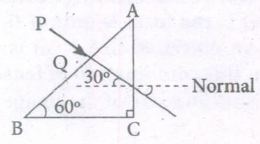
Formula.
Here,\({ \quad i }_{ c }={ sin }^{ -1 }\left( \cfrac { 1 }{ \mu } \right) \)
= \({ sin }^{ -1 }\left( \cfrac { 2 }{ 3 } \right) ={ sin }^{ -1 }\left( 0.66 \right) \)
∠i on face AC is 30o which is less than ∠ie.
Hence, the ray get refracted.
And, applying Snell's law at face AC
\({ sin30 }^{ o }\times \cfrac { 3 }{ 2 } =sinr\times 1\)
\(\Rightarrow sinr=\cfrac { 1 }{ 2 } \times \cfrac { 3 }{ 2 } \)
\(\Rightarrow r={ sin }^{ -1 }\left( \cfrac { 3 }{ 4 } \right) ={ sin }^{ -1 }(0.75)\)
And, dearly r > i, as ray passes from denser to rarer medium.
33.
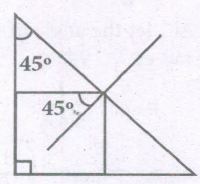
(i) At a minimum deviation \(\mu =\cfrac { sin\left( \frac { A+{ \delta }_{ m } }{ 2 } \right) }{ sin\left( \cfrac { A }{ 2 } \right) } \)
Given \({ \delta }_{ m }=A\)
\(\mu =\cfrac { sinA }{ sin\cfrac { A }{ 2 } } =\cfrac { 2sin\cfrac { A }{ 2 } cos\cfrac { A }{ 2 } }{ sin\cfrac { A }{ 2 } } \)
= \(2cos\cfrac { A }{ 2 } \)
\(\therefore cos\cfrac { A }{ 2 } =\cfrac { \sqrt { 3 } }{ 2 } \cfrac { A }{ 2 } =30\) A = 6o
(iii) \(\mu =\sqrt { 3 } \cfrac { 1 }{ { sini }_{ c } } \Rightarrow { sini }_{ c }=\cfrac { 1 }{ \sqrt { 3 } } \)
ஃ Angle of incidence > ic
Total internal reflection takes place.
34.
Dispersion: It is splitting of white light into its constituent colours.
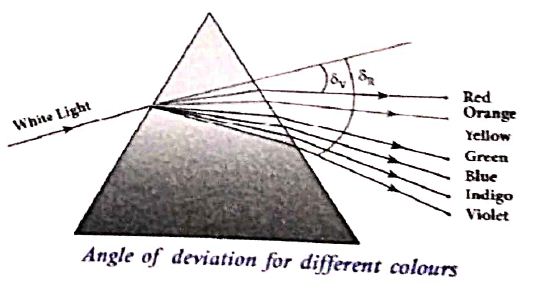
(i) Consider a beam of white light passes through a prism; it gets dispersed into its constituent colours as shown in Figure.
(ii) Let \(\delta_{v}, \delta_{R} \) are the angles of deviation for violet and red light. Let nV and nR are the refractive indices for the violet and red light respectively
(iii) The refractive index of the material of a prism is given by the equation
\(\mathrm{n}=\frac{\sin \left(\frac{\mathrm{A}+\mathrm{D}}{2}\right)}{\sin (\mathrm{A} / 2)}\)
(iv) Here A is the angle of the prism and D is the angle of minimum deviation. If the angle of prism is small of the order of 10o, the prism is said to be a small angle prism.
(v) When rays of light pass through such prisms, the angle of deviation also becomes small. If A be the angle of a smitt angle prism and the angle of deviation then the prism formula becomes.
\(n=\frac{\sin \left(\frac{A+\delta}{2}\right)}{\sin (A / 2)}\)
For small angles of \(A\ and \ \delta \)
\(\sin \frac{A+\delta}{A} \approx \frac{A+\delta}{A} \)
\(\sin \frac{A}{2} \approx \frac{A}{2} \)
\(n=\frac{(A+\delta / 2)}{(A / 2)}=\frac{A+\delta}{A}=1+\frac{\delta}{A} \)
Further simplifying,
\(\frac{\delta}{A} =n-1 \)
\(\delta =(n-1) A \) .....(1)
(vi) When white light enters the prism, the deviation is different for different colours. Thus, the refractive index is also different for different colours
For Violet colour, \( \delta_{\mathrm{v}}=\left(\mathrm{n}_{\mathrm{v}}-1\right) \mathrm{A} \) ...(2)
For Red colour, \(\delta_{\mathrm{R}}=\left(\mathrm{n}_{\mathrm{R}}-1\right) \mathrm{A} \) ....(3)
(vii) As, angle of deviation for violet colour \(\delta_{v}\) is greater the angle of deviation for red colour \(\delta_{\mathrm{R}}\) the refractive index for violet colour nv is greater than the refractive index for red colour nR Subtracting \(\delta_{v}\) from \(\delta_{\mathrm{R}}\) we get
\(\delta_{\mathrm{v}}-\delta_{\mathrm{R}}=\left(\mathrm{n}_{\mathrm{v}}-\mathrm{n}_{\mathrm{R}}\right) \mathrm{A}\) ....(4)
(viii) The term \(\left(\delta_{v}-\delta_{R}\right)\) is the angular separation between the two extreme colours (violet and red) in the spectrum is called the angular dispersion. If we take \(\delta\) is the angle of deviation for any middly ray (green or yellow) and the corresponding refractive index. Then,
\(\delta=(n-1) A\) .....(5)
Dispersive power (ω):
It is the ability of the material of the prism to cause dispersion. It is defined as the ratio of the angular dispersion for the extreme colours to the deviation for any mean colour.
Dispersive power
\(\omega=\frac{\text { Angular dispersion }}{\text { Mean deviation }}=\frac{\delta_{v}-\delta_{R}}{\delta}\) ....(6)
Substituting \(\left(\delta_{\mathrm{v}}-\delta_{\mathrm{R}}\right) \text { and }(\delta) \)
\(\omega=\frac{\mathrm{n}_{\mathrm{v}}-\mathrm{n}_{\mathrm{R}}}{(\mathrm{n}-1)} \) .......(7)
(ix) Dispersive power is a dimensionless quality It has no unit. Dispersive power is always positive. The dispersive power of a prism depends only on the nature of material of the prism and it is independent of the angle of the prism.
35.
Angle of deviation Produced by Prism:
(i) Let light ray PQ is incident on one of the refracting faces of the prism.
(ii) The angles of incidence and refraction at the first face AB are i1 and rl. The path of the light inside the prism is QR.
(iii) The angle of incidence and refraction at the second face AC is r2 and i2 respectively.
(iv) RS is the ray emerging from the second face. Angle i2 is also caned angle of emergence.
(v) The angle between the direction of the incident ray PQ and the emergent ray RS is called the angle of deviation d.
(vi) The two normals drawn at the point of incidence Q and emergence R meet at point N. They meet at point N.
(vii) The extended incident ray and the emergent ray meet at a point M.
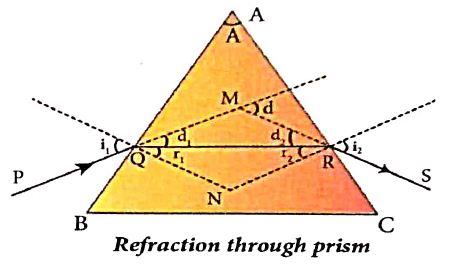
The angle of deviation d1 at the surface AB is,
ㄥRQM = d = i1 - r1 ...(1)
The angle of deviation d2 at the surface AC is
ㄥQRM = d2 = i2 - r2 .......(2)
Total angle of deviation d produced is,
d = d1 + d2 .....(3)
Substituting for d1 and d2 in equation (3)
d = (i1 - r1) + (i2 - r2)
After rearranging,
d = (i1 - r1) + (i2 - r2) ........(4)
In the quadrilateral AQNR, two of the angles (at the vertices Q and R) are right angles. Therefore, the sum of the other angles of the quadrilateral is 180°.
\(\angle A+\angle QNR={ 180 }^{ 0 }\) .........(5)
From the triangle ΔQNR
\({ r }_{ 1 }+{ r }_{ 2 }+\angle QNR={ 180 }^{ o }\) ......(6)
Comparing these two equations (5) and (6) we get,
r1 + r2 = A .......(7)
Substituting this in equation (4) for angle of deviation,
d = i1+ i2 - A .............(8)
(viii) Thus, the angle of deviation depends on the angle of incidence i1, angle of emergence i2 and the angle for the prism A.
(ix) For a given angle of incidence the angle of emergence is decided by the refractive index of the material of the prism. Hence the angle of deviation depends on these following factors.
(i) the angle of incidence
(ii) the angle of the prism.
(iii) the refractive index of the material of the prism (which decides the angle of emergence).
Refractive index of the material of the prism:
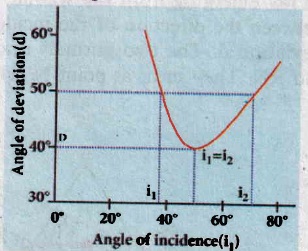
At minimum deviation, i1 = i2 = i and r1 = r2 = r
Now, the equation (8) becomes,
D - i1 + i2 - A = 2i - A (or) \(i=\cfrac { \left( A+D \right) }{ 2 } \)
The equation (7) becomes
r1 + r2 = A ⇒ 2r = A (or) \(r=\cfrac { A }{ 2 } \)
Substituting i and r in Snell's law
\(n=\cfrac { sini }{ sinr } \)
\(n=\cfrac{\cfrac{sin(A+D)}{2}}{sin(A/2)}\)
36.
(i) Let us consider a thin lens made up of a medium of refractive index n2 is placed in a medium of refractive index n1. Let R1 and R2 be the radii of curvature of two spherical surfaces (1) and (2) respectively and P be the pole.
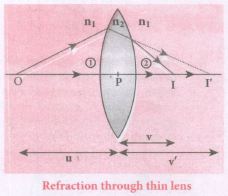
(ii) Consider a point object 'O' on the principal axis. A paraxial ray from 'O' which falls very close to P, after refraction at the surface (1) forms image at 1'.
(iii) Before it does so, it is again refracted by the surface (2). Therefore the final image is formed at I.
(iv) The general equation for the refraction at a single spherical surface is given from Equation,
\(\cfrac { { n }_{ 2 } }{ v } -\cfrac { { n }_{ 1 } }{ v} =\cfrac { \left( { n }_{ 2 }-{ n }_{ 1 } \right) }{ { R } } \)
For the refracting surface (1), the light goes from n1 to n2
\(\cfrac { { n }_{ 2 } }{ v' } -\cfrac { { n }_{ 1 } }{ u } =\cfrac { \left( { n }_{ 2 }-{ n }_{ 1 } \right) }{ { R }_{ 1 } } \) .....(1)
For the refracting surface (2), the light goes from n2 to n1
\(\frac{n_{1}}{v}+\frac{n_{2}}{v^{\prime}}=\frac{\left(n_{1}-n_{2}\right)}{R_{2}}\) ......(2)
For surface (2) I' acts as virtual object.
Adding the above two equations (1) and (2)
\(\cfrac { { n }_{ 1 } }{ v } -\cfrac { { n }_{ 1 } }{ u } =\left( { n }_{ 2 }-{ n }_{ 1 } \right) \left( \cfrac { 1 }{ { R }_{ 1 } } -\cfrac { 1 }{ { R }_{ 2 } } \right) \)
on further simplifying and rearranging,
\(\cfrac { 1 }{ v } -\cfrac { 1 }{ u } =\left( \cfrac { { n }_{ 2 }-{ n }_{ 1 } }{ { n }_{ 1 } } \right) \left( \cfrac { 1 }{ { R }_{ 1 } } -\cfrac { 1 }{ { R }_{ 2 } } \right) \)
\(\cfrac { 1 }{ v } -\cfrac { 1 }{ u } =\left( \cfrac { { n }_{ 2 } }{ n_{ 1 } } -1 \right) \left( \cfrac { 1 }{ { R }_{ 1 } } -\cfrac { 1 }{ { R }_{ 2 } } \right) \) ....(3)
If the object is at infinity, the image is formed at the focus of the lens. Thus, for u = \(\infty\), v = f. Then the equation becomes.
\(\cfrac { 1 }{ f } -\cfrac { 1 }{ \infty } =\left( \cfrac { { n }_{ 2 } }{ { { n }_{ 1 } } } -1 \right) \left( \cfrac { 1 }{ { R }_{ 1 } } -\cfrac { 1 }{ { R }_{ 2 } } \right) \)
\(\cfrac { 1 }{ f } =\left( \cfrac { { n }_{ 2 } }{ { n }_{ 1 } } -1 \right) \left( \cfrac { 1 }{ { R }_{ 1 } } -\cfrac { 1 }{ { R }_{ 2 } } \right) \) ......(4)
If the lens is kept in air, then we can take n2 = n and n1 = 1. So the equation (4) becomes,
\(\\ \cfrac { 1 }{ f } =\left( n-1 \right) \left( \cfrac { 1 }{ { R }_{ 1 } } -\cfrac { 1 }{ { R }_{ 2 } } \right) \) ..(5)
The above equation is called the lens maker's formula.
Significance:
It tells the lens manufacturers what curvature is needed to make a lens of desired focal length with a material of particular refractive index to make a lens of desired focal length. This formula holds good also for a concave lens.
37.
38.
Yes, It is possible for two lens to produce zero power.
Explanation:
when the two lens (one is concave & another one is convex lens) are combined together, the focal length of the combination of the two lenses is F.
Then
\(\frac{1}{F}=\frac{1}{f_{1}}+\frac{1}{f_{2}} \)
\(\text { if } f_{1}=f_{2}=f \)
\(f_{1}=f(\text { convex }) \)
\(f_{2}=-f(\text { concave) } \)
\(P=\frac{1}{F}=\frac{1}{f}-\frac{1}{f}=0 . \ P \rightarrow \text { power } \)
39.
λ = 589 nm = 589 x 10−9 m
For the film to have strong reflection, the reflected waves should interfere constructively. The least optical path difference introduced by the film should be λ/2. The optical path difference between the waves reflected from the two surfaces of the film is 2μd. Thus, for strong reflection, 2μd = λ/2 [As given in equation 6.145. with n = 1]
Rewriting, \(d=\frac{\lambda}{4 \mu}\)
Substituting, \(d=\frac{589 \times 10^{9}}{4 \times 1.25}=117.8 \times 10^{-9}\)
d = 117.8 x 10-9 = 117.8 nm
For the film to be anti-reflecting, the reflected rays should interfere destructively. The least optical path difference introduced by the film should be λ. The optical path difference between the waves reflected from the two surfaces of the film is 2μd. For strong reflection, 2μd = λ [As given in equation 6.146. with n = 1]
Rewriting, \(d=\cfrac { \lambda }{ 2\mu } \)
Substituting, \(d=\cfrac { 589\times { 10 }^{ 9 } }{ 2\times 1.25 } =235.6\times { 10 }^{ -9 }\)
d = 235.6 x 10-9 = 235.6 nm
40.
Amplitudes, a1 = 5, a2 = 3
Resultant amplitude,
\(A=\sqrt { { a }_{ 1 }^{ 2 }+{ a }_{ 2 }^{ 2 }+2{ a }_{ 1 }{ a }_{ 2 }cos\varphi } \)
Resultant amplitude is maximum when,
\(\phi =0,cos0=1,{ A }_{ max }=\sqrt { { a }_{ 1 }^{ 2 }+{ a }_{ 2 }^{ 2 }+{ 2a }_{ 1 }{ a }_{ 2 } } \)
\(\\ { A }_{ max }=\sqrt { \left( { a }_{ 1 }+{ a }_{ 2 } \right) ^{ 2 } } =\sqrt { \left( 5+3 \right) ^{ 2 } } =\sqrt { \left( 8 \right) ^{ 2 } } \)
= 8 units
Resultant amplitude is minimum when
\(\phi =\pi,cos\pi=1,{ A }_{ max }=\sqrt { { a }_{ 1 }^{ 2 }+{ a }_{ 2 }^{ 2 }+{ 2a }_{ 1 }{ a }_{ 2 } } \)
\({ A }_{ max }=\sqrt { \left( { a }_{ 1 }-{ a }_{ 2 } \right) ^{ 2 } } =\sqrt { \left( 5-3 \right) ^{ 2 } } =\sqrt { \left( 2 \right) ^{ 2 } } \)
= 2units
\(I\infty { A }^{ 2 }\)
\(\cfrac { { I }_{ max } }{ { I }_{ min } } =\cfrac { \left( { A }_{ max } \right) ^{ 2 } }{ \left( { { A }_{ min } } \right) ^{ 2 } } \)
Substituting,
\(\cfrac { { I }_{ max } }{ { I }_{ min } } =\cfrac { \left( 8 \right) ^{ 2 } }{ \left( 2 \right) ^{ 2 } } =\cfrac { 64 }{ 4 } 16\) (or)
\({ I }_{ max }:{ I }_{ min }=16:1\)
41.
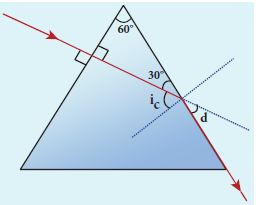
The given situation is shown in the figure
Given, A = 60o ; i1 = 0o; i2 = 90o
(a) Equation for angle of deviation,
d = i1 + i2 - A
Substituting the values
d = 0o + 90o- 60o = 30o
The angle of deviation produced is, d = 30°
(b) The light inside the prism must be falling on the second face at critical angle as it graces the boundary. ic = 90° – 30° = 60°
Equation for critical angle is, \(\sin i_{c}=\frac{1}{n}\)
\(n=\frac{1}{\sin i_{c}} ; \quad n=\frac{1}{\sin 60^{\circ}}=\frac{1}{\sqrt{3} / 2}=\frac{2}{\sqrt{3}}=1.15\)
The refractive index of the material of the prism is, n = 1.15
42.
For a biconvex lens, radius of curvature of the first surface is positive and that of the second surface is negative as shown in the figure.
.JPG)
Given, n = 1.5, R1 = 20 cm and R2 = –15 cm
(a) Lensmaker’s formula \(\frac{1}{f}=(n-1)\left(\frac{1}{R_{1}}-\frac{1}{R_{2}}\right)\)
Substituting the values,
\(\frac{1}{f}=(1.5-1)\left(\frac{1}{20}-\frac{1}{-15}\right)=(1.5-1)\left(\frac{1}{20}+\frac{1}{15}\right)\)
\(\frac{1}{f}=(0.5)\left(\frac{1}{20}+\frac{1}{15}\right)=(0.5)\left(\frac{3+4}{60}\right)=\left(\frac{1}{2} \times \frac{7}{60}\right)=\frac{7}{120}\)
\(f=\frac{120}{7}\) = 17.14 cm
As the focal length is positive the lens is a converging lens.
(b) When the lens is flipped by the side,
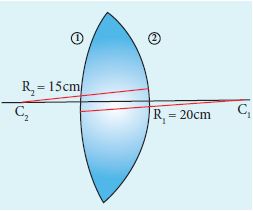
Now, R1= 15 cm and R2 = –20 cm, n = 1.5
Substituting the values in the lens maker's formula,
\(\cfrac { 1 }{ f } =\left( 1.5-1 \right) \left( \cfrac { 1 }{ 15 } -\cfrac { 1 }{-20 } \right) \)
\(\cfrac { 1 }{ f } =\left( 1.5-1 \right) \left( \cfrac { 1 }{ 15 } +\cfrac { 1 }{ 20 } \right) \)
This will also result in, f = 17.14 cm
Thus, it is concluded that the focal length of the lens will not change if it is flipped by the side. This is true for any lens. Students can verify this for any kind of lens.
43.
Given, n = 4/3, d = 10 m.
Radius of illumination, \(R=\cfrac { d }{ \sqrt { { n }^{ 2 }-1 } } \)
\(R=\cfrac { 10 }{ \sqrt { \left( 4/3 \right) ^{ 2 }- } 1 } =\cfrac { 10\times 3 }{ \sqrt { 16-9 } } \)
\(R=\cfrac { 30 }{ \sqrt { 7 } } =11.32cm\)
To find the critical angle,
\({ i }_{ c }={ sin }^{ -1 }\left( \cfrac { 1 }{ n } \right) \)
\({ i }_{ c }={ sin }^{ -1 }\left( \cfrac { 1 }{ 4/3 } \right) ={ sin }^{ -1 }\left( \cfrac { 3 }{ 4 } \right) =48.6^{ o }\)
The total angle of view of the cone is, \({ 2i }_{ c }=2\times { 48.6 }^{ 0 }={ 97.2 }^{ 0 }\)

12th Standard Syllabus & Materials
12th Standard
TN 12th Computer Applications களப்பெயர் முறைமை (DNS) Sample Question Papers Study Material - QB365 Set A
NEW12th Standard
TN 12th Computer Applications வலையமைப்பு எடுத்துக்காட்டுகள் மற்றும் நெறிமுறைகள் Sample Question Papers Study Material - QB365 Set A
NEW12th Standard
TN 12th Computer Applications கணினி வலையமைப்பு ஓர் அறிமுகம் Sample Question Papers Study Material - QB365 Set A
NEW12th Standard
TN 12th Computer Applications PHP-உடன் MySQL-ஐ இணைத்தல் Sample Question Papers Study Material - QB365 Set A



Tamilnadu Stateboard 12th Standard Subjects

Maths

Chemistry
Physics

Biology

Computer Science

Business Maths and Statistics

Economics

Commerce

Accountancy

History

Computer Applications
Biology
Computer Technology
Computer Applications
Computer Science
Business Maths and Statistics
Commerce
Economics
Maths
Chemistry
Physics
Computer Technology
History
Accountancy

Tamil

English

French
Tamilnadu Stateboard Standards

