
 100% FREE ACCESS
12th Standard Syllabus & Materials
12th Standard
TN 12th Computer Applications மின்னணு தரவு பரிமாற்றம் Sample Question Papers Study Material - QB365 Set A
NEW12th Standard
TN 12th Computer Applications மின் - வணிக பாதுகாப்பு அமைப்புகள் Sample Question Papers Study Material - QB365 Set A
NEW12th Standard
TN 12th Computer Applications மின்னணு செலுத்தல் முறைகள் Sample Question Papers Study Material - QB365 Set A
NEW12th Standard
TN 12th Computer Applications மின் - வணிகம் Sample Question Papers Study Material - QB365 Set A
NEW12th Standard
TN 12th Computer Applications திறந்த மூல கருத்துருக்கள் Sample Question Papers Study Material - QB365 Set A
NEW12th Standard
TN 12th Computer Applications வலையமைப்பு வடமிடல் Sample Question Papers Study Material - QB365 Set A

Published on: 25/01/2021
12th Standard Physics English Medium Reduced Syllabus Important Questions - 2021 Part - 1
Download Tamil Nadu 12th Standard Physics question papers, model tests, one-mark questions, important questions, and public exam papers in PDF format. Free study materials and answer keys for TN State Board students.
Questions + Answers key
Take MCQ Physics Test1.
What is called reverse saturation current?
2.
What is forbidden energy gap?
3.
Two charge d spherical conditioners of radii R1 & R2 when connected by a conducting wire acquire charges q1 & q2 respectively. Find the ratio of surface charge densities in terms of their radii.
4.
Gauss law is true for any closed surface, no matter what its shape or size is. Justify.
5.
Of which material is a potential wire normally made and why?
6.
What do you mean by parallel combination of cells?
7.
What is the effective resistance of resistors connected in series?
8.
What do you mean by Potential Energy of an electric dipole, when placed in electric field?
9.
What is a Capacitor?
10.
State Coulomb’s inverse law.
11.
Draw graphs showing the distribution of charge in a capacitor and current through an inductor during LC oscillations with respect to time. Assume that the charge in the capacitor is maximum initially.
12.
Write a short note on ‘electrostatic shielding’.
13.
Write the general definition of electric dipole moment for a collection of point charge.
14.
What is meant by ‘electric field lines’?
15.
Write a short note on superposition principle.
16.
What is meant by quantisation of charges?
17.
A water molecule has an electric dipole moment of 6.3 x 10⁻³⁰ Cm. A sample contains 1022 water molecules, with all the dipole moments aligned parallel to the external electric field of magnitude 3 x 10⁵ NC-1. How much work is required to rotate all the water molecules from θ = 0° to 90°?
18.
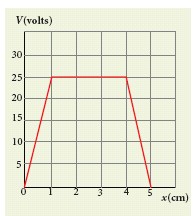
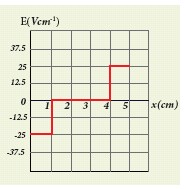
The following figure represents the electric potential as a function of x – coordinate. Plot the corresponding electric field as a function of x.
19.
An electron and a proton have the same kinetic energy. Which one of the two has the larger de Broglie wavelength and why?
20.
Write the applications of internet.
21.
Derive the energy expression for an electron is the hydrogen atom using Bohr atom model.
22.
A variable frequency ac source is connected to capacitor. How will the displacement current change with decrease in frequency.
23.
Write an expression for the momentum of Electromagnetic wave.
24.
Derive an expression of drift velocity and write the relation between drift velocity and mobility.
25.
Define and derive an expression for the energy density in parallel plate capacitor.
26.
What is dielectrics or insulators.
27.
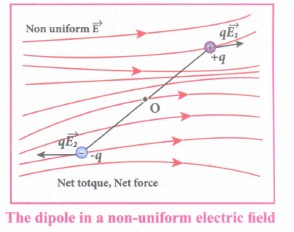
What happens when and electric dipole is held in a non-uniform electric field?
28.
Suppose a charge +q on Earth’s surface and another +q charge is placed on the surface of the Moon.
(a) Calculate the value of q required to balance the gravitational attraction between Earth and Moon.
(b) Suppose the distance between the Moon and Earth is halved, would the charge q change?
(Take mE = 5.9 x 1024 kg, mM = 7.9 x 10²² kg)
29.
Derive an expression for electrostatic potential energy of the dipole in a uniform electric field.
30.
From the given circuit,
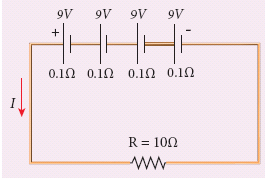
Find
i) Equivalent emf of the combination
ii) Equivalent internal resistance
iii) Total current
iv) Potential difference across external resistance
v) Potential difference across each cell
31.
The threshold wavelength for a metal surface whose photoelectric work function is 3.313 eV is _____.
4125 \(\mathring { A } \)
3750\(\mathring { A } \)
6000\(\mathring { A } \)
2062.5\(\mathring { A } \)
32.
Find the electric field at x = 5m from the graph.
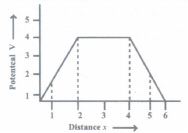
2 V/m
-2.5 V/m
2/5 V/m
-2/5 V/m
33.
The unit for electric susceptibility is
Nm2 C-2
C2 N-1 m-2
C-2Nm2
N-1 m-2C2
34.
The electric field created by a _________ is basically a non-uniform electric field.
Test charge
Positive charge
Negative charge
Point charge
35.
In an oscillating LC circuit, the maximum charge on the capacitor is Q. The charge on the capacitor when the energy is stored equally between the electric and magnetic fields is
\(\frac{Q}{2}\)
\(\frac{Q}{\sqrt3}\)
\(\frac{Q}{\sqrt2}\)
Q
36.
The electric and magnetic fields of an electromagnetic wave are _____.
in phase and perpendicular to each other
out of phase and not perpendicular to each other
in phase and not perpendicular to each other
out of phase and perpendicular to each other
37.
The total electric flux for the following closed surface which is kept inside water
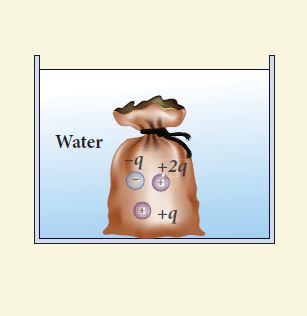
\(\frac { 80q }{ { \varepsilon }_{ 0 } } \)
\(\frac { q }{ { 40\varepsilon }_{ 0 } } \)
\(\frac { q }{ { 80\varepsilon }_{ 0 } } \)
\(\frac { q }{ { 160\varepsilon }_{ 0 } } \)
38.
39.
Which charge configuration produces a uniform electric field?
point charge
uniformly charged infinite line
uniformly charged infinite plane
uniformly charged spherical shell
40.
In a large building, there are 15 bulbs of 40 W, 5 bulbs of 100 W, 5 fans of 80 W and 1 heater of 1 kW are connected. The voltage of electric mains is 220 V. The maximum capacity of the main fuse of the building will be ______.
14 A
8 A
10 A
12 A
41.
What is RADAR? Explain its function. State its applications
42.
A wheel with 10 metallic spokes each 0.5m long is rotated with a speed of 120 rev/min in a plane normal to the horizontal component of the earth's magnetic field HE at a place if HE = 0.4 G at the place what is the induced emf between the a x k and the rim of the wheel? Take 1 gauss (G) = 10-4T.
43.
Explain magnetic dipole moment of a revolving electron.
44.
Straight in LC oscillations, the sum of energies stored in capacitor & the inductors is constant in time.
45.
An electric dipole of length 4cm, when placed with its axis making an angle of 60° with a uniform electric field, experiences a torque of 4√3 Nm. Calculate the potential energy of the dipole, if it has charge ± 8nC.
46.
Two point charges having equal charges separated by 1m distance experiences a force of 8N. What will be the force experienced by them, if they are held in water at the same distance?
47.
Explain what is
(i) Thomson effect,
(ii) Positive Thomson effect,
(iii) Negative effect.
48.
A copper slab of mass 2g contains 2 x 10²² atoms. The charge on the nucleus of each atom is 29 e. What fraction of the electrons must be removed from the sphere to give it a charge of +2μC?
49.
A thin metallic spherical shell of radius R carries a charge Q on its surface. A point charge \(\frac{Q}{2}\) is placed at the centre C and another is placed at the centre C and another a distance x from the centre as shown in the figure.
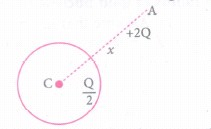
(i) Find the electric flux through the shell.
(ii) Find the force on the charges at C and A.
50.
Explain in detail the Electrostatic Potential difference between the charges.
51.
Define self-inductance of a coil interms of
(i) magnetic flux and
(ii) induced emf.
52.
Show that Lenz’s law is in accordance with the law of conservation of energy.
53.
Explain in detail the effect of a dielectric placed in a parallel plate capacitor.
54.
How do we determine the electric field due to a continuous charge distribution? Explain.
55.
1.
The current that flows under a reverse bias is called the reverse saturation current.
2.
The energy gap between the valance band and conduction band is called forbidden energy gap
3.
The charges will flow between the two spherical conditioners till their potential become equal.
\(i.e.\frac { { Kq }_{ 1 } }{ { R }_{ 1 } } =\frac { { Kq }_{ 2 } }{ { R }_{ 2 } } (or)\frac { { q }_{ 1 } }{ { R }_{ 1 } } =\frac { { q }_{ 2 } }{ { R }_{ 2 } } \)
The ratio of the surface charge densities on the two conditioners will be
\(\frac { { \sigma }_{ 1 } }{ { \sigma }_{ 2 } } =\frac { \frac { { q }_{ 1 } }{ 4\pi { R }_{ 1 }^{ 2 } } }{ \frac { { q }_{ 2 } }{ 4\pi { R }_{ 2 }^{ 2 } } } =\frac { { q }_{ 1 } }{ { q }_{ 1 } } .\frac { { R }_{ 2 }^{ 2 } }{ { R }_{ 1 }^{ 2 } } =\frac { { R }_{ 1 } }{ { R }_{ 2 } } \times \frac { { R }_{ 2 }^{ 2 } }{ { R }_{ 1 }^{ 2 } } \)
\(\frac { { \sigma }_{ 1 } }{ { \sigma }_{ 2 } } =\frac { { R }_{ 1 } }{ { R }_{ 2 } } \)
4.
This is due to the fact that
(i) electric field is radial
(ii) electric field E ∝ \(\frac{1}{R^2}\)
5.
The potential wire is usually made of an alloy such as manganin or nichrome. Such an alloy has high resistivity and low temperature coefficient of resistance.
6.
In parallel connection all the positive terminals of the cells are connected to one point and all the negative terminals to a second point. These two points form the positive and negative terminals of the battery.
7.
When several resistances are connected in series, the total or equivalent resistance is the sum of the individual resistances
R5 = R1 + R2 + .........+ Rn.
8.
An electric dipole always tends to current it self along the direction of electric field, work has to be done in rotating the dipole to same other orientation θ this work done in rotating dipole gets stored in the dipole in the form of potential energy.
9.
Capacitor is a device used to store electric charge and electrical energy.
10.
Coulomb's inverse square law states that the force of attraction or repulsion between two magnetic poles is directly proportional to the product of their pole strengths and inversely proportional to the square of the distance between them.
\(\vec { F } =k \frac { { q }_{ m_{A} }{ q }_{ m_{B} } }{ { r }^{ 2 } } \hat { r } \)
11.
For capacitor:
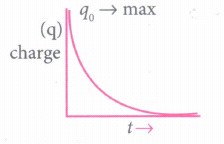
The charge decays exponentially with time. When the capacitor discharge.
For Inductor:
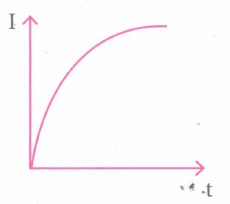
12.
Electrostatic shielding is the process of isolating a certain region of space from external field. It is based on the fact that electric field inside a conductor is zero. This property is called elecrostatic shielding because anything placed inside the cavity of the conductor will be completely shielded from external fields.
13.
For a collection of n point charges, the electric dipole moment is defined as follows, \(\vec{p}=\stackrel{i=n} \sum _{i=1}q_i\vec{r}_i\) where, \(\vec{r}_i\) is the position vector of charge qi from the origin.
14.
Electric field lines are a set of continuous lines which represent the electric field in some region of space visually.
15.
It there are more than two charges, the total force acting on a given charge is equal to the vector sum of forces exerted on it by all the other charges.
Consider a system of n charges namely q1, q2, q3 ...qn. The force on q1 exerted by the charge q2 is \(\overrightarrow{F_{12}}=k \frac{q_{1} q_{2}}{r_{21}^{2}} \hat{r}_{21}\) .
The force on q1 exerted by the charge q3 is \(\overrightarrow{F_{13}}=k \frac{q_{1} q_{3}}{r_{31}^{2}} \hat{r}_{31}\)
By continuing this, the total force acting on the charge q1 due to all other charges is given by
\( \vec{F}_{1}^{\text { tot }}=\overrightarrow{F_{12}}+\overrightarrow{F_{13}}+\overrightarrow{F_{14}}+\ldots+\vec{F}_{1 n} \)
\(\vec{F}_{1} ^{\text { tot }}=k\left\{\frac{q_{1} q_{2}}{r_{21}^{2}} \hat{r}_{21}+\frac{q_{1} q_{3}}{r_{31}^{2}} \hat{r}_{31}+\frac{q_{1} q_{4}}{r_{41}^{2}} \hat{r}_{41}+\ldots+\frac{q_{1} q_{n}}{r_{n 1}^{2}} \hat{r}_{n 1}\right\}\)
16.
The charge of an electron is the elementary charge in nature. Therefore, charge on any body is the integral multiple of an electron. The charge on any body can be expressed by the formula,
q = ne; where, n is the number of electrons, e is the charge on one electron.
n = 0, ±1, ±2, ±3, ±4, ...
This is called quantization of charge.
17.
When the water molecules are aligned in the direction of the electric field, it has minimum potential energy. The work done to rotate the dipole from θ = 0° to 90° is equal to the potential energy difference between these two configurations.
W = ΔU = U(90°) - U(0°)
From the equation U =−pE cosθ = −\(\hat p.\hat E\) ,
we write U = − pE cosθ, Next, we calculate the work done to rotate one water molecule from θ = 0° to 90°.
For one water molecule
W = - pE cos90o + pE cos0o = pE
W= 6.3 x 10-30 x 3 x 105 = 18.9 x 10⁻²⁵J
For 1022 water molecules, the total work done is
Wtot = 18.9 x 10-25 x 1022 = 18.9 x 10⁻³J
18.
In the given problem, since the potential depends only on x, we can use \(\vec { E } =\frac { dV }{ dx } \hat { i } \) (the other two terms \(\frac { \eth V }{ \eth y } \) and \(\frac { \eth V }{ \eth z } \) are zero)
From 0 to 1 cm, the slope is constant and so \(\frac { dV }{ dx } \) = 25V cm-1, So \(\vec { E } \)= -25V cm-1\(\hat { i } \)
From 1 to 4 cm, the potential is constant
V = 25 V. It implies that \(\frac { dV }{ dx } \) = 0, So \(\vec { E } \) = 0
From 4 to 5 cm, the slope \(\frac { dV }{ dx } \) = -25 V cm-1
So \(\vec { E } \) = + 25Vcm-1\(\hat { i } \)
The plot of electric field for the various points along the x-axis is given below
19.
An electron has a larger wavelength.
Reason: de- Broglie wavelength in terms of kinetic energy \(\lambda =\frac { h }{ \sqrt { 2m{ E }_{ K } } } \alpha \frac { 1 }{ \sqrt { m } } \) is for the same kinetic energy.
As an electron has a smaller mass than a proton, an electron has a larger de Broglie wavelength than a proton for the same kinetic energy.
20.
i) Search engine: The search engine is basically a web-based service tool used to search for information on World Wide Web.
ii) Communication: It helps millions of people to connect with the use of social networking: emails, instant messaging services and social networking tools.
iii) E-Commerce: Buying and selling of goods and services, transfer of funds are done over an electronic network.
21.
The electrostatic force is a conservative force, the potential energy for the electron in nth orbit is
\(U_{n} =\frac{1}{4 \pi \varepsilon_{0}} \frac{(+Z e)(-e)}{r_{n}}=-\frac{1}{4 \pi \varepsilon_{0}} \frac{Z^{2}}{r_{n}} \) \(\left[ \because r_n=\frac{\varepsilon_{0} h^{2} n^{2}}{\pi m Z e^{2}}\right]\)
\(U_{n} =-\frac{1}{4\varepsilon_{0}} -\frac{Z^{2} \mathrm{me}^{4}}{h^{2} n^{2}} \)
The kinetic energy of electron in nth orbit is
\(\mathrm{KE}_{\mathrm{n}}=\frac{1}{2} \mathrm{mv}_{\mathrm{n}}^{2}=\frac{\mathrm{Z}^{2} m \mathrm{e}^{4}}{8 \varepsilon_{0}^{2} \mathrm{~h}^{2} \mathrm{n}^{2}}\)
This implies that Un = -2KEn
Total energy of electron in the nth orbit is
\(E_{n}=K E_{n}+U_{n}=K E_{n}-2 K E_{n}=-K E_{n} \)
\(E_{n}=-\frac{Z^{2} m e^{4}}{8 \varepsilon_{0}^{2} h^{2} n^{2}} \)
For Hydrogen atom Z = 1
\(E_{n}=-\frac{m e^{4}}{8 \varepsilon_{0}^{2} h^{2} n^{2}} \text { joule }\)
n - principal quantum number
The negative sign indicates that the electron is bound to the nucleus.
Substituting the values of mass and charge of an electron (m and e), permittivity of free space \(\varepsilon^{0}\) and Planck's constant h and expressing in terms of (+(eV)), we get
\(E_{n}=-13.6\left(\frac{1}{n^{2}}\right) e V\)
(i) For the first orbit (ground state), the total energy of electron is E1 = - 13.6 eV.
(ii) For the second orbit (first excited state), the total energy of electron is E2 = -3.4 eV.
(iii) For the third orbit (second excited state), the total energy of electron is E3 = -1.51 eV and so on.
22.
On decreasing the frequency, reactance \({ X }_{ c }=\frac { 1 }{ \omega C } \) will increase which will lead to decrease in condition current. In this case Id = Ic hence displacement current will decrease.
23.
(i) If the electromagnetic wave incident on a material surface is completely absorbed, then the energy delivered is U, and momentum imparted on the surface is P = \(\frac{U}{c}\)
(ii) If the incident electromagnetic wave of energy U is totally reflected from the surface, then the momentum delivered to the surface is \(\Delta p=\frac { U }{ c } -\left( -\frac { U }{ c } \right) =2\frac { U }{ c } \)
(iii) The rate of flow of energy crossing a unit area is known as the pointing vector for electromagnetic waves.
24.
The drift velocity is the average velocity acquired by the electrons inside the conductor when it is subjected to an electric field. The average time between successive collisions is called the mean free time denoted by \(\tau \). The acceleration \(\vec { a } \) experienced by the electron in an electric field \(\vec { E } \) is given by
\(\vec { a } =\cfrac { -e\vec { E } }{ m } \left( since\vec { F } =-e\vec { E } \right) \)
The drift velocity is given by
\({ \vec { V } }_{ d }=\vec { a } \tau \)
\({ \vec { V } }_{ d }=\cfrac { e\tau }{ m } \vec { E } \)
\({ \vec { V } }_{ d }=-\mu \vec { E } \)
Here \(\mu =\cfrac { e\tau }{ m } \) is the mobility of the electron and it is defined as the magnitude of the drift velocity per unit electric field \(\mu =\cfrac { \left| { \vec { v } }_{ d } \right| }{ \left| \vec { E } \right| } \)
25.
Energy stored in the capacitor
\(U=\frac { 1 }{ 2 } { Cv }^{ 2 }\quad \quad ...(1)\)
This is rewritten as using \(C=\frac { { \varepsilon }_{ 0 }A }{ d } \& Ed=V\)
\(U=\frac { 1 }{ 2 } \left( \frac { { \varepsilon }_{ 0 }A }{ d } \right) { (Ed })^{ 2 }=\frac { 1 }{ 2 } { \varepsilon }_{ 0 }(Ad)\quad { E }^{ 2 }...(2)\)
where Ad = volume of the space between the capacitor plates. The energy stored per unit volume of space is defined as energy density \({ U }_{ E }=\frac { U }{ Volume } \) From equation (4),
We get
\({ u }_{ E }=\frac { 1 }{ 2 } { \varepsilon }_{ 0 }{ E }^{ 2 }\quad \quad \quad \quad \quad ...(3)\)
(iv) The energy density depends only on the electric field and not on the size of the plates of the capacitor.
26.
(i) A dielectric is a non-conducting material and has no free electrons. The electrons in a dielectric are bound within the atoms. Ebonite, glass and mica are some examples of dielectrics.
(ii) When an external electric field is applied, the electrons are not free to move anywhere but they are realigned in a specific way. A dielectric is made up of either polar molecules or non-polar molecules.
27.
If the electric field is not uniform, then the force experienced by +q is different from that experienced by -q. In addition to the torque, there will be net force acting on the dipole.
28.
G = 6.67 x 10⁻¹¹ Nm2kg-2
Mass of Earth mE = 5.9 x 1024 kg
Mass of Moon mm = 7.9 x 10²² kg
Gravitational force \(F_{g}=\frac{G m_{E} \times m_{M}}{r^{2}}\); Electro static force \(F_e=k\frac{q \times q}{r^2}\)
By equating the forces, \( k\frac{q \times q}{r^{2}}=G \cdot \frac{m_{E} \times m_{M}}{r^{2}} \)
\(\because k=\frac{1}{4 \pi \varepsilon_{0}}=9 \times 10^{9} \)
\( 4 \pi \varepsilon_{0} =0.11 \times 10^{-9} \)
\(q =\sqrt{4 \pi \varepsilon_{0} G m_{E} \cdot m_{M}} \) ....(1)
\(=\sqrt{0.11 \times 10^{-9} \times 6.67 \times 10^{-11} \times 5.9 \times 10^{24} \times 7.9 \times 10^{22}}\)
\( q =\sqrt{34.2 \times 10^{26}} \)
q ≈ 5.85 x 10¹³ C
b) Suppose the distance (r) between Moon and Earth is halved, there is no change in the value of charge (q). Because from equation (1), q is independent of distance (r).
29.
(i) Consider a dipole placed in the uniform electric field \(\vec { E } \). A dipole experiences a torque when kept in an uniform electric field \(\vec { E } \).(ii) To rotate the dipole (at constant angular velocity) from its initial angle θ' to another angle θ against the torque exerted by the electric field, an equal and opposite external torque must be applied on the dipole.
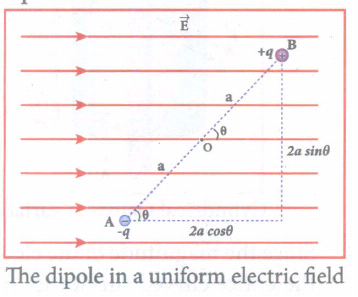
(iii) The work done by the external torque to rotate the dipole from angle θ' to θ at constant angular velocity is
\(W=\int _{ \theta ' }^{ \theta }{ { \tau }_{ ext }d\theta } \quad ...(1)\)
(iv) Since \({ \vec { \tau } }_{ ext }\) is equal and opposite to \({ \vec { \tau } }_{ E }=\vec { p } \times \vec { E } \), We have
\(|{ \vec { \tau } }_{ ext }|={ |\vec { \tau } }_{ E }|=|\vec { p } \times \vec { E } |\quad \quad \quad ...(2)\)
Substituting equation (2) in equation (1), we get
\(W=\int _{ \theta ' }^{ \theta }{ pEsin\theta d\theta } \)
\(W=pE(cos\theta '-cos\theta )\)
(v) This work done is equal to the potential energy difference between the angular positions θ to θ'.
U(θ) - U(θ') = ∆U= - pE cosθ + pE cosθ'
If the initial angle is θ' = 90o and is take as reference point, then U(θ') = pE cos 90o = 0. The potential energy stored in the system of dipole kept in the uniform electric field is given by
\(U=-pEcos\theta =-\vec { p } .\vec { E } \) ....(3)
In addition to p and E, the potential energy also depends on the orientation θ of the electric dipole with respect to the external electric field.
(vi) The potential energy is a) maximum when the dipole is aligned anti-parallel (θ = π) to the external electric field
b) minimum when the dipole is aligned parallel (θ = 0) to the external electric field.
30.
Equivalent emf of the combination
ξeq = nξ = 4 x 9 = 36 V
ii) Equivalent internal resistance req = nr = 4 x 0.1 = 0.4 Ω
iii) Total current \(I=\frac { n\xi }{ R+nr } \)
\(=\frac { 4\times 9 }{ 10+(4\times 0.1) } \)
\(=\frac { 4\times 9 }{ 10+0.4 } =\frac { 36 }{ 10.4 } \)
I = 3.46 A
iv) Potential difference across external resistance V = IR = 3.46 x 10 = 34.6 V. The remaining 1.4 V is dropped across the internal resistance of cells.
v) Potential difference across each cell \(\frac { V }{ n } =\frac { 34.6 }{ 4 } =8.65V\)
31.
\(\lambda_0 =\frac{h c}{\phi} \)
\(=\frac{6.626 \times 10^{-34} \times 3 \times 10^8}{3.313 \times 1.6 \times 10^{-19}} \)
\( =\frac{19.8782400}{5.3} \times 10^{-7} \)
\(\lambda_0 =3.750 \times 10^{-7} \simeq 3750 \stackrel{o}A\)
32.
(a)
2 V/m
33.
(b)
C2 N-1 m-2
34.
(d)
Point charge
35.
\(Q_{midpoint}=\frac{Q}{\sqrt{1^2+1^2}}=\frac{Q}{\sqrt2}\)
36.
(a)
in phase and perpendicular to each other
37.
\(Φ=\frac { q_{net} }{ { \varepsilon }_{ 0 } } \)
qnet = - q + q + 2q = 2q
Relative permittivity of water = 80
\(\therefore Φ=\frac { q }{{ \varepsilon }_{ r } { \varepsilon }_{ 0 } } \)
\(=\frac{2q}{{ 80 \times \varepsilon }_{ 0 }}=\frac{q}{{ 40 \varepsilon }_{ 0 }}\)
38.
(b)
39.
(c)
uniformly charged infinite plane
40.
Total power = 15 x 40 + 5 x 100 + 5 x 80 + 1000
= 600 + 500 + 400 + 1000
= 2500 W
P = VI, V = 220 V
\(I=\frac{P}{V}=\frac{2500}{220}=11.363 \ A\)
≃ 12 A
41.
(i) Radar basically stands for Radio Detection and Ranging System.
(ii) It is one of the important applications of communication systems' and is mainly used to sense, detect, and locate distant objects like aircraft, ships, spacecraft, etc.
(iii) The angle, range, or velocity of the objects that are invisible to the human eye can be determined.
(iii) Radar uses electromagnetic waves for communication. The electromagnetic signal is initially radiated into space by an antenna in all directions.
(iv) When this signal strikes the targeted object, it gets reflected or reradiated in many directions.
(v) This reflected (echo) signal is received by the radar antenna which in turn is delivered to the receiver.
(vi) Then, it is processed and amplified to determine the geographical statistics of the object. The range is determined by calculating the time taken by the signal to travel from RADAR to the target and back.
Applications :
Radars find extensive applications in almost all fields.
(i) In military, it is used for locating and detecting the targets.
(ii) It is used in navigation systems such as ship borne surface search, air search and weapons guidance systems.
(iii) To measure precipitation .rate and wind speed in meteorological observations, Radars are used.
(iv) It is employed to locate and rescue people in emergency situations.
42.
Given:
Induced emf, e = Blv (or) e = \(\frac12\) Bl2ω [where, v = rω, 1 = 2R]
Also, ω=2ㅠf = 2π x \(\frac{120}{60}\)
ω = 4ㅠ
Solution:
emf, e = \(\frac12\) x 4ㅠ x 0.4 x 10-4 (0.5)2
= 6.28 x 10⁻⁵V
The number of spokes is immaterial because the emf's across the spokes are in parallel
43.
(i) Electron revolves around a nucleus in a circular orbit of radius R.
(ii) Circulating electron is like a current in a circular loop.
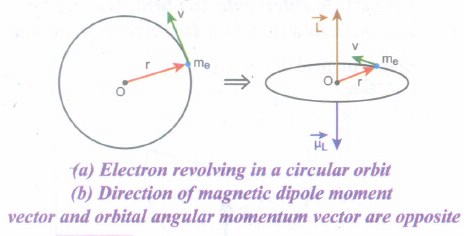
\(\vec { { \mu }_{ L } } =I\vec { A } \) ......(1)
In magnitude,
μL = IA
If T is the time period of an electron, the current due to the circular motion of the electron is
I = \(\frac { -e }{ T } \) ....(2)
where -e is the charge of an electron. If R is the radius of the circular orbit and v is the velocity of the electron in the circular orbit, then
T = \(\frac { 2\pi R }{ v } \) ..(3)
Using equation (2) and equation (3) in equation (1), we get
μL = \(\frac { e }{ \frac { 2\pi R }{ v } } \pi { R }^{ 2 }=\frac { evR }{ 2 } \) ....(4)
where A = πR2 is the area of the circular loop. By definition, the angular momentum of the electron about O is
\(\vec { L } =\vec { r } \times \vec { p } \)
In magnitude
L = Rp = mvR ...(5)
Using equation (4) and equation (5), we get
\(\frac { { \mu }_{ L } }{ L } =-\frac { \frac { evR }{ 2 } }{ mvR } =\frac { e }{ 2m } \Rightarrow \vec { { \mu }_{ L } } =\frac { e }{ 2m } \vec { L } \) ....(6)
The negative sign indicates that the magnetic moment and angular momentum are in opposite directions.
In magnitude
\(\frac{\mu_L}{L}=\frac{e}{2 m}=\frac{1.60 \times 10^{-19}}{2 \times 9.11 \times 10^{-31}}=0.0878 \times 10^{12} \mathrm{C} \mathrm{kg}^{-1}\)
\(\frac{\mu_L}{L}=8.78 \times 10^{10} \mathrm{C} \mathrm{kg}^{-1}=\text { constant }\)
The ratio \(\frac{\mu_L}{L}\) is aconstant known as Gyro-magnetic ratio \(\left(\frac{e}{2 m}\right)\).
According to Bohr quantization
\(\mathrm{L}=\mathrm{nh} / 2 \pi\)
\(\mu_L=\left(\frac{e}{2 m}\right) \mathrm{L}=\frac{\pi e h}{4 \pi m} \)
On substiting known values
\(\mu_L=9.27 \times 10^{-24} \mathrm{~A} \mathrm{~m}^2\)
The minimum magnetic moment can be obtained by substituting n = 1
\(\mu_2=9.27 \times 10^{-24} \mathrm{~A} \mathrm{~m}^2=9.27 \times 10^{-24} \mathrm{~J} \mathrm{~T}^{-1}\)
where, \(\mu_B=\frac{c h}{4 \pi m}=9.27 \times 10^{-24} \mathrm{~A} \mathrm{~m}^2\) is called Bohr magneton. which is used to measure atomic magnetic moments.
44.
(i) During LC oscillations in LC circuits, the energy of the system oscillates between the electric field of the capacitor and the magnetic field of the inductor.
(ii) Although these two forms of energy vary with time, the total energy remains constant. It means that LC oscillations take place in accordance with the law of conservation of energy.
Total energy, U= UE + UB = \(\frac { { q }^{ 2 } }{ 2C } +\frac { 1 }{ 2 } { Li }^{ 2 }\)
(iii) consider 3 different stages of LC oscillations and calculate the total energy of the system.
Case (i) When the charge in the capacitor, q Qm = and the current through the inductor, i = 0, the total energy is given by
\(U=\frac { { { Q }_{ m } }^{ 2 } }{ 2C } +0=\frac { { { Q }_{ m } }^{ 2 } }{ 2C } \)
The total energy is wholly electrical
Case (ii) When charge = 0; current = Im, the total energy is
\(U=0+\frac { 1 }{ 2 } { { Li }^{ 2 } }_{ m }=\frac { 1 }{ 2 } { { Li }^{ 2 } }_{ m }\)
\(=\frac { L }{ 2 } \times \left( \frac { { { Q }_{ m } }^{ 2 } }{ LC } \right) { Q }_{ m }\omega =\frac { { Q }_{ m } }{ \sqrt { LC } } \)
= \(\frac { { { Q }_{ m } }^{ 2 } }{ 2C } \)
Case (ii) When charge = 0 ; current = Im the total energy is
\(U=0+\frac { 1 }{ 2 } { { Li }^{ 2 } }_{ m }=\frac { 1 }{ 2 } { { Li }^{ 2 } }_{ m }\)
\(=\frac { L }{ 2 } \times \left( \frac { { { Q }_{ m } }^{ 2 } }{ LC } \right) \) since Im= \({ Q }_{ m }\omega =\frac { { Q }_{ m } }{ \sqrt { LC } } \)
= \(\frac { { { Q }_{ m } }^{ 2 } }{ 2C } \)
Case (iii) When charge = q; current = t. the total energy is
U = \(\frac { { q }^{ 2 } }{ 2C } +\frac { 1 }{ 2 } { Li }^{ 2 }\)
(iv) Since q = Qm = cos ωt, i = \(\frac { dq }{ dt } ={ Q }_{ m }=\omega \) sin ωt. The negative sign in current indicates that the charge in the capacitor decreases with time.
\(U=\frac { { { Q }_{ m } }^{ 2 }{ cos }^{ 2 }\omega t }{ 2C } +\frac { { { L{ \omega }^{ 2 }Q }_{ m } }^{ 2 }{ sin }^{ 2 }\omega t }{ 2 } \)
\(U=\frac { { { Q }_{ m } }^{ 2 }{ cos }^{ 2 }\omega t }{ 2C } +\frac { { { L{ \omega }^{ 2 }Q }_{ m } }^{ 2 }{ sin }^{ 2 }\omega t }{ 2LC } \)
since \({ \omega }^{ 2 }=\frac { 1 }{ LC } \)
= \(\frac { { { Q }_{ m } }^{ 2 } }{ 2C } { (cos }^{ 2 }\omega t+{ sin }^{ 2 }\omega t)\)
\(U=\frac { { { Q }_{ m } }^{ 2 } }{ 2C } \)
From the above three cases, it is clear that the total energy of the system remains constant.
45.
Length, I = 2a = 4cm = 4 x 10⁻²m
Angle, θ = 60°
torque ፔ = 4√3 Nm
Charge, Q = 8 x 10⁻⁹C
We know that, ፔ = pE sine [where p = Q x 2a]
ፔ = (Q x 2a)E sinθ
\(\tau =\frac { \partial }{ Q\times (2a)sin\theta } \)
\(=\frac { 4\sqrt { 3 } }{ 8\times { 10 }^{ -9 }\times 4\times { 10 }^{ -2 }\times { sin\quad 60 }^{ 0 } } \)
∴ Potential energy, U = -pE cosθ
= -Q(2a) x E x cosθ
\(=-8\times { 10 }^{ -9 }\times 4\times { 10 }^{ -2 }\times \frac { 4\sqrt { 3 } \times cos{ 60 }^{ 0 } }{ 8\times { 10 }^{ -9 }\times 4\times { 10 }^{ -2 }sin{ 60 }^{ 0 } } \)
\(U=\frac { -4\sqrt { 3 } }{ \sqrt { 3 } } =-4J\)
46.
\({ K }_{ W }=\frac { { F }_{ air } }{ { F }_{ water } } \quad ({ F }_{ air }=8N)\)
\({ F }_{ Water }=\frac { { F }_{ air } }{ { K }_{ W } } =\frac { 8 }{ 80 } =\frac { 1 }{ 10 } N\)
Note:
\(F=\frac { 1 }{ 4\pi { \varepsilon }_{ 0 } } \frac { { q }_{ 1 }{ q }_{ 2 } }{ { r }^{ 2 } } \)
\({ F }_{ m }=\frac { 1 }{ 4\pi { \varepsilon }_{ 0 }{ \varepsilon }_{ r } } \frac { { q }_{ 1 }{ q }_{ 2 } }{ { r }^{ 2 } } \)
\(\\ \\ \\ \frac { F }{ { F }_{ m } } ={ \varepsilon }_{ r }\Rightarrow [\therefore \frac { { F }_{ air } }{ { F }_{ water } } ={ K }_{ Water }]\)
47.
(i) If two points in a conductor are at different temperatures, the density of electrons at these points will differ and as a result the potential difference is created between these points. Thomson effect is also reversible.
(ii) Heat is transferred due to the current flow in the direction of the current. It is called positive Thomson effect. Similar effect is observed in metals like silver, zinc, and cadmium.
(iii) Heat is transferred due to the current flow in the direction opposite to the direction of current. It is called negative Thomson effect. Similar effect is observed in metals like platinum, nickel, cobalt, and mercury.
48.
Given:
Total number of electrons in the slab,
N = 29 x e = 29 x 2 x 1022
Number g electrons remvoed, n \(=\frac{q}{e}\)
\(n=\frac { 2\times { 10 }^{ -6 } }{ 1.6\times { 10 }^{ -19 } } \)
n 1.25 x 10¹³
∴ fraction of electrons removed
\(=\frac{No.of\ electrons\ removed\ (n)}{Total\ No.of \ electrons(N)}\)
\(\\ =\frac { 29\times 2\times { 10 }^{ 22 } }{ 1.25\times { 10 }^{ 13 } } =2.16\times { 10 }^{ -11 }\)
49.
(i) Electric flux \(\phi =\frac { Total\ enclosed\ charge }{ { \varepsilon }_{ 0 } } \)
Net charge enclosed inside the shell q = 0
∴ electric flux through the shell \(\frac { q }{ { \varepsilon }_{ 0 } } =0\)
(ii) The electric field or net charge inside the spherical conducting shell is zero.
Hence the force on charge \(\frac{Q}{2}\)is zero.
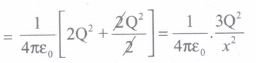
Force on charge at \(A,{ F }_{ A }=\frac { 1 }{ 4\pi { \varepsilon }_{ 0 } } .\frac { 2Q\left( Q+\frac { Q }{ 2 } \right) }{ { x }^{ 2 } } \)
50.
(i) Consider a positive charge q kept fixed at the origin which produces an electric field \(\overset { \rightarrow }{ E } \) around it.
(ii) A positive test charge q' is brought from point R to point P against the repulsive force between q and q' as shown in Figure. Work must be done to overcome this repulsion. This work done is stored as potential energy.
(iii) The test charge q' is brought from R to P with constant velocity which means that external force used to bring the test charge q' from R to P must be equal and opposite to the coulomb force \(\left( { \overset { \rightarrow }{ E } }_{ ext }=-{ \overset { \rightarrow }{ F } }_{ coloumb } \right) \)
The work done is
\(W=\int _{ R }^{ P }{ { \overset { \rightarrow }{ F } }_{ ext } } .d\overset { \rightarrow }{ r } \quad \quad \quad ...(1)\)
(iii) Since coulomb force is conservative, work done is independent of the path and it depends only on the initial and final positions of the test charge. If potential energy associated with q' at P is Up and that at R is UR' then difference in potential energy is defined as the work done to bring a test charge q' from point P to R and is given as Up - U R = W.
\(\Delta U=\int _{ R }^{ P }{ { \overset { \rightarrow }{ F } }_{ ext } } .d\overset { \rightarrow }{ r } \)
\(Since{ \overset { \rightarrow }{ F } }_{ ext }=-{ \overset { \rightarrow }{ F } }_{ coloumb }=-q'\overset { \rightarrow }{ E } \)
\(\Delta U=\int _{ R }^{ P }{ \left( -q'\overset { \rightarrow }{ E } \right) } .d\overset { \rightarrow }{ r } =q'\int _{ R }^{ P }{ \left( -\overset { \rightarrow }{ E } \right) } .d\overset { \rightarrow }{ r } \)
51.
(i) Self inductance of a coil is desined as the flux linkage with the coil, when a current of 1 A flows through it.
\(L=\frac{{ N\Phi }_{ B }}{i}\)
\(L={ N\Phi }_{ B }\)
(ii) Self inductance of a coil is defined as the opposing emf induced in the coil when the rate of change of current through the coil is 1 A s-1
\(\varepsilon =\frac { d{ (N\Phi }_{ B }) }{ dt } \)
\(=-\frac { d(Li) }{ dt }\)
\(\varepsilon =-L\frac { di }{ dt } \)
L = -e
52.
Conservation of energy:
(i) The truth of Lenz's law can be established on the basis of the law of conservation of energy. The explanation is as follows:
(ii) According to Lenz's law, when a magnet is moved either towards or away from a coil, the induced current produced opposes its motion
(iii) As a result, there will always be a resisting force on the moving magnet.
(iv) Work has to be done by some external agency to move the magnet against this resisting force
(v) Here the mechanical energy of the moving magnet is converted into the electrical energy which in turn, gets converted into Joule heat in the coil i.e., energy is converted from one form to another.
(vi) On the contrary to Lenz's law, let us assume that the induced current helps the cause responsible for its production.
(vii) Now When we push the magnet litle bit towards the coil, the induced current helps the movement of the magnet towards the coil.
(viii) Then the magnet starts moving towards the coil without any expense of energy. This, becomes a perpetual motion machine.
(ix) In practice, no such machine is possible. Therefore, the assumption that the induced current helps the cause is wrong.
53.
Effect of dielectrics in capacitors:
Suppose dielectrics like mica, glass or paper are introduced between the plates, then the capacitance of the capacitor is altered. The dielectric can be inserted into the plates in two different ways.
(i) when the capacitor is disconnected from the battery.
(ii) when the capacitor is connected to the battery.
(i) When the capacitor is disconnected from the battery
Consider a capacitor with two parallel plates each of cross-sectional area A and are separated by a distance d. The capacitor is charged by a battery of voltage Vo and the charge stored is Qo. The capacitance of the capacitor without the dielectric is,
\(C_{0}=\frac{Q_{0}}{V_{0}}\) ....(i)
The battery is then disconnected from the capacitor and the dielectric is inserted between the plates. This is shown in Figure.
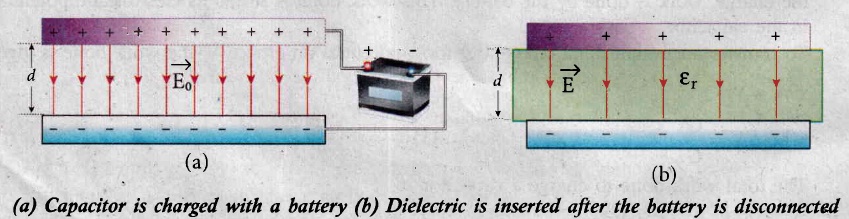
The introduction of dielectric between the plates will decrease the electric field. Experimentally it is found that the modified electric field is given by,
\(E=\frac{E_{0}}{\varepsilon_{r}}\) ....(2)
Here Eo is the electric field inside the capacitors when there is no dielectric and \(\varepsilon_{\mathrm{r}}\) is the relative permittivity of the dielectric or simply known as the dielectric constant. Since \(\varepsilon_{\mathrm{r}}\) > 1, the electric field E < Eo.
As a result, the electrostatic potential difference between the plates (V = Ed) is also reduced. But at the same time, the charge Qo will remain constant once the battery is disconnected.
Hence the new potential difference is
\(V=E d=\frac{E_{0}}{\varepsilon_{r}} d=\frac{V_{0}}{\varepsilon_{r}}\) .......(3)
We know that capacitance is inversely proportional to the potential difference. Therefore as V decreases, C increases.
Thus new capacitance in the presence of a dielectric is
\(C=\frac{Q_{0}}{V}=\varepsilon_{r} \frac{Q_{0}}{V_{0}}=\varepsilon_{r} C_{0}\) ......(4)
Since \(\varepsilon_{\mathrm{r}}\) > 1, we have C > Co. Thus insertion of the dielectric increases the capacitance.
We know that, Co =\(\frac{\varepsilon_{\mathrm{o}} A}{d}\) ...........(5)
Equation (4) ⇒ \(C=\frac{\varepsilon_{r} \varepsilon_{0} A}{d}=\frac{\varepsilon A}{d} \) ..........(6)
where \(\varepsilon=\varepsilon_{\mathrm{r}} \varepsilon_{\mathrm{o}}\) is the permittivity of the dielectric medium.
The energy stored in the capacitor before the insertion of a dielectric is given by,
\(U_{0}=\frac{1}{2} \frac{Q_{0}^{2}}{C_{0}}\) .......(7)
After the dielectric is inserted, the charge Qo remains constant but the capacitance is increased. As a result, the stored energy is decreased.
\(U=\frac{1}{2} \frac{Q_{0}^{2}}{C}=\frac{1}{2} \frac{Q_{0}^{2}}{\varepsilon_{r} C_{0}}=\frac{U_{0}}{\varepsilon_{r}}\) ..........(8)
Since \(\varepsilon_{\mathrm{r}}\) > 1we get U < Uo. There is a decrease in energy because, when the dielectric is inserted, the capacitor spends some energy in pulling the dielectric inside.
(ii) When the battery remains connected to the capacitor:
When the battery of voltage vo remains connected to the capacitor and the dielectric is inserted into the capacitor, then
(a) The potential difference vo across the plates remains constant.
(b) The charge stored in the capacitor is increased by a factor \(\varepsilon_{\mathrm{r}}\). (Experimentally found).
.jpg)
\({Q}=\varepsilon_{r} Q_{0}\) .......(1)
Due to this increased charge, the capacitance is also increased. The new capacitance is,
\(C=\frac{Q}{V_{0}}=\varepsilon_{r} \frac{Q_{0}}{V_{0}}=\varepsilon_{r} C_{0}\) ......(2)
However the reason for the increase in capacitance in this case where the battery remains connected is different from the case when the battery is disconnected before introducing the dielectric.
The energy stored in the capacitor before the insertion of a dielectric is given by,
\(U_{0}=\frac{1}{2} C_{0} V_{0}^{2}\) ....(4)
After the dielectric is inserted, the capacitance is increased; hence the stored energy is also increased.
\( U=\frac{1}{2} C V_{0}^{2}=\frac{1}{2} \varepsilon_{r} C_{0} V_{0}^{2}=\varepsilon_{r} U_{0} \) .....(5)
\(Since \ \varepsilon_{r}>1\ we \ have \ U>U_{o}.\)
Note: Here we have not used the expression \(U_o=\frac{1}{2}\frac{Q_0^2}{C_0}\)because here, both charge and capacitance are changed, whereas in equation (4), Vo remains constant.
Since voltage between the capacitor Vo is constant, the electric field between the plates also remains constant .The energy density is given by,
\(u=\frac{1}{2} \varepsilon E_{0}^{2}\) ..(6)
where ε is the permittivity of the given dielectric material.
54.
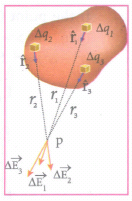
(i) Consider the following charged object of irregular shape as shown in Figure. The entire charged object is divided into a large number of charge elements \(\Delta { q }_{ 1 },\Delta { q }_{ 2 },\Delta { q }_{ 3 },.....\Delta { q }_{ n },\). and each charge element \(\Delta { q }\) is taken as a point charge.
(ii) The electric field at a point P due to a charged object is approximately given by the sum of the fields at P due to all such charge elements.
\(\vec { E } =\frac { 1 }{ 4\pi { \varepsilon }_{ 0 } } \left( \frac { { \Delta q }_{ 1 } }{ { r }_{ 1p }^{ 2 } } { \hat { r } }_{ 1p }+\frac { \Delta { q }_{ 2 } }{ { r }_{ 2p }^{ 2 } } { \hat { r } }_{ 2p }+.....+\frac { \Delta { q }_{ n } }{ { r }_{ np }^{ 2 } } { \hat { r } }_{ np } \right) \)
\(\approx \frac { 1 }{ 4\pi { \varepsilon }_{ 0 } } \sum _{ t=1 }^{ n }{ \frac { { \Delta q }_{ 1 } }{ { r }_{ 1P }^{ 2 } } { \hat { r } }_{ iP } } (1)\)
(iii) Here \(\Delta { q }_{ i }\) is the ith charge element, rip is the unit vector from the ith charge element to the point P. However the equation (1) is only an approximation. To incorporate the continuous distribution of charge, we take the limit \(\Delta q\rightarrow 0(=dq).\) In this limit, the summation in the equation (1) becomes an integration and takes the following form \(\vec { E } =\frac { 1 }{ 4\pi { \varepsilon }_{ 0 } } \int { \frac { dq }{ { r }^{ 2 } } \hat { r } } \) ...(2)
(iv) Here r is the distance of the point P from the infinitesimal charge dq and \(\hat { r } \) is the unit vector from dq to point P. Even though the electric field for a continuous charge distribution can be difficult to evaluate, the force experienced by some test charge q in this electric field is still given by \(\vec { F } =q\vec { E } \)
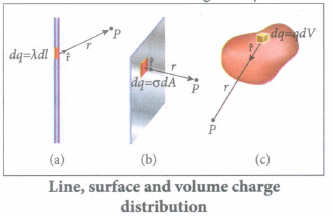
(a) If the charge Q is uniformly distributed along the line of length L, then linear charge density (charge per unit length) \(\lambda \) is \(\lambda =\frac { Q }{ L } \) unit is coulomb per meter (Cm-1). The charge present in the infinitesimal length dl is dq =\(\lambda \)dl. This is shown in Figure 1(a).
The electric field due to the line of total charge Q is given by
\(\vec { E } =\frac { 1 }{ 4\pi { \varepsilon }_{ 0 } } \int { \frac { \lambda dl }{ { r }^{ 2 } } } \hat { r } =\frac { \lambda }{ 4\pi { \varepsilon }_{ 0 } } \int { \frac { dl }{ { r }^{ 2 } } } \hat { r } \)
(b) If the charge Q is uniformly distributed on a surface of area A, then surface charge density (charge per unit area) \(\sigma \) is \(\sigma \) =\(\frac{Q}{A}\). Its unit is coulomb per square meter (C m-2). The charge present in the infinitesimal area dA is dq=\(\sigma dA\). This is shown in the figure 1(b). The electric field due to a total charge Q is given by \(\vec { E } =\frac { 1 }{ 4\pi { \varepsilon }_{ 0 } } \int { \frac { \sigma da }{ { r }^{ 2 } } \hat { r } =\frac { 1 }{ 4\pi { \varepsilon }_{ 0 } } \sigma \int { \frac { da }{ { r }^{ 2 } } } \hat { r } } \) This is shown in Figure 1(b).
(c) If the charge Q is uniformly distributed in a volume V, then volume charge density (charge per unit volume) p is given by \(\rho =\frac { Q }{ V } .\) Its unit is coulomb per cubic meter (Cm-3).
The charge present in the infinitesimal volume element dV is dq = pdV. This is shown in Figure 1(c). The electric field due to a volume of total charge Q is given by,\(\vec { E } =\frac { 1 }{ 4\pi { \varepsilon }_{ 0 } } \int { \frac { \rho dV }{ { r }^{ 2 } } =\hat { r } =\frac { 1 }{ 4\pi { \varepsilon }_{ 0 } } \rho \int { \frac { dV }{ { r }^{ 2 } } \hat { r } } } \).
55.

12th Standard Syllabus & Materials
12th Standard
TN 12th Computer Applications களப்பெயர் முறைமை (DNS) Sample Question Papers Study Material - QB365 Set A
NEW12th Standard
TN 12th Computer Applications வலையமைப்பு எடுத்துக்காட்டுகள் மற்றும் நெறிமுறைகள் Sample Question Papers Study Material - QB365 Set A
NEW12th Standard
TN 12th Computer Applications கணினி வலையமைப்பு ஓர் அறிமுகம் Sample Question Papers Study Material - QB365 Set A
NEW12th Standard
TN 12th Computer Applications PHP-உடன் MySQL-ஐ இணைத்தல் Sample Question Papers Study Material - QB365 Set A



Tamilnadu Stateboard 12th Standard Subjects

Maths

Chemistry
Physics

Biology

Computer Science

Business Maths and Statistics

Economics

Commerce

Accountancy

History

Computer Applications
Biology
Computer Technology
Computer Applications
Computer Science
Business Maths and Statistics
Commerce
Economics
Maths
Chemistry
Physics
Computer Technology
History
Accountancy

Tamil

English

French
Tamilnadu Stateboard Standards

