
 100% FREE ACCESS
12th Standard Syllabus & Materials
12th Standard
TN 12th Computer Applications மின்னணு தரவு பரிமாற்றம் Sample Question Papers Study Material - QB365 Set A
NEW12th Standard
TN 12th Computer Applications மின் - வணிக பாதுகாப்பு அமைப்புகள் Sample Question Papers Study Material - QB365 Set A
NEW12th Standard
TN 12th Computer Applications மின்னணு செலுத்தல் முறைகள் Sample Question Papers Study Material - QB365 Set A
NEW12th Standard
TN 12th Computer Applications மின் - வணிகம் Sample Question Papers Study Material - QB365 Set A
NEW12th Standard
TN 12th Computer Applications திறந்த மூல கருத்துருக்கள் Sample Question Papers Study Material - QB365 Set A
NEW12th Standard
TN 12th Computer Applications வலையமைப்பு வடமிடல் Sample Question Papers Study Material - QB365 Set A

Published on: 26/01/2021
12th Standard Physics English Medium Reduced Syllabus Important Questions with Answer key - 2021 Part - 1
Download Tamil Nadu 12th Standard Physics question papers, model tests, one-mark questions, important questions, and public exam papers in PDF format. Free study materials and answer keys for TN State Board students.
Questions + Answers key
Take MCQ Physics Test1.
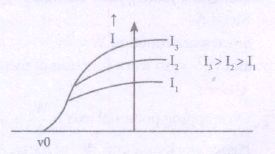
(i) Draw a graph showing variation of photoelectric current (I) with anode potential (V) for different intensities of incident radiation. Name the characteristic of the incident radiation that is kept constant in this experiment.
(ii) If the potential difference used to accelerate electrons is doubled, by what factor does the de-Broglie wavelength associated with the electrons change?
2.
A deuteron and an alpha particle are accelerated with the same potential. Which one of the two has i) greater value of de Broglie wavelength associated with it and ii) less kinetic energy? Explain.
3.
What are radioactive elements? What are the factors that affect radio activity?
4.
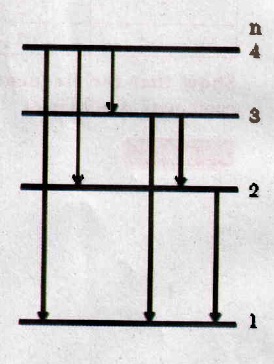
(a) A hydrogen atom is excited by radiation of wavelength 97.5 nm. Find the principal quantum number of the excited state
(b) Show that the total number of lines in emission spectrum is \(\frac { n(n-1) }{ 2 } \) Compute the total number of possible lines in emission spectrum as given in(a).
5.
Name the parts of Electromagnetic spectrum which is
(i) used to destroy becteria.
(ii) produced by where is a sudden deceleration of high speed electrons.
(iii) used in food industry.
6.
A rectangular current carrying loop placed 2 cm away from a long, street, current - carrying conductors. What is the direction and magnitude of the net force acting on the loop.
7.
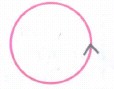
A circular loop carrying current I show the direction of the magnetic field with the help of lines of force.
8.
State Maxwell's right hand cork screw rule?
9.
What is impedance? When does LCR circuit have minimum impedance?
10.
Discuss briefly the experiment conducted by Hertz to produce and detect electromagnetic spectrum.
11.
The current in an inductive circuit is given by 0.3 sin (200t – 40°) A. Write the equation for the voltage across it if the inductance is 40 mH.
12.
An inverter is common electrical device which we use in our homes. When there is no power in our house, inverter gives AC power to run a few electronic appliances like fan or light. An inverter has inbuilt step-up transformer which converts 12 V AC to 240 V AC. The primary coil has 100 turns and the inverter delivers 50 mA to the external circuit. Find the number of turns in the secondary and the primary current.
13.
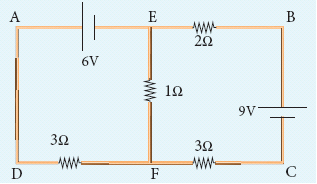
Calculate the current that flows in the 1 Ω resistor in the following circuit.
14.
In an N-P-N transistor circuit, the emitter, collector, and base current are respectively IE, IC, and lB. The relation between them is _____________.
IC
IB
IB > IC > IE
IB > IC > IE
15.
A Coolidge tube operates at 18600 V. The maximum frequency of X-radiation emitted from it is ______.
4.5 x10¹⁸ Hz
45 x 1018 Hz
4.05 x 10¹⁸ Hz
45.5 x 10¹⁸ Hz
16.
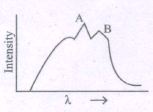
The fig. represents the observed intensity of X-rays emitted by an X-ray tube as a function of wavelength. The sharp peaks A and B denote ____________.
continuous spectrum
band spectrum
characteristic spectrum
white radiations
17.
Quality factor = ?
\(\frac{output \ power}{input \ power}\)
\(\frac{output \ current}{input \ current}\)
\(\frac{voltage \ across \ L (or) \ C}{applied \ voltage}\)
\(\frac{random \ frequency}{resonant \ frequency}\)
18.
In LCR circuit when KL = Xc (at resonance) the current _________________
is zero
is in phase with the voltage
leads the voltage
lags behind the voltage
19.
Lenz's law is in accordance with the law of ________________.
conservation of charges
conservation of flux
conservation of momentum
conservation of energy
20.
By using law of conservation of electric charge balance the following equations:
92U238 ⇾ 90Th234 +________.
2He4
1H3
1H2
1H1
21.
An unknown resistance is connected in parallel with a 15\(\Omega \) resistance and a 12V battery. What is the value of the unknown resistance if the current in the circuit is 2A?
\(10\Omega \)
\(20\Omega \)
\(30\Omega \)
\(40\Omega \)
22.
The instantaneous values of alternating current and voltage in a circuit are \(i=\frac { 1 }{ \sqrt { 2 } } \sin\left( 100\pi t \right) \) A and v \(=\frac { 1 }{ \sqrt { 2 } } \sin\left( 100\pi t+\frac { \pi }{ 3 } \right) V.\)The average power in watts consumed in the circuit is
\(\frac{1}{4}\)
\(\frac{\sqrt3}{4}\)
\(\frac{1}{2}\)
\(\frac{1}{8}\)
23.
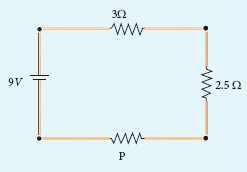
There is a current of 1.0 A in the circuit shown below. What is the resistance of P ?
1.5 Ω
2.5 Ω
3.5 Ω
4.5 Ω
24.
What is spectrum?
25.
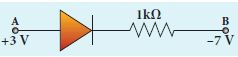
A silicon diode is connected with 1kΩ resistor as shown. Find the value of current flowing through AB is
26.
Assuming that energy released by the fission of a single \(_{ 92 }^{ 235 }{ U }\) nucleus is 200MeV, calculate the number of fissions per second required to produce 1-watt power.
27.
Give the factors that are responsible for transmission impairments.
28.
Two charge d spherical conditioners of radii R1 & R2 when connected by a conducting wire acquire charges q1 & q2 respectively. Find the ratio of surface charge densities in terms of their radii.
29.
Where on the earth's surface is the value of
(i) angle of dip maximum
(ii) vertical component of earth's magnetic field zero
30.
Draw a graph showing the variation of reactance of
(i) a capacitor and
(ii) an inductor with the frequency of an a.c circuit.
31.
When does the phenomenon of resonance is possibble in the circuit?
32.
Why are connecting resistors in a metre bridge made of thick copper strips?
33.
Explain the use of transformers in long distance transmission of electric power.
34.
Why are resistors connected in series and in parallel
(i) To increase the resistor of the circuit
(ii) The resistors are connected in series.
35.
How will you define RMS value of an alternating current?
36.
What for an inductor is used? Give some examples.
37.
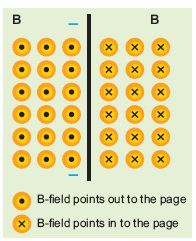
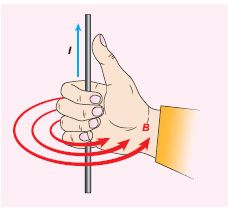
The magnetic field shown in the figure is due to the current carrying wire. In which direction does the current flow in the wire?
38.
Write down the various forms of expression for power in electrical circuit.
39.
Derive the expression for power P=VI in electrical circuit.
40.
An electron microscope uses electrons accelerated by a voltage of 50 kV. Determine the de Broglie wavelength associated with the electrons. If other factors (such as numerical aperture etc.) are taken to be roughly the same, how does the resolving power of an electron, microscope compare with that of an optical microscope which uses yellow light? Given: wavelength of yellow light = 5990 Á.
41.
Draw the circuit diagram of a half-wave rectifier and explain its working.
42.
In an electric circuit, there is a capacitor of reactance 100 Ω connected across the source of 220 V, find the displacement current.
43.
A cyclotron's frequency is 8 μHz. What should be the operating magnetic field for accelerating protons? If the radius of its dees is 50cm. Calculate the k.E (is μeV) of the proton beam produced by the accelerator.
44.
An AC generator consists of a coil of 1000 turns and cross sectional area of 100 cm2, rotating at an angular speed of 100 rpm in a uniform magnetic field of 1.6 x 10⁻² T calculate the maximum emf produced in the coil.
45.
The instantaneous current and voltage of an a.c circuit are given by i = 10 sin 314t A and V = 50 sin (314t + π/2)V. What is the power dissipation in the circuit?
46.
In a wheat stone bridge circuit P = 7, Q = 8 , R = 12 & s = 7. Find the additional resistance to be used in series with S, so that the bridge is balanced.
47.
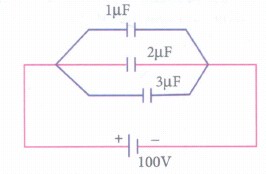
In the circuit shown in figure. Find
(i) The equivalent capacitance and
(ii) The charge stored in each capacitor
48.
Define Power in AC circuits? Derive an relation between true power & virtual power?
49.
Using the concept of drift velocity of charge carries in a conductor, deduce the relationship between circuit density and resistivity of the conductor?
50.
A conductor of length I is connected to d.c. source of potential V. If the length of the conductor is doubled by treating it, keeping V constant, explain how do the following factors vary in the conductor
(i) Drift velocity.
(ii) Resistor
(iii) Resistivity.
51.
Deduce the relation for the magnetic field at a point due to an infinitely long straight conductor carrying current using Biot-Savart law.
52.
Derive an expression for phase angle between the applied voltage and current in a series RLC circuit.
53.
Show that Lenz’s law is in accordance with the law of conservation of energy.
54.
Establish the fact that the relative motion between the coil and the magnet induces an emf in the coil of a closed circuit.
55.
Write down Maxwell equations in integral form.
1.
1) The frequency of incident radiation was kept constant.
2) de Broglie wavelength,
\(\lambda =\frac { h }{ \sqrt { 2mqV } } \alpha \frac { 1 }{ V } \)
If potential difference V is doubled, the de-Broglie wavelength is decreased to \(\frac { 1 }{ \sqrt { 2 } } \) time.
2.
\(\text { (i) } \lambda_{\mathrm{d}}=\frac{\mathrm{h}}{\sqrt{2 \mathrm{meV_1}}} ; \lambda_{\alpha}=\frac{\mathrm{h}}{\sqrt{\mathrm{me}}}\)
\(\frac{\lambda_{\mathrm{d}}}{\lambda_{\alpha}}=\frac{\frac{1}{\sqrt{2 m e}}}{\frac{1}{\sqrt{4 m 2 e}}} \Rightarrow \lambda_{\mathrm{d}}=2 \lambda_{\alpha}\)
\(\text { (ii) } =\frac{K.E_d}{K.E_a}=\frac{eV}{2eV} =\frac{1}{2}\Rightarrow K.E_d=\frac{1}{2}K.E_a\)
∴ K.E of deuteron is half of K.E of α-particle.
3.
(i) The phenomenon of spontaneous emission of highly penetrating radiations such as α, β, γ rays by heavy elements having atomic number greater than 82 is called radioactivity and the substances which emit these radiations are called radioactive elements.
(ii) The radioactive phenomenon spontaneous and is unaffected by any external agent like temperature, pressure, and magnetic fields.
4.
Wavelength of incident radiation = 97.5 nm = 97.5 x 10⁻⁹ m
Energy of hydrogen atom in its ground state = -13.6 eV
(a) Principal quantum number n = ?
(b) (i) Number of possible transitions = ?
(ii) Total number possible lines = ?
(a) Energy absorbed by Hydrogen atom
\(E=\frac{h c}{\lambda}=\frac{6.6 \times 10^{-34} \times 3 \times 10^{8}}{97.5 \times 10^{-9}} \mathrm{~J} \)
\(E=\frac{h c}{\lambda}=\frac{6.6 \times 10^{-34} \times 3 \times 10^{8}}{97.5 \times 10^{-9} \times 1.6 \times 10^{-19}} \mathrm{eV} \)
E = 12.74 eV
Energy of the electron in first orbit of Hydrogen is -13.6 ev
En = -13.6 + 12.74 = -0.86 eV
We know that
\(\mathrm{E}_{\mathrm{n}} =-\frac{13.6}{\mathrm{n}^{2}} \)
\(-0.86 =-\frac{13.6}{\mathrm{n}^{2}} \)
\(\mathrm{n}^{2} =15.88 \)
\(\mathrm{n} \cong 4 \)
(b) (i) By using arithmetic progression, For the principle quantum number "n",
Total number of possible transition form level n is \(\frac{\mathrm{n}(\mathrm{n}-1)}{2}\)
(ii) Total number of possible transitions form level 4 is 3
Total number of possible transitions form level 3 is 2
Total number of possible transition form level 2 is 1
Hence total number of possible transitions is 3 + 2 + 1 = 6
5.
(i) u - v rays
(ii) X - rays
(iii) ૪ - rays.
6.
The like currents i.e current in both the wire are in the same direction attracts each other. The force is repulsive when the current flows in opposite direction through the wires.
F = \(\frac { { \mu }_{ 0 }{ I }_{ 1 }{ I }_{ 2 }dl }{ 2\pi r } \)
i.e \(F\alpha \frac { 1 }{ r } \)
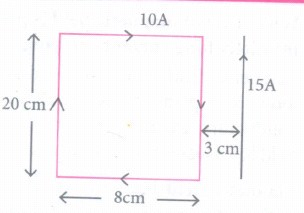
As the wire of the loop carrying the opposite current is near so the net force acting on the loop is repulsive.
7.
(i) Acceleration to the right-hand thumb rule, when the current flows through the circular loop in the direction.
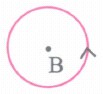
(ii) The direction of magnetic field (B) is perpendicular to the plane of the loop and in the outward direction.
8.
If we rotate aright-handed screw by ascrew driver, then the direction of current is same as the direction in which screw advances and the direction of rotation of the screw gives the direction of the magnetic field.
9.
(i) The total resistance offered to the flow of current due to resistance R, inductive resistance XL, and capacitive reactance Xc in a circuit is called impedance.
It is given by \(z=\sqrt { { R }^{ 2 }+({ { X }_{ L }-{ X }_{ C }) }^{ 2 } } \)
(ii) At resonance, when XL= XC
10.
i) Maxwell's prediction was experimentally confirmed by Heinrich Rudolf Hertz in 1888. The experimental set up used is shown in Figure.
ii) It consists of two metal electrodes which are made of small spherical metals. These are connected to larger spheres and the ends of them are connected to induction coil with very large number of turns. This is to produce very high electromotive force (emf).
iii) Since the coil is maintained at very high potential, air between the electrodes gets ionized and spark (spark means discharge of electricity) is produced.
iv) The gap between electrode (ring type - not completely closed and has a small gap in between) kept at a distance also gets spark. This implies that the energy is transmitted from electrode to the receiver (ring electrode) as a wave, known as electromagnetic waves.
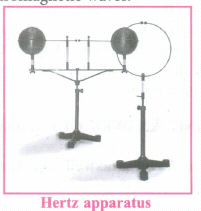
v) If the receiver is rotated by 90° - then no spark is observed by the receiver. This confirms that electromagnetic waves are transverse waves as predicted by Maxwell.
vi) Hertz detected radio waves and also computed the speed of radio waves which is equal to the speed of light (3 x 10⁸m S-1).
11.
L = 40 x 10-3 H; i = 0.3 sin (200t – 40o)
XL = ωL = 200 x 40 x 10-3 = 8 Ω
Vm = Im XL = 0.3 x 8 = 2.4 V
In an inductive circuit, the voltage leads the current by 90o Therefore,
v = Vmsin (ωt + 90o)
v = 2.4sin (200t - 40o + 90o)
v = 2.4sin (200t + 50o)volt
12.
Vp = 12 V; Vs = 240 V
Is = 50 mA; Np = 100 turns
\(\frac { { V }_{ s } }{ { V }_{ P } } =\frac { { N }_{ s } }{ { N }_{ p } } =\frac { { I }_{ P } }{ { I }_{ S } } =K\)
Transformation ratio, K = \(\frac{240}{12}=20\)
The number of turns in the secondary
NS = NP x K = 100 x 20 = 2000
Primary current,
IP = K x Is = 20 x 50 mA = 1 A
13.
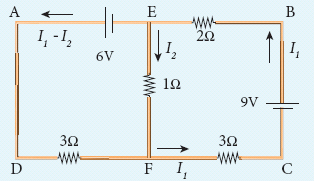
We can denote the current that flows from 9V battery as I1 and it splits up nto I2 and (I1 – I2) at the junction E according Kirchoff’s current rule (KCR).
Now consider the loop EFCBE and apply KVR, we get
1I2 + 3I1 + 2I1 = 9
5I1 + I2 = 9 (1)
Applying KVR to the loop EADFE, we get
3 (I1 – I2 ) – 1I2 = 6
3I1 – 4I2 = 6 (2)
Solving equation (1) and (2), we get
I1 = 1.83 A and I2 = -0.13 A
It implies that the current in the 1 ohm resistor flows from F to E.
14.
(b)
IB
15.
(a)
4.5 x10¹⁸ Hz
16.
(c)
characteristic spectrum
17.
(c)
\(\frac{voltage \ across \ L (or) \ C}{applied \ voltage}\)
18.
(b)
is in phase with the voltage
19.
(d)
conservation of energy
20.
(a)
2He4
21.
(a)
\(10\Omega \)
22.
Pav = \(\frac{1}{2}\)V0I0cosΦ
\(= \frac{1}{2}\times\frac{1}{\sqrt{2}}\times\frac{1}{\sqrt{2}}cos\times\frac{\pi}{3}\times \frac{1}{2}\times\frac{1}{2}\times\frac{1}{2}=\frac{1}{8}\)
23.
Rs = 3 + 2.5 + P = 5.5 + P
V = 9 V, I = 1.0 A
Rs = \(\frac{V}{I}=\frac{9}{1}= 9 \Omega\)
∴ 9 = 5.5 + P
∴ P = 9 - 5.5 = 3.5 Ω
24.
Dispersion is splitting of white light into its constituent colours. This band of colours of lightis called its spectrum.
25.
The P.D. between A and B is given by
\(V =\left[V_{\mathrm{A}}-V_{\mathrm{B}}\right]-V_{\mathrm{b}}(\mathrm{Si}) \)
\(=[3.3-(-7.4)]-0.7 \)
\(=10.7-0.7=10 \mathrm{~V} \)
The value of current flowing through AB can be obtained by using Ohm’s law
\(I=\frac { V }{ R } =\frac { 10}{ 1\times { 10 }^{ 3 } } ={ 10 }^{ -2 }A=10mA\)
26.
Energy produced per second in reactor = 1 W = 1 J/s
Energy produced per fission = 200 MeV = 200 x 106 x 1.6 x 10-19 J
= 3.2 x 10¹¹ J
Number of fissions per second required \(=\frac{\text { Energy produced per second in reactor }}{\text { Energy produced per fission }} \)
\(=\frac{1}{3.2 \times 10^{11}}=\frac{10 \times 10^{10}}{3.2}=3.125 \times 10^{10} \)
Number of fissions per second = 3.125 x 10¹⁰
27.
i) Noise : Interference of undesirable electrical signal with the transmitted signal.
ii) Attenuation: Loss of strength of a signal.
iii) Medium : It makes some distortion tothe signal.
28.
The charges will flow between the two spherical conditioners till their potential become equal.
\(i.e.\frac { { Kq }_{ 1 } }{ { R }_{ 1 } } =\frac { { Kq }_{ 2 } }{ { R }_{ 2 } } (or)\frac { { q }_{ 1 } }{ { R }_{ 1 } } =\frac { { q }_{ 2 } }{ { R }_{ 2 } } \)
The ratio of the surface charge densities on the two conditioners will be
\(\frac { { \sigma }_{ 1 } }{ { \sigma }_{ 2 } } =\frac { \frac { { q }_{ 1 } }{ 4\pi { R }_{ 1 }^{ 2 } } }{ \frac { { q }_{ 2 } }{ 4\pi { R }_{ 2 }^{ 2 } } } =\frac { { q }_{ 1 } }{ { q }_{ 1 } } .\frac { { R }_{ 2 }^{ 2 } }{ { R }_{ 1 }^{ 2 } } =\frac { { R }_{ 1 } }{ { R }_{ 2 } } \times \frac { { R }_{ 2 }^{ 2 } }{ { R }_{ 1 }^{ 2 } } \)
\(\frac { { \sigma }_{ 1 } }{ { \sigma }_{ 2 } } =\frac { { R }_{ 1 } }{ { R }_{ 2 } } \)
29.
(i) Angle of dip (90°) is maximum at the magnetic piles.
(ii) Vertical component of earth's magnetic field is zero at magnetic equator.
30.
(i) Capacitive reactance \({ X }_{ c }=\frac { 1 }{ 2\pi \gamma c } \)
\({ X }_{ c }\alpha \frac { 1 }{ \gamma } \)
The graph between γ and XL
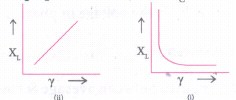
(ii) Inductive reactance XL = 2πγL
XL α γ
31.
The phenomenon of electrical resonance is possible when the circuit contains both L and C. Only then does the voltage across L and C cancels one another when VL and VC are 1800 out of phase and the circuit becomes purely resistive. This implies that resonance will not occur in RL and RC circuits.
32.
Thick copper strips offer minimum resistance and hence avoid the error due to end resistance. Which have not been taken into account in the bridge formula.
33.
At the transmitting point, the voltage is increased and the corresponding current is decreased by using a step-up transformer. Then it is transmitted through transmission lines. This reduced current at high voltage reaches the destination without any appreciable loss. At the receiving point, the voltage is decreased and the current is increased to appropriate values by using a step-down transformer, and then it is given to consumers.
34.
(i) To increase the resistance of the circuit the resistor are connected in series.
(ii) When they are connected in parallel resistance of the circuit is decreased
35.
RMS value is also defined as that value of the steady current which when flowing through a given circuit for a given time produces the same amount of heat as produced by the alternating current when flowing through the same Circuit for the same time. (or)
The root mean square value of an alternating current is defined as the square root of the mean of the squares of all currents over one cycle
\(I_{RMS}=\sqrt\frac{\text {Area of one cycle of squared wave}}{\text {Base length of one cycle}}\)
36.
Inductor is a device used to store energy in a magnetic field, when an electric current flows through it. Examples: coils, solenoids and toroids
37.
Using right hand rule, current flows upwards.
38.
(i) Electrical power P = VI
(ii) Erectrical power \(P=V\left(\frac{V}{R}\right)=\frac{V^{2}}{R} \quad \therefore P=\frac{V^{2}}{R}\)
(iii) P = Iv = I(IR) = I2R
(iv) P = I2R
39.
Electric power is the rate at which the electrical potential energy is delivered
\(P =\frac{d U}{d t} \)
\(P =\frac{VdQ}{d t}=\mathrm{V} \frac{d Q}{d t} \)
Since \(\frac{d Q}{d t}=I\), where I - electric current
∴ P = VI
40.
de Broglie wavelength, \(\lambda =\frac { h }{ \sqrt { 2mE } } \)
Given data
h = 6.62 x 10 - 34 Js, m = 9.1 x 10 - 31kg
E = 50 KeV = 50 x 1.6 x 10-19J
\(\lambda =\frac { { 6.62\times 10 }^{ -34 } }{ \sqrt { 2\times 9.1\times { 10 }^{ -31 }\times 8\times { 10 }^{ -15 } } } m\)
\(=\frac { 6.62 }{ \sqrt { 145.6 } } \times { 10 }^{ -11 }m\)
\(=\frac { 6.62 }{ 12.07 } \times { 10 }^{ -11 }m=5.48\times { 10 }^{ -12 }m\)
Wavelength of yellow light,
λ' = 5990 x 10-10 m = 5.99 x 10⁻⁷ m
Now \(\frac { \lambda }{ \lambda ' } ={ 10 }^{ -5 }\)
Since resolving power is inversely proportional to wavelength, therefore, the resolving power of an electron microscope is 105 times larger than the resolving power of the optical microscope.
41.
HaIf wave rectifier:
Only one half of the input wave reaches the output. Therefore it is called half wave rectifier.
Construction:
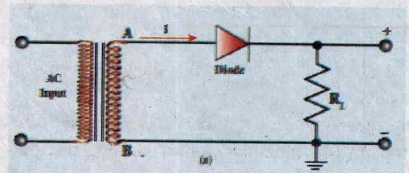
(i) The circuit consists of a transformer, a p-n junction diode and a resistor
(ii) In a half wave rectifier circuit, either a positive half or the negative half of the AC input is passed through by the diode while the other half is blocked
(iii) It acts as a rectifier diode.
.jpg)
(iv) Efficiency (η) is the ratio of the output DC power to the AC input power circuit. supplied to the circuit.
(v) The efficiency (η) of a half wave rectifier is found to be 40.6 %.
.jpg)
42.
Since displacement current = conduction current
\({ I }_{ d }=\frac { V }{ { X }_{ C } } =\frac { 220 }{ 100 } =2.2A\)
43.
The cyclotron's frequency v = 18 μHz
= 8 x 10⁶ Hz
The mass of the proton m = 1.67 x 10⁻²⁷ kg
The charge of the proton q = 1.6 x 10⁻¹⁹C
Radius of the dees r = 50 cm = 50 x 10-2 m
Magnetic field B = ?
k.E of the proton k.E = ?
Magnetic field B = \(\frac { 2\pi mv }{ q } \)
B = \(\frac { 2\times 3.14\times 1.67\times 10^{ -27 }\times 8\times 10^{ 6 } }{ 1.6\times 10^{ -19 } } \)
= \(\frac { 83.90\times 10^{ -21 } }{ 1.6\times 10^{ -19 } } \)
= 52.438 x 10⁻²
B = 0.524T
k.E = \(\frac { 1 }{ 2 } \) mv2
v = rω = r x 2πv
= 0.5 x 2 x 3.14 x 8 x 106
= 25.12 x 10⁶ m/s
k.E = \(\frac { 1 }{ 2 } \) x 1.67 x 10-27 x (25.12 x 106)2
=\(\frac { 41.95\times 10^{ -21 }\times 25.12\times 10^{ 6 } }{ 2 } \)
= 526.89 x 10⁻¹⁵ J (or) 5.269 x 10⁻¹³J
To convert J into MeV
= \(\frac { 526.89\times 10^{ -15 } }{ 1.6\times 10^{ -19 } } \) = 3.29 x 10⁶ eV
k.E = 3.29 x 10⁶ MeV
44.
Given: N = 1000
A = 100 cm2 = 10-2 m2
v = 100 rpm = \(\frac{100}{60}\) rps
B = 3.6 x 10⁻²⁷
em = ?
em = NBAω = NBA (2πγ)
= 1000 x 3.6 x 10-2 x 10-2 x 2 x \(\frac{22}{7}\times\frac{100}{60}\)
e = 5.77 V
45.
Phase difference between V and i = \(\frac{\pi}{2}\)red
∴ Paverage = \(\frac { { V }_{ m }{ I }_{ m } }{ 2 } \). cos Φ = \(\frac { 50\times 10 }{ 2 } \) cos 0o
46.
For the bridge to be balanced \(\cfrac { \\ P }{ Q } =\cfrac { R }{ S } \)
Since additionally a resistance 'x' is added in series with S, equation (1) can be written as
\(\cfrac { \\ P }{ Q } =\cfrac { R }{ (S+x) } \)
\(\left( S+x \right) =\cfrac { QR }{ P } x=\cfrac { \theta R }{ P } -S\)
\(x=\cfrac { 8\times 12 }{ 7 } -7\)
\(x=\frac{96}{7}-7=6.714 \Omega\)
47.
(i) The equivalent capacitance is,
Cp = C1+ C2 + C3
= (1 + 2 + 3) = 6μF
(ii) Total charge, q = CμV
= 6 x 10-6 x 100 = 600μC
q1 = C1V = 1 x 100 = 100μC
q2 = C2V = 2 x 100 = 200μC
q3 = C3V = 3 x 100 = 300μC
48.
(i) Power of a circuit is defined as the rate of consumption of electric energy in that circuit. It is given by the product of the voltage and current. In an AC circuit, the voltage and current vary continuously with time.
(ii) The alternating voltage and alternating current in the series RLC circuit at an instant are given by
v = Vm sin ωt and i = Im sin(ωt + Φ)
(iii) Where Φ is is the phase angle between v and i. The instantaneous power is then written as
P = vi
= VmIm sin ω sin(ωt + Φ)
= VmImsin ωt[sin ωt cos Φ - cos ωt sin Φ)
P = VmIm[cos Φ sin2 ωt - sin ωt cos ωt sin Φ]
(iv) Here the average of sin2ωt over a cycle is \(\frac { 1 }{ 2 } \) and that of sin wt cos wt is zero. Substituting these values, we obtain average power over a cycle.
= \(\frac { { V }_{ m } }{ \sqrt { 2 } } \frac { { I }_{ m } }{ \sqrt { 2 } } \) cos Φ
Pav = VRMSIRMS cosΦ
(v) where VRMS IRMS is called apparent power and cos Φ is power factor. The average power of an AC circuit is also known as the true power of the circuit.
49.
By the concept of Drift velocity \(I=nAeu_{ d }\)
\({ \mu }_{ d }=\cfrac { eE }{ m } \tau \)
\(\rho =\cfrac { m }{ { ne }^{ 2 }\tau } \)
\(\therefore\) Current density
\(J=\cfrac { I }{ A } ={ \cfrac { nA{ ev }_{ d } }{ A } =ne.\cfrac { em\tau }{ m } }=\left( \cfrac { { ne }^{ 2 }\tau }{ A } \right) E\)
\(J=\cfrac { 1 }{ \rho } .E\)
50.
(i) Drift velocity \({ u }_{ d }=\cfrac { ev }{ ml } .\tau \)
When I am doubled, drift velocity, become \(\cfrac { 1 }{ 2 } \) times the original vd
(ii) Resistor \(R=\rho .\cfrac { l }{ A } \)
Resistor becomes doubled i.e. 2 times the original resistors.
(iii) Resistivity is not affected.
51.
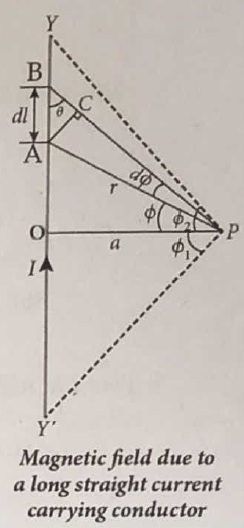
Let YY' be an infinitely long straight conductor carry current I. In order to calculate magnetic field at a point P which is at a distance a from the wire, let us consider a small line element dl (segment AB).
According to Biot Savart law, the magnetic field at a point P due to current element Idl is,
\({ d \vec B } =\frac { { \mu }_{ 0 } }{ 4\pi } \frac { { Idl sin \theta} }{ { r }^{ 2 } }\hat n \).
To apply trigonometry, draw a perpendicular AC to the line BP as shown in Figure.
In triangle ΔABC, \(\sin \theta=\frac{\mathrm{AC}}{\mathrm{AB}}\)
∴ AC = AB sinθ
\(\text { But, } A B =d l \Rightarrow A C=d l \sin \theta\)
Let dΦ be the angle subtended between AP and BP
ie., \(\angle \mathrm{APB}=\angle \mathrm{APC}=d \phi\)
In a triangle \(\triangle \mathrm{APC}, \sin (d \phi) \simeq A C / A P\)
Since, dΦ is very small, \(\sin (d \phi) \simeq d \phi\)
But, \(\mathrm{AP} =r \Rightarrow A C=r d \phi \)
\(\therefore \mathrm{AC} =d l \sin \theta=r d \phi \)
\(\therefore d \vec{B} =\frac{\mu_0}{4 \pi} \frac{I}{r^2}(r d \phi) \hat{n}=\frac{\mu_0}{4 \pi} \frac{I d \phi}{r} \hat{n}\)
Let Φ be the angle between AP and OP
\(\text {In a } \triangle \mathrm{OPA}, \cos \phi =\frac{\mathrm{OP}}{\mathrm{AP}}=\frac{\mathrm{a}}{\mathrm{r}} \)
\(r =\frac{a}{\cos \phi} \)
\(\text {Now, } d \vec{B} =\frac{\mu_0}{4 \pi} \frac{I}{a / \cos \phi} d \phi . \hat{n} \)
\(d \vec{B} =\frac{\mu_0 I}{4 \pi a} \cos \phi d \phi \hat{n}\)
The total magnetic field at P due to the conductor YY' is
\(\vec { B } = \int _{- \Phi _{ 1 } }^{ { \Phi }_{ 2} }d\vec B =\int _{ -\Phi _{ 1 } }^{ { \Phi }_{ 2 } }\frac { { \mu }_{ 0 }I }{ 4\pi a }{ cos\phi d\phi } \hat { n }\)
\(=\frac { { \mu }_{ 0 }I }{ 4\pi a }[{ sin\phi ]^{\phi_2} _{\phi_-1}} \hat { n }\)
\( \vec{B}=\frac { { \mu }_{ 0 }I }{ 4\pi a } (sin{ \Phi }_{ 1 }+sin{ \Phi }_{ 2 })\hat { n } \)
For infinitely long conductor, Φ1 = Φ2 = 90o
\(\therefore \vec{B}=\frac { { \mu }_{ 0 }I }{ 4\pi a } \times 2\hat{n}\Rightarrow\vec { B } =\frac { { \mu }_{ 0 }I }{ 2\pi a } \hat { n } \)
52.
(i) Consider a circuit containing a resistor of resistance R, a inductor of inductance L and a capacitor of capacitance C connected across an alternating voltage source (Figure ). The instantaneous value of the alternating voltage is given by the equation
ሀ = Vm sin ωt ......(1)
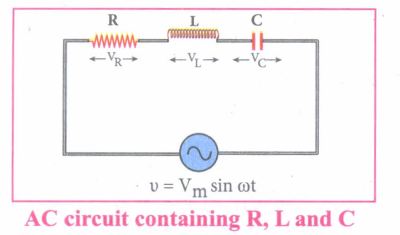
(ii) Let i be the resulting circuit current in the circuit at that instant. As a result, the voltage is developed across R, Land C.
(iii) We know that voltage across R (VR) is in phase with i, voltage across L (VL) leads i by \(\frac { \pi }{ 2 } \) and voltage across C (Vc) lags behind i by \(\frac { \pi }{ 2 } \)
(iv) The phasor diagram is drawn with current as the reference phasor. The current is represented by the phasor \(\vec { OI } \), VR by \(\vec { OA } \); VL by \(\vec { OB } \); Vc by \(\vec { OC } \) as shown in Figure.
(v) The length of these phasors are OI = Im, OA = ImR, OB = ImXL; OC = ImXC
The circuit is either effectively inductive or capacitive or resistive that depends on the value of VL or VC. Let us assume that VL>VC so that nef voltage drop across L-C combination is VL - VC which is represented by a phasor \(\vec { OD } \)
(vi) By parallelogram law, the diagonal \(\vec { OE } \) gives the resultant voltage ሀ of VR and (VL - VC) and its length OE is equal to Vm Therefore,
V2m = V2R + (VL - VC)2 = \(\sqrt { { ({ { I }_{ m }R) } }^{ 2 }+{ ({ I }_{ m }{ X }_{ L }-{ I }_{ m }{ X }_{ C }) }^{ 2 } }=I_m \sqrt {R^2+({X_L-X_C)}^2}\)
or \({ I }_{ m }=\frac { { V }_{ m } }{ \sqrt { R^{ 2 }+({ { X }_{ L }-{ X }_{ C }) }^{ 2 } } } \) ......(2)
\((or) { I }_{ m }=\frac { { V }_{ m } }{ Z } \) where z = \(\sqrt { { R }^{ 2 }+({ { X }_{ L }-{ X }_{ C }) }^{ 2 } } \) ......(3)
(vii) Z is called impedance of the circuit which refers to the effective opposition to the circuit current by the series RLC circuit. The voltage triangle and impedance triangle are given in the Figure.
.JPG)
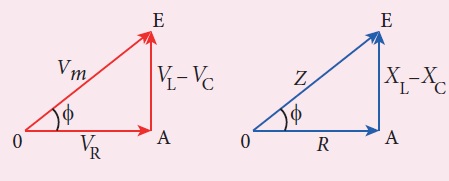
(viii) From phasor diagram, the phase angle between v and i is found out from the following relation
\(tan\phi =\frac { V_{ L }-{ V }_{ C } }{ { V }_{ R } } =\frac { X_{ L }-{ V }_{ C } }{ R } \)
Special cases:
(i) If XL > XC (XL - XC) is positive and phase angle \(\phi \) is also positive. It means that the applied voltage leads the current by \(\phi \) (or current lags behind voltage by \(\phi\)). The circuit is inductive.
∴v = Vm sin ωt; i = Im sin(ωt - \(\phi \))
(ii) If XL < XC (XL - XC) is negative and\(\phi \) is also negative. Therefore current leads voltage by \(\phi \) (or voltage lags behind current by\(\phi \)) and the circuit is capacitive.
∴ = Vm sin ωt; i = Im sin(ωt + \(\phi \))
(ii) If XL = XC \(\phi \) is zero. Therefore current and voltage are in the same phase and the circuit is resistive
∴v = Vm sin ωt, i = Im sinωt
53.
Conservation of energy:
(i) The truth of Lenz's law can be established on the basis of the law of conservation of energy. The explanation is as follows:
(ii) According to Lenz's law, when a magnet is moved either towards or away from a coil, the induced current produced opposes its motion
(iii) As a result, there will always be a resisting force on the moving magnet.
(iv) Work has to be done by some external agency to move the magnet against this resisting force
(v) Here the mechanical energy of the moving magnet is converted into the electrical energy which in turn, gets converted into Joule heat in the coil i.e., energy is converted from one form to another.
(vi) On the contrary to Lenz's law, let us assume that the induced current helps the cause responsible for its production.
(vii) Now When we push the magnet litle bit towards the coil, the induced current helps the movement of the magnet towards the coil.
(viii) Then the magnet starts moving towards the coil without any expense of energy. This, becomes a perpetual motion machine.
(ix) In practice, no such machine is possible. Therefore, the assumption that the induced current helps the cause is wrong.
54.
(i) Consider a closed circuit consisting of a coil C of insulated wire and a galvanometer G. The galvanometer does not indicate deflection as there is no electric current in the circuit.
(ii) When a bar magnet is inserted into the stationary coil, with its north pole facing the coil, there is a momentary deflection in the galvanometer. This indicates that an electric current is set up in the coil. If the magnet is kept stationary inside the coil, the galvanometer does not indicate deflection.
(iii) The bar magnet is now withdrawn from the coil, the galvanometer again gives a momentary deflection but in the opposite direction. So, the electric current flows in opposite direction. Now if the magnet is moved faster, it gives a larger deflection due to a greater current in the circuit.
(iv) The ar magnet is reversed, i.e., the south pole now faces the coil. When the above experiment is repeated, the deflections are opposite to that obtained in the case of north pole.
(v) If the magnet is kept stationary and the coil is moved towards or away from the coil, similar results are obtained. It is concluded that whenever there is a relative motion between the coil and the magnet, there is deflection in the galvanometer, indicating the electric current setup in the coil.
55.
MaxWell's equations in integral form
i) Gauss law in electricity, \(\oint _s\vec{E} \vec{d} A=\frac{Q_{\text {enclosed }}}{\varepsilon_{o}}\)
ii) Gauss law in magnetism \(\oint _s \vec{B} \cdot \vec{d} A=0\)
iii) Faraday's law \(\oint_l \vec E. \vec {d l}=-\frac{d \phi _B}{d t}\)
iv) Ampere-Maxwell's law \(\oint_l \vec {B}. \vec {d l}=\mu_{o} i_c+\mu_{o} \varepsilon_{o} \frac{d}{d t} \oint_s \vec{E} \cdot {d} \vec A\)

12th Standard Syllabus & Materials
12th Standard
TN 12th Computer Applications களப்பெயர் முறைமை (DNS) Sample Question Papers Study Material - QB365 Set A
NEW12th Standard
TN 12th Computer Applications வலையமைப்பு எடுத்துக்காட்டுகள் மற்றும் நெறிமுறைகள் Sample Question Papers Study Material - QB365 Set A
NEW12th Standard
TN 12th Computer Applications கணினி வலையமைப்பு ஓர் அறிமுகம் Sample Question Papers Study Material - QB365 Set A
NEW12th Standard
TN 12th Computer Applications PHP-உடன் MySQL-ஐ இணைத்தல் Sample Question Papers Study Material - QB365 Set A



Tamilnadu Stateboard 12th Standard Subjects

Maths

Chemistry
Physics

Biology

Computer Science

Business Maths and Statistics

Economics

Commerce

Accountancy

History

Computer Applications
Biology
Computer Technology
Computer Applications
Computer Science
Business Maths and Statistics
Commerce
Economics
Maths
Chemistry
Physics
Computer Technology
History
Accountancy

Tamil

English

French
Tamilnadu Stateboard Standards

