
 100% FREE ACCESS
12th Standard Syllabus & Materials
12th Standard
TN 12th Computer Applications மின்னணு தரவு பரிமாற்றம் Sample Question Papers Study Material - QB365 Set A
NEW12th Standard
TN 12th Computer Applications மின் - வணிக பாதுகாப்பு அமைப்புகள் Sample Question Papers Study Material - QB365 Set A
NEW12th Standard
TN 12th Computer Applications மின்னணு செலுத்தல் முறைகள் Sample Question Papers Study Material - QB365 Set A
NEW12th Standard
TN 12th Computer Applications மின் - வணிகம் Sample Question Papers Study Material - QB365 Set A
NEW12th Standard
TN 12th Computer Applications திறந்த மூல கருத்துருக்கள் Sample Question Papers Study Material - QB365 Set A
NEW12th Standard
TN 12th Computer Applications வலையமைப்பு வடமிடல் Sample Question Papers Study Material - QB365 Set A

Published on: 26/01/2021
12th Standard Physics English Medium Reduced Syllabus Important Questions with Answer key - 2021 Part - 2
Download Tamil Nadu 12th Standard Physics question papers, model tests, one-mark questions, important questions, and public exam papers in PDF format. Free study materials and answer keys for TN State Board students.
Questions + Answers key
Take MCQ Physics Test1.
Define angle of deviation d.
2.
Write the two conditions for total internal reflection.
3.
What is meant by concave and convex mirror?
4.
Write the difference of real and virtual images by a plane mirror.
5.
Is there any difference between coloured light obtained from prism and colours of soap bubble?
6.
Calculate the cut-off wavelength and cutoff frequency of x-rays from an x-ray tube of accelerating potential 20,000 V.
7.
8.
The angle of minimum deviation for an equilateral prism is 37o . Find the refractive index of the material of the prism.
9.
An object is placed in front of a concave mirror of focal length 20 cm. The image formed is three times the size of the object. Calculate two possible distances of the object from the mirror.
10.
What is the use of an erecting lens in a terrestrial telescope?
11.
Discuss about Nicol prism.
12.
Write a note on optical fibre.
13.
(i) How is the speed of Electromagnetic waves in vacuum determined by the electric and magnetic fields? and
(ii) Do Electromagnetic waves carry energy and momentum?
14.
Define draft velocity and write its relationship with the current flowing through it.
15.
What are LC oscillations?
16.
Distinguish between drift velocity and mobility.
17.
What is thin lens?
18.
Write the difference between paraxial rays and marginal rays.
19.
What is principal axis of the mirror?
20.
Light travels from air into a glass slab of thickness 50 cm and refractive index 1.5.
(i) What is the speed of light in the glass?
(ii) What is the time taken by the light to travel through the glass slab?
(iii) What is the optical path of the glass slab?
21.
A thin rod of length f /3 is placed along the optical axis of a concave mirror of focal length f such that one end of image which is real and elongated just touches the respective end of the rod. Calculate the longitudinal magnification.
22.
(a) Show that the ratio of velocity of an electron in the first Bohr orbit to the speed of light c is a dimensionless number.
(b) Compute the velocity of electrons in ground state, first excited state and second excited state in Bohr atom model for hydrogen atom.
23.
Write the properties of cathode rays.
24.
Derive the relation between f and R for a spherical mirror.
25.
State the laws of reflection
26.
Name the parts of Electromagnetic spectrum which is
(i) used to destroy becteria.
(ii) produced by where is a sudden deceleration of high speed electrons.
(iii) used in food industry.
27.
Two identical charged produces moving with the same speed enter a region of uniform magnetic field. If one of these enters normal to the field direction and the other enters along a direction at 30° with the field. What would be the ratio of their angular frequencies.
28.
Give and explain the mechanical analogy of LC oscillations by qualitative treatment.
29.
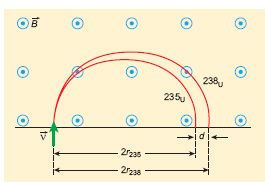
Two singly ionized isotopes of uranium \(_{ 92 }^{ 235 }{ U \ and \ _{ 92 }^{ 238 }{ U } }\) (isotopes have same atomic number but different mass number) are sent with velocity 1.00 x 10⁵ m s–1 into a magnetic field of strength 0.500 T normally. Compute the distance between the two isotopes after they complete a semi-circle. Also, compute the time taken by each isotope to complete one semi-circular path. (Given: masses of the isotopes: m235 = 3.90 x 10⁻²⁵ kg and m238 = 3.95 x 10⁻²⁵ kg)
30.
An electron moving perpendicular to a uniform magnetic field 0.500 T undergoes circular motion of radius 2.50 mm. What is the speed of electron?
31.
Suppose a charge +q on Earth’s surface and another +q charge is placed on the surface of the Moon.
(a) Calculate the value of q required to balance the gravitational attraction between Earth and Moon.
(b) Suppose the distance between the Moon and Earth is halved, would the charge q change?
(Take mE = 5.9 x 1024 kg, mM = 7.9 x 10²² kg)
32.
Discuss the basic properties of electric charges.
33.
A coil of a tangent galvanometer of diameter 0.24 m has 100 turns. If the horizontal component of Earth’s magnetic field is 25 x 10–6 T then, calculate the current which gives a deflection of 60o .
34.
Two conducting spheres of radius r1 = 8 cm and r2 = 2 cm are separated by a distance much larger than 8 cm and are connected by a thin conducting wire as shown in the figure. A total charge of Q = +100 nC is placed on one of the spheres. After a fraction of a second, the charge Q is redistributed and both the spheres attain electrostatic equilibrium.
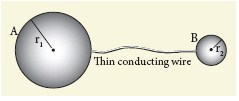
(a) Calculate the charge and surface charge density on each sphere.
(b) Calculate the potential at the surface of each sphere.
35.
Which of the following two form a pair in pair-production?
electron and positron
proton and positron
electron and neutron
neutron and positron
36.
The change in the resting frequency of a FM transmitter is called ________
frequency swing
frequency deviation
range offrequency
centre deviation
37.
When a material particle of rest mass m0, attains the velocity of light its mass becomes ______________.
0
2 m0
4 m0
∞
38.
If Vg, Vx, Vm are speeds of gamma rays, X rays and microwaves respectively in vacuum, then ______________.
Vg
Vg > Vk > Vm
Vg > Vx < Vm
Vg= Vx= Vm
39.
The velocity of light is maximum in ______________.
Diamond
Water
Vacuum
Glass
40.
An α-particle enters a magnetic field of 1T with a velocity 106 m/s in a direction perpendicular to the field. The force on α-particle is _____________________.
1.6 x 10⁻¹³N
6.4 x 10⁻¹³N
4.8 x 10⁻¹³N
3.2 x 10⁻¹³N
41.
This works on the principle of Tangent Law ____________________.
Tangent Galvanometer
Galvanometer
Potentiometer
Metre Bridge
42.
Which one of the following pair of particles move with same velocity along the same circular path in a uniform magnetic field?
electron, proton
proton, deutron
proton, alpha particle
deutron, alpha particle
43.
What physical quantities may X and Y represent? [Y represents the first mentioned quantity].
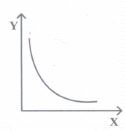
K.E - velocity of a particle
pressure - temperature of a given gas (constant volume)
capacitance - charge to give a constant potential
potential - capacitance to give a constant charge
44.
Which of the following electromagnetic radiations is used for viewing objects through fog
microwave
gamma rays
X- rays
infrared
45.
Prove the laws of reflection using Huygen's principle.
46.
Derive the equation for lateral magnification in spherical mirrors.
47.
(i) For a glass ( \(\mu =\sqrt { 5 } \)) the angle of minimum deviation is equal to the angle of the prism. Find the angle of the prism.
(ii) Draw ray diagram when incident ray falls normally on one of the two equal sides of a right-angled isosceles prism having refractive indeed \(\mu =\sqrt { 3 } \).
48.
Write the application of x-rays.
49.
Derive the equation for acceptance angle and numerical aperture of optical fibre.
50.
51.
Derive the mirror equation and the equation for lateral magnification.
52.
An electromagnetic wave is traveling in vacuum with a speed 3 x 10⁸ m/s. find its velocity in a medium having relative electric and magnetic permeability 2 and 1 respectively.
53.
Explain the mechanical analogy of LC oscillations by quantitative treatment.
54.
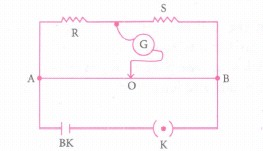
In a meter bridge, the balancing length is found to be 40 cm from end A. If the resistance of 10 \(\Omega \) is connected in series with R, balancing length is obtained 60 em from A. calculate the value R & S.
55.
An electric dipole of length 4cm, when placed with its axis making an angle of 60° with a uniform electric field, experiences a torque of 4√3 Nm. Calculate the potential energy of the dipole, if it has charge ± 8nC.
1.
The angle between the direction of the incident ray PQ and the emergent ray RS is called the angle of deviation d.
2.
(i) Light must travel from denser to rarer medium,
(ii) Angle of incidence in the denser medium must be greater than critical angle (i > ic).
3.
If the reflection takes place at the convex surface, it is called a convex mirror and if the reflection takes place at the concave surface, it is called a concave mirror.
4.
Real image :
This type of image which can be formed on a screen and can also be seen with the eyes is called real image.
Virtual image :
Image which cannot be formed on the screen but can only be seen with the eyes.
5.
Yes, there is a difference between coloured light obtained from prism and soap bubble Dispenion takes place in prism. Interference takes place in soap bubbles.
6.
The cut-off wavelength of the characteristic x - rays is
\({ \lambda }_{ ° }\frac { 12400 }{ V } \mathring { A } =\frac { 12400 }{ 20000 } \mathring { A }\)
= 0.62 \(\mathring { A } \)
The corresponding frequency is
\({ \upsilon }_{ o }=\frac { c }{ { \lambda }_{ o } } =\frac { 3\times 10^{ 8 } }{ 0.62\times 10^{ -10 } }\) = 4.84 x 10¹⁸ Hz
7.
8.
Given, A = 60°; D = 37°
Equation for refractive index is,
\(n=\cfrac { \sin\left( \frac { A+D }{ 2 } \right) }{ \sin\left( \frac { A }{ 2 } \right) } \)
Substituting the values,
\(n=\cfrac { \sin\left( \frac { 60^{ o }+37^{ o } }{ 2 } \right) }{ \sin\left( \cfrac { { 60 }^{ o } }{ 2 } \right) } =\cfrac { \sin\left( 48.5^{ o } \right) }{ \sin\left( { 30 }^{ o } \right) } =1.5\)
The refractive index of the material of the prism is, n = 1.5
9.
\(v=\pm 3u, f=\mp 20 cm\)
Case i :
V = -3u,
\(\frac{1}{f} =\frac{1}{u}+\frac{1}{v} =\frac{1}{u}-\frac{1}{3 u} =\frac{2}{3 u} \)
\(\)3u = 2f
\(u=\frac{2 f}{3}=\frac{2 \times(-20)}{3} \)
\(u=\frac{-40}{3} \mathrm{~cm} \)
Case ii :
v = 3u
\(\frac{1}{f} =\frac{1}{u}+\frac{1}{3 u} \)
\(=\frac{4}{3 u} \)
3u = 4f = -4 x 20
\(u=\frac{-4 \times 20}{3} \)
\(u=\frac{-80}{3} \mathrm{~cm} \)
10.
A terrestrial telescope has an additional erecting lens to make the final image erect.
11.
Uses:
To produce plane polarised light and also serve as analyser.
Construction:
(i) lt is a clacite crystal whose length is three times of its breadth.
(ii) Cut in to two halves having face angles 72° and 108°.
(iii) Joined together by a transparent cement (canada balsam).
Working:
(i) When a monochromatic light from sodium vapour lamp is incident on Nicol prism, double refraction takes places.
(ii) It's split as ordinary (O) ray and extra ordinary ray (E)
Refractive index of the crystal for
Ordinary ray : 1.658
Extra ordinary ray : 1.486
Canada balsam : 1.523
(iii) Ordinary ray is total internally reflected and extra ordinary ray alone is transmitted which is plane polarised.
12.
(i) Optical fibers consist of the inner part called core and the outer part called cladding (or) sleeving. The refractive index of core is higher than that of cladding.
(ii) Signal in the form of light is made to incident inside the core-cladding boundary at an angle greater than the critical angle. So, that total internal reflection happens without undergoing any refraction. The light travels without appreciable loss of intensity.
13.
(i) Speed of Electromagnetic wave \(=\frac{Peak\ value\ of\ Electric\ field}{Peak\ value\ of\ magnetic\ field}\)
\(c=\frac { { E }_{ 0 } }{ { B }_{ 0 } } \)
(ii) Yes, As Electromagnetic waves contain both electric and magnetic fields, there is a non-zero energy density associated with it.
\(E=\frac { hc }{ \lambda } \)
Momentum p \(=\frac{Total\ energy\ transferred\ to\ the\ surface}{Velocity\ of\ light\ in\ vacuum}\)
i.e.p = \(\frac{U}{c}=mc\)
U - total energy transferred to the surface.
EM waves carry not only energy and momentum but also angular momentum.
14.
The drift velocity is defined as the average velocity with which free electrons in a conductor get drifted under the influence of an external electricity applied across the conductor. The relation between drift velocity of free electrons the circuit flowing through the conductor is \(I=\eta Ae{ v }_{ d }e-\) charge of the electron n - no of free electrons in the conductor; A - area of cross-section.
15.
Whenever energy is given to a circuit containing a pure indicator L and a capacitor of capacitance C, the energy oscillates back and fourth between the magnetic field of the indicator and the electric field of the capacitor. Thus the electrical oscillations of definite frequency are generated. these oscillations are called LC oscillations.
16.
| S.No | Drift velocity | Mobility |
| (i) | Drift velocity is the average velocity acquired by the electrons inside the conductor when it is subjected to an electric field. | Mobility is defined as the magnitude of the drift velocity per unit electric field. |
| (ii) | Vd = a\(\tau\) (or) Vd = μE. | μ =e\(\tau\)/m (or) u = vd/E. |
| (iii) | Its unit is m / s. | Its unit is m2/ Vs. |
17.
(i) A lens is formed by a transparent material bounded between two spherical surfaces or one plane and another spherical surface.
(ii) In a thin lens, the distance between the surfaces is very small. If there are two spherical surfaces, then there will be two centers of curvature C1 and C2 and correspondingly two radii of curvature R1 and R2.
(iii) A plane surface has its center of curvature C at infinity and its radius of curvature R is infinity (R = ∞).
18.
|
Paraxial Rays |
Marginal Rays |
|---|---|
| The rays traveling very close to the principal axis and make small angles with it are called paraxial rays. | the rays traveling far away from the principal axis and fall on the mirror far away from the pole are called marginal rays. |
19.
(i) The line joining the pole and the centre of curyature is called the principal axis of the mirror.
(ii) The light ray travelling along the principal axis towards the mirror after reflection travels back along the same principal axis. It is also called optical axis.
20.
Given, thickness of glass slab, d = 50 cm = 0.5 m, refractive index, n = 1.5
refractive index, \(n=\cfrac { c }{ v } \)
(a) speed of light in the glass slab is,
\(v=\cfrac { c }{ n } =\cfrac { 3\times { 10 }^{ 8 } }{ 1.5 } =2\times { 10 }^{ 8 }{ ms }^{ -1 }\)
(b) time taken by light to travel through the glass slab is,
\(t=\cfrac { d }{ v } =\cfrac { 0.5 }{ 2\times { 10 }^{ 8 } } =2.5\times { 10 }^{ -9 }{ s }\)
(c) optical path,
d' = nd = 1.5 x 0.5 = 0.75 m = 75 cm
Light would have traveled an additional 25 cm (75 cm – 50 cm) in vacuum at the same time had there been no glass slab in its path.
21.
\(\text{ longitudinal magnifcation}(m_l)=\frac { length\ of\ image\left( l' \right) }{ length\ of\ object\left( l \right) } \)
Given: length of object, \(l=\cfrac { f }{ 3 } \)
For the given condition, the image formation is shown in the figure.
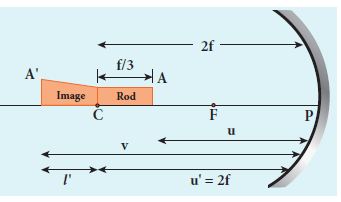
Let, l' be the length of the image, then
\(m=\cfrac { l' }{ l } =\cfrac { l' }{ f/3 } \) (or) \(l=\cfrac { m_lf }{ 3 } \)
Image of one end coincides with the object. Thus, the coinciding end must be at center of curvature.
\(u_B=u_A-\cfrac { f }{ 3 } =2f-\cfrac { f }{ 3 } =\cfrac { 5f }{ 3 } \)
\(v_B=u_B+l+l'\)
\(v_b =\cfrac { 5f }{ 3 } +\cfrac { f }{ 3 } +\cfrac { mf }{ 3 } =\cfrac { f(6+m) }{ 3 } \)
Mirror equation,\(\cfrac { 1 }{ v } +\cfrac { 1 }{ u } =\cfrac { 1 }{ f } \)
\(\cfrac { 1 }{ -\left( \cfrac { f(6+m_l) }{ 3 } \right) } +\cfrac { 1 }{ -\left( \cfrac { 5f }{ 3 } \right) } =\cfrac { 1 }{ -f } \)
After simplifying,
\(\cfrac { 3 }{ f(6+m_l) } +\cfrac { 3 }{ 5f } =\cfrac { 1 }{ f } ;\cfrac { 3 }{ (6+m_l) } =\cfrac { 2 }{ 5 } \)
\(6+m_l=\cfrac { 15 }{ 2 } ;m_l=\cfrac { 15 }{ 2 } -6\)
\(m_l=\cfrac { 3 }{ 2 } =1.5\)
22.
(a) The velocity of an electron in nth orbit is
\(\upsilon _{ n }=\frac { h }{ 2\pi m{ a }_{ 0 } } \frac { Z }{ n } \)
Where \({ a }_{ 0 }=\frac { { \epsilon }_{ 0 }{ h }^{ 2 } }{ \pi { me }^{ 2 } } \) = Bohr radius. Substituting for a0 in ሀn,
\({ \upsilon }_{ n }=\frac { { e }^{ 2 } }{ 2{ \epsilon }_{ 0 }h } \frac { Z }{ n } =c\left( \frac { { e }^{ 2 } }{ 2{ \epsilon }_{ 0 }hc } \right) \frac { Z }{ n } =\frac { \alpha cZ }{ n } \)
where c is the speed of light in free space or vacuum and its value is c = 3 x 10⁸ m s–1 and α is called fine structure constant.
For a hydrogen atom, Z = 1 and for the first orbit, n = 1, the ratio of velocity of electron in first orbit to the speed of light in vacuum or free space is
\(\frac { { \upsilon }_{ 1 } }{ c } =\alpha =\frac { { e }^{ 2 } }{ 2{ \epsilon }_{ 0 }hc } \)
\(\alpha =\frac { { (1.6\times { 10 }^{ -19 }C })^{ 2 } }{ 2\times (8.854\times { 10 }^{ -12 }{ C }^{ 2 }{ N }^{ -1 }{ m }^{ -2 }) } \) x \(\frac { 1 }{ (6.6\times { 10 }^{ -34 }{ Nms)\times (3\times { 10 }^{ 8 } }{ ms }^{ -1 }) } \)
≈ \(\frac{1}{136.9}=\frac{1}{137}\) which is a dimensionless number
⇒ α = \(\frac{1}{137}\)
(b) Using fine structure constant, the velocity of electron can be written as vn = \(\frac{αcZ}{n}\)
For hydrogen atom (Z = 1) the velocity of electron in nth orbit is vn = \(\frac{c}{137}\frac{1}{n}=(2.19\times10^6)\frac{1}{n}ms^{-1}\)
For the first orbit (ground state), the velocity of electron is v1 = 2.19 x 10⁶ms−1
For the second orbit (first excited state), the velocity of electron is v2 = 1.095 x 10⁶ms−1
For the third orbit (second excited state), the velocity of electron is v3 = 0.73 x 10⁶ms−1
Here, v1 > v2 > v3
23.
(i) Cathode rays possess energy and momentum and travel in a straight line with high speed of the order of 107m s-1or \({ \left( \frac { 1 }{ 10 } \right) }^{ th }\) of the speed of light.
(ii) It can be deflected by application of electric and magnetic fields. The direction of deflection indicates that they are negatively charged particles.
(ii) When the cathode rays are allowed to fall on matter, they produce heat. They affect the photographic plates and also produce fluorescence when they fall on certain crystals and minerals.
(iii) When the cathode rays fall on a material of high atomic weight, x-rays are produced.
(iv) Cathode rays ionize the gas through which they pass.
24.
Relation between f and R:
C ⇒ Center of curvature
F ⇒ Principal focus
i ⇒ Angle of incidence
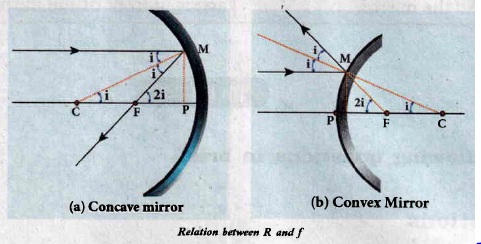
The angles
\(\tan i=\frac{P M}{P C} \text { and } \tan 2 i=\frac{P M}{P F}\)
As the angles are small, tan i = i and tan 2i = 2i.
\(\mathrm{i}=\frac{\mathrm{PM}}{\mathrm{PC}} \text { and } 2 \mathrm{i}=\frac{\mathrm{PM}}{\mathrm{PF}}\)
Simplifying further,
\(2 \frac{\mathrm{PM}}{\mathrm{PC}}=\frac{\mathrm{PM}}{\mathrm{PF}} ; 2 \mathrm{PF}=\mathrm{PC}, \mathrm{R}=2 \mathrm{f}\)
PF is focal length f and PC is the radius of curvature R.
R = 2f (or) f = R/2
25.
According to law of reflection,
(i) The incident ray, reflected ray and normal to the reflecting surface all are coplanar (ie. lie in the same plane).
(ii) The angle of incidence i is equal to the angle of reflection r.
i = r
26.
(i) u - v rays
(ii) X - rays
(iii) ૪ - rays.
27.
w = \(\frac { qB }{ m } \) independence of angle of the entrance with the magnetic field.
W1 : w2 = 1 : 1
28.
(i) The electromagnetic oscillations of LC system can be compared with the mechanical oscillations of a spring-mass system.
(ii) There are two forms of energy involved in LC oscillations. One is electrical energy of the charged capacitor; the other magnetic energy of the inductor carrying current.
(iii) Likewise, the mechanical energy of the spring-mass system exists in two forms; the potential energy of the compressed or extended spring and the kinetic energy of the mass. The Table lists these two pairs of energy.
(iv) By examining, the analogies between the various quantities can be understood and these correspondences.
(v) The angular frequency of oscillations of a spring-mass is given by equation
\(\omega =\sqrt { \frac { k }{ m } } \)
k ⟶ \(\frac { 1 }{ C } \) and m ⟶ L. Therefore, the angular frequency of LC oscillations is given by
ω = \(\frac { 1 }{ \sqrt { LC } } \)
29.
Since isotopes are singly ionized, they have equal charge which is equal to the charge of an electron, q = - 1.6 x 10⁻¹⁹ C. Mass of uranium \(_{ 92 }^{ 235 }{ U and _{ 92 }^{ 238 }{ U } }\) are 3.90 x 10⁻²⁵ kg and 3.95 x 10⁻²⁵ kg respectively. Magnetic field applied, B = 0.500 T. Velocity of the electron is 1.00 x 10⁵ m s-1, then
(a) the radius of the path of \(_{ 92 }^{ 235 }{ U }\) is r235
\({ r }_{ 235 }=\frac { { m }_{ 235 }v }{ \left| q \right| B } =\frac { 3.90\times { 10 }^{ -25 }\times 1.00\times { 10 }^{ 5 } }{ 1.6\times { 10 }^{ -19 }\times 0.500 } =48.8\times { 10 }^{ -2 }m\)
r235 = 48.8cm
The diameter of the semi-circle due to \(_{ 92 }^{ 235 }{ U\ \ is \ \ { d }_{ 235 }=2{ r }_{ 235 } }\) = 97.6 cm
The radius of the path of \(_{ 92 }^{ 238 }{ U\ is\ 2{ r }_{ 238 }\ then}\)
\({ r }_{ 238 }=\frac { { m }_{ 238 }v }{ \left| q \right| B } =\frac { 3.90\times { 10 }^{ -25 }\times 1.00\times { 10 }^{ 5 } }{ 1.6\times { 10 }^{ -19 }\times 0.500 } =49.4\times { 10 }^{ -2 }m\)
r238 = 49.4 cm
The diameter of the semi-circle due to \(^{ 238 }_{92}{ U\ is \ 2{ r }_{ 238 } \ =98.8 \ cm}\)
Therefore the separation distance between the isotopes is \(\triangle d={ d }_{ 238 }-{ d }_{ 235 }=1.2 \ cm\)
(b) The time taken by each isotope to complete one semi-circular path are
\({ t }_{ 235 }=\frac { \text{ magnitude of the displacement} }{ velocity } \)
\(=\frac { 97.6\times { 10 }^{ -2 } }{ 1.00\times { 10 }^{ 5 } } =9.76\times { 10 }^{ -6 }s=9.76\mu s\)
\({ t }_{ 238 }=\frac { \text{magnitude of the displacement }}{ velocity } \)
\(=\frac { 98.8\times { 10 }^{ -2 } }{ 1.00\times { 10 }^{ 5 } } =9.88\times { 10 }^{ -6 }s=9.88\mu s\)
30.
Charge of an electron q = –1.60 × 10⁻¹⁹ C ⇒ |q| = 1 60 x 10-19 C
Magnitude of magnetic field B = 0.500 T
Mass of the electron, m = 9.11 × 10⁻³¹ kg
Radius of the orbit, r = 2.50 mm = 2.50 × 10⁻³ m
Speed of the electron, V = \(q \frac{\mathrm{rB}}{\mathrm{m}}\)
\( v = 1.60 \times 10^{-19} \times\frac{ 2.50 \times 10^{-3} \times 0.500}{9.11 \times 10^{-31}}\)
\(v=2.195 \times 10^8 \mathrm{~m} \mathrm{s} ^{-1}\)
31.
G = 6.67 x 10⁻¹¹ Nm2kg-2
Mass of Earth mE = 5.9 x 1024 kg
Mass of Moon mm = 7.9 x 10²² kg
Gravitational force \(F_{g}=\frac{G m_{E} \times m_{M}}{r^{2}}\); Electro static force \(F_e=k\frac{q \times q}{r^2}\)
By equating the forces, \( k\frac{q \times q}{r^{2}}=G \cdot \frac{m_{E} \times m_{M}}{r^{2}} \)
\(\because k=\frac{1}{4 \pi \varepsilon_{0}}=9 \times 10^{9} \)
\( 4 \pi \varepsilon_{0} =0.11 \times 10^{-9} \)
\(q =\sqrt{4 \pi \varepsilon_{0} G m_{E} \cdot m_{M}} \) ....(1)
\(=\sqrt{0.11 \times 10^{-9} \times 6.67 \times 10^{-11} \times 5.9 \times 10^{24} \times 7.9 \times 10^{22}}\)
\( q =\sqrt{34.2 \times 10^{26}} \)
q ≈ 5.85 x 10¹³ C
b) Suppose the distance (r) between Moon and Earth is halved, there is no change in the value of charge (q). Because from equation (1), q is independent of distance (r).
32.
Basic properties of charges:
(i) Electric charge:
(a) Most objects in the universe are made up of atoms, which in turn are made up of protons, neutrons and electrons.
(b) These particles have mass, an inherent property of particles. Similarly, the electric charge is another intrinsic and fundamental property of particles.
(ii) Conservation of charges:
Total electric charge is conserved. Charge can neither be created nor be destroyed. In any physical process, the net change in charge will be zero.
(iii) Quantisation of charges:
(a) The charge q on any object is equal to an integral multiple of this fundamental unit of charge.
(b) q = ne
(c) Here, n is any integer \((0, \pm 1, \pm 2, \pm 3, \pm 4 \ldots)\) This is called Quantisation of electric charge.
33.
The diameter of the coil is 0.24 m. Therefore, radius of the coil is 0.12 m.
Number of turns is 100 turns. Earth’s magnetic field is 25 x 10-6 T
Deflection is
\(\theta =60°\Rightarrow tan60°=\sqrt { 3 } =1.732\)
\(I=\frac { 2R{ B }_{ H } }{ { \mu }_{ ° }N } tan\theta \)
\(=\frac { 2\times 0.12\times 25\times 1{ 0 }^{ -6 } }{ 4\times 1{ 0 }^{ -7 }\times 3.14\times 100 } \times 1.732=0.82\times 1{ 0 }^{ -1 }A\)
I = 0.082 A
34.
(a) The electrostatic potential on the surface of the sphere A is VA = \(\frac { 1 }{ 4\pi { \epsilon }_{ 0 } } \frac { { q }_{ 1 } }{ { r }_{ 1 } } \)
The electrostatic potential on the surface of the sphere A is VB = \(\frac { 1 }{ 4\pi { \epsilon }_{ 0 } } \frac { { q }_{ 2 } }{ { r }_{ 2 } } \)
Since VA = VB. We have
\(\frac { { q }_{ 1 } }{ { r }_{ 1 } } =\frac { { q }_{ 2 } }{ { r }_{ 2 } } \Rightarrow { q }_{ 1 }=\left( \frac { { r }_{ 1 } }{ { r }_{ 2 } } \right) { q }_{ 2 }\)
But from the conservation of total charge, Q = q1 + q2, we get q1 = Q – q2. By substituting this in the above equation,
Q - q2 = \(\left( \frac { { r }_{ 1 } }{ { r }_{ 2 } } \right) { q }_{ 2 }\)
so that q2 = Q\(\left( \frac { { r }_{ 2 } }{ { r }_{ 1 }+{ r }_{ 2 } } \right) \)
Therefore,
q2 = 100 x 10-9 x \(\left( \frac { 2 }{ 10 } \right) \) = 20nC and q1 = Q - q2 = 80nC
The electric charge density for sphere A is σ1 = \(\frac { { q }_{ 1 } }{ 4\pi { r }_{ 1 }^{ 2 } } \)
The electric charge density for sphere B is σ2 = \(\frac { { q }_{ 2 } }{ 4\pi { r }_{ 2 }^{ 2 } } \)
Therefore,
σ1 = \(\frac { 80\times 10^{ -9 } }{ 4 \pi \times 64\times 10^{ -4 } } \) = 0.99 x 10⁻⁶ Cm-2 and
σ2 =\(\frac { 20\times 10^{ -9 } }{ 4\pi \times 4\times 10^{ -4 } } \) = 3.9 x 10⁻⁶ Cm-2
Note that the surface charge density is greater on the smaller sphere compared to the larger sphere (σ2 ≈ 4σ1) which confirms the result \(\frac { { \sigma }_{ 1 } }{ \sigma _{ 2 } } =\frac { { r }_{ 2 } }{ { r }_{ 1 } } \)
The potential on both spheres is the same. So we can calculate the potential on any one of the spheres
VA=\(\frac { 1 }{ 4\pi { \varepsilon }_{ 0 } } \frac { { q }_{ 1 } }{ { r }_{ 1 } } =\frac { 9\times 10^{ 9 }\times 80\times { 10 }^{ -9 } }{ 8\times 10^{ -2 } } \) = 9kV
35.
(a)
electron and positron
36.
(b)
frequency deviation
37.
(d)
∞
38.
(d)
Vg= Vx= Vm
39.
(c)
Vacuum
40.
(d)
3.2 x 10⁻¹³N
41.
(a)
Tangent Galvanometer
42.
(d)
deutron, alpha particle
43.
(d)
potential - capacitance to give a constant charge
44.
(d)
infrared
45.
(i) Consider a parallel beam of light, incident on a reflecting plane surface such as a plane mirror XY as shown in Figure.
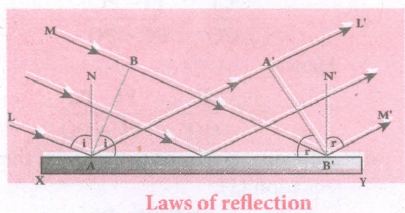
(ii) The incident wavefront is AB and the reflected wavefront is A'B' in the same medium. These wavefronts are perpendicular to the incident rays L, M and reflected rays L', M' respectively.
(iii) By the time point A of the incident wavefront touches the reflecting surface, point B is yet to travel a distance BB' to touch the reflecting surface a B'.
(iv) When point B falls on the reflecting surface at H', point A would have reached A.
(v) This is applicable to all the points on the wavefront. Thus, the reflected wavefront A'B' emanates as a plane wavefront. The two normals Nand N' are considered at the points where the rays Land Mfallon the reflecting surface.
(vi) As reflection happens in the same medium, the speed of light is the same before and after the reflection.
(vii) Hence, the time is taken for the ray to travel from B to B' is the same as the time taken for the ray to travel from A to A'.
(viii) Thus, the distance BB' is equal to the distance AA'; (A~A' = BB').
(a) The incident rays, the reflected rays, and the normal are in the same plane.
(b) Angle of incidence,\(\angle i=\angle NAL={ 90 }^{ o }-\angle NAB=\angle BAB'\)
Angle of reflection,
∠r= ∠N' B' M' = 900 - ∠N' B' A' = A' B' A'
(ix) For the two right-angle triangles, ΔABB' and ΔB' A' A', the right angles, ∠B and ∠A' are equal, (∠B and∠A = 900); the two sides, ∠A' and ∠B' are equal, (AA'= BB'); the side AB' is common.
(x) Thus, the two triangles are congruent. As per the property of congruency, the two angles, ∠BAB' and A' B' A' must also be equal.
i = r
Hence, the laws of reflection are proved.
46.
(i)The lateral or transverse magnification is defined as the ratio of the height of the image to the height of the object.
(ii) The height of the object and image are measured perpendicular to the principal axis
\(magnification(m)=\cfrac { height \ of\ the\ image(h') }{ heigh \ of\ the\ object(h) } \)
\(m=\cfrac { h' }{ h } \)
Applying proper sign conventions for equation (1),
\(\cfrac { A'B' }{ AB } =\cfrac { PA' }{ PA } \)
A'B' = -h, AB = h, PA' = -v, PA = -u
\(\cfrac { -h' }{ h } =\cfrac { -v }{ -u } \)
On simplifying we get,
\(m=\cfrac { h' }{ h } =-\cfrac { v }{ u } \)
Using mirror equation, we can further write the magnification as, magnification as,
\(m=\cfrac { h' }{ h } =\cfrac { f-v }{ f } =\cfrac { f }{ f-u } \) ...(3)
47.
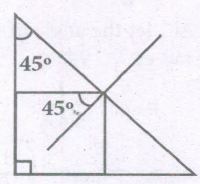
(i) At a minimum deviation \(\mu =\cfrac { sin\left( \frac { A+{ \delta }_{ m } }{ 2 } \right) }{ sin\left( \cfrac { A }{ 2 } \right) } \)
Given \({ \delta }_{ m }=A\)
\(\mu =\cfrac { sinA }{ sin\cfrac { A }{ 2 } } =\cfrac { 2sin\cfrac { A }{ 2 } cos\cfrac { A }{ 2 } }{ sin\cfrac { A }{ 2 } } \)
= \(2cos\cfrac { A }{ 2 } \)
\(\therefore cos\cfrac { A }{ 2 } =\cfrac { \sqrt { 3 } }{ 2 } \cfrac { A }{ 2 } =30\) A = 6o
(iii) \(\mu =\sqrt { 3 } \cfrac { 1 }{ { sini }_{ c } } \Rightarrow { sini }_{ c }=\cfrac { 1 }{ \sqrt { 3 } } \)
ஃ Angle of incidence > ic
Total internal reflection takes place.
48.
X-rays are being used in many fields. Let us list a few of them.
(i) Medical diagnosis X-rays can pass through flesh more easily than through bones. Thus an x-ray radiograph containing a deep shadow of the bones and a light shadow of the flesh may be obtained. X-ray radiographs are used to detect fractures, foreign bodies, diseased organs, etc.
(ii) Medical therapy Since x-rays can kill diseased tissues, they are employed to cure skin diseases, malignant tumors, etc.
(iii) Industry X-rays are used to check for flaws in welded joints, motor tires, tennis balls, and wood. At the customs post, they are used for the detection of contraband goods.
(iv) Scientific research X-ray diffraction is an important tool to study the structure of the crystalline materials - that is, the arrangement of atoms and molecules in crystals.
49.
From the Snell's law in product form, n1 sini = n2 sinr ....(1)
The equation for this refraction at the point A is as shown in the Figure
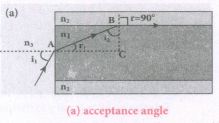
n3sin ia = n1sin ra ........(1)
(vi) To have the total internal reflection inside optical fibre, the angle of incidence at the core-cladding interface at B should be at least critical angle ie' From equation (1), for equation for the refraction at point B is,
n1 sin ic = n2 sin 90o ...(3)
n1sin ic = n2 ∵ sin 90o=1
\(sin{ i }_{ c }=\cfrac { { n }_{ 2 } }{ { n }_{ 1 } } \) ...(4)
From the right angle triangle Δ ABC,
ic = 90o - ra
Now, equation (4) becomes
\(sin\left( { 90 }^{ o }-{ r }_{ a } \right) =\cfrac { { n }_{ 2 } }{ { n }_{ 1 } } \) (or) \(cos{ r }_{ a }=\cfrac { { n }_{ 2 } }{ { n }_{ 1 } } \) ...(5)
\(sin{ r }_{ a }=\sqrt { 1-{ cos }^{ 2 }{ r }_{ a } } \)
Substituting for cos ra
\(sin{ r }_{ a }=\sqrt { 1-\left( \cfrac { { n }_{ 2 } }{ { n }_{ 1 } } \right) ^{ 2 } } =\sqrt { \cfrac { { n }_{ 1 }^{ 2 }-{ n }_{ 2 }^{ 2 } }{ { n }_{ 1 }^{ 2 } } } \) ...(6)
Substituting this in equation
\({ n }_{ 3 }{ sini }_{ a }={ n }_{ 1 }\sqrt { \cfrac { { n }_{ 1 }^{ 2 }-{ n }_{ 2 }^{ 2 } }{ { n }_{ 1 }^{ 2 } } } =\sqrt { { n }_{ 1 }^{ 2 }-{ n }_{ 2 }^{ 2 } } \) ...(7)
On further simplification
\(sini_{ a }=\cfrac { \sqrt { { n }_{ 1 }^{ 2 }-{ n }_{ 2 }^{ 2 } } }{ n_{ 3 } } \) (or) \(\quad { i }_{ a }=\sqrt { \cfrac { { n }_{ 1 }^{ 2 }-{ n }_{ 2 }^{ 2 } }{ { n }_{ 3 }^{ 2 } } } \) ...(8)
\(\therefore{ i }_{ a }={ sin }^{ -1 }\left( \sqrt { \cfrac { { n }_{ 1 }^{ 2 }-{ n }_{ 2 }^{ 2 } }{ { n }_{ 3 }^{ 2 } } } \right) \) ...(9)
If outer medium is air, then n3 = 1. The acceptance angle ia becomes
\({ i }_{ a }={ sin }^{ -1 }\left( \sqrt { { n }_{ 1 }^{ 2 }-{ n }_{ 2 }^{ 2 } } \right) \) ..(10)
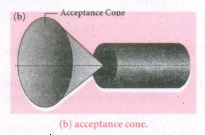
Light can have any angle of incidence from 0 to ia with the normal at the end of the optical fibre forming a conical shape called acceptance cone. In the equation (6), the term (n3sinia) is called numerical aperture NA of the optical fibre.
\(NA={ n }_{ 3 }{ sini }_{ a }=\sqrt { { n }_{ 1 }^{ 2 }-{ n }_{ 2 }^{ 2 } } \)
If outer medium is ab then n3 = 1
The numerical aperture NA becomes,
\(NA={ sini }_{ a }=\sqrt { { n }_{ 1 }^{ 2 }-{ n }_{ 2 }^{ 2 } } \)
50.
51.
Mirror Equation :
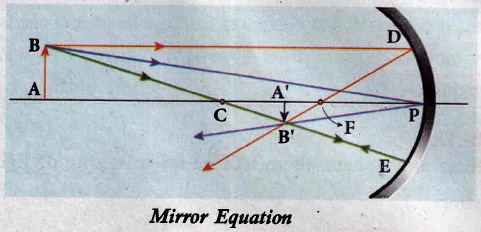
(i) AB is an object which is placed on the principal axis of a concave mirror beyond the center of curvature C. A' B' is an image which is formed between the point pole P, and the centre of curvature.
(ii) From the figure As per law of reflection, the angle of incidence ∠BPA is equal to the angle of reflection ∠B'PA'.
(iii) The triangles ∠BPA and ∠B'PA' are similar. Thus, from the rule of similar triangles,
\(\cfrac { { A }^{ ' }{ B }^{ ' } }{ AB } =\cfrac { { PA }^{ ' } }{ PA } \) ................(1)
(iv) The other set of similar triangles are, ΔDPF and ΔB'A'F. (PD is almost a straight vertical line)
\(\cfrac { { A }^{ ' }B' }{ PD } =\cfrac { A'F }{ PF } \)
(v) As, PD = AB the above equation becomes,
\(\cfrac { A'B' }{ AB } =\cfrac { A'F }{ PF } \) ......(2)
(vi) From equations (1) and (2) we can write,
\(\cfrac { PA' }{ PA } =\cfrac { A'F }{ PF } \)
(vii) As, A'F = PA' - PF, the above equation becomes,
\(\cfrac { PA' }{ PA } =\cfrac { PA'-PF }{ PF } \) .....(3)
(viii) We can apply the sign conventions for the various distances in the above equation
PA = - u, PA' = -v, PF = - f
(ix) All the three distances are negative as per sign convention, because they are measured to the left of the pole. Now, the equation (3) becomes,
\(\cfrac { -v }{ -u } =\cfrac { -v-\left( -f \right) }{ -f } \)
On further simplification,
\(\cfrac { v }{ u } =\cfrac { v-f }{ f } ;\cfrac { v }{ u } =\cfrac { v }{ f } -1 \)
Dividing either side with v,
\(\cfrac { 1 }{ u } =\cfrac { 1 }{ f } -\cfrac { 1 }{ v } \)
After rearranging,
\(\cfrac { 1 }{ v } +\cfrac { 1 }{ u } =\cfrac { 1 }{ f } \)
The above equation is called mirror equation.
Lateral magnification:
The lateral or transverse magnification is defined as the ratio of the height of the image to the height of the object. The height of the object and image are measured perpendicular to the principal axis.
Magnification (m) \(=\frac{\text { height of the image }\left(h^{\prime}\right)}{\text { height of the image }(h)} \)
\(m=\frac{h^{\prime}}{h} \) ....(1)
Applying proper sign conventions for equation,
\(\frac{A^{\prime} B^{\prime}}{A B}=\frac{P A^{\prime}}{P A} \)
\(A^{\prime} B^{\prime}=-h^{\prime}, A B=h, P A^{\prime}=-v, P A=-u \)
\(-\frac{h}{h}=\frac{-v}{-u} \)
On simplifying we get,
\(\mathrm{m}=\frac{\mathrm{h}^{\prime}}{\mathrm{h}}=-\frac{\mathrm{v}}{\mathrm{u}}\) ...(2)
Using mirror equation, we can further write the magnification as,
\(m=\frac{h^{\prime}}{h}=\frac{f-v}{f}=\frac{f}{f-u}\) ..(3)
52.
Given: Velocity of electromagnetic wave is
c = 3 x 10⁸ m/s.
Relative electric permittivity εr = 2
Relative magnetic permeability μr = 1
To find:
Velocity of Electromagnetic in a medium is
\(v=\frac { 1 }{ \sqrt { { \varepsilon }_{ 0 }{ \varepsilon }_{ r }.{ \mu }_{ 0 }{ \mu }_{ r } } } =\frac { 1 }{ \sqrt { { \varepsilon }_{ 0 }{ \mu }_{ 0 } } \times \sqrt { { \varepsilon }_{ r }{ \varepsilon }_{ r } } } \)
Solution:
\(\therefore v=\frac { 1 }{ \sqrt { { \varepsilon }_{ 0 }{ \mu }_{ 0 } } } ,v=\frac { 1 }{ \sqrt { { \varepsilon }_{ r }{ \mu }_{ R } } } \)
\(\therefore v=\frac { 3\times { 10 }^{ 8 } }{ \sqrt { 2\times 1 } } =\frac { 3 }{ \sqrt { 2 } } \times 10^{ 8 }m/s\)
53.
(i) The energy E remains constant for varying values of x and v. Differentiating E with respect to time, we get \(\frac { dE }{ dt } =\frac { 1 }{ 2 } \left( 2v\frac { dv }{ dt } \right) +\frac { 1 }{ 2 } k\left( \frac { dx }{ dt } \right) =0\)
or m \(\frac { { d }^{ 2 }x }{ { dt }^{ 2 } } +kx=0\)
since \(\frac { dx }{ dt } =\nu \) and \(\frac { dv }{ dt } =\frac { { d }^{ 2 }x }{ d{ t }^{ 2 } } \)
(ii) This is the differential equation of the oscillations of the spring-mass system. The general solution of an equation is of the form
x(t) = Xm cos (ωt + Φ)
where X is the maximum value of x(t), ω the angular frequency, and Φ the phase constant.
(iii) Similarly, the electromagnetic energy of the LC system is given by
\(U=\frac { 1 }{ 2 } { Li }^{ 2 }+\frac { 1 }{ 2 } \left( \frac { 1 }{ C } \right) { q }^{ 2 }\) = constant
Differentiating U with respect to time, we get
\(\frac { dU }{ dt } =\frac { 1 }{ 2 } L\left( 2i\frac { di }{ dt } \right) +\frac { 1 }{ 2C } \left( 2q\frac { dq }{ dt } \right) =0\)
(or) \(\frac { { d }^{ 2 }q }{ { dt }^{ 2 } } +\frac { 1 }{ C } q=0\) ....(1)
since \(i=\frac { dq }{ dt } \frac { di }{ dt } =\frac { { d }^{ 2 }q }{ d{ t }^{ 2 } } \)
(iv) The general solution of equation (1) is of the form
q(t) = Qm cos (ωt + Φ)
(v) where Qm is the maximum value of q(t), ω the angular frequency, and Φ the phase constant.
54.
According to Wheatstone bridge \(\cfrac { P }{ Q } =\cfrac { R }{ S } \)
\(\cfrac { R }{ S } =\cfrac { OA }{ OB } =\cfrac { 40 }{ 60 } \)
\(\cfrac { R }{ S } =\cfrac { OA }{ OB } =\cfrac { 40 }{ 60 } \)
If resistance 10 \(\Omega \) connected in series with R, the balance length is 60 cm.
\(\cfrac { R+10 }{ S } =\cfrac { 60 }{ 40 } \Rightarrow 2R+20=3S\)
From (1) & (2) \(\Rightarrow \left[ \cfrac { 4S }{ 3 } +20=3S \right] \)
45 + 60 = 95
55 = 60
\(S=\cfrac { 60 }{ 5 } =12\)
\(2\times \cfrac { 2S }{ 3 } +20=3S\)
\(s=12\Omega \)
From equation (1)
\(R=2\times \cfrac { 12 }{ 3 } =8\Omega \)
\(R=8\Omega \)
55.
Length, I = 2a = 4cm = 4 x 10⁻²m
Angle, θ = 60°
torque ፔ = 4√3 Nm
Charge, Q = 8 x 10⁻⁹C
We know that, ፔ = pE sine [where p = Q x 2a]
ፔ = (Q x 2a)E sinθ
\(\tau =\frac { \partial }{ Q\times (2a)sin\theta } \)
\(=\frac { 4\sqrt { 3 } }{ 8\times { 10 }^{ -9 }\times 4\times { 10 }^{ -2 }\times { sin\quad 60 }^{ 0 } } \)
∴ Potential energy, U = -pE cosθ
= -Q(2a) x E x cosθ
\(=-8\times { 10 }^{ -9 }\times 4\times { 10 }^{ -2 }\times \frac { 4\sqrt { 3 } \times cos{ 60 }^{ 0 } }{ 8\times { 10 }^{ -9 }\times 4\times { 10 }^{ -2 }sin{ 60 }^{ 0 } } \)
\(U=\frac { -4\sqrt { 3 } }{ \sqrt { 3 } } =-4J\)

12th Standard Syllabus & Materials
12th Standard
TN 12th Computer Applications களப்பெயர் முறைமை (DNS) Sample Question Papers Study Material - QB365 Set A
NEW12th Standard
TN 12th Computer Applications வலையமைப்பு எடுத்துக்காட்டுகள் மற்றும் நெறிமுறைகள் Sample Question Papers Study Material - QB365 Set A
NEW12th Standard
TN 12th Computer Applications கணினி வலையமைப்பு ஓர் அறிமுகம் Sample Question Papers Study Material - QB365 Set A
NEW12th Standard
TN 12th Computer Applications PHP-உடன் MySQL-ஐ இணைத்தல் Sample Question Papers Study Material - QB365 Set A



Tamilnadu Stateboard 12th Standard Subjects

Maths

Chemistry
Physics

Biology

Computer Science

Business Maths and Statistics

Economics

Commerce

Accountancy

History

Computer Applications
Biology
Computer Technology
Computer Applications
Computer Science
Business Maths and Statistics
Commerce
Economics
Maths
Chemistry
Physics
Computer Technology
History
Accountancy

Tamil

English

French
Tamilnadu Stateboard Standards

