
 100% FREE ACCESS
12th Standard Syllabus & Materials
12th Standard
TN 12th Computer Applications மின்னணு தரவு பரிமாற்றம் Sample Question Papers Study Material - QB365 Set A
NEW12th Standard
TN 12th Computer Applications மின் - வணிக பாதுகாப்பு அமைப்புகள் Sample Question Papers Study Material - QB365 Set A
NEW12th Standard
TN 12th Computer Applications மின்னணு செலுத்தல் முறைகள் Sample Question Papers Study Material - QB365 Set A
NEW12th Standard
TN 12th Computer Applications மின் - வணிகம் Sample Question Papers Study Material - QB365 Set A
NEW12th Standard
TN 12th Computer Applications திறந்த மூல கருத்துருக்கள் Sample Question Papers Study Material - QB365 Set A
NEW12th Standard
TN 12th Computer Applications வலையமைப்பு வடமிடல் Sample Question Papers Study Material - QB365 Set A

Published on: 27/01/2021
12th Standard Chemistry English Medium Reduced Syllabus Model Question paper - 2021 Part - 1
Download Tamil Nadu 12th Standard Chemistry question papers, model tests, one-mark questions, important questions, and public exam papers in PDF format. Free study materials and answer keys for TN State Board students.
Questions + Answers key
Take MCQ Chemistry Test
1.
The button cell used is watches function as follows
Zn (s) + Ag2O (s) + H2O (l) ⇌ 2Ag (s) + Zn2+ (aq) + 2OH-(aq) the half cell potentials are Ag2O (s) + H2O (l) + 2e- → 2Ag (s) + 2OH- (aq) Eo = 34V and Zn (s) → Zn2+ (aq) + 2e− E0 = 0.76V . The cell potential will be_______.
0.84V
1.34V
1.10V
0.42V
2.
Using Gibb’s free energy change, ∆Go=57.34 kJ mol-1, for the reaction, X2Y(s)⇌2X++Y2- (aq), calculate the solubility product of X2Y in water at 300 K_______. (R = 8.3 J K-1Mol-1)
10-10
10-12
10-14
can not be calculated from the given dat
3.
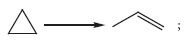 This reaction follows first order kinetics. The rate constant at particular temperature is 2.303 x 10⁻² hour-1. The initial concentration of cyclopropane is 0.25 M. What will be the concentration of cyclopropane after 1806 minutes? (log 2 = 0.3010)
0.125 M
0.215 M
0.25 x 2.303 M
0.05 M
4.
Predict the rate law of the following reaction based on the data given below
2A+B⟶C+3D
| Reaction number | [A] (min) | [B] (min) | Initial rate (M s-1) |
| 1 | 0.1 | 0.1 | x |
| 2 | 0.2 | 0.1 | 2x |
| 3 | 0.1 | 0.2 | 4x |
| 4 | 0.2 | 0.2 | 8x |
rate = k[A]2 [B]
rate = k[A] [B]2
rate = k[A] [B]
rate = k[A]1/2 [B]3/2
5.
The fraction of total volume occupied by the atoms in a simple cubic is ________.
\(\left( \frac { \pi }{ 4\sqrt { 2 } } \right) \)
\(\left( \frac { \pi }{ 6 } \right) \)
\(\left( \frac { \pi }{ 4 } \right) \)
\(\left( \frac { \pi }{ 3\sqrt { 2 } } \right) \)
6.
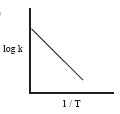
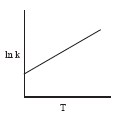
Among the following graphs showing variation of rate constant with temperature (T) for a reaction, the one that exhibits Arrhenius behavior over the entire temperature range is _______.

both (b) and (c)
7.
The number of carbon atoms per unit cell of diamond is _______.
8
6
1
4
8.
An ionic compound Ax By crystallizes in fcc type crystal structure with B ions at the centre of each face and A ion occupying corners of the cube the correct formula of Ax, By is ________.
AB
AB3
A3B
A8B6
9.
A complex in which the oxidation number of the metal is zero is_______.
K4[Fe(CN)6]
[Fe(CN)3(NH3)3]
[Fe(CO)5]
both (b) and (c)
10.
Which one of the following is not correct?
La(OH)3 is less basic than Lu(OH)3
In lanthanoid series ionic radius of Ln3+ ions decreases
La is actually an element of transition metal series rather than lanthanide series
Atomic radii of Zr and Hf are same because of lanthanide contract
11.
Which one of the following statements related to lanthanons is incorrect?
Europium shows +2 oxidation state
The basicity decreases as the ionic radius decreases from Pr to Lu.
All the lanthanons are much more reactive than aluminium
Ce4+ solutions are widely used as oxidising agents in volumetric analysis.
12.
Which of the following is strongest acid among all?
HI
HF
HBr
HCl
13.
Oxidation state of carbon in its hydrides _______.
+4
-4
+3
+2
14.
Which of the following is not true with respect to Ellingham diagram?
Free energy changes follow a straight line. Deviation occurs when there is a phase change.
The graph for the formation of CO2 is a straight line almost parallel to free energy axis.
Negative slope of CO shows that it becomes more stable with increase in temperature.
Positive slope of metal oxides shows that their stabilities decrease with increase in temperature.
15.
Zinc is obtained from ZnO by________.
Carbon reduction
Reduction using silver
Electrochemical process
Acid leaching
16.
How are silicates classified? Give an example for each type of silicate.
17.
The time for half change in a first order decomposition of a substance A is 60 seconds. Calculate the rate constant. How much of A will be left after 180 seconds?
18.
Explain the principle of electrolytic refining with an example.
19.
Give the IUPAC name of the following compounds
i) \({ H }_{ 3 }C-\underset { \overset { | }{ CN } }{ CH } -{ CH }_{ 2 }-COOH\)
ii) \({ CH }_{ 3 }-\underset { \overset { | }{ { CH }_{ 3 } } }{ CH } -CN\)
iii) C6H5-NC
20.
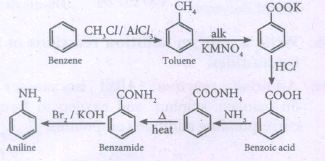
Use the following reagents in the correct order and bring about the conversion of benzene to aniline.
Reagents - HCI, NH3, heat, alk KMnO4, CHCl3 / AlCl3, Br2/KOH that can be used.
21.
How will you distinguish between formaldehyde and acetaldehyde?
22.
\({ C }_{ 6 }{ H }_{ 5 }{ NH }_{ 2 }\xrightarrow [ 273k,HCl ]{ { HNO }_{ 2 } } A\xrightarrow [ { Cu }_{ 2 }({ CN })_{ 2 } ]{ KCN } B \stackrel { { H }_{ 3 }O }\rightarrow C\)
Identify A, Band C.
23.
Give the structural formula of
i) 2-amino-2-methyl propane
ii) 2-(N, N- dimethyl) amino butane
24.
Name the vitamin responsible for coagulation of blood.
25.
Name the types of emulsions.
26.
Define Deemulsification.
27.
Why sodium metal cannot be used to dry alcohols but it can be used to dry ethers?
28.
Complete the following reactions
i) CH3- CH2 - OH \(\overset { { P}{ Br_3 }{ } }{ \underset { {} }{ \longrightarrow } }\) A \(\overset { { aq.NaOH}{ }{ } }{ \underset { {} }{ \longrightarrow } }\) B \(\overset { { Na}{ } }{ \underset { {} }{ \longrightarrow } }\) C
ii) C6H5- OH \(\overset { { Zn \ dust}{ } }{ \underset { {} }{ \longrightarrow } }\) A \(\overset { { CH_3}{Cl}{ } }{ \underset { {Anhydrs}{AlCl_3} }{ \longrightarrow } }\) B \(\overset { { acid}{K MnO_4}{ } }{ \underset { {} }{ \longrightarrow } }\) C


29.
Write the expression for the solubility product of Hg2Cl2 .
30.
Why first ionization enthalpy of chromium is lower than that of zinc?
31.
32.
How are the following compounds obtained from benzene diazonium chloride?
(i) phenol
(ii) ester
(iii) p-hydroxy azo benzene
33.
Write short notes on Popoff's rule.
34.
Give the structure of sucrose.
35.
Write a note on tertiary structure of proteins.
36.
ExpIain the classification of proteins based on their structure.
37.
Complete the following equations by writing the missing A, B, C, D etc.,
38.
Write a note on Ultrafilteration?
39.
Explain the relationship between free energy of the cell and its emf.
40.
9.2\(\times\)1012 litres of water is available in a lake. A power reactor using the electrolysis of water in the lake, produces electricity at the rate of 2\(\times\)106 Cs−1 at an appropriate voltage. How many years would it take to completely electrolyse the water in the lake. Assume that there is no loss of water except due to electrolysis.
41.
Give examples for first order reaction.
42.
The E0M2+/M value for copper is positive. Suggest a possible reason for this.
43.
Aluminium crystallizes in a cubic close packed structure. Its metallic radius is 125pm. calculate the edge length of unit cell.
1.
Anodic Oxidation: (Reverse the given reaction)
(Eoox ) = 0.76 V Cathodic reduction
Eocell = (Eoox )+ (Eored)
= 0.76 + 0.34 = 1.1 V
2.
(a)
10-10
3.
\(k=\frac { 2.303 }{ t } log\frac { \left[ { A }_{ 0 } \right] }{ \left[ A \right] } \)
2.303 x 10⁻² hour-1 = \(\frac { 2.303 }{ 1806 min } log\frac { \left[ { 0.25 }_{ } \right] }{ \left[ A \right] } \)
\(=\left(\frac{2.303 \times 10^{-2} hour^{-1 }\times 1806 min}{2.303}\right) = \log \left(\frac{0.25}{A}\right) \)
\(=\left(\frac{ 1806 \times 10 ^{-2}}{60}\right) = \log \left(\frac{0.25}{A}\right) \)
\(= 0.301 = \log \left(\frac{0.25}{A}\right) \)
\(=\log2 = \log \left(\frac{0.25}{A}\right) \)
\(2 = \log \left(\frac{0.25}{A}\right) \)
\([A] = \log \left(\frac{0.25}{2}\right) = 0.125 M\)
4.
rate1 = k[0.1]n [0.1]m ....(1)
rate2 = k[0.2]n [0.1]m ....(2)
(2) (1)
\(=\frac{2x}{x} = \frac{k[0.2]^n [0.1]^m}{k[0.1]^n [0.1]^m}\)
\(= \frac{2x}{x} = 2^n\)
n = 1
rate3 = k[0.1]n [0.2]m ....(3)
rate4 = k[0.2]n [0.2]m ....(4)
\(=\frac{8x}{2x} = \frac{k[0.2]^n [0.2]^m}{k[0.2]^n [0.1]^m}\)
= 8/2 = 2m
m = 2
rate = k[A] [B]2
5.
(b)
\(\left( \frac { \pi }{ 6 } \right) \)
6.
\(k=A{ e }^{ -\left( \frac { { E }_{ a } }{ RT } \right) }\)
In k = In A - \({ \left( \frac { { E }_{ a } }{ R } \right) }\) \(\left( \frac { 1 }{ T } \right) \)
This equation is of the form of a straight line y = mx+c
A plot of In k Vs \(\left( \frac { 1 }{ T } \right) \) gives a straight line with a negative slope.
7.
(a)
8
8.
Number of A ions = Nc/8 = 8/8 = 1
Number of B ions = Nf/2 = 6/2 = 3
Simplest formula = AB3
9.
a) Fe2+ b) Fe3+ c) Fe0
10.
(a)
La(OH)3 is less basic than Lu(OH)3
11.
As we move from La to Lu, their metallic behaviour because almost similar to that of aluminium.
12.
(a)
HI
13.
(a)
+4
14.
(b)
The graph for the formation of CO2 is a straight line almost parallel to free energy axis.
15.
(a)
Carbon reduction
16.
Silicates are classified into various types based on the way in which the tetrahedral units, [SiO4]4- are linked together.
(i) Ortho silicates (Neso silicates):
The simplest silicates which contain discrete [SiO4]4- tetrahedral units are called ortho silicates or nesosilicates.
Examples: Phenacite - Be2SiO4 (Be2+ ions are tetrahedrally surrounded by O2- ions)
(ii) pyro silicate (or) Soro silicates: Silicates:
Which contain [Si2O7]6- ions are called pyro silicates (or) Soro silicates.
Example: Thortveitite - Sc2Si2O7
(iii) Cyclic silicates (or Ring silicates):
Silicates which contain (SiO3)32n- ions which are formed by linking three or more tetrahedral SiO44- units cyclically are called cyclic silicates.
Example: Beryl [Be3Al2 (SiO3)6] (an aluminosilicate with each aluminium is surrounded by 6 oxygen atoms octahedrally)
(iv) Inosilicates: Silicates which contain 'n':
number of silicate units liked by sharing two or more oxygen atoms are called inosilicates.
Example: They are further classified as chain silicates and double chain silicates.
(v) Chain silicates (or pyroxenes):
These silicates contain [(SiO3)n]2n- ions formed: by linking 'n' number of tetrahedral [SiO4]4- units linearly. Each silicate unit shares two of its oxygen atoms with other units.
Example: Spodumene - LiAl(SiO3)2·
(vi) Double chain silicates (or amphiboles):
These silicates contains \(\left[ { Si }_{ 4 }{ O }_{ 11 } \right] _{ n }^{ 6n- }\) ions. In these silicates there are two different types of tetrahedra:
(a) Those sharing 3 vertices
(b) those sharing only 2 vertices.
Example:
Asbestos: These are fibrous and non-combustible silicates.
(vii) Sheet or phyllo silicates:
Silicates which contain \(({ Si }_{ 2 }{ O }_{ 5 })_{ n }^{ 2n- }\) are called sheet or phyllo silicates. In these, Each [SiO4]4- tetrahedron unit shares three oxygen atoms with others and thus by forming two dimensional sheets.
Example: Talc, Mica etc.
(viii) Three dimensional silicates (or tectosilicates):
Silicates in which all the oxygen atoms of [SiO4]4- tetrahedra are shared with other tetrahedra to form three dimensional network are called three dimensional or tectosilicates.
Example: Quartz.
17.
(i) Order of the reaction =1; \(\mathrm{t}_{1 / 2}=60 \mathrm{~s} ; \mathrm{k}=?\)
\(\mathrm{k}=\frac{0.6932}{\mathrm{t}_{\frac{1}{2}}} \)
\(=\frac{0.6932}{60} \)
\(k =1.155 \times 10^{-2} \mathrm{~s}^{-1}\)
(ii) \(\left[\mathrm{A}_{0}\right]=100 \% ; \mathrm{t}=180 \mathrm{~s} ;[\mathrm{A}]=? ; \mathrm{k}=1.155 \times 10^{-2} \mathrm{~s}^{-1}\)
For first order reaction
\(\mathrm{k}=\frac{2.303}{\mathrm{t}} \log \frac{\left[\mathrm{A}_{0}\right]}{[\mathrm{A}]} \)
\(1.155 \times 10^{-2} =\frac{2.303}{180} \log \left(\frac{100}{[A]}\right) \)
\(\frac{0.01155 \times 180}{2.303} =\log \left(\frac{100}{[A]}\right) \)
\(0.9027 =\log 100-\log [\mathrm{A}] \)
\(\log [\mathrm{A}] =\log 100-0.9027 \)
\(\log [A]=2-0.9027 \)
\(\log [A]=1.0972 \)
[A] = antilog of (1.0972)
[A] =12.51 %
18.
1. The crude metal is refined by electrolysis. It is carried out in an electrolytic cell
Anode : Impure metal to be refined with dilute acid.
Cathode : Thin strips of pure metal
Electrolyte : Aqueous solution of the salts of the metal with dilute acid.
2. The metal dissolves from the anode, pass into the solution.
3. At the same amount of metal ions from the solution will be deposited at the cathode.
4. During electrolysis, the less electropositive impurities in the anode, settle down at the bottom and are removed as anode mud.
Example: Electrolytic refining of silver.
Cathode: Pure silver
Anode: lmpure silver rods
Electrolyte: Acidified aqueous solution of silver nitrate
5. When a current is passed through the electrodes the following reactions will take place
(a) Reaction at anode: \({ Ag }_{ (s) }\longrightarrow { Ag }^{ + }_{ (aq) }+{ 1e }^{ - }\)
(b) Reaction at cathode: \({ Ag }^{ + }_{ (aq) }+{ 1e }^{ - }\longrightarrow { Ag }_{ (s) }\)
6. During electrolysis, at anode silver loses electrons and form silver ions and the silver ions migrate towards the cathode and get discharged and deposited on the cathode.
7. Copper, Zinc etc can also be refined by this process.
19.
(i) 3 - cyanobutanoic acid
(ii) 2 - methyl propanenitrile
(iii) phenyl carbylamine
20.
21.
| Formaldehyde | acetaldehyde | |
|---|---|---|
| 1. | It does not undergo iodoform reaction with I2+NaOH | It undergo iodoform reaction with I2+NaOH |
| 2. | It undergoes Cannizzaro reaction with alkaline solution. | It undergoes Aldol condensation with alkaline solution. |
22.
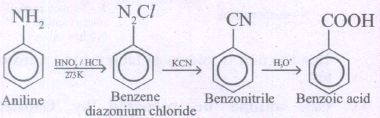
23.
(i) 2-amino-2-methyl propane
\(\quad { CH }_{ 3 }-\overset { \underset { | }{ { CH }_{ 3 } } }{ \underset { \overset { | }{ { NH }_{ 3 } } }{ C } } -{ CH }_{ 3 }\)
(ii) 2-(N, N- dimethyl) amino butane
\({ CH }_{ 3 }-{ CH }_{ 2 }-\overset { \underset { | }{ { CH }_{ 3 } } }{ CH } -\overset { \underset { | }{ { CH }_{ 3 } } }{ N } -{ CH }_{ 3 }\)
24.
Vitamin K.
25.
(i) Oil dispersed in water (O/W type)
(ii) Water dispersed in oil (W/O type).
26.
Emulsion can be separated into two separate layers. The process is called Deemulsification.
27.
Alcohols are acidic enough to react with sodium but ethers are inert.
28.
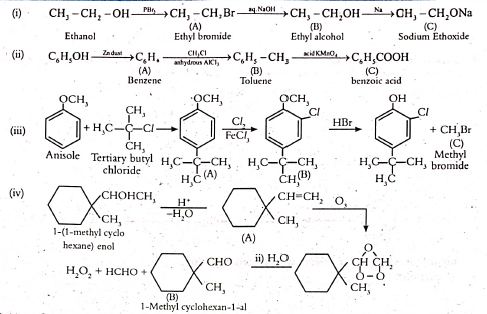
29.
\(\mathrm{Hg}_{2} \mathrm{Cl}_{2(\mathrm{~s})} \rightleftharpoons \mathrm{Hg}_{2}^{2+} \text { (aq) }+2 \mathrm{Cl^-}_{(\mathrm{aq})}\\ s \quad \quad \quad \quad \quad \quad s \quad \quad \quad \quad \quad 2s\)
\(\mathrm{K}_{\mathrm{sp}} =\left[\mathrm{Hg}_{2}^{2+}\right]{\left[\mathrm{Cl}^{-}\right]^{2}} \)
\(=(\mathrm{s})(2 \mathrm{~s})^{2} \)
\(\mathrm{~K}_{\mathrm{sp}} =4 \mathrm{~s}^{3}\)
30.
Chromium (24), the electronic configuration is 3d54s1. It ready to lose its outer most electron (4s1) to get exactly half-filled stable electronic configuration. The electronic configuration of Zinc is 3d104s2.ie., It has completely filled stable configuration. From this configuration, the removal of 1e- from 4s orbital is very difficult & it required more ionisation enthalpy. Due to this reason Zn has higher first Ionisation enthalpy (1.E1) than that of chromium.
31.
32.
(i) Repl cementby-OH: When the aqueous solution is boiled, phenol is obtained

This is an example of SN1 reaction in which C6H5N2CI initially gives C6H5+ and water is the nudeophile.
(ii) Replacement of RO- (or) RCOO- groups Similarly -N2CI can be replaced acyloxy group by boiling with carboxylic acids.
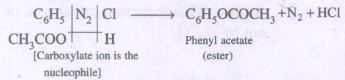
(iii) Diazonlum coupling reaction: Diazonium salt reacts with aromatic amine and phenols to give azo compounds of the general formula.
Ar - N = N - Ar'
This reaction is known as Coupling reaction since all these compounds are intensely coloured and used as dyes, thousands of azodyes have been synthesised by this procedure.

33.
During oxidation of unsymmetric ketones with oxidising agent which brings about the cleavage of C-C bond, the smaller alkyl group goes preferentially with the carbonyl group resulting in the carboxylic acids.
\({ CH }_{ 3 }-{ CH }_{ 2 }-{ CH }_{ 2 }-\underset { \overset { || }{ O } }{ C } -{ CH }_{ 3 }\overset { (O) }{ \underset { Con.HNO_{ 3 } }{ \longrightarrow } } \underset { Propanoic\ acid }{ { CH }_{ 3 }{ CH }_{ 2 }-COOH } +\underset { acetic\ acid }{ { CH }_{ 3 }COOH } \)
34.
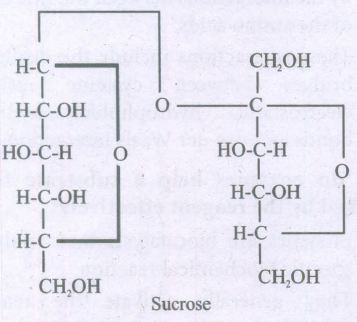
35.
(i) The secondary structure elements (α-helix & βsheets) further folds to form the three dimensional arrangement. This structure is called tertiary structure of the polypeptide (protein).
(ii) Tertiary structure of proteins are stabilised by the interactions between the side chains of the amino acids.
(iii) These interactions include the disulphide bridges between cysteine residues, electrostatic, hydrophobic, hydrogen bonds and van der Waals interactions.
36.
Proteins are classified based on their structure (overall shape) into two major types. They are fibrous protein and globular proteins.
(i) Fibrous proteins: These proteins are linear molecules. These are generally insoluble in water and are held together by disulphide bridges and weak intermolecular hydrogen bonds. The Example: Keratin, Collagen etc
(ii) Globular proteins: These proteins have an overall spherical shape. The polypeptide chain is folded into a spherical shape. These proteins are usually soluble in water and have many functions including catalysis.
37.
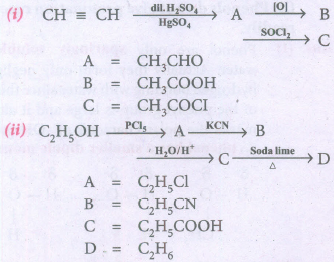
38.
(i) The pores of ordinary filter papers permit the passage of colloidal solutions.
(ii) In ultra filtrations, the membranes are made by using collodion cellophane or visiking.
(iii) When a colloidal solution is filtered using such a filter, colloidal particles are separated on the filter and the impurities are removed as washings.
(iv) This process is quickened by application of pressure.
(v) The separation of sol particles from electrolyte by filteration through an ultrafilter is called ultrafiltration.
39.
The maximum work that can be obtained from a galvanic cell is
(Wmax)cell = - nFEcell ...(1)
Here the (-) sign is introduced to indicate that the work is done by the system on the surroundings. According to Second Law of thermodynamics, the maximum work done by the system is equal to the change in the Gibbs free energy of the system.
i,e, Wmax= ∆G .......(2)
From (1) and (2),
∆G = - nFEcell ....(3)
For a spontaneous cell reactions, the ∆G should be negative. The above expression (3) indicates that Ecell should be positive to get a negative ∆G value.
When all the cell components are in their standard state, the equation becomes
∆Go = -nFEocell
40.
Hydrolysis of water
At anode:
\(2H_{2}O\rightarrow 4H^{+}+O_{2}+4e^{-}\) ..... (1)
At cathode:
\(2H_{2}O+2e^{-}\rightarrow H_{2}+2OH^{-}\) ....(2)
Overall reaction
\(6H_{2}O\rightarrow 4H^{+}+4OH^{-}+2H_{2}+O_{2}\)
(or)
Equation (1) +(2) \(x^2 \Rightarrow 2H_{2}O\rightarrow 2H_{2}+O_{2}\)
\(\therefore\) According to faradays Law of electrolysis, to electrolyse two mole of Water (36g ≃ 36 mL of H2O), 4F charge is required alternatively, when 36 mL of water is electrolysed, the charge generated = \(4\times 96500\)C.
\(\therefore\) When the whole water which is available on the lake is completely electrolysed the amount of charge generated is equal to \(\frac{4\times96500\quad C}{36 \quad mL}\times9\times10^{12}L\)
\(=\frac{4\times96500\times9\times10^{12}}{36\times10^{-3}}C\)
= \(96500\times10^{15}C\)
\(\therefore\) Given that in 1 second, \(2\times10^{6}\) C is generated therefore, the time required to generate \(96500 \times 10^{15}\) C is = \(\frac{1\quad S}{2\times 10^{6}C}\times 96500 \times10^{15}C\)
=\(48250 \times 10^{9} S\)
\(\therefore\) Number of years = \(\frac{48250 \times 10^{9}}{365 \times 24 \times 60 \times 60}\)
=\(1.5299 \times 10^{6}\) years
1 year = 365 days
= 365\(\times\)24 hours
= 365\(\times\)24\(\times\)60 min
= 365\(\times\)24\(\times\)60\(\times\)60 sec.
41.
(i) All radioactive transformations follow first order kinetics. For example,
92U238 ⟶ 90U234 +2He4
(ii) Decomposition of sulphuryl chloride in the gas phase proceeds by first order kinetics.
SO2Cl2(g) ⟶ SO2(g) + Cl2(g)
(iii) Inversion of sucrose in acidic aqueous medium follows first order reaction.
C12H22O11 +H2O \(\overset { H+ }{ \longrightarrow } \) C6H12O6 +C6H12O6
42.
Elemental copper is more stable than Cu2+. The electronic configuration of copper is 3d10 4s1 completely filled 3d orbital with stable configuration.
But Cu2+ has configuration as 3d9. Hence \(\mathrm{E}_{\mathrm{M}^{2+} / \mathrm{M}}^{0}\) value is positive for Cu2+.
43.
For cubic closed packed structure
\(r =\frac{a \sqrt{2}}{4} \)
\(\therefore a =\frac{4 r}{\sqrt{2}} \)
\(=\frac{4 \times 1.25 \times 10^{-8}}{1.414}=3.53 \times 10^{-8} \mathrm{~cm} \)
= 353 pm

12th Standard Syllabus & Materials
12th Standard
TN 12th Computer Applications களப்பெயர் முறைமை (DNS) Sample Question Papers Study Material - QB365 Set A
NEW12th Standard
TN 12th Computer Applications வலையமைப்பு எடுத்துக்காட்டுகள் மற்றும் நெறிமுறைகள் Sample Question Papers Study Material - QB365 Set A
NEW12th Standard
TN 12th Computer Applications கணினி வலையமைப்பு ஓர் அறிமுகம் Sample Question Papers Study Material - QB365 Set A
NEW12th Standard
TN 12th Computer Applications PHP-உடன் MySQL-ஐ இணைத்தல் Sample Question Papers Study Material - QB365 Set A



Tamilnadu Stateboard 12th Standard Subjects

Maths
Chemistry

Physics

Biology

Computer Science

Business Maths and Statistics

Economics

Commerce

Accountancy

History

Computer Applications
Biology
Computer Technology
Computer Applications
Computer Science
Business Maths and Statistics
Commerce
Economics
Maths
Chemistry
Physics
Computer Technology
History
Accountancy

Tamil

English

French
Tamilnadu Stateboard Standards
