
 100% FREE ACCESS
12th Standard Syllabus & Materials
12th Standard
TN 12th Computer Applications மின்னணு தரவு பரிமாற்றம் Sample Question Papers Study Material - QB365 Set A
NEW12th Standard
TN 12th Computer Applications மின் - வணிக பாதுகாப்பு அமைப்புகள் Sample Question Papers Study Material - QB365 Set A
NEW12th Standard
TN 12th Computer Applications மின்னணு செலுத்தல் முறைகள் Sample Question Papers Study Material - QB365 Set A
NEW12th Standard
TN 12th Computer Applications மின் - வணிகம் Sample Question Papers Study Material - QB365 Set A
NEW12th Standard
TN 12th Computer Applications திறந்த மூல கருத்துருக்கள் Sample Question Papers Study Material - QB365 Set A
NEW12th Standard
TN 12th Computer Applications வலையமைப்பு வடமிடல் Sample Question Papers Study Material - QB365 Set A

Published on: 27/01/2021
12th Standard Chemistry English Medium Reduced Syllabus Model Question paper - 2021 Part - 2
Download Tamil Nadu 12th Standard Chemistry question papers, model tests, one-mark questions, important questions, and public exam papers in PDF format. Free study materials and answer keys for TN State Board students.
Questions + Answers key
Take MCQ Chemistry Test
1.
Iodoform is ________
antibiotic
antiseptic
disinfectant
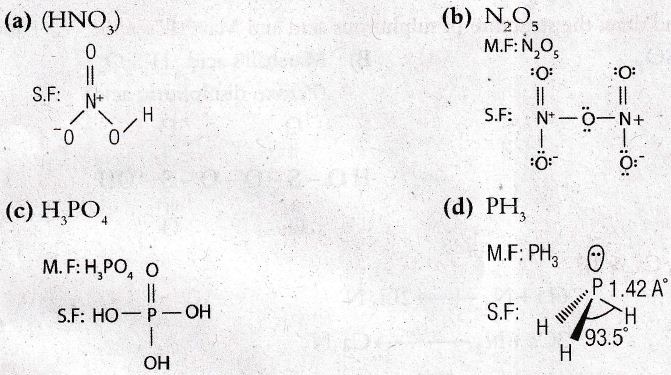
both (a) and (c)
2.
Pain killers are known a _______
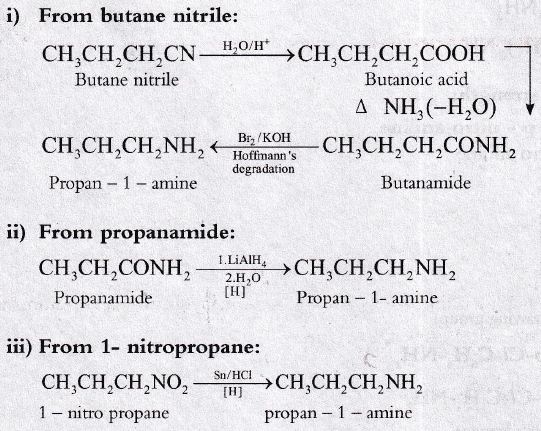
antipyretics
analgesics
antibiotics
antiseptics
3.
The quality of a soap is described in term of _______
LDPE
HDPE
TFM (Total fatty matter)
LFM (Lowfatty matter)
4.
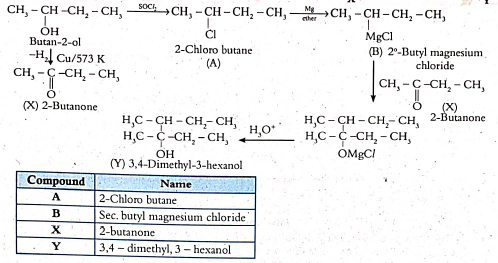
Teflon is an _______ polymer.
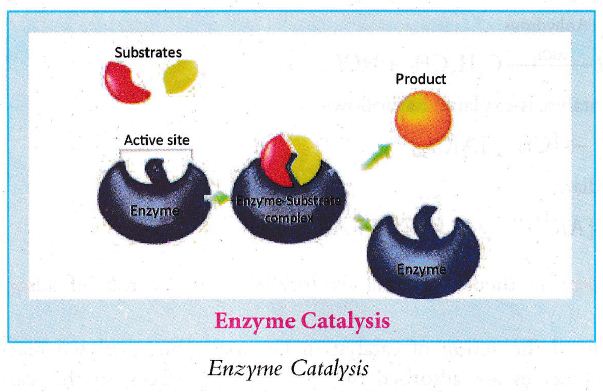
LDPE
HDPE
Condensation
All the above
5.
Nylon -66 is an example of ______ polymer.
addition
condensation
both (a) and (b)
natural
6.
The active component of dynamite is _______.
keiselghur
nitro glycerine
nitro benzene
trinitro toluene
7.
The ether used in perfumery is ________.
diethyl ether
dimethyl ether
methyl phenyl ether
diphenyl ether
8.
\(\overset { { CH }_{ 2 }-OH }{ \underset { { CH }_{ 2 }-OH }{ | } } \overset { { PI }_{ 3 } }{ \longrightarrow } \) __________ethan-1,2-diol
ethane
ethene
ethyl iodide
ethyne
9.
The compound that acts as a solvent for Grignard reagent is ______.
Ethyl alcohol
Diethyl ether
Acetone
Benzene
10.
Which is the group that decreases the acid strength of phenol?
-NO2
-CN-
-NH2
Both (a) and (b)
11.
XeF6 on complete hydrolysis produces________.
XeOF4
XeO2F2
XeO3
XeO2
12.
The basic structural unit of silicates is _______.
\(\left( SiO_{ 3 } \right) ^{ 2- }\)
\(\left( SiO_{ 4 } \right) ^{ 2- }\)
\(\left( Sio \right) ^{ - }\)
\(\left( SiO_{ 4 } \right) ^{ 4- }\)
13.
Which of the following plot gives Ellingham diagram
\(\Delta S \ \text{Vs} \ T\)
\(\Delta { G }^{ 0 }\ \text{Vs} \ T\)
\(\Delta { G }^{ 0 }\ \text{Vs} \ \frac { 1 }{ T } \)
\(\Delta { G }^{ 0 }\ \text{Vs} \ { T }^{ 2 }\)
14.
15.
Which of the following statements, about the advantage of roasting of sulphide ore before reduction is not true?
\(\Delta { G }_{ f }^{ 0 }\) of sulphide is greater than those for CS2 and H2S
\(\Delta { G }_{ r }^{ 0 }\) is negative for roasting of sulphide ore to oxide
Roasting of the sulphide to its oxide is thermodynamically feasible
Carbon and hydrogen are suitable reducing agents for metal sulphides
16.
Identify A and B in the following sequence of reactions.\({ CH }_{ 3 }-Br\xrightarrow [ 675k\\ Red\ hot\ si\ tube ]{ { HNO }_{ 3 } } A\xrightarrow [ NaOH ]{ { Cl }_{ 2 } } B\)
17.
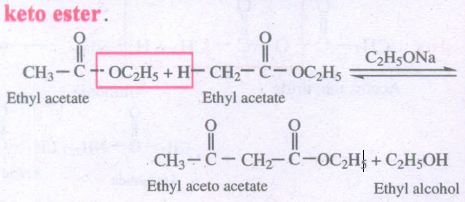
Write a note on Claisen Condensation.
18.
Write any three uses of formic acid.
19.
Which of the following does not give iodoform reaction?

20.
Write the IUPAC names of
(a) C2H5OCH3
(b) C6H5OC2H5
21.
Give the IUPAC names of
(i) CH3CH(OH)CH2OH
(ii) HO-CH2-CH2-OH
(iii) \({ { CH } }_{ 3 }-\underset { \overset { | }{ OH } }{ CH } -COOH\)
22.
Define ionic product of water. Give its value at room temperature.
23.
Atoms X and Y form bcc crystalline structure. Atom X is present at the corners of the cube and Y is at the centre of the cube. What is the formula of the compound?
24.
Write the molecular formula and structural formula for the following molecules.
a) Nitric acid
b) Dinitrogen pentoxide
c) phosphoric acid (PTA)
d) phosphine
25.
Why fluorine is more reactive than other halogens?
26.
Write a short note on anomalous properties of the first element of p-block.
27.
How will you prepare propan – 1- amine from
i) butane nitrile
ii) propanamide
ii) 1- nitropropane
28.
Arrange the following solutions in the decreasing order of specific conductance.
i) 0.01M KCl
ii) 0.005M KCl
iii) 0.1M KCl
iv) 0.25M KCl
v) 0.5M KCl
29.
Copper and silver lie low in the electrochemical series and yet they are found in the combined state as sulphides in nature. Comment.
30.
Define average rate and instantaneous rate.
31.
Which metal in the 3d series exhibits +1 oxidation state most frequently and why?
32.
33.
Ail organic compound. (A) C7H6O reduces Tollens reagent. Compound (A) reacts with acetic anhydride in the presence of anhydrous sodium acetate and gives an unsaturated acid (B). Compound (A) reacts with acetone in the presence of alkali and gives (C). What are (A)(B) and (C) Explain the reactions.
34.
List the importance of proteins in biological processes.
35.
Write a note on drug target interaction.
36.
Write the differences between nitro methane and nitro benzene.
37.
What happens when ethylamine is treated with
(i) CHCl3/NaOH
(ii) CS2
(iii) C6H5CHO.
38.
Predict the product A,B,X and Y in the following sequence of reaction
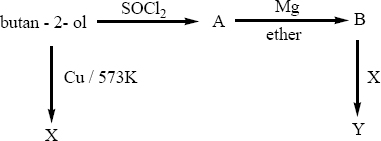
39.
What are enzymes? Write a brief note on the mechanism of enzyme catalysis.
40.
Arrange the following
i. In increasing order of solubility in water, C6H5 NH2, (C2H5)2NH, C2H5NH2
ii. In increasing order of basic strength
a) aniline, p- toludine and p – nitroaniline
b) C6H5 NH2, C6H5 NHCH3, C6H5NH2, p-Cl-C6- H4-NH2
iii. In decreasing order of basic strength in gas phase
(C2H5)NH2, (C2H5)NH, (C2H5)5N and NH3
iv. In increasing order of boiling point
C6H5OH, (CH3)2NH, C2H5NH2
v. In decreasing order of the pKb values
C2H5NH2, C6H5NHCH3.(C2H5)2 NH and CH3NH2
vi. Increasing order of basic strength
C2H5NH2,C6H5N(CH3)2, (C2H5)2 NH and CH3NH2
vii. In decreasing order of basic strength

41.
The conductivity of a 0.01M solution of a 1 :1 weak electrolyte at 298K is 1.5\(\times\)10-4 S cm−1.
i) molar conductivity of the solution
ii) degree of dissociation and the dissociation constant of the weak electrolyte
Given that
\(\lambda^{0}_{cation}=248.2 \ S\) cm2 mol-1
\(\lambda^{0}_{anlon}=51.8 \ S\) cm2 mol-1
42.
What are narcotic and non – narcotic drugs. Give examples
43.
Explain the mechanism of cleansing action of soaps and detergents.
1.
(b)
antiseptic
2.
(b)
analgesics
3.
(c)
TFM (Total fatty matter)
4.
(b)
HDPE
5.
(b)
condensation
6.
(b)
nitro glycerine
7.
(c)
methyl phenyl ether
8.
(b)
ethene
9.
(b)
Diethyl ether
10.
(c)
-NH2
11.
(c)
XeO3
12.
(d)
\(\left( SiO_{ 4 } \right) ^{ 4- }\)
13.
(b)
\(\Delta { G }^{ 0 }\ \text{Vs} \ T\)
14.
(c)
15.
(d)
Carbon and hydrogen are suitable reducing agents for metal sulphides
16.
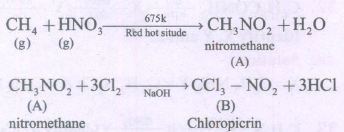
A - Nitromethane - CH3NO2.
B - Chloropicrin - CCl3 - NO2.
17.
Esters containing at least one ∝- hydrogen atom undergo self condensation in the presence of a strong base such as sodium ethoxide to form β-keto ester.
18.
(i) for the dehydration of hides.
(ii) as a coagulating agent for rubber latex
(iii) in medicine for treatment of gout
(iv) as an antiseptic in the preservation of fruit juice.
19.
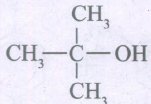 Tertiary butyl alcohol does not give iodoform reaction. All other compounds contains α H atoms and they undergo iodoform reaction.
20.
| Formula | IUPAC Name |
| (a) C2H5OCH3 | Methoxy ethane |
| (b) C6H5OC2H5 | Ethoxy benzene |
21.
(i) Propane-1, 2-diol
(ii) Ethane-1,2 - diol
(iii) 2-Hydroxy propanoic acid
22.
(i) \(\mathrm{K}_{\mathrm{w}}=\left[\mathrm{H}_{3} \mathrm{O}^{+}\right]\left[\mathrm{OH}^{-}\right]=1 \times 10^{-14}\left(25^{\circ} \mathrm{C}\right)\)
(ii) Ionic product of water is defined as the product of the concentration of hydronium and hydroxide ions of pure water. Its value at 25oC is \(1 \times 10^{-14} \mathrm{~mol}^{2} \mathrm{dm}^{-2}\)
23.
Number of X type atoms in the unit cell \(=8 \times \frac{1}{8}=1\)
Number of Y type atoms in the unit cell \(=1 \times \frac{1}{1}=1\)
Hence the formula is XY (or) X1Y1
24.
25.
(i) Fluorine is more electro negative than other halogens.
(ii) Because except fluorine all the other halogens have positive oxidation state.
(iii) It has high electron affinity character
Example:
\(\mathrm{Cl}_{2}\mathrm{O} \Rightarrow+1 \text { oxidation state }(\mathrm{Cl}) \)
\(\mathrm{OF}_{2} \Rightarrow-1 \text { oxidation state }(\mathrm{F})\)
26.
In p-block elements, the first member of each group differs from the other elements of the corresponding group. The following factors are responsible for this anomalous behaviour
(i) Small size of the first member.
(ii) High ionisation enthalpy and high electronegativity.
(iii) Absence of d-orbitals in their valance shell.
27.
 + 2H2O
28.
1. \(\kappa=\mathrm{C}\left(\frac{1}{\mathrm{~A}}\right)\)
2. \(\operatorname{let} \frac{l}{A}=x\)
i) \(0.01 \mathrm{M} \mathrm{KCl}: \kappa=0.01 x=10^{-2} x\)
ii) \(0.005 \mathrm{M} \mathrm{KCl}: \kappa=0.005 x=5 \times 10^{-3} x\)
iii) \(0.1 \mathrm{M} \mathrm{KCl} \quad: \kappa=0.1 x=10^{-1} x\)
iv) \(0.25 \mathrm{M} \mathrm{KCl}: \kappa=0.25 x=2.5 \times 10^{-1} x\)
v) \(0.5 \mathrm{M} \mathrm{KCl}: \mathrm{K}=0.5 x=5 \times 10^{-1} x\)
\(\therefore 5 \times 10^{-1} x>2.5 \times 10^{-1} x>10^{-1} x>10^{-2} x>5 \times 10^{-3} x\)
\((ie) 0.5 \mathrm{M} \mathrm{KCl}>0.25 \mathrm{M} \mathrm{KCl}>0.1 \mathrm{M} \mathrm{KCl}>0.01 \mathrm{M} \mathrm{KCl}>0.005 \mathrm{M} \mathrm{KCl}\)
29.
(i) At higher temperature, the reaction between copper and sulphur becomes feasible.
(ii) So they combine together and copper exists as copper sulphides in nature.
(iii) Besides this due to high polarising power of copper and silver ions, their sulphides are more stable.
30.
Average rate of reaction:
The average rate is defined as the ratio of change in the final concentration of reactants and the initial concentration of reactants over the entire time period of reaction.
Average rate=\(\frac{-[Final \space concentration \space of \space reactants - Initial \space concentration \space of \space reactants}{(Change \space in \space time)}\)
R \(=\frac{-\left(\left[A_{2}\right]-\left[A_{1}\right]\right)}{\left(t_{2}-t_{1}\right)}=-\left(\frac{\Delta[A]}{\Delta t}\right)\)
[A]1 = Concentration of reactant A1 at time t1
[A]2 = Concentration of reactant A2 at time t2
Instantaneous rate of reaction:
The rate of reaction at any particular instant during the course of reaction is called as instantaneous rate.
Instantaneous rate \(=(\text { Average rate })_{\Delta t \rightarrow 0}\)
Rate of the reaction \(=\left(\frac{-\Delta \mathrm{A}}{\Delta \mathrm{t}}\right)\)
31.
Copper exhibits +1 oxidation state most frequently Cu (29) - electronic configuration 3d104s1 copper ready to lose outer most one electron to attain the stable full filled electronic configuration. Hence it exhibits +1 oxidisation state.
32.
33.
(i) An organic compound (A) is identified as C6H5CHO benzaldehyde. Benzaldehyde reduces Tollen'sreagent and also undergoes. Cannizaro reaction.
\(\underset { (A) }{ C_{ 6 }{ H }_{ 5 }CHO } +{ Ag }_{ 2 }O\longrightarrow 2Ag+\underset { (B) }{ { C }_{ 6 }{ H }_{ 5 }COOH } \)
(ii) Benzaldehyde reacts with acetic anhydride in the presence of sodium acetate gives cinnamic acid and it is (B) an unsaturated acid
\(\underset { (A) }{ { C }_{ 6 }{ H }_{ 5 }CHO } +\left( { CH }_{ 3 }CO \right) _{ 2 }O\overset { { CH }_{ 3 }COONa }{ \longrightarrow } \underset { (B) }{ { C }_{ 6 }{ H }_{ 5 }CH } { =CHCOOH }+{ CH }_{ 3 }COOH\)
(iii) Compound A reacts with acetone to form compound (C) benzal acetone.
\(\underset {(A)}{{ C }_{ 6 }{ H }_{ 5 }CHO}+{ CH }_{ 3 }COC{ H }_{ 3 }\overset { NaOH }{ \longrightarrow } { C }_{ 6 }{ H }_{ 5 }CH=\underset { (C) }{ CH } -CO{ CH }_{ 3 }\)
| Compound | Compound Name | Formula |
| A | Benzaldehyde | C6H5CHO |
| B | Cinnamic acid | C6H5CH = CHCOOH |
| C | Benzal acetone | C6H5CH - CH-COCH3 |
34.
Importance of proteins:
Proteins are the functional units of living things : play vital role in all biological processes
(i) All biochemical reactions occur in the living systems are catalysed by the catalytic proteins called enzymes.
(ii) Proteins such as keratin, collagen acts as structural back bones.
(iii) Proteins are used for transporting molecules (Haemoglobin), organelles (Kinesins) in the cell and control the movement of molecules in and out of the cells (Transporters).
(iv) Antibodies help the body to fight various diseases
(v) Proteins are used as messengers to coordinate many functions. Insulin & glucagon controls the glucose level in the blood.
(vi) Proteins act as receptors that detect presence of certain signal molecules and activate the proper response.
(vii) Proteins are also used to store metals such as iron (Ferritin) etc.
35.
(i) The biochemical processes such as metabolism, cell-signaling etc... are essential for the normal functioning of our body.
(ii) These routine processes may be disturbed by any external factors such as microorganism, chemicals etc ..
(iii) Under such conditions medicines restore the normal functioning of the body.
(iv) These drug molecules interact with biomolecules such as proteins, lipids, etc .. that are responsible for different functions of the body.
(v) The drug interacts with these molecules and modify the normal biochemical reactions either by modifying the enzyme activity or by stimulating/suppressing certain receptors.
36.
| S. No. | Nitromethane | Nitrobenzene |
| i. | It is colourless | It is yellow coloured. |
| ii. | It is soluble in water | Insoluble in water. |
| iii. | Has pleasant smell | Has smell of bitter almonds. |
| iv. | Exhibits tautomerism | Doesnot exhibit tautomerism |
| v. | Used as good solvent | Used to prepare explosives Eg. TNT |
| vi. | Undergoes reduction in acidic and neutral medium. | Undergoes reduction in acidic, basic and neutral medium |
37.
(i) When ethylamines is treated with chloroform and an alkali, carbylamine reaction takes place and a foul smelling substance called carbylamlne (or) alkyl isocyanide is formed.
C2H5NH2 + CHCl3 + 3NaOH ➝ \(\underset { Ethyl \ isocyanide }{ { C }_{ 2 }{ H }_{ 5 }NC+3NaCl+3{ H }_{ 2 }O } \)
(ii) When ethylamine is warmed with CS2 and mercuric chloride, alkyl isothiocyanate having a pungent mustard like odour is obtained. This reaction is called mustard oil reaction.
C2H2NH2 + S = C-S \(\underrightarrow { Hg{ Cl }_{ 2 } } \) C2H5 - N = C = S + H2S
(iii) When ethylamine condense with aromatic aldehyde (benzaldehyde) Schiff's base is formed.
C6H5CHO + H2NC2H5 ➝ \(\underset { Schiffi's \ base \ Benzal-ethylamine }{ { C }_{ 6 }{ H }_{ 5 }CH=N{ C }_{ 2 }{ H }_{ 5 }+{ H }_{ 2 }O } \)
38.
39.
(i) Enzymes are complex protein molecules with three dimensional structures. They catalyse the chemical reaction in living organism. They are often present in colloidal state and extremely specific in catalytic action. Each enzyme produced in a particular living cell can catalyse a particular reaction in the cell.
Some common examples for enzyme catalysis:
(ii) The peptide glycyl L-glutamyl L-tyrosin is hydrolysed by an enzyme called pepsin.
(iii) The enzyme diastase hydrolyses starch into maltose
\(2\left(\mathrm{C}_{6} \mathrm{H}_{10} \mathrm{O}_{5}\right)_{\mathrm{n}}+\mathrm{nH}_{2} \mathrm{O} \rightarrow \mathrm{nC}_{12} \mathrm{H}_{22} \mathrm{O}_{11}\)
(iv) The yeast contains the enzyme zymase which converts glucose into ethanol.
\(\mathrm{C}_{6} \mathrm{H}_{12} \mathrm{O}_{6} \rightarrow 2 \mathrm{C}_{2} \mathrm{H}_{5} \mathrm{OH}+2 \mathrm{CO}_{2}\)
(v) The enzyme micoderma aceti oxidises alcohol into acetic acid.
\(\mathrm{C}_{2} \mathrm{H}_{5} \mathrm{OH}+\mathrm{O}_{2} \rightarrow \mathrm{CH}_{3} \mathrm{COOH}+\mathrm{H}_{2} \mathrm{O}\)
(vi) The enzyme urease present in soya beens hydrolyses the urea.
\(\mathrm{NH}_{2}-\mathrm{CO}-\mathrm{NH}_{2}+\mathrm{H}_{2} \mathrm{O} \rightarrow 2 \mathrm{NH}_{3}+\mathrm{CO}_{2}\)
Mechanism of enzyme catalysed reaction
(vii) The following mechanism is proposed for the enzyme catalysis
\(\mathrm{E}+\mathrm{S} \rightleftharpoons \mathrm{ES} \rightarrow \mathrm{P}+\mathrm{E}\).
(viii) Where E is the enzyme, S the substrate (reactant), ES represents activated complex and P the products.
40.
i) In increasing order of solubility in water:
\(\mathrm{C}_{6} \mathrm{H}_{5} \mathrm{NH}_{2},\left(\mathrm{C}_{2} \mathrm{H}_{5}\right)_{2} \mathrm{NH}, \mathrm{C}_{2} \mathrm{H}_{5} \mathrm{NH}_{2} \)
\(\mathrm{C}_{2} \mathrm{H}_{5} \mathrm{NH}_{2}>\mathrm{C}_{6} \mathrm{H}_{5} \mathrm{NH}_{2}>\left(\mathrm{C}_{2} \mathrm{H}_{5}\right)_{2} \mathrm{NH}\)
ii) In increasing order of basic strength:
a. Aniline, p - toluidine and p - nitro aniline
p - toluidine > aniline >p - nitro aniline
.JPG)
b. \(\mathrm{C}_{6} \mathrm{H}_{5} \mathrm{NH}_{2}, \mathrm{C}_{6} \mathrm{H}_{5} \mathrm{NHCH}_{3}, \mathrm{p}-\mathrm{Cl}-\mathrm{C}_{6} \mathrm{H}_{4}-\mathrm{NH}_{2} \)
\(\mathrm{C}_{6} \mathrm{H}_{5} \mathrm{NHCH}_{3}>\mathrm{C}_{6} \mathrm{H}_{5} \mathrm{NH}_{2}>\mathrm{p}-\mathrm{Cl}-\mathrm{C}_{6} \mathrm{H}_{4}-\mathrm{NH}_{2}\\ 2^{o} \text { amine } \quad \quad \quad \quad e^{\ominus} \text { with drawing (group) }\)
(iii) In decreasing order of basic strength in gas phase:
\(\mathrm{C}_{2} \mathrm{H}_{5} \mathrm{NH}_{2},\left(\mathrm{C}_{2} \mathrm{H}_{5}\right) \mathrm{NH},\left(\mathrm{C}_{2} \mathrm{H}_{5}\right)_{3} \mathrm{~N} \text { and } \mathrm{NH}_{3} \)
\(\mathrm{NH}_{3}<\mathrm{C}_{2} \mathrm{H}_{5} \mathrm{NH}_{2}<\left(\mathrm{C}_{2} \mathrm{H}_{5}\right)_{2} \mathrm{~N}<\left(\mathrm{C}_{2} \mathrm{H}_{5}\right)_{3} \mathrm{NH}\\ \quad \quad \quad 1^{0} \text { amine } \quad 2^{0} \text { amine } \quad \quad \quad 3^{0} \text { amine }\)
(iv) In increasing order of boiling point:
\(\mathrm{C}_{6} \mathrm{H}_{5} \mathrm{OH},\left(\mathrm{CH}_{3}\right)_{2} \mathrm{NH}, \mathrm{C}_{2} \mathrm{H}_{5} \mathrm{NH}_{2} \)
\(\left(\mathrm{CH}_{3}\right)_{2} \mathrm{NH}>\mathrm{C}_{2} \mathrm{H}_{5} \mathrm{NH}_{2}>\mathrm{C}_{6} \mathrm{H}_{5} \mathrm{OH} \\ 2^{0} \text { amine } \quad \quad1^{0} \text { amine }\)
Generally amines have lower boiling point than alcohol. Due to comparable molecular mass and weaker H-bonds in Amines.
(v) In decreasing order of the pKb values:
\( \mathrm{C}_{2} \mathrm{H}_{5} \mathrm{NH}_{2}, \mathrm{C}_{6} \mathrm{H}_{5} \mathrm{NHCH}_{3},\left(\mathrm{C}_{2} \mathrm{H}_{5}\right)_{2} \mathrm{NH} \text { and } \mathrm{CH}_{3} \mathrm{NH}_{2} \)
\(\left(\mathrm{C}_{2} \mathrm{H}_{5}\right)_{2} \mathrm{NH}<\mathrm{C}_{2} \mathrm{H}_{5} \mathrm{NH}_{2}<\mathrm{CH}_{3} \mathrm{NH}_{2}<\mathrm{C}_{6} \mathrm{H}_{5} \mathrm{NHCH}_{3} \)
\(\quad \quad \quad 2^{0} \text { amine } \quad 1^{0} \text { amine } 1^{0} \text { amine } \quad 2^{0} \text { amine } \)
\(\mathrm{PK}_{b}: \quad 3.00\quad < \quad 3.29 \quad < \quad 3.38 \quad<\quad 9.30\)
pKb ,Due to + 1 effect of C2H5 group. Higher the value of pKb lower is the basicity
(vi) Increasing Order of basic strength:
\(\mathrm{C}_{6} \mathrm{H}_{5} \mathrm{NH}_{2}, \mathrm{C}_{6} \mathrm{H}_{5} \mathrm{~N}\left(\mathrm{CH}_{3}\right)_{2},\left(\mathrm{C}_{2} \mathrm{H}_{5}\right)_{2} \mathrm{NH} \text { and } \mathrm{CH}_{3} \mathrm{NH}_{2} \)
\(\mathrm{C}_{6} \mathrm{H}_{5} \mathrm{NH}_{2}>\mathrm{C}_{6} \mathrm{H}_{5} \mathrm{~N}\left(\mathrm{CH}_{3}\right)_{2}>\mathrm{CH}_{3} \mathrm{NH}_{2}>\left(\mathrm{C}_{2} \mathrm{H}_{5}\right)_{2} \mathrm{NH} \\ \left(\mathrm{pK}_{6}: 9.38 \quad > \quad \quad 8.92 \quad \quad > \quad 3.38 \quad > \quad \quad 3.00\right)\)
Due to + 1 effect of C2H5 group.
In decreasing order of basic strength:
.JPG)
41.
i) Molar conductivity
Given : C = 0.01 M;
\(\kappa=1.5 \times 10^{-4} \mathrm{~S} \mathrm{~cm}^{-1} \)
\(=1.5 \times 10^{-2} \mathrm{~S} \mathrm{~m}^{-1} \)
\(\lambda_{\text {cation }}^{0}=248.2 \mathrm{~S} \mathrm{~cm}^{2} \mathrm{~mol}^{-1} \)
\(\lambda_{\text {anion }}^{0}=51.8 \mathrm{~S} \mathrm{~cm}^{2} \mathrm{~mol}^{-1} \)
\(\Lambda_{m}^{0}=\frac{\kappa \times 10^{-3}}{C} \mathrm{~S} \mathrm{~m}^{2} \mathrm{~mol}^{-1} \)
\(=\frac{1.5 \times 10^{-2} \times 10^{-3}}{0.01} \)
\(=1.5 \times 10^{-3} \mathrm{~S} \mathrm{~m}^{2} \mathrm{~mol}^{-1}\)
ii) \(\alpha=\frac{\Lambda_{m}}{\Lambda_{m}^{0}}\)
\(\Lambda_{\mathrm{m}}^{0}=\lambda_{\text {cation }}^{0}+\lambda_{\text {anion }}^{0} \)
\(=(248.2+51.8) \mathrm{S} \mathrm{cm}^{2} \mathrm{~mol}^{-1} \)
\(=300 \mathrm{~S} \mathrm{~cm}^{2} \mathrm{~mol}^{-1}\)
\(=300 \times 10^{-4} \mathrm{Sm}^{2} \mathrm{~mol}^{-1} \)
\(\alpha =\frac{1.5 \times 10^{-3}}{300 \times 10^{-4}}=0.05\)
iii) \(\mathrm{K}_{\mathrm{a}} =\frac{\alpha^{2} \mathrm{C}}{1-\alpha} \)
\(\mathrm{K}_{\mathrm{a}} =\frac{(0.05)^{2} \times(0.01)}{1-0.05}=2.6 \times 10^{-5} \)
(or)
\(\mathrm{K}_{\mathrm{a}} =\alpha^{2} \mathrm{C} \)
\(=(0.05)^{2} \times(0.01) \)
\(\mathrm{K}_{\mathrm{a}} =2.5 \times 10^{-5}\)
42.
Narcotic drugs: [Opioids]
(i) These are narcotic analgesics. These relieve pain and produce sleep. These drugs are addictive. In poisonous dose, these produces coma and ultimately death.
(ii) They are used for either short-term or long term relief of severe pains. They are mainly used for post operative pain, pain of terminal cancer.
(iii) Eg: Morphine, Codeine
Non-narcotic drugs:
(i) These are non- narcotic analgesics. These reduce the pain without causing impairment of consciousness.
(ii) They alleviate pain by reducing local inflammatory responses.
(iii) These are used for short-term pain relief and for modest pain like headache, muscle strain, bruising or arthritis.
(iv) These drugs have many other effects such as reducing fever (antipyretic) and preventing platelet coagulation (eg. aspirin).
(v) These reduce fever by causing the hypothalamus to over ride a prostaglandin - induced increase in temperature.
(vi) Eg. Aspirin, Paracetamol, Ibuprofen. There are two types in it.
a) Anti inflammatory: eg: Aspirin, Paracetamol
b) Non steroidal anti -inflammatory drugs: (NSAIDs) eg: Ibuprofen
43.
(i) To understand how a soap works as a cleansing agent, let us consider sodium palmitate an example of a soap. The cleansing action of soap is directly related to the structure of carboxylate ions (palmitate ion) present in soap. The structure of palmitate exhibit dual polarity. The hydrocarbon portion is non polar and the carboxyl portion is polar.

(ii) The nonpolar portion is hydrophobic while the polar end is hydrophilic. The hydrophobic hydro carbon portion is soluble in oils and greases, but not in water. The hydrophilic carboxylate group is soluble in water.
(iii) The dirt in the cloth is due to the presence of dust particles intact or grease which stick. When the soap is added to an oily or greasy part of the cloth, the hydrocarbon part of the soap dissolve in the grease, leaving the negatively charged carboxylate end exposed on the grease surface.
(iv) At the same time the negatively charged carboxylate groups are strongly attracted by water, thus leading to the formation of small droplets called micelles and grease is floated away from the solid object. When the water is rinsed away, the grease goes with it. As a result, the cloth gets free from dirt and the droplets are washed away with water. The micelles do not combine into large drops because their surfaces are all negatively charged and repel each other. The cleansing ability of a soap depends upon its tendency to act as a emulsifying agent between water and water insoluble greases.
.JPG)
The cleansing action of detergents are similar to cleansing action of soap. Eg: the structure of a cationic detergents is:
.JPG)

12th Standard Syllabus & Materials
12th Standard
TN 12th Computer Applications களப்பெயர் முறைமை (DNS) Sample Question Papers Study Material - QB365 Set A
NEW12th Standard
TN 12th Computer Applications வலையமைப்பு எடுத்துக்காட்டுகள் மற்றும் நெறிமுறைகள் Sample Question Papers Study Material - QB365 Set A
NEW12th Standard
TN 12th Computer Applications கணினி வலையமைப்பு ஓர் அறிமுகம் Sample Question Papers Study Material - QB365 Set A
NEW12th Standard
TN 12th Computer Applications PHP-உடன் MySQL-ஐ இணைத்தல் Sample Question Papers Study Material - QB365 Set A



Tamilnadu Stateboard 12th Standard Subjects

Maths
Chemistry

Physics

Biology

Computer Science

Business Maths and Statistics

Economics

Commerce

Accountancy

History

Computer Applications
Biology
Computer Technology
Computer Applications
Computer Science
Business Maths and Statistics
Commerce
Economics
Maths
Chemistry
Physics
Computer Technology
History
Accountancy

Tamil

English

French
Tamilnadu Stateboard Standards
