
 100% FREE ACCESS
12th Standard Syllabus & Materials
12th Standard
TN 12th Computer Applications மின்னணு தரவு பரிமாற்றம் Sample Question Papers Study Material - QB365 Set A
NEW12th Standard
TN 12th Computer Applications மின் - வணிக பாதுகாப்பு அமைப்புகள் Sample Question Papers Study Material - QB365 Set A
NEW12th Standard
TN 12th Computer Applications மின்னணு செலுத்தல் முறைகள் Sample Question Papers Study Material - QB365 Set A
NEW12th Standard
TN 12th Computer Applications மின் - வணிகம் Sample Question Papers Study Material - QB365 Set A
NEW12th Standard
TN 12th Computer Applications திறந்த மூல கருத்துருக்கள் Sample Question Papers Study Material - QB365 Set A
NEW12th Standard
TN 12th Computer Applications வலையமைப்பு வடமிடல் Sample Question Papers Study Material - QB365 Set A

Published on: 26/01/2021
12th Standard Physics English Medium Reduced Syllabus Model Question paper with answer key - 2021 Part - 1
Download Tamil Nadu 12th Standard Physics question papers, model tests, one-mark questions, important questions, and public exam papers in PDF format. Free study materials and answer keys for TN State Board students.
Questions + Answers key
Take MCQ Physics Test1.
ln NPN transistors, when the emitter-base junction is forward-biased, the direction of conventional current is from _____________
base to emitter
emitter to base
collector to base
base to collector
2.
The collector-base junction of a transistor offers _________ resistance to current
low
high
zero
moderate
3.
Acceptor of majority charge carriers in a transistor is ___________
emitter
base
collector
resistor.
4.
Supplier of majority charge carriers in a transistor is ______
emitter
base
collector
resistor
5.
Heavily doped region of a transistor is ___________
base
emitter
collectorresistor
resistor
6.
In actual practice, the range of uplink frequencies used is _________ GHz.
5.725 - 7.075
3.4 - 4.8
6 - 10
9 - 10
7.
The principle used for 'transmission of light signals through optical fibre is ________.
refraction
diffraction
polarisation
total internal reflection
8.
The nucleus is approximately spherical in shape. Then the surface area of nucleus having mass number A varies as _____.
A2/3
A4/3
A1/3
A5/3
9.
When a metallic surface is illuminated with radiation of wavelength λ, the stopping potential is V. If the same surface is illuminated with radiation of wavelength 2λ, the stopping potential is \(\frac{V}{4}\). The threshold wavelength for the metallic surface is _____.
4λ
5λ
\(\frac{5}{2}λ\)
3λ
10.
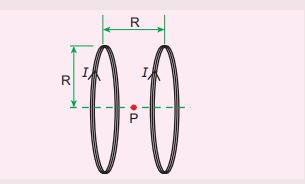
Two identical coils, each with N turns and radius R are placed coaxially at a distance R as shown in the figure. If I is the current passing through the loops in the same direction, then the magnetic field at a point P at a distance of R/2 from the centre of each coil is _____.
\(\frac { 8N{ \mu }_{ ° }I }{ \sqrt { 5 } R } \)
\(\frac { 8N{ \mu }_{ ° }I }{ { 5 }^{ 3/2 }R } \)
\(\frac { 8N{ \mu }_{ ° }I }{ { 5 }R } \)
\(\frac { 4N{ \mu }_{ ° }I }{ \sqrt { 5 } R } \)
11.
An inductor 20 mH, a capacitor 50 μF and a resistor 40Ω are connected in series across a source of emf V = 10 sin 340 t. The power loss in AC circuit is
0.76 W
0.89 W
0.46 W
0.67 W
12.
A thin semi-circular conducting ring (PQR) of radius r is falling with its plane vertical in a horizontal magnetic field B, as shown in the figure.
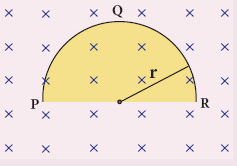
The potential difference developed across the ring when its speed v, is
Zero
\(\frac { { Bv\pi { r }^{ 2 } } }{ 2 } \) and P is at higher potential
πrBv and R is at higher potential
2rBv and R is at higher potential
13.
The electric and magnetic fields of an electromagnetic wave are _____.
in phase and perpendicular to each other
out of phase and not perpendicular to each other
in phase and not perpendicular to each other
out of phase and perpendicular to each other
14.
Two identical conducting balls having positive charges q1 and q2 are separated by a centre to centre distance r. If they are made to touch each other and then separated to the same distance, the force between them will be _____.
less than before
same as before
more than before
zero
15.
16.
What is meant by correspoding points?
17.
What is transducer?
18.
What is conduction band?
19.
What is forbidden energy gap?
20.
Which ray has high ionising power? Why?
21.
If the focal length is 150 cm for a lens, what is the power of the lens?
22.
Calculate the average atomic mass of chlorine if no distinction is made between its different isotopes?
23.
Define electrical conductivity of a conductor. On what factor does it depend?
24.
In Young's experiment, the upper slit is covered by a thin glass plate of refractive index 1.4 while the lower slit is covered by another glass plate having the same thickness as the first one but having refractive index 1.7. Interference pattern is observed using light of wavelength 5400 Å. It is observed that the point P on the screen where the central maximum (n = 0) fell before the glass were inserted now has \(\cfrac { 3 }{ 4 } \) th original intensity. It is further observed that what used to be the fifth maximum earlier, lies below the point P while the sixth minimum lies above P. Calculate the thickness of the glass plate.
25.
You are given two converging lenses of focal lengths 1.25 cm and 5 cm to design a compound microscope. If it is desired to have a magnification of 30, find out the separation between the objective and the eyepiece.
26.
For a BJT circuit shown, assume that the 'β' of the transistor is very large and VBE= 0.7 V. The mode of operation.
27.
Express one joule in eV. Taking 1 amu = 931 MeV. Calculate the mass of C-12 atom.
28.
Write the application of alpha decay in smoke detectors.
29.
Discuss the applications of Nanomaterials in various fields.
30.
State Boolean laws. Elucidate how they are used to simplify Boolean expressions with suitable example.
31.
Explain the construction and working of a full wave rectifier
32.
What is the radius of the illumination when seen above from inside a swimming pool from a depth of 10 m on a sunny day? What is the total angle of view? [Given, refractive index of water is 4/3]
1.
(a)
base to emitter
2.
(b)
high
3.
(c)
collector
4.
(b)
base
5.
(b)
emitter
6.
(a)
5.725 - 7.075
7.
(d)
total internal reflection
8.
r ∝ A1/3
Surface Area = 4πr2
Hence, Surface Area ∝ A2/3
9.
\(\frac{\mathrm{hc}}{\lambda}=\phi+\mathrm{eV} \) .....(1)
\(\frac{\mathrm{hc}}{2 \lambda}=\phi+\frac{\mathrm{eV}}{4}\) .....(2)
multiply (2) eqn by 4
\(\frac{2 h c}{\lambda}=4 \phi+\mathrm{eV}\) .....(3)
subtract eqn (1) from (3), we get
\(\frac{ h c}{\lambda}=3 \phi \Rightarrow \phi = \frac{ h c}{3\lambda}\)
\(\frac{ h c}{\lambda_o}=\frac{ h c}{3\lambda}\)
⋋o = 3⋋
10.
\(B=\frac { { \mu }_{ ° }NI a^2}{ { 2(a^2+x^2)}^{ \frac { 3 }{ 2 } } } \)
put a = R
and x = R/2, we get,
\(B=\frac { 8N{ \mu }_{ ° }I }{ { 5 }^{ 3 / 2 }R } \)
11.
L = 20 x 10-3H. C = 50 x 10-6 F, R= 40Ω
enf V = 10 sin 340 t
\(\therefore V_0=10 \mathrm{~V}, \omega=340 \)
\(X_1=1 \omega^{\prime}=20 \times 10^3 \times 340 \)
\(=6800 \times 10^{-1}=6.8 \Omega \)
\(X_C=\frac{1}{C .} \)
\(=\frac{1}{50 \times 10^{-\alpha} \times 340}=\frac{10^{\circ}}{17000}=\frac{10^{\prime}}{17}=58.823 \Omega \)
\(Z=\sqrt{R^2+\left(X_6-X_1\right)^2} \)
\(=\sqrt{(40)^2+(58.82-6.8)^2} \)
\(=\sqrt{(40)^2+(52.02)^2} \)
\(=65.62 \Omega\)
The peak current in the circuit is,
\(I_0=\frac{V_0}{Z}=\frac{10}{65.62} \)
\(\cos 0=\frac{R}{Z}=\frac{40}{65.62} \)
\(\text{Power loss in A.C. circuit }=V_{r m} 1_{r \rightarrow \infty} \cos \phi \)
\(=\frac{1}{2} V_{\mathrm{o}} I_{\mathrm{c}} \cos \phi \)
\(=\frac{1}{2} \times 10 \times \frac{10}{65.62} \times \frac{40}{65.62}\)
\(\frac{2000}{4305.98}\)
= 0.46 W
12.
(d)
2rBv and R is at higher potential
13.
(a)
in phase and perpendicular to each other
14.
Force ∝ charge
After the separation, the magnitude of charge will be increased. So the force will be more than before.
15.
(b)
16.
The combined width of a ruling and a slit is called grating element (e = a + b). Points on successive slits separated by a distance equal to the grating element are called corresponding points.
17.
A transducer is a device that converts information such as pressurc, temperature, sound, picture etc. into an equivalent electrical signal or vice versa.
18.
Band of very large number of closely spaced energy levels in a very small energy range is known as energy band.
19.
The energy gap between the valance band and conduction band is called forbidden energy gap
20.
(i) Alpha ray has high ionizing power.
(ii) α - particle has a large mass and large nuclear cross-section. So it has high ionizing power.
21.
Given, focal length, f = 150 cm = 1.5 m
Equation for power of lens is, \(p=\cfrac { 1 }{ f } \)
Substituting the values,
\(p=\cfrac { 1 }{ 1.5 } =0.67 D\)
As the power is positive, it is a converging lens.
22.
The element chlorine is a mixture of 75.77% of \(_{ 17 }^{ 35 }{ Cl }\) and 24.23% of \(_{ 17 }^{ 37 }{ Cl }\). So the average atomic mass will be
\(\frac { 75.77 }{ 100 } \times 34.96885u+\frac { 24.23 }{ 100 } \times 36.96593u\)
= 35.453 u
In fact, the chemist uses the average atomic mass or simply called chemical atomic weight (35.453 u for chlorine) of an element. So it must be remembered that the atomic mass which is mentioned in the periodic table is basically averaged atomic mass.
23.
The reciprocal of resistivity of a material is called electrical conductivity \(\left( \sigma \right) \sigma =\cfrac { 1 }{ \rho } \) .
It depends upon number density nature of material relaxation time & temperature
i.e \(\sigma =\cfrac { { ne }^{ 2 }\tau }{ m } \).
24.
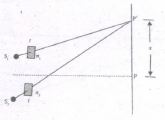
Path difference = \(\cfrac { xd }{ D } +\left( { n }_{ 2 }-{ n }_{ 1 } \right) t\)
For P, = 0; x path difference
= (n2 - n1) t = 0.3 t
\(I={ I }_{ o }{ cos }^{ 2 }\cfrac { \phi }{ 2 } \)
\(\cfrac { I }{ { I }_{ o } } ={ cos }^{ 2 }\cfrac { \phi }{ 2 } ,cos\cfrac { \phi }{ 2 } =\cfrac { \sqrt { 3 } }{ 2 } \)
\(\cfrac { \phi }{ 2 } =\cfrac { \pi }{ 6 } ,\phi =\cfrac { \pi }{ 3 } \)
Path difference = \(\cfrac { \lambda }{ 2\pi } \phi =\cfrac { 2\lambda }{ 2\pi } \cfrac { \pi }{ 3 } =\cfrac { \pi }{ 6 } \)
\(0.3t=5\lambda +\cfrac { \pi }{ 6 } \)
25.
The magnification due to the objective lens
\({ m }_{ o }=\cfrac { { v }_{ o } }{ \left( -{ \mu }_{ o} \right) } \)
If the object is close to the focus of the objective lens then
uo = fo and v = L
(L = distance between two lenses)
\({ m }_{ o }=\cfrac { L }{ { f }_{ o } } \)
If the final image is at the near point, then magnification due to the eye lens is
\({ m }_{ e }=\left( 1+\cfrac { D }{ { f }_{ e } } \right) \)
\(M={ m }_{ o }\times { m }_{ e }=\cfrac { L }{ { f }_{ o } } \left( 1+\cfrac { D }{ { f }_{ e } } \right) \)
The separation between the two lenses is 6.25 cm.
26.
VBE =0.7V
Input junction is a forward biased.
Since,
VBE = 0.7V
VCE = VBE+ VCB
VCB = VCE-VBE
To determine VCB we find IC
\({ I }_{ C }\cong { I }_{ C }\frac { 2-{ V }_{ BE } }{ { R }_{ 2 } } =\frac { 2-0.7 }{ 1k\Omega } \)
IC = 1.3mA
VCE = VCC - IC (R1 + R2)
= 10 - 1.3mA (10K + 1K)
VCE = - 4.3 V
VCE =-4.3V-0.7
VCB = - 5V
27.
1eV = 1.6 x 10⁻¹⁹ J
or \(1J=\frac { 1 }{ 1.6\times { 10 }^{ -19 } } eV=6.25\times { 10 }^{ 18 }eV\)
Mass of C-12 atom = 12 amu
= 12 x 931 MeV = 12 x 931 x 1.6 x 10-13J
\(=\frac { 12\times 931\times 1.6\times { 10 }^{ -13 } }{ (3\times { 10 }^{ 8 })^{ 2 } } =1.99\times { 10 }^{ -26 }kg\)
28.
(i) The smoke detector uses around 0.2 mg of a man-made weak radioactive isotope called americium \((_{ 95 }^{ 241 }{ Am })\)
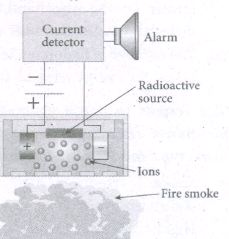
(ii) This radioactive source is placed between two oppositely charged metal plates and α radiations from \(_{ 95 }^{ 241 }{ Am }\) continuously ionize the nitrogen, oxygen molecules in the air space between the plates
(iii) As a result, there will be a continuous flow of small steady currents in the circuit.
(iv) If smoke enters, the radiation is being absorbed by the smoke particles rather than air molecules.
(v) As a result, the ionization and along with it the current is reduced. This drop-in current is detected by the circuit and the alarm starts.
(vi) The radiation dosage emitted by americium is very much less than the safe level, so it can be considered harmless.
29.
Materials made up of particles sizes of 1-100 made up nm differ in their properties from the materials made up of bulk particles. Thus, nano materials find wide range of applications
Automotive industry :
(i) Lightweight construction
(ii) Painting (fillers, base coat, clear coat)
(iii) Catalysts
(iv) Tires (fillers)
(v) Sensors
(vi) Coatings for wind-screen and car bodies.
Chemical industry :
(i) Fillers for paint systems
(ii) Coating systems based on nanocomposites
(iii) Impregnation of papers
(iv) Switchable adhesives
(v) Magnetic fluids
Engineering :
(i) Wear protection for tools and machines (anti blocking coatings, scratch resistant coatings on plastic parts etc.)
(ii) Lubricant-free bearings.
Electronic industry :
(i) Data memory
(ii) Displays
(iii) Laser diodes
(iv ) Glass fibres
(v) Optical switches
(vi) Filters (lR-blocking)
(vii) Conductive, antistatic coatings.
Construction :
(i) Construction materials
(ii) Thermal insulation
(iii) Flame retardants
(iv) Surface-functionalised building materials for wood, floors, stone, facades, tiles, roof tiles, etc.
(v) Facade coating
(v) Groove mortar.
Medicine :
(i) Drug delivery systems
(ii) Active agents
(iii) Contrast medium
(iv) Medical rapid tests
(v) Prostheses and implants
(vi) Antimicrobial agents and coatings
(vii) Agents in cancer therapy.
Textile/fabrics/non-wovens :
(i) Surface-processed textiles
(ii) smart clothes.
Energy :
(i) Fuel cells
(il) Solar cells
(iii) Batteries
(iv) Capacitors.
Cosmetics :
(i) Sun protection
(ii) Lipsticks
(iii) Skin creams
(iv) Tooth paste.
Food and drinks :
(i) Package materials
(ii) Storage life sensors
(iii) Additives
(iv) Clarification of fruit juices.
Household :
(i) Ceramic coatings for irons
(ii) Orders catalyst
(iii) Cleaner for glass, ceramic, floor, windows.
Sports/Outdoor :
(i) Ski wax
(ii) Antifogging of glasses /goggles
(iii) Antifouling coating for ships /boats
(iv) Reinforced tennis rackets and balls.
30.
Laws of Boolean algebra:
Complement law:
| A | Y=Ā |
| 0 | Y = \(\bar { 0 } \) = 1 |
| 0 | Y=\(\bar { 1 } \)=0 |
The complement law can be realised as Ā = A
OR laws:
| A | B | Y=A+B |
| 0 | 0 | Y = 0 + 0 = 0 |
| 0 | 1 | Y = 0 + 1 = 1 |
| 1 | 0 | Y = 1 + 0 = 1 |
| 1 | 1 | Y = 1 + 1 = 1 |
The OR laws can be realised as:
| 1st law | A+0=A |
| 2st law | A+1=1 |
| 3st law | A+A=A |
| 4st law | A+Ā=1 |
AND law:
| A | B | Y=A.B |
| 0 | 0 | Y=0.0=0 |
| 0 | 1 | Y=0.1=0 |
| 1 | 0 | Y=1.0=0 |
| 1 | 1 | Y=1.1=1 |
The AND laws can be realised as:
| 1st law | A.0=0 |
| 2st law | A.1=A |
| 3st law | A.A=A |
| 4st law | A.Ā=0 |
The Boolean operations obey the folloWing laws:
Communtative laws:
A+B =B+A
A.B =B.A
A sociate laws:
A + (B + C) = (A + B) + C
A. (B.C) = (A.B).C
D stributive laws:
A (B + C) = AB + BC
A + BC = (A + B) (A + C)
The above laws are used to simplify complicated expressions and to simplify the logic circuitry.
31.
FuIl wave rectifier :
The positive and negative half cycles of the AC input signal pass through the full wave rectifier circuit and hence it is called the full wave rectifier
Construction:
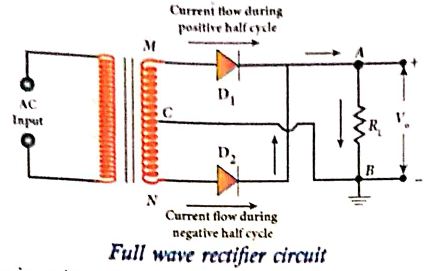
(i) It consists of two p-n junction diodes, a center-tapped transformer, and a load resistor (R1)
(ii) The centre is usually taken as the ground or zero voltage reference point.
(iii) Due to the centre tap transformer, the output voltage rectified by each diode is only one-half of the total secondary voltage.
Working:
During positive half cycle :
(i) When the positive half cycle of the ac input signal passes through the circuit, terminal M is positive, G is at zero potential and N is at negative potential.
(ii) This forward biases diode D1 and reverse biases diode D2.
(iii) Hence, being forward biased, diode D1 conducts and current flows along the path MD1AGC.
During negative half cycle:
(i) When the negative half cycle of the AC input signal passes through the circuit, terminal N becomes positive, C is at zero potential and M is at negative potential.
(ii) This forward biases diode D2 and reverse biases diode D1.
(iii) Hence, being forward biased, diode D2 conducts and current flows along the path ND2BGC.
(iii) During both positive and negative half cycles of the input signal, the current flows through the load in same direction.
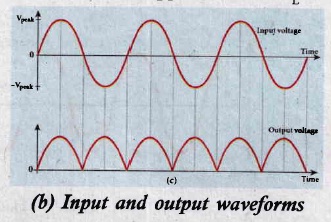
(iv) The output signal corresponding to the input signal is shown in Figure. Though both half cycles of AC input are rectified, the output is still pulsating in nature.
(v) The efficiency (η) of full wave rectifier is twice that of a half wave rectifier and is found to be 81.2 %.
32.
Given, n = 4/3, d = 10 m.
Radius of illumination, \(R=\cfrac { d }{ \sqrt { { n }^{ 2 }-1 } } \)
\(R=\cfrac { 10 }{ \sqrt { \left( 4/3 \right) ^{ 2 }- } 1 } =\cfrac { 10\times 3 }{ \sqrt { 16-9 } } \)
\(R=\cfrac { 30 }{ \sqrt { 7 } } =11.32cm\)
To find the critical angle,
\({ i }_{ c }={ sin }^{ -1 }\left( \cfrac { 1 }{ n } \right) \)
\({ i }_{ c }={ sin }^{ -1 }\left( \cfrac { 1 }{ 4/3 } \right) ={ sin }^{ -1 }\left( \cfrac { 3 }{ 4 } \right) =48.6^{ o }\)
The total angle of view of the cone is, \({ 2i }_{ c }=2\times { 48.6 }^{ 0 }={ 97.2 }^{ 0 }\)

12th Standard Syllabus & Materials
12th Standard
TN 12th Computer Applications களப்பெயர் முறைமை (DNS) Sample Question Papers Study Material - QB365 Set A
NEW12th Standard
TN 12th Computer Applications வலையமைப்பு எடுத்துக்காட்டுகள் மற்றும் நெறிமுறைகள் Sample Question Papers Study Material - QB365 Set A
NEW12th Standard
TN 12th Computer Applications கணினி வலையமைப்பு ஓர் அறிமுகம் Sample Question Papers Study Material - QB365 Set A
NEW12th Standard
TN 12th Computer Applications PHP-உடன் MySQL-ஐ இணைத்தல் Sample Question Papers Study Material - QB365 Set A



Tamilnadu Stateboard 12th Standard Subjects

Maths

Chemistry
Physics

Biology

Computer Science

Business Maths and Statistics

Economics

Commerce

Accountancy

History

Computer Applications
Biology
Computer Technology
Computer Applications
Computer Science
Business Maths and Statistics
Commerce
Economics
Maths
Chemistry
Physics
Computer Technology
History
Accountancy

Tamil

English

French
Tamilnadu Stateboard Standards

