
 100% FREE ACCESS
12th Standard Syllabus & Materials
12th Standard
TN 12th Maths Applications of Matrices and Determinants Sample Question Papers Study Material - QB365 Set A
NEW12th Standard
TN 12th Computer Applications மின்னணு தரவு பரிமாற்றம் Sample Question Papers Study Material - QB365 Set A
NEW12th Standard
TN 12th Computer Applications மின் - வணிக பாதுகாப்பு அமைப்புகள் Sample Question Papers Study Material - QB365 Set A
NEW12th Standard
TN 12th Computer Applications மின்னணு செலுத்தல் முறைகள் Sample Question Papers Study Material - QB365 Set A
NEW12th Standard
TN 12th Computer Applications மின் - வணிகம் Sample Question Papers Study Material - QB365 Set A
NEW12th Standard
TN 12th Computer Applications திறந்த மூல கருத்துருக்கள் Sample Question Papers Study Material - QB365 Set A

Published on: 26/01/2021
12th Standard Physics English Medium Reduced Syllabus Model Question paper with answer key - 2021 Part - 2
Download Tamil Nadu 12th Standard Physics question papers, model tests, one-mark questions, important questions, and public exam papers in PDF format. Free study materials and answer keys for TN State Board students.
Questions + Answers key
Take MCQ Physics Test1.
When a light of frequency 9 x 10¹⁴ Hz is incident on a metal surface, photoelectrons are emitted with a maximum speed of 8 x 10⁵ m/s. Determine the threshold frequency of the surface.
2.
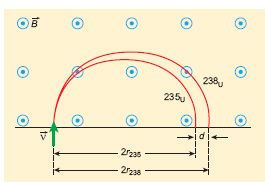
Two singly ionized isotopes of uranium \(_{ 92 }^{ 235 }{ U \ and \ _{ 92 }^{ 238 }{ U } }\) (isotopes have same atomic number but different mass number) are sent with velocity 1.00 x 10⁵ m s–1 into a magnetic field of strength 0.500 T normally. Compute the distance between the two isotopes after they complete a semi-circle. Also, compute the time taken by each isotope to complete one semi-circular path. (Given: masses of the isotopes: m235 = 3.90 x 10⁻²⁵ kg and m238 = 3.95 x 10⁻²⁵ kg)
3.
Obtain the expression for energy stored in the parallel plate capacitor.
4.
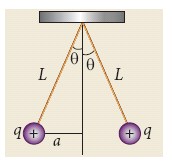
Two small-sized identical equally charged spheres, each having mass 1 g are hanging in equilibrium as shown in the figure. The length of each string is 10 cm and the angle θ is 30° with the vertical. Calculate the magnitude of the charge in each sphere. (Take g = 10 ms−2)
5.
For the same angle of incidence, the angles of refraction in media P, Q and R are 35°, 25°, 15° respectively. In which medium will the velocity of light be minimum?
6.
Write the difference of real and virtual images by a plane mirror.
7.
What is the role of nanostructure in the morpho butterfly wings?
8.
Define internal field emission or field ionization.
9.
An object is placed at a certain distance from a convex lens of focal length 20 cm. Find the object distance if the image obtained is magnified 4 times.
10.
Why are Infrared radiation referred to as heatwaves? Name the radiations, which are next to these radiation having
(i) shorter λ
(ii) longer λ.
11.
Write the uses of Radio waves.
12.
A cylindrical bar magnet is kept along the axis of a circular solenoid. If the magnet is rotated about its axis, find out whether an electric current is induced in the coil.
13.
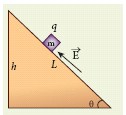
A block of mass m carrying a positive charge q is placed on an insulated frictionless inclined plane as shown in the figure. A uniform electric field E is applied parallel to the inclined surface such that the block is at rest. Calculate the magnitude of the electric field E.
14.
An object 2.5 cm high is placed at a distance of 10 cm from a concave mirror of radius of curvature 30 cm. The size of the image is _______________.
9.2 cm
10.5 cm
5.6 cm
7.5 cm
15.
An object is initially at a distance of 100 cm from the plane mirror. If the mirror approaches the object at a speed of 5 cms, then after 6 s the distance between the object and its images will be _____________.
60 cm
140 cm
170 cm
150 cm
16.
If the nuclear radius of 27Al is 3.6 fermi, the approximate nuclear radius of 64Cu, in femi is _____.
2:4
1.2
4.8
3.6
17.
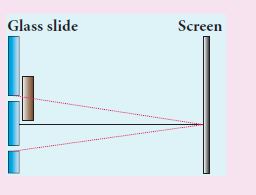
One of the of Young’s double slits is covered with a glass plate as shown in figure. The position of central maximum will,_____.
get shifted downwards
get shifted upwards
will remain the same
data insufficient to conclude
18.
An air bubble in glass slab of refractive index 1.5 (near normal incidence) is 5 cm deep when viewed from one surface and 3 cm deep when viewed from the opposite face. The thickness of the slab is ______.
8 cm
10 cm
12 cm
16 cm
19.
A rod of length 10 cm lies along the principal axis of a concave mirror of focal length 10 cm in such a way that its end closer to the pole is 20 cm away from the mirror. The length of the image is, ______.
2.5 cm
5cm
10 cm
15cm
20.
During charging a capacitor variation of potential V of the capacitor with time t as shown a
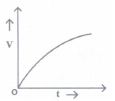
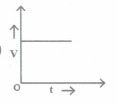
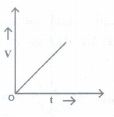
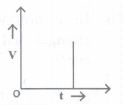
21.
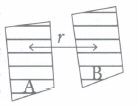
The figure shows tow parallel equipotential surface A and B kept at a small distance 'r' a part from each other. A point change of Q coulomb is taken from the surface A to B. The amount of net work done will be
\(W=\frac { -1 }{ 4\pi { \varepsilon }_{ 0 }r } \frac { q }{ r } \)
\(W=\frac { 1 }{ 4\pi { \varepsilon }_{ 0 }r } \frac { q }{ r } \)
\(W=\frac { -1 }{ 4\pi { \varepsilon }_{ 0 }r } \frac { q }{ r^2 } \)
zero
22.
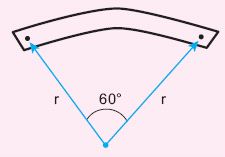
A bar magnet of length l and magnetic moment pm is bent in the form of an arc as shown in Figure. The new magnetic dipole moment will be
pm
\(\frac{3}{\pi} p_{m}\)
\(\frac{2}{\pi} p_{m}\)
\(\frac{1}{2} p_{m}\)
23.
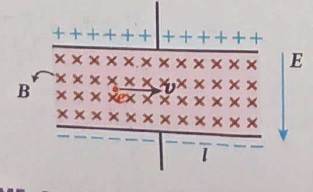
An electron moves in a straight line inside a charged parallel plate capacitor of uniform charge density σ. The time taken by the electron to cross the parallel plate capacitor undeflected when the plates of the capacitor are kept under constant magnetic field of induction \((\vec{B})\) is
\({ \varepsilon }_{ ° }\frac { elB }{ \sigma } \)
\({ \varepsilon }_{ ° }\frac { lB }{ \sigma {l} } \)
\({ \varepsilon }_{ ° }\frac { lB }{ {e}\sigma } \)
\({ \varepsilon }_{ ° }\frac { lB }{ \sigma } \)
24.
A thin semi-circular conducting ring (PQR) of radius r is falling with its plane vertical in a horizontal magnetic field B, as shown in the figure.
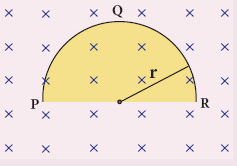
The potential difference developed across the ring when its speed v, is
Zero
\(\frac { { Bv\pi { r }^{ 2 } } }{ 2 } \) and P is at higher potential
πrBv and R is at higher potential
2rBv and R is at higher potential
25.
An electric field \(\vec { E } =10x\hat { i } \) exists in a certain region of space. Then the potential difference V = Vo – VA, where Vo is the potential at the origin and VA is the potential at x = 2 m is _____.
10 V
-20 V
+20 V
-10 V
26.
The total electric flux for the following closed surface which is kept inside water
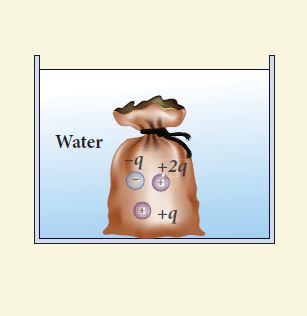
\(\frac { 80q }{ { \varepsilon }_{ 0 } } \)
\(\frac { q }{ { 40\varepsilon }_{ 0 } } \)
\(\frac { q }{ { 80\varepsilon }_{ 0 } } \)
\(\frac { q }{ { 160\varepsilon }_{ 0 } } \)
27.
Two identical point charges of magnitude –q are fixed as shown in the figure below. A third charge +q is placed midway between the two charges at the point P. Suppose this charge +q is displaced a small distance from the point P in the directions indicated by the arrows, in which direction(s) will +q be stable with respect to the displacement?
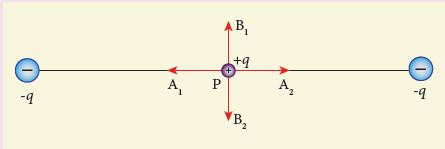
A1 and A2
B1 and B2
both directions
No stable
28.
A toaster operating at 240 V has a resistance of 120 Ω. The power is ______.
400 W
2 W
480 W
240 W
29.
Let I1 and I2 be the steady currents passing through a long horizontal wire XY and PQ respectively. The wire PQ is fixed in horizontal plane and the wire XY be is allowed to move freely in a vertical plane. Let the wire XY is in equilibrium at a height d over the parallel wire PQ as shown in figure.
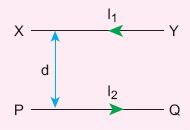
Show that if the wire XY is slightly displaced and released, it executes Simple Harmonic Motion (SHM). Also, compute the time period of oscillations.
30.
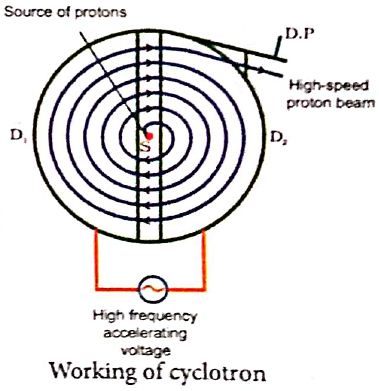
Discuss the working of cyclotron in detail.
31.
The current through an element is shown in the figure. Determine the total charge that pass through the element at a) t = 0 s, b) t = 2 s, c) t = 5s
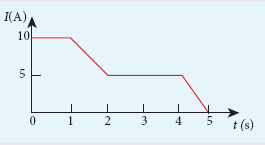
32.
Describe the microscopic model of current and obtain general form of Ohm’s law.
1.
\(v= 9 \times 10^{14} \mathrm{~Hz} ; \mathrm{V}=8 \times 10^{5} \mathrm{~m} / \mathrm{s} \)
\(\mathrm{E}= \mathrm{h}-\mathrm{h} v_{o} \Rightarrow v_{o}=\frac{\mathrm{h}v-\mathrm{E}}{\mathrm{h}}=\mathrm{V}-\frac{\mathrm{E}}{\mathrm{h}}=\mathrm{V}-\frac{\frac{1}{2} \mathrm{mv}^{2} }{h}\)
\(v_s={9 \times 10^{14}-\frac{\left[\frac{1}{2} \times 9.1 \times 10^{-31} \times\left(8 \times 10^{5}\right)^{2}\right]}{6.626 \times 10^{-34}}}=4.605 \times 10^{14} \)
\( v_{o} \simeq 4.6 \times 10^{14} \mathrm{~Hz} \)
2.
Since isotopes are singly ionized, they have equal charge which is equal to the charge of an electron, q = - 1.6 x 10⁻¹⁹ C. Mass of uranium \(_{ 92 }^{ 235 }{ U and _{ 92 }^{ 238 }{ U } }\) are 3.90 x 10⁻²⁵ kg and 3.95 x 10⁻²⁵ kg respectively. Magnetic field applied, B = 0.500 T. Velocity of the electron is 1.00 x 10⁵ m s-1, then
(a) the radius of the path of \(_{ 92 }^{ 235 }{ U }\) is r235
\({ r }_{ 235 }=\frac { { m }_{ 235 }v }{ \left| q \right| B } =\frac { 3.90\times { 10 }^{ -25 }\times 1.00\times { 10 }^{ 5 } }{ 1.6\times { 10 }^{ -19 }\times 0.500 } =48.8\times { 10 }^{ -2 }m\)
r235 = 48.8cm
The diameter of the semi-circle due to \(_{ 92 }^{ 235 }{ U\ \ is \ \ { d }_{ 235 }=2{ r }_{ 235 } }\) = 97.6 cm
The radius of the path of \(_{ 92 }^{ 238 }{ U\ is\ 2{ r }_{ 238 }\ then}\)
\({ r }_{ 238 }=\frac { { m }_{ 238 }v }{ \left| q \right| B } =\frac { 3.90\times { 10 }^{ -25 }\times 1.00\times { 10 }^{ 5 } }{ 1.6\times { 10 }^{ -19 }\times 0.500 } =49.4\times { 10 }^{ -2 }m\)
r238 = 49.4 cm
The diameter of the semi-circle due to \(^{ 238 }_{92}{ U\ is \ 2{ r }_{ 238 } \ =98.8 \ cm}\)
Therefore the separation distance between the isotopes is \(\triangle d={ d }_{ 238 }-{ d }_{ 235 }=1.2 \ cm\)
(b) The time taken by each isotope to complete one semi-circular path are
\({ t }_{ 235 }=\frac { \text{ magnitude of the displacement} }{ velocity } \)
\(=\frac { 97.6\times { 10 }^{ -2 } }{ 1.00\times { 10 }^{ 5 } } =9.76\times { 10 }^{ -6 }s=9.76\mu s\)
\({ t }_{ 238 }=\frac { \text{magnitude of the displacement }}{ velocity } \)
\(=\frac { 98.8\times { 10 }^{ -2 } }{ 1.00\times { 10 }^{ 5 } } =9.88\times { 10 }^{ -6 }s=9.88\mu s\)
3.
Energy stored in the capacitor
i) Capacitor not only stores the charge but also it stores energy. When a battery is connected to the capacitor, electrons of total charge - Q are transferred from one plate to the other plate. To transfer the charge, work is done by the battery. This work done is stored as electrostatic potential energy in the capacitor.
ii) To transfer an infinitesimal charge dQ for a potential difference V, the work done is given by
dW = V dQ
Where \(V=\frac { Q }{ C } \) .....(1)
iii) The total work done to charge a capacitor is
\(W=\int _{ 0 }^{ Q }{ \frac { Q }{ C } } dQ=\frac { { Q }^{ 2 } }{ 2C } \quad \quad ....(2)\)
This work done is stored as electrostatic potential energy (UE) in the capacitor.
\({ U }_{ E }=\frac { { Q }^{ 2 } }{ 2C } =\frac { 1 }{ 2 } { CV }^{ 2 },\quad (\therefore Q=CV)\quad ....(3)\)
(iv) This stored energy is thus directly proportional to the capacitance of the capacitor and the square of the voltage between the plates of the capacitor.Substituting \(C=\frac { { \varepsilon }_{ 0 }A }{ d } \) and V = Ed.
\(U=\frac { 1 }{ 2 } \left( \frac { { \varepsilon }_{ 0 }A }{ d } \right) { (Ed) }^{ 2 }=\frac { 1 }{ 2 } { \varepsilon }_{ 0 }(Ad){ E }^{ 2 }\quad \quad \quad \quad \quad ...(4)\)
where Ad = volume of the space between the capacitor plates. The energy stored per unit volume of space is defined as energy density \({ u }_{ E }=\frac { U }{ Volume } \)
Equation (4) ⇒ \({ u }_{ E }=\frac{1}{2}{ \varepsilon }_{ 0 }{ E }^{ 2 }\).....(5)
(v) From equation (5),
(a) We infer that the energy is stored in the electric field existing between the plates of the capacitor. Once the capacitor is allowed to discharge, the energy is retrieved.
(b) The energy density depends only on the electric field and not on the size of the plates of the capacitor.
(c) This is true for the electric field due to any type of charge configuration.
4.
If the two spheres are neutral, the angle between them will be 0o when hanged vertically. Since they are positively charged spheres, there will be a repulsive force between them and they will be at equilibrium with each other at an angle of 30° with the vertical. At equilibrium, each charge experiences zero net force in each direction. We can draw a free-body diagram for one of the charged spheres and apply Newton’s second law for both vertical and horizontal directions.
The free-body diagram is shown below
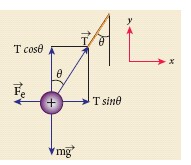
In the x-direction, the acceleration of the charged sphere is zero.
Using Newton’s second law \((\vec { { F }_{ tot }= } m\vec { a } )\), we have
T sinθ\(\hat { i } \) - Fe\(\hat { i } \) =0
T sinθ = Fe ......(1)
Here T is the tension acting on the charge due to the string and Fe is the electrostatic force between the two charges.
In the y-direction also, the net acceleration experienced by the charge is zero
Tcosθ\(\hat { j } \) - mg\(\hat { j } \) = 0
Tcosθ = mg ..(2)
By dividing equation (1) by equation (2),
tanθ = \(\frac { { F }_{ e } }{ mg } \) .....(3)
Since they are equally charged, the magnitude of the electrostatic force is
\({ F }_{ e }=k\frac { { q }^{ 2 } }{ { r }^{ 2 } } \) where k=\(\frac { 1 }{ 4\pi { \varepsilon }_{ 0 } } \)
Here r = 2a = 2Lsinθ. By substituting these values in equation (3),
tanθ = k\(\frac { { q }^{ 2 } }{ mg(2Lsin\theta )^{ 2 } } \) ..........(4)
Rearranging the equation (4) to get q
q = 2 Lsinθ\(\\ \sqrt { \frac { mgtan\theta }{ k } } \)
= 2 x 0.1 x sin 30o x \(\sqrt { \frac { 10^{ -3 }\times 10\times { tan30 }^{ 0 } }{ 9\times 10^{ 9 } } } \)
q = 8.01 x 10⁻⁸C = 80.1 nC
5.
\(\\ \mu =\cfrac { c }{ v } =\cfrac { sini }{ sinr } \)
It follows that: v of sin r Since r is minimum in medium R, therefore, sin r and hence the velocity of light is minimum in medium R.
6.
Real image :
This type of image which can be formed on a screen and can also be seen with the eyes is called real image.
Virtual image :
Image which cannot be formed on the screen but can only be seen with the eyes.
7.
The scales on the wings of a morpho butterfly contain nanostructures that change the way light waves interact with each other, giving the wings brilliant metallic blue and green hues.
8.
The process of emission of electrons due to the rupture of bands in from the lattice due to strong electric field is known as internal field emission or field ionization.
9.
\(\frac{1}{f}=\frac{1}{v}-\frac{1}{u} \)
\(m=\frac{-v}{u}=-4, f=20 \mathrm{~cm} \text { (Given) } \)
V = 4u
\(\frac{1}{f} =\frac{1}{4 u}-\frac{1}{u} \)
\(=\frac{1-4}{4 u}=\frac{-3}{4 u} \)
\(\frac{1}{f} =\frac{-3}{4 u} \)
4u = -3 x f
\(u=\frac{-3}{4} \times 20=-15 \mathrm{~cm}\)
10.
Infrared radiation waves are produced by hot bodies and molecules so it is referred as heat waves. (eg. Sun)
(i) Electromagnetic waves having shorter λ than Infrared radiation are visible, U - v, X-rays, and ૪ - rays.
(ii) Electromagnetic waves having longer λ than Infrared radiation are microwaves, radiowaves.
11.
It is used in radio and television communication systems and also in cellular phones to transmit voice communication in the ultra high frequency band.
12.
The magnetic field of a cylindrical magnet is symmetrical about its axis. As the magnet is rotated along the axis of the solenoid, there is no induced current in the solenoid because the flux linked with the solenoid does not change due to the rotation of the magnet.
13.
Note: A similar problem is solved in XIth Physics volume I, unit 3 section 3.3.2. There are three forces that acts on the mass m:
(i) The downward gravitational force exerted by the Earth (mg)
(ii) The normal force exerted by the inclined surface (N)
(iii) The Coulomb force given by uniform electric field (qE) The free body diagram for the mass m is drawn below.
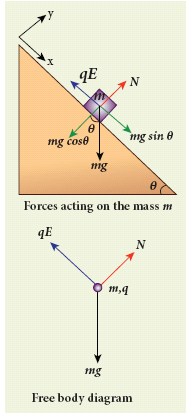
A convenient inertial coordinate system is located in the inclined surface as shown in the figure. The mass m has zero net acceleration both in x and y-direction.
Along x-direction, applying Newton’s second law, we have
mg sinθ\(\hat { i } \) - qE\(\hat { i } \) = 0
mg sinθ - q E = 0
or, E = \(\\ \frac { mgsin\theta }{ q } \)
Note that the magnitude of the electric field is directly proportional to the mass m and inversely proportional to the charge q. It implies that, if the mass is increased by keeping the charge constant, then a strong electric field is required to stop the object from sliding. If the charge is increased by keeping the mass constant, then a weak electric field is sufficient to stop the mass from sliding down the plane.
The electric field also can be expressed in terms of height and the length of the inclined surface of the plane.
E = \(\frac { mgh }{ qL } \).
14.
(d)
7.5 cm
15.
(b)
140 cm
16.
\(r \propto A^{\frac{1}{3}} \)
\(\frac{r_{\mathrm{Cu}}}{\mathrm{r}_{\mathrm{Al}}}=\frac{\mathrm{A}_{\mathrm{Cu}}^\frac{1}{3}}{\mathrm{~A}_{\mathrm{Al}}^{\frac{1}{3}}}=\frac{4}{3} \)
\(\mathrm{r}_{\mathrm{Cu}}=\frac{4}{3} \times 3.6 \mathrm{~F}=4.8 \mathrm{~F}\)
17.
(b)
get shifted upwards
18.
Apparent depth = 3 + 5 = 8 cm
Real depth = thickness of the slab = t
n = 1.5
\(n=\frac{Real \ depth}{Apparent \ depth}\)
\(\therefore 1.5=\frac{t}{8}\)
t = 1.5 x 8
t = 12 cm
19.
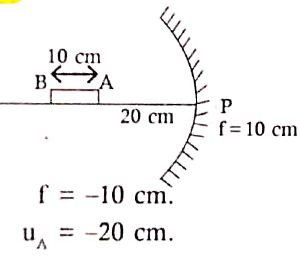
At end A,
\(\frac{1}{f} =\frac{1}{u_A}+\frac{1}{v_A} \)
\(\therefore \frac{1}{v_A} =\frac{1}{-10}-\frac{1}{-20} \)
\(\frac{1}{v_A} =-\frac{1}{10}+\frac{1}{20}=\frac{-2+1}{20}=-\frac{1}{20} \)
\(v_A =-20 \mathrm{~cm} \)
\(\left|v_{\wedge}\right|=20 \mathrm{~cm}\)
At end B,
\(\frac{1}{f} =\frac{1}{u_B}+\frac{1}{v_B} \)
\(\frac{1}{v_B} =\frac{1}{f}-\frac{1}{u_B}, \)
\(u_B =-30 \mathrm{~cm} \)
\(\frac{1}{v_B} =-\frac{1}{10}+\frac{1}{30} \)
\(=\frac{-3+1}{30}=\frac{-2}{30}=\frac{-1}{15} \)
\(v_B =-15 \mathrm{~cm} \)
\(\left|v_B\right| =15 \mathrm{~cm} \)
\(\therefore \quad\left|\mathrm{v}_{\mathrm{A}}\right|-\left|\mathrm{v}_{\mathrm{B}}\right| \) is the length of the image
= 20 - 15 = 5 cm
20.
(a)
21.
(d)
zero
22.
Magnetic moment,
p'm = ml
From figure, \(l=\frac{\pi r}{3}\)
\(\therefore r=\frac{3l}{\pi}\)
∴ New magnetic moment,
p'm = m x r
\(=m\times \frac{3l}{\pi}=\frac{3}{\pi}ml\)
∴ p'm = \(\frac{3}{\pi}p_m\)
23.
Electric field between the plates \(= \frac{σ}{ε_0}\)
Electric force on an electron \(= e\frac{σ}{ε_0}\)
Magnetic force on an electron, F = BIl
But, \(I= \frac{e}{t}\)
∵Electron moves in a straight line. So,
EF = MF
\(e\frac{σ}{ε_0}=B(\frac{e}{t})l\)
\(\therefore t = ε_0\frac{lB}{σ}\)
24.
(d)
2rBv and R is at higher potential
25.
\(\vec {E}\) = 10x\(\hat{i},\) when x = 2 m
\(\vec {E}\) = 10 x 2 x \(\hat{i}\) = 20\(\hat{i}\)
Since, \(E=\frac{-dV}{dx}\therefore V=+20 V\)
26.
\(Φ=\frac { q_{net} }{ { \varepsilon }_{ 0 } } \)
qnet = - q + q + 2q = 2q
Relative permittivity of water = 80
\(\therefore Φ=\frac { q }{{ \varepsilon }_{ r } { \varepsilon }_{ 0 } } \)
\(=\frac{2q}{{ 80 \times \varepsilon }_{ 0 }}=\frac{q}{{ 40 \varepsilon }_{ 0 }}\)
27.
The charge + q will be stable between B1 and B2 with respect to the displacement.
28.
\(P=\frac{V^2}{R}=\frac{240 \times 240}{120}=480 \ W\)
29.
Let the currents flowing through wires XY and PQ be I1 and I2
Magnetic field along PQ is \(\mathrm{B}_{1}=\frac{\mu_{o} I_{2}}{2 \pi r}\)
Force per unit length on PQ is \(\frac{F_{2}}{l}=\frac{\mu_{0} I_{1} I_{2}}{2 \pi r}\)
If the wire XY is slightly displaced and released, it executes simple harmonic motion with the condition that acceleration is directly proportional to the displacement y
\(\therefore a=-\omega^{2} y\) .....(1)
The distance between two wires = d
Time period
\(T=\frac{2 \pi}{\omega} \)
\(a=\frac{g}{d} y \) .....(2)
By comparing the equations (1) and (2) we get
\(\omega^{2} =-\frac{g}{d} \ \therefore \omega=\sqrt{\frac{g}{d}} \)
\(\text { Time period } =\frac{2 \pi}{\omega}=2 \pi \sqrt{\frac{d}{g}} \)
\(\therefore T =2 \pi \sqrt{\frac{d}{g}} \)
30.
Cyclotron:
Device used to accelerate the charged particles to gain large kinetic energy.
Principle:
When a charged particle moves perpendicular to the magnetic field, it experiences magnetic Lorentz force.
Construction:
(i) The particles are allowed to move in between two semi-circular metal containers called Dees (hollow D - shaped objects).
(ii) The uniform magnetic field is controlled by an electromagnet. The direction of magnetic field is normal to the plane of the Dees.
(iii) Source is kept between two Dees.
(vi) Dees are connected to high frequency alternating potential difference.
Working:
(i) The ion ejected from source is positively charged.
(ii) It is accelerated towards negative potential Dees
(iii) This ion undergoes a circular path.
(iv) At this time, the polarities of the Dees are reversed, so that the ion is now accelerated towards Dee-2 with a greater velocity. For this circular motion, the centripetal force of the charged particle q is provided by Lorentz force.
\(\frac { m{ v }^{ 2 } }{ r } \) = qvB
⇒ r = \(\frac { m }{ qB } \)v ........(1)
⇒ r ∝ v
(v) If radius of the circular paths, increases, velocity also increases particles undergo spiral path with increasing radius.
(vi) When the frequency f at which the positive ion ciculates in the magnetic field must be equal to the constant frequency of the electrical oscillator fosc. This is called Resonance condition.
From equation, f = \(\frac { qB }{ 2\pi m } \) we have
fosc = \(\frac { qB }{ 2\pi m } \),
The time period of oscillation is
T = \(\frac { 2\pi m }{ qB } \)
The kinetic energy of the charged particle is,
KE = \(\frac { 1 }{ 2 } mv^{ 2 }=\frac { { q }^{ 2 }B^{ 2 }{ r }^{ 2 } }{ 2m } \) ........(2)
Limitations:
(i) The speed of ion is limited.
(ii) Electron cannot be accelerated.
(iii) Uncharged particles cannot be accelerated.
31.
Charge Q = Current x Time interval
= I x t
At t = 0 s,
dq = dI x t
= 5 x 0
dq = 0 C
At t = 2 s,
dg = dI x t
=5 x 2
dq = 10 C
At t = 5 s,
dg = dl x t
=0 x 5
dq = 0 C
At t= 0 s, dg = 0 C; At t = 2 s, dg = 10 C; At t= 5 s, dg = 0 C.
32.
(i) XY is a conductor of area cross section A. \(\vec { E } \)is the applied electric field. n is the number of electrons per unit volume with same drift velocity (Vd) .
(ii) Let electrons move through a distance dx in time interval dt.
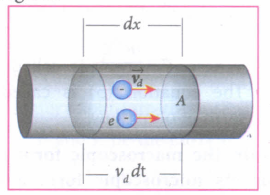
(iii) The drift velocity of the electrons = vd
(iv) If the electrons move through a distance dx within a small interval of time dt,
\({ v }_{ d }=\cfrac { dx }{ dt } ;dx={ v }_{ d }dt\) ..(i)
(v) Since A is the area of cross section of the conductor, the electrons available in the volume of length dx is
= volume x number of electrons per unit volume = A dx x n ...(2)
(vi) Substituting for dx from equation (1) in (2)
= (A vd dt) n
(vii) Total charge in volume element dQ =(charge) x (number of electrons in the volume element)
dQ = (e) (Avddt)n
Hence the current \(I=\cfrac { dQ }{ dt } =\cfrac { ne{ Av }_{ d }dt }{ dt } \)
\(I=ne{ Av }_d\) ..........(3)
Current density (J):
(viii) The current density (J) is defined as the current per unit area of cross section of the conductor.
\(J=\cfrac { I }{ A } \)
(ix) The S.I unit of current density is \({ Am }^{ -2 }\)
\(J=\cfrac { neAv_{ d } }{ A } \) (∵I = nAeVd)
\(J={ nev }_{ d }\) .........(4)
(x) The above expression holds only when the direction of the current is perpendicular to the area A.
In general, the current density is a vector quantity and it is given by,
\(\vec { J } =ne\vec { v_{ d } } \)
Substituting \(\vec { v_{ d } } \) from equation
\(\vec { v_{ d } } =\cfrac { e\tau }{ m } \vec { E } \)
\(\vec { J } =\cfrac { n.{ e }^{ 2 }\tau }{ m } \vec { E } \) ...(5)
\(\vec { J } =\sigma \vec { E } \) ....(6)
(xi) But conventionally, we take the direction of (conventional) current density as the direction of electric field. So, the above equation becomes,
\(\vec { J } =\sigma \vec { E } \) .....(7)
(xii) Where, \(\sigma =\cfrac { { ne }^{ 2 }\tau }{ m } \) is called conductivity. The equation (7) is called microscopic form of ohm's law.

12th Standard Syllabus & Materials
12th Standard
TN 12th Computer Applications வலையமைப்பு வடமிடல் Sample Question Papers Study Material - QB365 Set A
NEW12th Standard
TN 12th Computer Applications களப்பெயர் முறைமை (DNS) Sample Question Papers Study Material - QB365 Set A
NEW12th Standard
TN 12th Computer Applications வலையமைப்பு எடுத்துக்காட்டுகள் மற்றும் நெறிமுறைகள் Sample Question Papers Study Material - QB365 Set A
NEW12th Standard
TN 12th Computer Applications கணினி வலையமைப்பு ஓர் அறிமுகம் Sample Question Papers Study Material - QB365 Set A



Tamilnadu Stateboard 12th Standard Subjects

Maths

Chemistry
Physics

Biology

Computer Science

Business Maths and Statistics

Economics

Commerce

Accountancy

History

Computer Applications
Biology
Computer Technology
Computer Applications
Computer Science
Business Maths and Statistics
Commerce
Economics
Maths
Chemistry
Physics
Computer Technology
History
Accountancy

Tamil

English

French
Tamilnadu Stateboard Standards

