
 100% FREE ACCESS
12th Standard Syllabus & Materials
12th Standard
TN 12th Computer Applications மின்னணு தரவு பரிமாற்றம் Sample Question Papers Study Material - QB365 Set A
NEW12th Standard
TN 12th Computer Applications மின் - வணிக பாதுகாப்பு அமைப்புகள் Sample Question Papers Study Material - QB365 Set A
NEW12th Standard
TN 12th Computer Applications மின்னணு செலுத்தல் முறைகள் Sample Question Papers Study Material - QB365 Set A
NEW12th Standard
TN 12th Computer Applications மின் - வணிகம் Sample Question Papers Study Material - QB365 Set A
NEW12th Standard
TN 12th Computer Applications திறந்த மூல கருத்துருக்கள் Sample Question Papers Study Material - QB365 Set A
NEW12th Standard
TN 12th Computer Applications வலையமைப்பு வடமிடல் Sample Question Papers Study Material - QB365 Set A

Published on: 31/12/2022
QB365 provides a detailed and simple solution for every Possible Questions in Class 12 Physics Subject - Revision Model Question Paper, English Medium. It will help Students to get more practice questions, Students can Practice these question papers in addition to score best marks.
Download Tamil Nadu 12th Standard Physics question papers, model tests, one-mark questions, important questions, and public exam papers in PDF format. Free study materials and answer keys for TN State Board students.
Questions + Answers key
Take MCQ Physics Test1.
Why do metals have a large number of free electrons?
2.
Give any two examples for “Nano” in nature.
3.
What is the difference between Nano materials and Bulk materials?
4.
What are cathode rays?
5.
What is angle of deviation due to refraction?
6.
7.
The relative magnetic permeability of the medium is 2.5 and the relative electrical permittivity of the medium is 2.25. Compute the refractive index of the medium.
8.
A circular antenna of area 3 m2 is installed at a place in Madurai. The plane of the area of antenna is inclined at 47o with the direction of Earth’s magnetic field. If the magnitude of Earth’s field at that place is 4.1 x 10⁻⁵ T find the magnetic flux linked with the antenna.
9.
The horizontal component and vertical component of Earth’s magnetic field at a place are 0.15 G and 0.26 G respectively. Calculate the angle of dip and resultant magnetic field. (G - gauss, cgs unit for magnetic field 1G = 10–4 T)
10.
Distinguish between drift velocity and mobility.
11.
Why current is a scalar?
12.
Calculate the number of electrons in one coulomb of negative charge.
13.
Discuss the Hertz experiment.
14.
List out the laws of photo electric effect.
15.
Derive the energy expression for an electron is the hydrogen atom using Bohr atom model.
16.
Write the properties of cathode rays.
17.
A pulse of light of duration 10−6 s is absorbed completely by a small object initially at rest. If the power of the pulse is 60\(\times\) 10−3 W. Calculate the final momentum of the object.
18.
A solenoid of 500 turns is wound on an iron core of relative permeability 800. The length and radius of the solenoid are 40 cm and 3 cm respectively. Calculate the average emf induced in the solenoid if the current in it changes from 0 to 3 A in 0.4 second.
19.
Discuss the basic properties of electric charges.
20.
Consider a magnetic dipole which on switching ON external magnetic field orient only in two possible ways i.e., one along the direction of the magnetic field (parallel to the field) and another anti-parallel to magnetic field. Compute the energy for the possible orientation.
21.
Calculate the electrostatic force and gravitational force between the proton and the electron in a hydrogen atom. They are separated by a distance of 5.3 x 10⁻¹¹ m. The magnitude of charges on the electron and proton are 1.6 x 10⁻¹⁹ C. Mass of the electron is me = 9.1 x 10⁻³¹ kg and mass of proton is mp = 1.6 x 10⁻²⁷ kg.
22.
The particle size of ZnO material is 30 nm. Based on the dimension it is classified as _____.
Bulk material
Nanomaterial
Soft material
Magnetic material
23.
The barrier potential of a silicon diode is approximately, ______.
0.7 V
0.3 V
2.0 V
2.2 V
24.
25.
The wavelength λe of an electron and λp of a photon of same energy E are related by _____.
λp ∝ λe
\({ \lambda }_{ p }∝ \sqrt { { \lambda }_{ e } } \)
\({ \lambda }_{ p }∝ \frac { 1 }{ \sqrt { { \lambda }_{ e } } } \)
\({ \lambda }_{ p }∝ { \lambda }_{ e }^{ 2 }\)
26.
A plane glass is placed over a various coloured letters (violet, green, yellow, red) The letter which appears to be raised more is _____.
red
yellow
green
violet
27.
The speed of light in an isotropic medium depends on, ______.
its intensity
its wavelength
the nature of propagation
the motion of the source w.r.t medium
28.
A thin insulated wire forms a plane spiral of N = 100 tight turns carrying a current I = 8 m A (milli ampere). The radii of inside and outside turns are a = 50 mm and b = 100 mm respectively. The magnetic induction at the centre of the spiral is ______.
\(5\mu T\)
\(7\mu T\)
\(8\mu T\)
\(10\mu T\)
29.
A circular coil of radius 5 cm and 50 turns carries a current of 3 ampere. The magnetic dipole moment of the coil is nearly ____.
1.0 A m2
1.2 A m2
0.5 A m2
0.8 A m2
30.
When the current changes from +2A to −2A in 0.05 s, an emf of 8 V is induced in a coil. The co-efficient of self-induction of the coil is
0.2H
0.4H
0.8H
0.1H
31.
The flux linked with a coil at any instant t is given by \(\Phi\)B = 10t2 − 50t + 250. The induced emf at t = 3s is
−190 V
−10 V
10 V
190 V
32.
33.
34.
Which charge configuration produces a uniform electric field?
point charge
uniformly charged infinite line
uniformly charged infinite plane
uniformly charged spherical shell
35.
A carbon resistor of (47 ± 4.7 ) k Ω to be marked with rings of different colours for its identification. The colour code sequence will be ______.
Yellow – Green – Violet – Gold
Yellow – Violet – Orange – Silver
Violet – Yellow – Orange – Silver
Green – Orange – Violet - Gold
36.
A toaster operating at 240 V has a resistance of 120 Ω. The power is ______.
400 W
2 W
480 W
240 W
37.
Briefly discuss the observations of Hertz, Hallwachs and Lenard.
38.
Discuss the applications of Nanomaterials in various fields.
39.
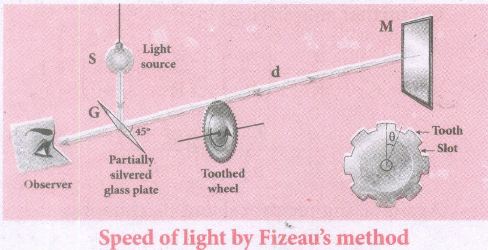
Prove law of refraction using Huygens’ principle.
40.
41.
Discuss Earth’s magnetic field in detail.
42.
Give the uses of Foucault current.
43.
Describe the microscopic model of current and obtain general form of Ohm’s law.
1.
In metals, the electrons in the outer most shells are loosely bound to the nucleus. Even at room temperature, these large number of electrons which are moving inside the metal in random manner and they cannot leave the surface of metal. So that metals have a large number of free electrons.
2.
(i) The scales on the wings of a morpho butterfly.
(ii) Peacock feathers.
3.
(i) If the particle of a solid is of size less than 100 nm, it is said to be a nano solid, if the particle size exceeds 100 nm, it is a bulk solid.
(ii) Both have same chemical properties. But their mechanical, electrical, optical, magnetic properties differ.
4.
(i) When the pressure of the gas in discharge tube is reduced to around 0.01 mm of Hg, positive column disappears.
(ii) At this time, a dark space is formed between anode and cathode which is called Crooke's dark space.
(iii) The walls of the tube appear with green colour.
(iv) At this stage, some invisible rays emanate from cathode called cathode rays, which are beam of electrons.
5.
The angle between the incident and deviated light is called Angle of deviation due to refraction. When light travels from
(i) rarer to denser medium, d = i - r
(ii) denser to rarer medium, d = r - i
6.
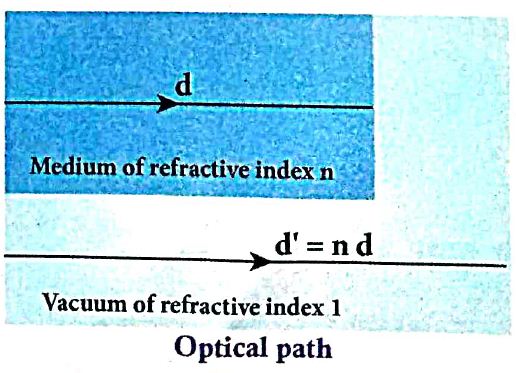
7.
Dielectric constant (relative permittivity of the medium) is εr = 2.25
Magnetic permeability is μr = 2.5
Refractive index of the medium,
n = \(\sqrt { { \varepsilon }_{ r }{ \mu }_{ r } } =\sqrt { 2.25\times 2.5 } \) = 2.37
8.
B = 4.1 x 10⁻⁵ T; θ = 90o – 47o = 43° ;
A = 3m2
We know that \(\Phi_{B}=B A \cos \theta\)
\(\Phi_{\mathrm{B}}\) = 4.1 x 10–5 x 3 x cos 43o
= 4.1 x 10–5 x 3 x 0.7314
= 89.96 \(\mu \mathrm{Wb}\).
9.
BH = 0.15 G and BV = 0.26 G
tan I = \(\frac { 0.26 }{ 0.15 } \Rightarrow I=ta{ n }^{ -1 }(1.732)=60°\)
The resultant magnetic field of the Earth is
\(B=\sqrt { { B }_{ H }^{ 2 }+{ B }_{ V }^{ 2 } } =0.3G\)
10.
| S.No | Drift velocity | Mobility |
| (i) | Drift velocity is the average velocity acquired by the electrons inside the conductor when it is subjected to an electric field. | Mobility is defined as the magnitude of the drift velocity per unit electric field. |
| (ii) | Vd = a\(\tau\) (or) Vd = μE. | μ =e\(\tau\)/m (or) u = vd/E. |
| (iii) | Its unit is m / s. | Its unit is m2/ Vs. |
11.
Current is defined as the ratio of the net (i.e. amount of) charge (Q) passing through any cross section of a conductor to time.
\(I=\frac{Q}{t}\)
Since current is the ratio of two scalar quantities, it is a scalar. In addition current I is defined as the scalar product of the current density and area vector at which the charges cross.
I = \(\vec{J}.\vec{A}\)
12.
According to the quantisation of charge
q = ne
Here q = 1C. So the number of electrons in 1 coulomb of charge is
n = \(\frac { q }{ e } =\frac { 1C }{ 1.6\times 10^{ -19 } } \) = 6.25 x 10¹⁸ electrons
13.
(i) The experimental set up it consists of two metal electrodes which are made of small spherical metals. These are connected to larger spheres and the ends of them are connected to induction coil with very large number of turns.
(ii) This is to produce very high electromotive force (emf). Since the coil is maintained at very high potential, air between the electrodes gets ionized and spark (spark means discharge of electricity) is produced.
(iii) This discharge of electricity affects another electrode (ring type - not completely closed) which is kept at far distance. This implies that the energy is transmitted from electrode to the receiver (ring electrode) in the form of waves, known as electromagnetic waves. If the receiver is rotated by 90o then no spark is observed by the receiver.
(iv) This confirms that electromagnetic waves are transverse waves as predicted by Maxwell. Hertz detected radio waves and also computed the speed of radio waves which is equal to the speed of light (3 x 10⁸ ms-1).
14.
(i) For a given frequency of incident light the number of photoelectrons emitted is directly proportional to the intensity of the incident light. The saturation current is also directly proportional to the intensity of incident light.
(ii) Maximum kinetic energy of the photo electrons is independent of intensity 0 the incident light.
(iii) Maximum kinetic energy of the photo electrons from a given metal is directly proportional to the frequency of incident light.
(iv) For a given surface, the emission of photoelectrons takes place only if the frequency of incident light is greater than a certain minimum frequency called the threshold frequency.
(v) There is no time lag between incidence of light and ejection of photo electrons.
15.
The electrostatic force is a conservative force, the potential energy for the electron in nth orbit is
\(U_{n} =\frac{1}{4 \pi \varepsilon_{0}} \frac{(+Z e)(-e)}{r_{n}}=-\frac{1}{4 \pi \varepsilon_{0}} \frac{Z^{2}}{r_{n}} \) \(\left[ \because r_n=\frac{\varepsilon_{0} h^{2} n^{2}}{\pi m Z e^{2}}\right]\)
\(U_{n} =-\frac{1}{4\varepsilon_{0}} -\frac{Z^{2} \mathrm{me}^{4}}{h^{2} n^{2}} \)
The kinetic energy of electron in nth orbit is
\(\mathrm{KE}_{\mathrm{n}}=\frac{1}{2} \mathrm{mv}_{\mathrm{n}}^{2}=\frac{\mathrm{Z}^{2} m \mathrm{e}^{4}}{8 \varepsilon_{0}^{2} \mathrm{~h}^{2} \mathrm{n}^{2}}\)
This implies that Un = -2KEn
Total energy of electron in the nth orbit is
\(E_{n}=K E_{n}+U_{n}=K E_{n}-2 K E_{n}=-K E_{n} \)
\(E_{n}=-\frac{Z^{2} m e^{4}}{8 \varepsilon_{0}^{2} h^{2} n^{2}} \)
For Hydrogen atom Z = 1
\(E_{n}=-\frac{m e^{4}}{8 \varepsilon_{0}^{2} h^{2} n^{2}} \text { joule }\)
n - principal quantum number
The negative sign indicates that the electron is bound to the nucleus.
Substituting the values of mass and charge of an electron (m and e), permittivity of free space \(\varepsilon^{0}\) and Planck's constant h and expressing in terms of (+(eV)), we get
\(E_{n}=-13.6\left(\frac{1}{n^{2}}\right) e V\)
(i) For the first orbit (ground state), the total energy of electron is E1 = - 13.6 eV.
(ii) For the second orbit (first excited state), the total energy of electron is E2 = -3.4 eV.
(iii) For the third orbit (second excited state), the total energy of electron is E3 = -1.51 eV and so on.
16.
(i) Cathode rays possess energy and momentum and travel in a straight line with high speed of the order of 107m s-1or \({ \left( \frac { 1 }{ 10 } \right) }^{ th }\) of the speed of light.
(ii) It can be deflected by application of electric and magnetic fields. The direction of deflection indicates that they are negatively charged particles.
(ii) When the cathode rays are allowed to fall on matter, they produce heat. They affect the photographic plates and also produce fluorescence when they fall on certain crystals and minerals.
(iii) When the cathode rays fall on a material of high atomic weight, x-rays are produced.
(iv) Cathode rays ionize the gas through which they pass.
17.
Power of the pulse P = 60 x 10-3 W
Time internal t = 10-6 S
Energy U = Power x time
U = p x t
= 60 x 10-3 x 10-6
U = 60 x 10-9 J
Lineral momentum, \(\mathrm{P}=\frac{\text { Energy }}{\text { speed }}=\frac{U}{C} \ \)
\(\mathrm{P}=\frac{60 \times 10^{-9}}{3 \times 10^{8}} \)
P = 20 x 10-17 kg ms-1
18.
N = 500 turns; μr = 800;
l = 40 cm = 0.4 m; r = 3 cm = 0.03 m;
di = 3 – 0 = 3 A; dt = 0.4 s
Self inductance,
\(L=\mu { n }^{ 2 }Al\left( \because \mu ={ \mu }_{ o }{ \mu }_{ r };A={ \pi r }^{ 2 };n=\frac { N }{ l } \right) \)
\(=\frac { { \mu }_{ 0 }{ \mu }_{ r }{ N }^{ 2 }\pi { r }^{ 2 } }{ l } \)
\(=\frac { 4\times 3.14\times { 10 }^{ -7 }\times 800\times { 500 }^{ 2 }\times 3.14\times { (3\times 10 }^{ -2 }{ ) }^{ 2 } }{ 0.4 } \)
L=1.77H
Induced emf, ε = -L\(\frac{di}{dt}\)
\(=\frac{1.77\times3}{0.4}\)
ε = -13.275V
19.
Basic properties of charges:
(i) Electric charge:
(a) Most objects in the universe are made up of atoms, which in turn are made up of protons, neutrons and electrons.
(b) These particles have mass, an inherent property of particles. Similarly, the electric charge is another intrinsic and fundamental property of particles.
(ii) Conservation of charges:
Total electric charge is conserved. Charge can neither be created nor be destroyed. In any physical process, the net change in charge will be zero.
(iii) Quantisation of charges:
(a) The charge q on any object is equal to an integral multiple of this fundamental unit of charge.
(b) q = ne
(c) Here, n is any integer \((0, \pm 1, \pm 2, \pm 3, \pm 4 \ldots)\) This is called Quantisation of electric charge.
20.
Let \(\vec{p}_m\)be the dipole and before switching ON the external magnetic field, there is no orientation. Therefore, the energy U = 0.
As soon as external magnetic field is switched ON, the magnetic dipole orient parallel (θ = 0o) to the magnetic field with energy,
Uparallel = Uminimum = -pmBcos 0
Uparallel = -pmB
since cos 0o = 1
Otherwise, the magnetic dipole orients anti-parallel (θ = 180o) to the magnetic field with energy,
U anti-parallel = U maximum = -pmBcos 180
\(\Rightarrow \) Uanti-parallel = PmB
since cos 180o = -1
21.
The proton and the electron attract each other. The magnitude of the electrostatic force between these two particles is given by
\(F_e=\frac { ke^{ 2 } }{ { r }^{ 2 } } =\frac { 9\times 10^{ 9 }\times (1.6\times 10^{ -19 })^{ 2 } }{ (5.3\times 10^{ -11 })^{ 2 } } \)
=\(\frac { 9\times 2.56 }{ 28.09 } \) x 10-7 = 8.2 x 10⁻⁸ N
The gravitational force between the proton and the electron is attractive. The magnitude of the gravitational force between these particles is
FG = \(\frac { G{ m }_{ e }{ m }_{ p } }{ { r }^{ 2 } } \)
= \(\frac { 6.67\times 10^{ -11 }\times 9.1\times 10^{ -31 }\times 1.6\times 10^{ -27 } }{ (5.3\times 10^{ -11 })^{ 2 } } \)
= \(\frac { 97.11 }{ 28.09 } \) x 10-47 = 3.4 x 10-47N
The ratio of the two forces \(\frac { { F }_{ e } }{ F_{ G } } =\frac { 8.2\times 10^{ -8 } }{ 3.4\times 10^{ -47 } } \)
= 2.41 x 1039
Note that Fe ≈ 1039 FG
The electrostatic force between a proton and an electron is enormously greater than the gravitational force between them. Thus the gravitational force is negligible when compared with the electrostatic force in many situations such as for small size objects and in the atomic domain. This is the reason why a charged comb attracts an uncharged piece of paper with greater force even though the piece of paper is attracted downward by the Earth. This given figure is shown in below.
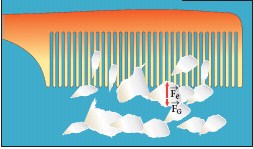
Electrostatic attraction between a comb and pieces of papers
22.
Size of the particle is between
1-100 nm - Nano.
Size of the particle is greater
than-100 nm - Bulk.
23.
(a)
0.7 V
24.
(b)
25.
\(\mathrm{E}_{\mathrm{p}} =\frac{\mathrm{hc}}{\lambda_{\mathrm{p}}} \)
\(\mathrm{E}_{\mathrm{e}} =\frac{\mathrm{h}^2}{2 \mathrm{~m} \lambda_{\mathrm{e}}^2} \)
\(\frac{\mathrm{hc}}{\lambda_{\mathrm{p}}} =\frac{\mathrm{h}^2}{2 \mathrm{~m} \lambda_{\mathrm{e}}^2} \)
\(\lambda_{\mathrm{p}} \propto \lambda_{\mathrm{e}}^{{ }^2}\)
26.
Refractive index for violet is more and wavelength for violet is very low comparing other colours. So, the letter which appears to be raised more is violet.
27.
v = nג
In an isotropic medium, there is no change in the frequency of the light. So, the speed of light depends on wavelength of light.
28.
(b)
\(7\mu T\)
29.
Dipole moment, \(\vec{p}_m=n\times I\times\vec{A}\)
\(\vec{p}_m\) = 50 x 3 x 3.14 x 25 x 10-4 ≈ 1.2 A m2
30.
\(\text {emf } e=8 \mathrm{~V} \)
\(d I=I_1-I_0=2-(-2)=4 \mathrm{~A} \)
\(\text {dt }=0.05 \mathrm{~s} \)
\(L=\frac{-e}{d I / d t}=\frac{-8}{4 / 0.05} \)
\(=\frac{-8 \times 0.05}{4}=\frac{-0.40}{4} \)
=-0.1 H
-ve sign indicates that self-induced emf always opposes the current w.r.t. time.
31.
\(\phi_B =10 t^2-50 t+250 \)
\(e =\frac{-d \phi_B}{d t} \)
\(=\frac{-d}{d t}\left(10 t^2-50 t+250\right) \)
=-(20 t - 50)
=-20 t + 50
When, t = 3 s, e =-20(3) + 50 = -60 + 50
e = -10V
32.
(b)
33.
(b)
34.
(c)
uniformly charged infinite plane
35.
Yellow - 4
Violet - 7
Orange - 103
Silver - Tolerance - 10%
36.
\(P=\frac{V^2}{R}=\frac{240 \times 240}{120}=480 \ W\)
37.
Hertz observation:
(i) Maxwell's theory of electromagnetism predicted the existence of electromagnetic waves and concluded that light itself is just an electromagnetic wave. Then, the experimentalists tried to generate and detect electromagnetic waves through various experiments.
(ii) In 1887, Heinrich Hertz first became successful in generating and detecting electromagnetic wave with his high voltage spark discharge between two metallic spheres.
(iii) When a spark is formed, the charges will oscillate back and forth rapidly and the electromagnetic waves are produced.
(iv) The electromagnetic waves thus produced were detected by a detector that has a copper wire bent in the shape of a circle.
(v) Although the detection of waves is successful, there is a problem in observing the tiny spark produced in the detector.
(vi) In order to improve the visibility of the spark, Hertz made many attempts and finally noticed an important thing that small detector spark became more vigorous when it was exposed to ultraviolet light.
(vii) The reason for this behavior of the spark was not known at that time. Later it was found that it is due to the photoelectric emission. whenever ultraviolet light is incident on the metallic sphere, the electrons on the outer surface are emitted which caused the spark to be more vigorous.
Hallwachs' observation:
(i) In 1888, Wilhelm Hallwachs, a German physicist, confirmed that the strange behaviour of the spark is due to the action of ultraviolet light with his simple experiment.
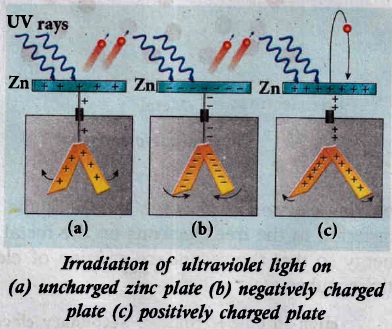
(ii) A clean circular plate of zinc is mounted on an insulating stand and is attached to a gold leaf electroscope by a wire.
(iii) When the uncharged zinc plate is irradiated by ultraviolet light from an arc lamp, it becomes positively charged and the leaves will open.
(iv) Further, if the negatively charged zinc plate is exposed to ultraviolet light, the leaves will close as the charges leaked away quickly.
(v) If the plate is positively charged, it becomes more positive upon UV rays irradiation and the leaves will open further.
(vi) From these observations, it was concluded that negatively charged electrons were emitted from the zinc plate under the action of ultraviolet light.
Lenard's observation:
(i) ln 1902, Lenard studied this electron emission phenomenon in detail. His simple experimental setup is as shown in Figure.
(ii) The apparatus consists of two metallic plates A and C placed in an evacuated quartz bulb. The galvanometer G and battery B are connected in the circuit.
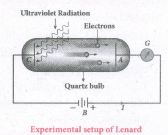
(iii) When ultraviolet light is incident on the negative plate C, an electric current flows in the circuit that is indicated by the deflection in the galvanometer.
(iv) On other hand, if the positive plate is irradiated by the ultraviolet light, no current is observed in the circuit.
(v) From these observations, it is concluded that when ultraviolet light falls on the negative plate, electrons are ejected from it which are attracted by the positive plate A.
(vi) On reaching the positive plate through the evacuated bulb, the circuit is completed and the current flows in it.
(vii) Thus, the ultraviolet light falling on the negative plate causes the electron emission from the surface of the plate.
38.
Materials made up of particles sizes of 1-100 made up nm differ in their properties from the materials made up of bulk particles. Thus, nano materials find wide range of applications
Automotive industry :
(i) Lightweight construction
(ii) Painting (fillers, base coat, clear coat)
(iii) Catalysts
(iv) Tires (fillers)
(v) Sensors
(vi) Coatings for wind-screen and car bodies.
Chemical industry :
(i) Fillers for paint systems
(ii) Coating systems based on nanocomposites
(iii) Impregnation of papers
(iv) Switchable adhesives
(v) Magnetic fluids
Engineering :
(i) Wear protection for tools and machines (anti blocking coatings, scratch resistant coatings on plastic parts etc.)
(ii) Lubricant-free bearings.
Electronic industry :
(i) Data memory
(ii) Displays
(iii) Laser diodes
(iv ) Glass fibres
(v) Optical switches
(vi) Filters (lR-blocking)
(vii) Conductive, antistatic coatings.
Construction :
(i) Construction materials
(ii) Thermal insulation
(iii) Flame retardants
(iv) Surface-functionalised building materials for wood, floors, stone, facades, tiles, roof tiles, etc.
(v) Facade coating
(v) Groove mortar.
Medicine :
(i) Drug delivery systems
(ii) Active agents
(iii) Contrast medium
(iv) Medical rapid tests
(v) Prostheses and implants
(vi) Antimicrobial agents and coatings
(vii) Agents in cancer therapy.
Textile/fabrics/non-wovens :
(i) Surface-processed textiles
(ii) smart clothes.
Energy :
(i) Fuel cells
(il) Solar cells
(iii) Batteries
(iv) Capacitors.
Cosmetics :
(i) Sun protection
(ii) Lipsticks
(iii) Skin creams
(iv) Tooth paste.
Food and drinks :
(i) Package materials
(ii) Storage life sensors
(iii) Additives
(iv) Clarification of fruit juices.
Household :
(i) Ceramic coatings for irons
(ii) Orders catalyst
(iii) Cleaner for glass, ceramic, floor, windows.
Sports/Outdoor :
(i) Ski wax
(ii) Antifogging of glasses /goggles
(iii) Antifouling coating for ships /boats
(iv) Reinforced tennis rackets and balls.
39.
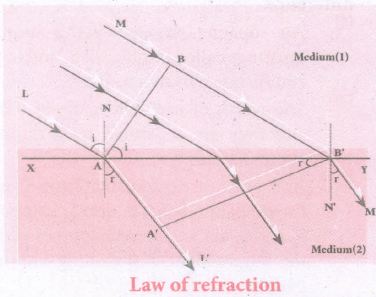
(i) Let us Consider a parallel beam of light is incident on a refracting plane surface XY such as a glass surface as shown in Figure.
(ii) The incident wavefront AB is in rarer medium (1) and the refracted wavefront A'B' is in denser medium (2).
(iii) These wavefronts are perpendicular to the incident rays L, M and refracted rays L', M' respectively.
\(t=\cfrac { BB' }{ { v }_{ 1 } } =\cfrac { AA' }{ { v }_{ 2 } } \) or \(\cfrac { BB' }{ AA' } =\cfrac { { v }_{ 1 } }{ { v }_{ 2 } } \)
(i) The incident rays, the refracted rays and the normal are in the same plane.
(ii) Angle of incidence
i = ∠ NAL = 90o - ∠NAB = ㄥ BAB'
Angle of refraction,
r = ∠ N'B'M = 90o-ㄥN'B'A' =∠ A'B'A
For the two right angle triangles ∆ABB' and ∆AA'B',
\(\cfrac { sini }{ sinr } =\cfrac { \frac { BB' }{ AB' } }{ \frac { AA' }{ AB' } } =\cfrac { BB' }{ AA' } =\cfrac { { v }_{ 1 } }{ { v }_{ 2 } } =\cfrac { \frac { c }{ { v }_{ 2 } } }{ \frac { c }{ { v }_{ 1 } } } \)
(iv) Here, C is speed of light in vacuum. The ratio \(\cfrac { c }{ v } \) is the constant, called refractive index of the medium. The refractive index of medium (1) is,\(\cfrac { c }{ { v }_{ 1 } } ={ n }_{ 1 }\) and that of medium (2) is,\(\cfrac { c }{ { v }_{ 1 } } ={ n }_{ 2 }\) In ratio form,
\(\cfrac { sini }{ sinr } =\cfrac { { n }_{ 2 } }{ { n }_{ 1 } } \) .............(1)
In product form,
n1 sin i = n2 sin r ..........(2)
Hence, the laws of refraction are proved.
40.
41.
There are three quantities required to specify the magnetic field of the Earth on its surface, which are often called as the elements of the Earth's magnetic field. They are:
(a) magnetic declination (D)
(b) magnetic dip or inclination (I)
(c) the horizontal component of the Earth's magnetic field (BH)
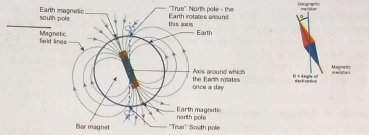
Let BE be the net Earth's magnetic field at any point P on the surface of the Earth. BE can be resolved into two perpendicular components.
Horizontal component, BH = BE cos I .... (1)
Vertical component, BV = BE sin I .....(2)
Dividing equation (1) and (2), we get,
\(=\frac{B_{V}}{B_{H}} ...(3)\)
(i) At magnetic equator:
The Earth's magnetic field is parallel to the surface of the Earth (i.e., horizontal) which implies that the needle of magnetic compass rests horizontally at an angle of dip, I = 0o Hence, BH = BE
BV = 0
This implies that the horizontal component is maximum and vertical component is zero at equator.
(ii) At magnetic poles:
The Earth's magnetic field is perpendicular to the surface of the Earth (i.e, vertical) which implies that the needle of magnetic compass rests vertically at an angle of dip, I = 90o
Hence, BH = 0
BV = BE
This implies that the vertical component is maximum at poles and horizontal component is zero at poles.
42.
(a) Induction stove
(i) Induction stove is used to cook the food quickly and safely with less energy consumption. Below the cooking zone, there is a tightly wound coil of insulated wire.
(ii) The cooking pan made of suitable material, is placed over the cooking zone. When the stove is switched on, an alternating current flowing in the coil produces high frequency alternating magnetic field which induces very strong eddy currents in the cooking pan.
(iii) The eddy currents in the pan produce so much of heat due to Joule heating which is used to cook the food.
(b) Eddy current brake
(i) This eddy current braking system is generally used in high speed trains and roller coasters. Strong electromagnets are fixed just above the rails.
(ii) To stop the train, electromagnets are switched on. The magnetic field of these magnets induces eddy currents in the rails which oppose or resist the movement of the train. This is Eddy current linear brake.
(c) Eddy current testing
(i) It is one of the simple non-destructive testing methods to find defects like surface cracks, air bubbles present in a specimen.
(ii) A coil of insulated wire is given an alternating electric current, so that it produces an alternating magnetic field.
(iii) When this coil is brought near the test surface, eddy current is induced in the test surface.
(iv) The presence of defects causes the change in phase and amplitude of the eddy current that can be detected by some other means. In this way, the defects present in the specimen are identified.
(d) Electro magnetic damping:
(i) The armature of the galvanometer coil is wound on a soft iron cylinder.
(ii) Once the armature is deflected, the relative motion between the soft iron cylinder and the radial magnetic field induces eddy current in the cylinder.
(iii) The damping force due to the flow of eddy current brings the armature to rest immediately and then galvanometer shows a steady deflection. This is called electromagnetic damping.
43.
(i) XY is a conductor of area cross section A. \(\vec { E } \)is the applied electric field. n is the number of electrons per unit volume with same drift velocity (Vd) .
(ii) Let electrons move through a distance dx in time interval dt.
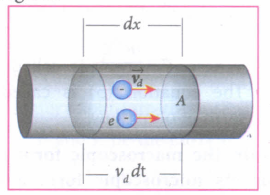
(iii) The drift velocity of the electrons = vd
(iv) If the electrons move through a distance dx within a small interval of time dt,
\({ v }_{ d }=\cfrac { dx }{ dt } ;dx={ v }_{ d }dt\) ..(i)
(v) Since A is the area of cross section of the conductor, the electrons available in the volume of length dx is
= volume x number of electrons per unit volume = A dx x n ...(2)
(vi) Substituting for dx from equation (1) in (2)
= (A vd dt) n
(vii) Total charge in volume element dQ =(charge) x (number of electrons in the volume element)
dQ = (e) (Avddt)n
Hence the current \(I=\cfrac { dQ }{ dt } =\cfrac { ne{ Av }_{ d }dt }{ dt } \)
\(I=ne{ Av }_d\) ..........(3)
Current density (J):
(viii) The current density (J) is defined as the current per unit area of cross section of the conductor.
\(J=\cfrac { I }{ A } \)
(ix) The S.I unit of current density is \({ Am }^{ -2 }\)
\(J=\cfrac { neAv_{ d } }{ A } \) (∵I = nAeVd)
\(J={ nev }_{ d }\) .........(4)
(x) The above expression holds only when the direction of the current is perpendicular to the area A.
In general, the current density is a vector quantity and it is given by,
\(\vec { J } =ne\vec { v_{ d } } \)
Substituting \(\vec { v_{ d } } \) from equation
\(\vec { v_{ d } } =\cfrac { e\tau }{ m } \vec { E } \)
\(\vec { J } =\cfrac { n.{ e }^{ 2 }\tau }{ m } \vec { E } \) ...(5)
\(\vec { J } =\sigma \vec { E } \) ....(6)
(xi) But conventionally, we take the direction of (conventional) current density as the direction of electric field. So, the above equation becomes,
\(\vec { J } =\sigma \vec { E } \) .....(7)
(xii) Where, \(\sigma =\cfrac { { ne }^{ 2 }\tau }{ m } \) is called conductivity. The equation (7) is called microscopic form of ohm's law.

12th Standard Syllabus & Materials
12th Standard
TN 12th Computer Applications களப்பெயர் முறைமை (DNS) Sample Question Papers Study Material - QB365 Set A
NEW12th Standard
TN 12th Computer Applications வலையமைப்பு எடுத்துக்காட்டுகள் மற்றும் நெறிமுறைகள் Sample Question Papers Study Material - QB365 Set A
NEW12th Standard
TN 12th Computer Applications கணினி வலையமைப்பு ஓர் அறிமுகம் Sample Question Papers Study Material - QB365 Set A
NEW12th Standard
TN 12th Computer Applications PHP-உடன் MySQL-ஐ இணைத்தல் Sample Question Papers Study Material - QB365 Set A



Tamilnadu Stateboard 12th Standard Subjects

Maths

Chemistry
Physics

Biology

Computer Science

Business Maths and Statistics

Economics

Commerce

Accountancy

History

Computer Applications
Biology
Computer Technology
Computer Applications
Computer Science
Business Maths and Statistics
Commerce
Economics
Maths
Chemistry
Physics
Computer Technology
History
Accountancy

Tamil

English

French
Tamilnadu Stateboard Standards

