
 100% FREE ACCESS
12th Standard Syllabus & Materials
12th Standard
TN 12th Maths Applications of Matrices and Determinants Sample Question Papers Study Material - QB365 Set A
NEW12th Standard
TN 12th Computer Applications மின்னணு தரவு பரிமாற்றம் Sample Question Papers Study Material - QB365 Set A
NEW12th Standard
TN 12th Computer Applications மின் - வணிக பாதுகாப்பு அமைப்புகள் Sample Question Papers Study Material - QB365 Set A
NEW12th Standard
TN 12th Computer Applications மின்னணு செலுத்தல் முறைகள் Sample Question Papers Study Material - QB365 Set A
NEW12th Standard
TN 12th Computer Applications மின் - வணிகம் Sample Question Papers Study Material - QB365 Set A
NEW12th Standard
TN 12th Computer Applications திறந்த மூல கருத்துருக்கள் Sample Question Papers Study Material - QB365 Set A

Published on: 02/09/2022
QB365 provides a detailed and simple solution for every Possible Book Back Questions in Class 12 Physics Subject - Retirement and Death of a Partner, English Medium. It will help Students to get more practice questions, Students can Practice these question papers in addition to score best marks.
Download Tamil Nadu 12th Standard Physics question papers, model tests, one-mark questions, important questions, and public exam papers in PDF format. Free study materials and answer keys for TN State Board students.
Questions + Answers key
Take MCQ Physics Test1.
What is the use of collimator in a spectrometer?
2.
What is Rayleigh’s criterion?
3.
What is intensity (or) amplitude division?
4.
A person has farsightedness with the far distance he could see clearly is 75 cm. Calculate the power of the lens of the spectacles needed to rectify the defect.
5.
Calculate the power of the lens of the spectacles needed to rectify the defect of nearsightedness for a person who could see clearly up to a distance of 1.8 m.
6.
A microscope has an objective and eyepiece of focal lengths 5 cm and 50 cm respectively with tube length 30 cm. Find the magnification of the microscope in the
(a) near point and
(b) normal focusing.
7.
8.
Find the polarizing angles for
(i) glass of refractive index 1.5 and
(ii) water of refractive index 1.33.
9.
Two polaroids are kept crossed (transmission axes at 90o ) to each other.
(a) What will be the intensity of the light coming out from the second polaroid when an unpolarised light of intensity I falls on the first polaroid?
(b) What will be the intensity of light coming out from the second polaroid if a third polaroid is kept in between at 45o inclination to both of them.
10.
Two polaroids are kept with their transmission axes inclined at 30o. Unpolarised light of intensity I falls on the first polaroid. Find out the intensity of light emerging from the second polaroid.
11.
The optical telescope in the Vainu Bappu Observatory at Kavalur has an objective lens of diameter 2.3 m. What is its angular resolution if the wavelength of light used is 589 nm?
12.
A monochromatic light of wavelength of 500 nm strikes a grating and produces fourth order maximum at an angle of 30°. Find the number of slits per centimeter.
13.
A diffraction grating consists of 4000 slits per centimeter. It is illuminated by a monochromatic light. The second order diffraction maximum is produced at an angle of 30°. What is the wavelength of the light used?
14.
15.
The wavelength of a light is 450 nm. How much phase it will differ for a path of 3 mm?
16.
Two light sources have intensity of light as I0. What is the resultant intensity at a point where the two light waves have a phase difference of π/3?
17.
Two light sources of equal amplitudes interfere with each other. Calculate the ratio of maximum and minimum intensities.
18.
The wavelength of light from sodium source in vacuum is 5893Å. What are its
(a) wavelength,
(b) speed and
(c) frequency when this light travels in water which has a refractive index of 1.33.
19.
A beam of light of wavelength 600 nm from a distant source falls on a single slit 1 mm wide and the resulting diffraction pattern is observed on a screen 2 m away. What is the distance between the first dark fringes on either side of the central bright fringe?
20.
What is astigmatism? What is its remedy?
21.
What is presbyopia?
22.
What is hypermetropia? What is its remedy?
23.
What is myopia? What is its remedy?
24.
What are the uses of spectrometer?
25.
What is the use of an erecting lens in a terrestrial telescope?
26.
Why is oil immersed objective preferred in a microscope?
27.
What are near point and normal focusing?
28.
How is polarisation of light obtained by scattering of light?
29.
Discuss about Nicol prism.
30.
Mention the types of optically active crystals with example.
31.
What is double refraction?
32.
What is polarisation?
33.
What is call 'grating element'?
34.
Discuss the special cases on first minimum in Fraunhofer diffraction.
35.
What is diffraction?
36.
What is bandwidth of interference pattern?
37.
How do source and images behave as coherent sources?
38.
How does wavefront division provide coherent sources?
39.
What are coherent sources?
40.
What is phase of a wave?
41.
What is interference of light?
42.
State Huygens’ principle.
43.
Define wavefront.
44.
Write a short note on quantum theory of light.
45.
What is the significance of electromagnetic wave theory of light?
46.
What are the important points of wave theory of light?
47.
What are the salient features of corpuscular theory of light?
48.
Discuss about pile of plates.
49.
What is angle of polarisation and obtain the equation for angle of polarisation.
1.
The collimator is an arrangement to produce a parallel beam of light.
2.
According to Rayleigh's criterion, the two point sources are said to be just resolved when the distance between the two maxima is at least ro.
\(r_{0}=\frac{1.22 \lambda \mathrm{f}}{a}\)
Here,
\(\lambda\) → wavelength
f → distance of screen from the width
a → slit width
3.
If we allow light to pass through a partially silvered mirror (beam splitter), both reflection and refraction take place simultaneously. As the two light beams are obtained from the same light source, the two divided light beams will be coherent beams. They will be either in-phase or at constant phase differences.
4.
The minimum distance the person could see clearly is, y = 75 cm.
The lens should have a focal length of,
\(f=\cfrac { y\times 25cm }{ y-25cm } \)
\(f=\cfrac { 75cm\times 25cm }{ 75cm-25cm } =37.5cm\)
It is a convex (or) converging lens.
The power of the lens is,
\(P=\cfrac { 1 }{ 0.375m } =2.67\ D\)
5.
The maximum distance the person could see is, x = 1.8 m.
The lens should have a focal length of,
f = –x m = –1.8 m.
It is a concave (or) diverging lens.
The power of the lens is,
\(\\ \\ \\ \\ P=-\cfrac { 1 }{ 1.8m } =-0.56D\)
6.
fo = 5 cm = 5 x 10⁻² m; fe = 50 cm = 50 x 10-2m;
L = 30 cm = 30 x 10-2 m; D = 25 cm = 25 x 10-2m
(i) The total magnification m in near point focusing is \(m={ m }_{ 0 }{ m }_{ e }=\left( \cfrac { L }{ { f }_{ 0 } } \right) \left( 1+\cfrac { D }{ { f }_{ e } } \right) \)
Substituting,
\(m={ m }_{ 0 }{ m }_{ e }=\left( \cfrac { 30\times { 10 }^{ -2 } }{ 5\times { 10 }^{ -2 } } \right) \left( 1+\cfrac { 25\times { 10 }^{ -2 } }{ 50\times { 10 }^{ -2 } } \right) \)
= (6) (1.5) = 9
(ii) The total magnification m in normal
focusing is,\(m={ m }_{ o }{ m }_{ e }=\left( \cfrac { L }{ { f }_{ 0 } } \right) \left( \cfrac { D }{ { f }_{ e } } \right) \)
Substituting,
\(m=m_{ o }{ m }_{ e }=\left( \cfrac { 30\times { 10 }^{ -2 } }{ 5\times { 10 }^{ -2 } } \right) \left( \cfrac { 25\times { 10 }^{ -2 } }{ 50\times { 10 }^{ -2 } } \right) \)
= (6) (0.5) = 3
7.
8.
Brewster’s law, tan ip = n
For glass, tanip = 1.5 ; ip = tan-11.5 ; ip= 56.3o
For water, tanip= 1.33; ip= tan-1 = tan-1 1.33; ip = 53.1o
9.
(a) As the intensity of the unpolarised light falling on the first polaroid is I, the intensity of polarized light emerging from it will be \({ I }_{ o }=\left( \cfrac { 1 }{ 2 } \right) \). Let I' be the intensity of light emerging from the second polaroid.
Malus’ law, I' = Io cos2θ
Here θ is 90o as the transmission axes are perpendicular to each other.
Substituting,
\(I'=\left( \cfrac { 1 }{ 2 } \right) { cos }^{ 2 }\left( { 90 }^{ o } \right) =0\left[ \therefore cos\left( { 90 }^{ o } \right) =0 \right] \)
No light comes out from the second polaroid
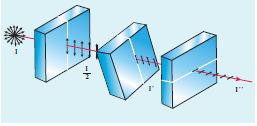
(b) Let the first polaroid be P1 and the second polaroid be P2. They are oriented at 90o. The third polaroid P3 is introduced between them at 45o. Let ′I be the intensity of light emerging from P3.
Angle between P1 and P3 is 45o. The intensity of light coming out from P3 is, I' = Io cos2θ
Substituting,
\(I'=\left( \cfrac { 1 }{ 2 } \right) { cos }^{ 2 }\left( { 45 }^{ o } \right) =\left( \cfrac { 1 }{ 2 } \right) \left( \cfrac { 1 }{ \sqrt { 2 } } \right) ^{ 2 }=\cfrac { 1 }{ 4' } ;I'\cfrac { I }{ 4 } \)
Finally, the light has to pass through P2. Angle between P3 and P2 is 45o. Let I″ is the intensity of light coming out from P2 I''= I'os2 θ
Here, I' is the intensity of polarized light existing between P3 and P2. I'= \(\cfrac { 1 }{ 4 } \)
Substituting,
\({ I }^{ n }=\left( \cfrac { 1 }{ 4 } \right) { cos }^{ 2 }\left( { 45 }^{ o } \right) =\left( \cfrac { 1 }{ 4 } \right) \left( \cfrac { 1 }{ \sqrt { 2 } } \right)^2 =\cfrac { 1 }{ 8 } \)
\(I^{ n }=\cfrac { 1 }{ 8 } \)
10.
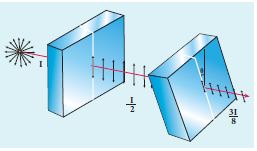
As the intensity of the unpolarised light falling on the first polaroid is I, the intensity of polarized light emerging from will be, \({ I }_{ 0 }=\left( \cfrac { 1 }{ 2 } \right) \)
Let I' be the intensity of light emerging from the second polaroid.
Malus’ law, I' = Io = cos2θ
Substituting,
\({ I }^{ ' }=\left( \cfrac { 1 }{ 2 } \right) { cos }^{ 2 }\left( { 30 }^{ o } \right) =\left( \cfrac { 1 }{ 2 } \right) \left( \cfrac { \sqrt { 3 } }{ 2 } \right) ^{ 2 }=1\cfrac { 3 }{ 8 } \)
\(I'=\left( \cfrac { 3 }{ 8 } \right) I\)
11.
a = 2.3 m; λ = 589 nm = 589 x 10-9 m; θ = ?
The equation for angular resolution is,
\(\theta =\cfrac { 1.22\lambda }{ a } \)
Substituting,
\(\theta =\cfrac { 1.22\times 589\times { 10 }^{ -9 } }{ 2.3 } =3.124\times { 10 }^{ -9 }\)
θ = 3.214 x 10⁻⁷ rad (or) θ = 0.0011'
Note: The angular resolution of human eye is approximately, 3 x 10⁻⁴ rad ≃ 1.03'.
12.
λ = 500 nm = 500 x 10-9 m; m = 4;
θ = 30°; number of lines per cm = ?
Equation for diffraction maximum in grating is, sin θ = Nm λ
Rewriting, \(N=\cfrac { sin\theta }{ m\lambda } \)
Substituting,
\(N=\frac{0.5}{4 \times 500 \times 10^{-9}}\)
= 2.5 x 10⁵ m-1
= 2.5 x 103 cm-1
13.
Number of lines per cm = 4000 cm-1; m = 2; θ = 30°; λ = ?
Number of lines per unit length
\(N=\cfrac { 4000 }{ 1\times { 10 }^{ -2 } } =4\times { 10 }^{ 5 }\)
Equation for diffraction maximum in grating is, sinθ = Nmλ
After Rewriting, \(\lambda =\cfrac { sin\theta }{ Nm } \)
Substituting,
\(\lambda =\cfrac { { \sin30 }^{ o } }{ 4\times { 10 }^{ 5 }\times 2 } =\cfrac { 0.5 }{ 4\times { 10 }^{ 5 }\times 2 } \)
= \(\cfrac { 1 }{ 2\times 4\times { 10 }^{ 5 }\times 2 } =\cfrac { 1 }{ 16 \times 10^5} \)
λ = 6250 x 10-10 m = 6205 Å
14.
15.
Wavelength is, λ = 450 nm = 450 x 10-9m
Path difference is, ઠ = 3mm = 3 x 10⁻³m
Relation between phase difference and path difference is \(\phi =\cfrac { 2\pi }{ \lambda } \times \delta \)
Substituting,
\(\phi =\cfrac { 2\pi }{ 450\times { 10 }^{ -9 } } \times 3\times { 10 }^{ -3 }=\cfrac { \pi }{ 75 } \times { 10 }^{ 6 }\)
\(\phi=\frac{\pi}{75} \times 10^{6} \mathrm{rad}=4.19 \times 10^{4} \mathrm{rad}.\)
16.
Let the intensities be I0.
The resultant intensity is,\(I=4{ I }_{ 0 }{ cos }^{ 2 }\left( \phi /2 \right) \)
Resultant intensity when, \(\phi =\pi /3\), is
\(I={ 4I }_{ 0 }{ cos }^{ 2 }\left( \pi /6 \right) \)
\(I={ 4I }_{ 0 }\left( \sqrt { 3 } /2 \right) ^{ 2 }=3{ I }_{ 0 }\)
17.
Let the amplitude be a.
The intensity is \(I\propto { 4a }^{ 2 }{ cos }^{ 2 }\left( \phi /2 \right) \)
or \(I=4{ I }_{ 0 }{ cos }^{ 2 }\left( \phi /2 \right) \)
Resultant intensity is maximum when,
\(\phi =0,cos=0=1,{ I }_{ max }\propto { 4a }^{ 2 }\)
Resultant amplitude is minimum when,
\(\phi =\pi ,cos\left( \pi /2 \right) =0,{ I }_{ min }=0\)
Imax : Imin = 4aa : 0
18.
The refractive index of vacuum, n1 = 1
The wavelength in vacuum, λ1 = 5893 Å.
The speed in vacuum, c = v1 = 3 x 10⁸ m s–1
The refractive index of water, n2 = 1.33
The wavelength of light in water, λ2
The speed of light in water, v2
(a) The equation relating the wavelength and refractive index is,
\(\cfrac { { \lambda }_{ 1 } }{ \lambda _{ 2 } } =\cfrac { { n }_{ 2 } }{ { n }_{ 1 } } \)
Rewriting, \({ \lambda }_{ 2 }=\cfrac { { n }_{ 1 } }{ { n }_{ 2 } } \times { \lambda }_{ 1 }\)
Substituting the values,
\({ \lambda }_{ 2 }=\cfrac { 1 }{ 1.33 } \times 5893\overset { o }{ A } =4431\overset { o }{ A } \)
\({ \lambda }_{ 2 }=4431\overset { o }{ A } \)
(b) The equation relating the speed and refractive index is,
\(\cfrac { { v }_{ 1 } }{ { v }_{ 2 } } =\cfrac { { n }_{ 2 } }{ { n }_{ 1 } } \)
Rewriting, \({ v }_{ 2 }=\cfrac { { n }_{ 1 } }{ { n }_{ 2 } } \times { v }_{ 1 }\)
Substituting the values,
\({ v }_{ 2 }=\cfrac { 1 }{ 1.33 } \times 3\times { 10 }^{ 8 }=2.256\times { 10 }^{ 8 }\)
v2 = 2.256 x 10⁸ ms-1
(c) Frequency of light in vacuum is,
\({ v }_{ 1 }=\cfrac { c }{ { \lambda }_{ 1 } } \)
Substituting the values,
\({ v }_{ 1 }=\cfrac { 3\times { 10 }^{ 8 } }{ 5893\times { 10 }^{ -10 } } =5.091\times { 10 }^{ 14 }Hz\)
Frequency of light in water is, \({ v }_{ 2 }=\cfrac { v }{ { \lambda }_{ 2 } } \)
Substituting the values,
\(\\ { v }_{ 2 }=\cfrac { 2.256\times { 10 }^{ 8 }{ ms }^{ -1 } }{ 4431\times { 10 }^{ -10 } } =5.091\times { 10 }^{ 14 }Hz\)
The results show that the frequency remains same in all media.
19.
⋋2 = 600 x 10-9 m, ⇒ d = 1 x 10⁻³ m, D =2m
n⋋ = dsinθ
For first dark fringe
n = 1 For minimum
d sinθ = ⋋, here
CO = Nc (approximately)
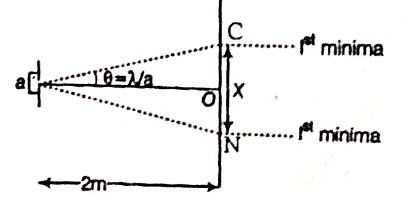
From Fig, sinθ \(=\frac{x/2}{D} =x/2D\)
\(sin \theta =\frac{ \lambda}{d} \)
\(\lambda/d=x/2D\)
\(\therefore x =\frac{2D\lambda}{d}=\frac{2 \times 2 \times 600\times 10^{-9}}{ 10^{-3}} \)
\(x=2.4 \times10^{-3}m =2.4\mathrm{~mm} \)
20.
Astigmatism:
Astigmatism is the defect arising due to different curvatures along different planes in the eye lens.
Remedy:
Use of Cylindrical, Bi-focal and progressive lenses.
21.
Farsightedness arising due to aging is called presbyopia as the aged people cannot strain their eye more to reduce the focal length of the eye lens.
22.
Hypermetropia:
A person suffering from farsightedness (or) hypermetropia (or) hyperopia cannot see closer object clearly.
Remedy:
Hypermetropia occurs when the eye lens has long focal length or shortening of the eyeball than usual.
23.
Myopia:
A person suffering from nearsightedness or myopia cannot see distant objects clearly. This may due to short focal length of the eye lens or larger diameter of the eyeball than usual.
Remedy:
These people have difficulty in relaxing their eye more than what is needed to overcome this difficulty. They need correcting lens, which should be concave lens.
24.
(i) To study the spectra of different sources of light.
(ii) To measure the refractive indices of materials due to determinant of angle of prism (A) and angle of minimum deviation (D).
(iii) To find the refractive indices of liquids.
(iv) To find the wavelength of light using grating.
25.
A terrestrial telescope has an additional erecting lens to make the final image erect.
26.
Resolving Power of microscope
\(d_{min}=\frac{1.22 \lambda}{2 n \sin \beta}\)
To further reduce the value of dmin, the optical path of the light should be increased. So, in order to increase the optical path, the objective of the microscope immerses into a bath containing oil of refractive index 'n'.
27.
(i) Near point focusing:
The eye is least strained when image is formed at near point, i.e. 25 cm. The near point is also called as least distance of distinct vision.
(ii) Normal focusing:
The eye is most relaxed when the image is formed at infinity. The focusing is called normal focusing when the image is formed at infinity.
28.
polarisation of light obtained by scattering of light :
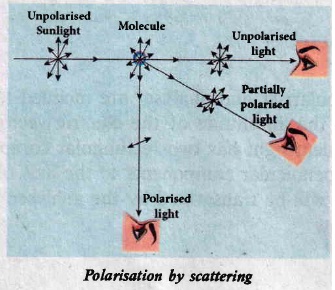
When sun light gets scattered by the atmospheric molecules, the electrons of these molecules are influenced by the vibrating components of the electric field present in the sun light. As the sunlight is unpolarised, it produces these vibrations in all directions. These vibrating electrons radiate energy only in the direction perpendicular to their vibrations. When an observer views a beam of sunlight perpendicular to its direction of travel, the radiations produced by the electrons vibrating in the direction perpendicular to the direction of view will only reach the observer. Hence, the light reaching the observer is plane polarised.
29.
Uses:
To produce plane polarised light and also serve as analyser.
Construction:
(i) lt is a clacite crystal whose length is three times of its breadth.
(ii) Cut in to two halves having face angles 72° and 108°.
(iii) Joined together by a transparent cement (canada balsam).
Working:
(i) When a monochromatic light from sodium vapour lamp is incident on Nicol prism, double refraction takes places.
(ii) It's split as ordinary (O) ray and extra ordinary ray (E)
Refractive index of the crystal for
Ordinary ray : 1.658
Extra ordinary ray : 1.486
Canada balsam : 1.523
(iii) Ordinary ray is total internally reflected and extra ordinary ray alone is transmitted which is plane polarised.
30.
i) Uniaxial crystals (only one optic axes)
eg: calcite qrartz, ice, tourmaline
ii) Biaxial crystals. (two optic axes)
eg: Mica, topaz, selenite
31.
When a ray of unpolarised light is incident on a calcite crystal, two refracted rays are produced, Hence, two images of a single object are formed. This phenomenon is called double refraction.
32.
The Phenomenon of restricting the vibrations of light to a particular direction perpendicular to the direction of wave propagation motion is called polarization of light.
33.
(i) In Grating, the combined width of a ruling and a slit is called 'grating element' (1.e.) e = a + b.
34.
The equation for first minimum in single slit diffraction is, a sin θ = λ.
\(sin\theta =\cfrac { \lambda }{ a } \)
Cases:
(i) When a < λ, the diffraction is not possible, because sin θ > 1.
(ii) When a ≥ λ, the diffraction is possible.
For a = λ, sin θ = 1 i.e, θ = 90°. That means the first minimum is at 90°.
For a >> λ, sin θ << 1 i.e, the first minimum fall within the width space of the slit itself.
(iii) When a > λ and also comparable, say a = 2λ, \(sin\theta =\cfrac { 1 }{ 2 } \), then θ = 30°. These are practical cases where diffraction could be observed effectively.
35.
Diffraction is bending of waves around sharp edges into the geometrically shadowed region.
36.
The bandwidth (β) is defined as the distance between any two consecutive bright or dark fringes.
37.
Source and images
In this method, a source and its image will act as a set of coherent source, because the source and its image will have waves in-phase or constant phase difference.
Examples: Fresnel's Biprism, Lloyd's Mirror
38.
This is the most commonly used method for producing two coherent sources. If two points are chosen on the wavefront by using a double slit, the two points will act as coherent sources.
39.
Two light sources are said to be coherent if they produce waves which have same phase or constant phase difference, same frequency or wavelength (monochromatic), same waveform and preferably same amplitude.
40.
Phase is the angular position of vibration when a wave is progresses.
41.
The phenomenon of addition or superposition of two light waves which produces increase in intensity at some points and decrease in intensity at some other points is called interference of light.
42.
According to Huygens's principle, each point of the wavefront is the source of secondary wavelets emanating from these points spreading out in all directions with the speed of the wave. These are called as secondary wavelets.
43.
A wavefront is the locus of points which are in the same state or phase of vibration.
44.
Quantum theory of light:
Quantum theory states that light waves consist of small packets of energy called photons. The energy associated with each photon is E = hv, Where 'h' is Planck's constant (h = 6.625 x 10⁻³⁴ J s) and v is frequency of electromagnetic radiation.
45.
Electromagnetic wave theory of light:
Light is an electromagnetic wave which is transverse in nature carrying electromagnetic energy. No medium is necessary for the propagation of electromagnetic waves. All the phenomenon of light could be successfully explained by this theory.
46.
Wave theory of light:
(i) According to Huygen's wave theory, light is propagated in the form of longitudinal waves through an invisible elastic medium called ether, which pervades all space.
(ii) Later Fresnel and Young suggested that light waves are transverse. Wave theory could satisfactorily explain reflection, refraction, interference diffraction and polarisation.
(iii) According to this theory, the velocity of light in a denser medium is lesser than that in a rarer medium.
47.
Salient features of corpuscular theory:
(i) A luminous body emits tiny massless perfectly elastic particles called corpuscles.
(ii) As the corpuscles are very small, the source does not suffer appreciable loss of mass.
(iii) They are not affected by gravity. so they travel with high speed in a straight line.
(iv) When these corpuscles impinge on the retina of the eye, the vision is produced.
(v) The different size of corpuscles is the reason for different colors.
(vi) The reflection is due to repulsion of the corpuscles by the medium.
(vii) The refraction is due to the attraction of the corpuscles by the medium.
(viii) This theory could not explain the reason why the speed of light is lesser in denser medium than in denser medium and also the phenomena like interference, diffraction and polarisation.
48.
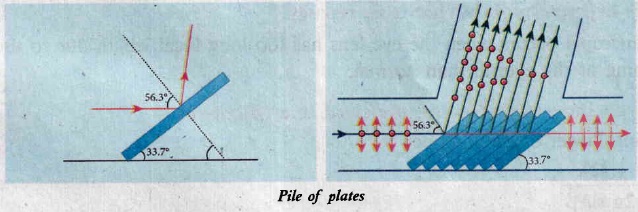
(i) Pile of plates makes use of Brewster's law to convert the partially polarised refracted light into plane polarised light.
(ii) It consists of several plates kept one behind the other at an angle 90° - ip with the horizontal surface as shown in Figure.
(iii) This arrangement ensures that the parallel light falls on these plates at ip. When this unpolarised light passes successively through these plates, the few parallel vibrations to the surface which may be present in the refracted light, get a chance for further reflections at the succeeding plates.
(iv) Thus, both the reflected and the refracted lights are found to be plane polarised.
Uses :
The pile of plates is used as a polarizer and also as an analyser.
49.
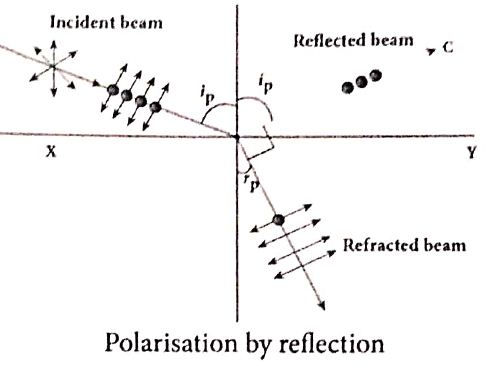
The angle of incidence at which a beam of unpolarised light falling on a transparent surface is reflected as a beam of plane polarised light is called polarising angle or Brewster's angle.
When the reflected ray in plane polarised, the angle between the reflected ray (BC) and the refracted ray (BD) is 90o angle.
Therefore, iP + 90° + rp = 180°
iP = 90 - rp.

12th Standard Syllabus & Materials
12th Standard
TN 12th Computer Applications வலையமைப்பு வடமிடல் Sample Question Papers Study Material - QB365 Set A
NEW12th Standard
TN 12th Computer Applications களப்பெயர் முறைமை (DNS) Sample Question Papers Study Material - QB365 Set A
NEW12th Standard
TN 12th Computer Applications வலையமைப்பு எடுத்துக்காட்டுகள் மற்றும் நெறிமுறைகள் Sample Question Papers Study Material - QB365 Set A
NEW12th Standard
TN 12th Computer Applications கணினி வலையமைப்பு ஓர் அறிமுகம் Sample Question Papers Study Material - QB365 Set A



Tamilnadu Stateboard 12th Standard Subjects

Maths

Chemistry
Physics

Biology

Computer Science

Business Maths and Statistics

Economics

Commerce

Accountancy

History

Computer Applications
Biology
Computer Technology
Computer Applications
Computer Science
Business Maths and Statistics
Commerce
Economics
Maths
Chemistry
Physics
Computer Technology
History
Accountancy

Tamil

English

French
Tamilnadu Stateboard Standards

