
 100% FREE ACCESS
12th Standard Syllabus & Materials
12th Standard
TN 12th Maths Applications of Matrices and Determinants Sample Question Papers Study Material - QB365 Set A
NEW12th Standard
TN 12th Computer Applications மின்னணு தரவு பரிமாற்றம் Sample Question Papers Study Material - QB365 Set A
NEW12th Standard
TN 12th Computer Applications மின் - வணிக பாதுகாப்பு அமைப்புகள் Sample Question Papers Study Material - QB365 Set A
NEW12th Standard
TN 12th Computer Applications மின்னணு செலுத்தல் முறைகள் Sample Question Papers Study Material - QB365 Set A
NEW12th Standard
TN 12th Computer Applications மின் - வணிகம் Sample Question Papers Study Material - QB365 Set A
NEW12th Standard
TN 12th Computer Applications திறந்த மூல கருத்துருக்கள் Sample Question Papers Study Material - QB365 Set A

Published on: 02/09/2022
QB365 provides a detailed and simple solution for every Possible Creative Questions in Class 12 Physics Subject - Retirement and Death of a Partner, English Medium. It will help Students to get more practice questions, Students can Practice these question papers in addition to score best marks.
Download Tamil Nadu 12th Standard Physics question papers, model tests, one-mark questions, important questions, and public exam papers in PDF format. Free study materials and answer keys for TN State Board students.
Questions + Answers key
Take MCQ Physics Test1.
The near point and the far point for a person are 50 cm and 500 cm, respectively. Calculate the power of the lens the person should wear to read a book held in hand at 25 cm. What maximum distance is clearly visible for the person with this lens on the eye?
2.
The reflected light is found to be plane polarised when an unpolarized light falls on a denser medium at 60° with the normal. Find the angle of refraction and critical angle of incidence for total internal reflection in the denser to rarer medium reflection.
3.
An unpolarised light of intensity 32 Wm–2 passes through three Polaroids such that the axes of the first and the last Polaroids are at 90°. What is the angle between the axes of the first and middle Polaroids so that the emerging light has an intensity of only 3 Wm–2?
4.
I0 is the intensity of light existing between two cross Polaroids kept with their axes perpendicular to each other. A third polaroid is introduced between them. What must be the angle between the axes of first and the newly introduced polaroid to get the maximum light from the whole arrangement?
5.
Light of wavelength of 5000 Å produces diffraction pattern of the single slit of width 2.5 μm. What is the maximum order of diffraction possible?
6.
Write the drawbacks of Nicol prism.
7.
What are Airy's discs?
8.
Discuss diffraction at single slit and obtain the condition for nth maximum.
9.
What are the conditions for obtaining clear and broad interference bands?
10.
What is the difference between resolution and magnification?
1.
If an object is placed at 25 cm from the correcting lens, it should produce the virtual image at 50 cm. Thus, u = - 25 cm ; v = - 50 cm
\(\frac{1}{\mathrm{f}} =\frac{1}{\mathrm{v}}-\frac{1}{\mathrm{u}} \)
\(=\frac{1}{-50}-\frac{1}{-25}. \)
\(\frac{1}{\mathrm{f}} =\frac{1}{23}-\frac{1}{50}=\frac{2-1}{50} \)
\(\frac{1}{\mathrm{f}} =\frac{1}{50} \)
\(\mathrm{f} =50 \mathrm{~cm} \)
\(\text {Power } =\frac{1}{\mathrm{f}}=+\frac{1}{0.5} \)
\(\mathbf{P} =+2.0 \mathrm{D}\)
The unaided eye can see a maximum distance of 500 cm suppose the maximum distance for clear vision is d when the lens is used. Then the object at a distance d is imaged by the lens at 500 cm.
We have, \(\frac{1}{\mathrm{v}}-\frac{1}{\mathrm{u}}=\frac{1}{\mathrm{f}}\)
\(-\frac{1}{500}-\frac{1}{\mathrm{d}} =\frac{1}{50}\)
\(\frac{1}{500}+\frac{1}{d}=-\frac{1}{50}\)
\(\frac{1}{d}=-\frac{1}{50}-\frac{1}{500}=-\frac{11}{500}\)
\(d=\frac{500}{11}=-45.45 cm\)
∴ Maximum distance, d = 45.45 cm
2.
ip = 60°
We know, rp = 90° - ip
The angle of refraction \(r_p=90^{\circ}-60^{\circ}=30^{\circ}\)
By Brewster's law, \(n^i=\tan i_p\)
\(\mathrm{n}=\tan 60^{\circ}=\sqrt{3}\)
We know, \(\mathrm{n}=\frac{1}{\sin \mathrm{c}}\) where, c is the critical angle
\(\therefore \sin c =\frac{1}{n}=\frac{1}{\sqrt{3}} \)
\(=\frac{1}{\sqrt{3}} \times \frac{\sqrt{3}}{\sqrt{3}}=\frac{1.732}{3} \)
sin c = 0.577
c = 35o 15'
3.
I = 3 Wm-2,
I0 = 32Wm-2,
Consider the following figure
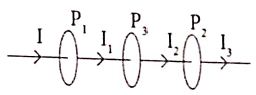
\(\mathrm{I}=32 \mathrm{Wm}^{-2} \)
\(\mathrm{I}_1=\frac{\mathrm{I}}{2}=16 \mathrm{Wm}^{-2} \)
\(\mathrm{I}_2=\mathrm{I}_1 \cos ^2 \theta_1 \quad \theta_1 \text { is the angle between the optic axes of } \mathrm{P}_1 \text { and } \mathrm{P}_3 \)
\(\mathrm{I}_2=16 \cos ^2 \theta_1 \)
\(\mathrm{I}_3=\mathrm{I}_2 \cos ^2 \theta_2 \)
θ2 is the angle between the optic axes of P2 and P3
\(I_3=\left(16 \cos ^2 \theta_1\right) \cos ^2 \theta_2 \)
\(\text { i.e., } \frac{3}{16}=\cos ^2 \theta_1 \cdot \cos ^2 \theta_2 \)
\(If \ \theta_1=30^{\circ} ; \quad \theta_2=60^{\circ} (Let \ us \ assume) \)
\(\frac{3}{16}=\left(\frac{\sqrt{3}}{2}\right)^2 \times\left(\frac{1}{2}\right)^2=\frac{3}{16} \)
\(\text { LHS }=\text { RHS }\)
Therefore, the angle between the axes of P1 and P3 is 30o.
4.
The following figure clearly depicts the situation given
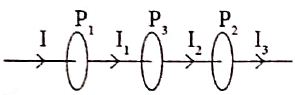
Let I be the intensity of unpolarised light which falls on polaroid P1
Then, I =\(\frac{I}{2}\)
Since the angle between the optic axes of P1 and P2 is 90°, no light is emerging from polaroid P2. After introducing the polaroid P3 between P1 and P2 let the angle between the optic axes of P1 and P3 be θ1 = 30°. If θ1 = 30, the angle between the optic axes of P3 and P2, will be 60°.
For this values i.e., θ1 = 30° & θ2 = 60°
I2 = I1 cos2 ∝ θ1 I2 = I1 cos2 ∝ θ1
\(=\frac{I}{2} \cos ^{2} 30^o\) and I3 = I2 cos2 60o
\(=\frac{I}{2}\times\frac{3}{4}\) \(=\frac{3I}{8}\times\frac{1}{4}\)
\(I_2=\frac{3I}{8} .......(1) \quad \quad\quad I_3=\frac{3I}{32} .......(2)\)
Instead, if θ1 = 45° and θ2 = 45°
\(NowI_2=\frac{I}{2}\times cos^245^o \quad and\quad I_3=\frac{I}{4}\times cos^245^o\)
\(=\frac{I}{2}\times\frac{1}{2} \quad \quad I_3=\frac{I}{8} ......(8)\)
\(I_2=\frac{I}{4} ......(3)\)
Compare the results (2) and (4)
I3 value for 45° is greater.
Therefore, we conclude that if the angle between the axes of first and newly introduced polaroid is 45°, the emerging light from the polaroid will be greater.
5.
λ = 5000 Å = 0.5 x 10⁻⁶ m,
a = 2.5 μm = 2.5 x 10⁻⁶ m
We know, a sin θ = nλ
For maximum order of diffraction, sin θ = 1
Therefore, 2.5 x 10-6 = n x 0.5 x 10⁻⁶
\(n=\frac{2.5}{0.5}=5\)
Maximum order of diffraction = 5.
6.
(i) Its cost is very high due to scarity of large and flawless calcite crystals
(ii) Due to extraordinary ray passing obliquely through it the emergent ray is always displaced a little to one side.
(iii) The effective field of view is quite limited
(iv) Light emerging out of it is not uniformly plane polarised.
7.
(i) Similar to a rectangular slit, when a circular aperture or opening (like a lens or the iris of our eye) forms an image of a point object, the image formed will not be a point but a diffraction pattern of concentric circles that become fainter while moving away from the center as shown in Figure. These are known as Airy's discs
\(asin\theta =1.22\lambda \)
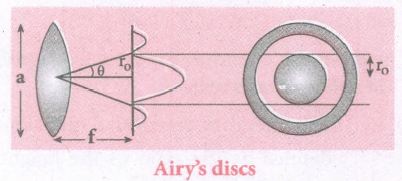
(ii) Here, the numerical value 1.22 comes for central "maximum formed by circular apertures.
For small angles, sin θ = θ
\(a\theta =1.22\lambda \)
Rewriting further,
\(\theta =\cfrac { 1.22\lambda }{ a } \ and \cfrac { { r }_{ o } }{ f } =\cfrac { 1.22\lambda }{ a } \)
\({ r }_{ o }=\cfrac { 1.22\lambda f }{ a } \)
8.
(i) For points of maxima, the slit is to be divided into an odd number of equal parts so that one part remains un-canceled making the point P appear bright.
The condition for the first maximum is,
\(\cfrac { a }{ 3 } sin\theta =\cfrac { \lambda }{ 2 } \) (or) \(asin\theta =\cfrac { 3\lambda }{ 2 } \)
The condition for the second maximum is
\(\cfrac { a }{ 5 } sin\theta =\cfrac { \lambda }{ 2 } \) (or) \(asin\theta =\cfrac { 5\lambda }{ 2 } \)
The condition for the third maximum is,
\(\cfrac { a }{ 7 } sin\theta =\cfrac { \lambda }{ 2 } \) (or) \( asin\theta =\cfrac { 7\lambda }{ 2 } \)
In the same way, the condition for nth maximum is
\(asin\theta =\left( 2n+1 \right) \cfrac { \lambda }{ 2 } \) (nth maximum)
where, n = 0, 1, 2, 3, ... , is the order of diffraction maximum.
(ii) The central maximum is called the order maximum. The points of the maximum intensity lie nearly midway between the successive minima.
9.
(i) The distance D between the screen and douhle slit should be as large as possibie.
(ii) The wavelength \(\lambda\) of light used must be as long as possible.
(iii) The distance d between the two slits must be as small as possible.
10.
| S.No | Resolution | Magnification |
| (i) | It's the ability to distinguish two objects from each other. | It's the ability to make small objects see larger. |
| (ii) | The effect of diffraction has an adverse effect in the sharpness of the image formed. | It's the ratio of the height of the image to the height of the object. |
| (iii) | For the condition of central maximum for rectangular slit is, a sin θ= λ and for circular slit is, a sin θ = 1.22 λ. | In terms of focal length by using lens equation \(\frac{1}{v}-\frac{1}{u}=\frac{1}{f}\) and the equation\( m=\frac{v}{u}\) we get \(m=1- \frac{v}{f}\). |

12th Standard Syllabus & Materials
12th Standard
TN 12th Computer Applications வலையமைப்பு வடமிடல் Sample Question Papers Study Material - QB365 Set A
NEW12th Standard
TN 12th Computer Applications களப்பெயர் முறைமை (DNS) Sample Question Papers Study Material - QB365 Set A
NEW12th Standard
TN 12th Computer Applications வலையமைப்பு எடுத்துக்காட்டுகள் மற்றும் நெறிமுறைகள் Sample Question Papers Study Material - QB365 Set A
NEW12th Standard
TN 12th Computer Applications கணினி வலையமைப்பு ஓர் அறிமுகம் Sample Question Papers Study Material - QB365 Set A



Tamilnadu Stateboard 12th Standard Subjects

Maths

Chemistry
Physics

Biology

Computer Science

Business Maths and Statistics

Economics

Commerce

Accountancy

History

Computer Applications
Biology
Computer Technology
Computer Applications
Computer Science
Business Maths and Statistics
Commerce
Economics
Maths
Chemistry
Physics
Computer Technology
History
Accountancy

Tamil

English

French
Tamilnadu Stateboard Standards

