
 100% FREE ACCESS
12th Standard Syllabus & Materials
12th Standard
TN 12th Computer Applications மின்னணு தரவு பரிமாற்றம் Sample Question Papers Study Material - QB365 Set A
NEW12th Standard
TN 12th Computer Applications மின் - வணிக பாதுகாப்பு அமைப்புகள் Sample Question Papers Study Material - QB365 Set A
NEW12th Standard
TN 12th Computer Applications மின்னணு செலுத்தல் முறைகள் Sample Question Papers Study Material - QB365 Set A
NEW12th Standard
TN 12th Computer Applications மின் - வணிகம் Sample Question Papers Study Material - QB365 Set A
NEW12th Standard
TN 12th Computer Applications திறந்த மூல கருத்துருக்கள் Sample Question Papers Study Material - QB365 Set A
NEW12th Standard
TN 12th Computer Applications வலையமைப்பு வடமிடல் Sample Question Papers Study Material - QB365 Set A

Published on: 27/01/2021
12th Standard Physics English Medium Wave Optics Reduced Syllabus Important Questions 2021
Download Tamil Nadu 12th Standard Physics question papers, model tests, one-mark questions, important questions, and public exam papers in PDF format. Free study materials and answer keys for TN State Board students.
Questions + Answers key
Take MCQ Physics Test1.
A rear mirror of a vehicle is cylindrical having a radius of curvature of 10 cm. The length of the arc of the curved surface is also 10 cm. If the eye of the driver is assumed to be at a large distance, from the mirror, then the field of view in radian is ____________.
0.5
1
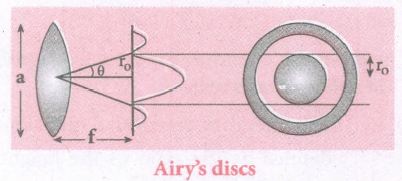
2
4
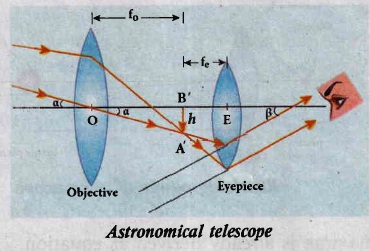
2.
3.
Light transmitted by Nicol prism is, _____.
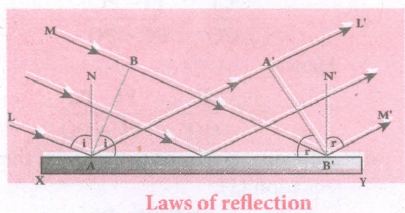
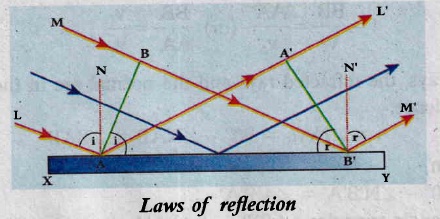
partially polarised
unpolarised
plane polarised
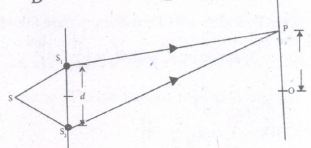
elliptically polarised
4.
One of the of Young’s double slits is covered with a glass plate as shown in figure. The position of central maximum will,_____.
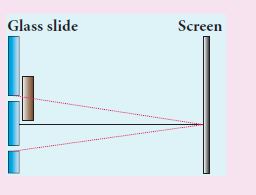
get shifted downwards
get shifted upwards
will remain the same
data insufficient to conclude
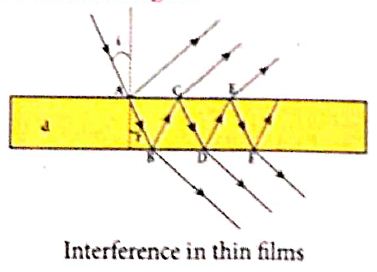
5.
A ray of light strikes a glass plate at an angle 60o. If the reflected and refracted rays are perpendicular to each other, the refractive index of the glass is, _____.
\(\sqrt3\)
\(\frac{3}{2}\)
\(\sqrt{\frac{3}{2}}\)
2
6.
7.
When light is incident on a soap film of thickness 5 x 10⁻⁵ cm, the wavelength of light reflected maximum in the visible region is 5320 Å. Refractive index of the film will be, _____.
1.22
1.33
1.51
1.83
8.
Two coherent monochromatic light beams of intensities I and 4I are superposed. The maximum and minimum possible intensities in the resulting beam are _____.
5I and I
5I and 3I
9I and I
9I and 3I
9.
In a Young’s double-slit experiment, the slit separation is doubled. To maintain the same fringe spacing on the screen, the screen-to-slit distance D must be changed to, _____.
2D
\(\frac{D}{2}\)
\(\sqrt{2}\)D
\(\frac{D}{\sqrt2}\)
10.
A plane glass is placed over a various coloured letters (violet, green, yellow, red) The letter which appears to be raised more is _____.
red
yellow
green
violet
11.
Light of wavelength 600 nm that falls on a pair of slits producing interference pattern on a screen in which the bright fringes are separated by 7.2 mm. What must be the wavelength of another light which produces bright fringes separated by 8.1 mm with the same apparatus?
12.
A beam of light of wavelength 600 nm from a distant source falls on a single slit 1 mm wide and the resulting diffraction pattern is observed on a screen 2 m away. What is the distance between the first dark fringes on either side of the central bright fringe?
13.
What is astigmatism? What is its remedy?
14.
What are polariser and analyser?
15.
What is call 'grating element'?
16.
Differentiate between Fresnel and Fraunhofer diffraction.
17.
What are coherent sources?
18.
State Huygens’ principle.
19.
Write a short note on quantum theory of light.
20.
What are the salient features of corpuscular theory of light?
21.
Write the drawbacks of Nicol prism.
22.
What are Airy's discs?
23.
What are the conditions for obtaining clear and broad interference bands?
24.
Discuss about astronomical telescope.
25.
State and obtain Malus’ law. (or) State Malus' Law.
26.
Differentiate between polarised and unpolarised light.
27.
Prove the laws of reflection using Huygen's principle.
28.
If a particle is thrown horizontally at a speed of 3 x 10⁸ms-1, deduce the verticalfall in traveling 1 km distance. Given: g = 10 ms-2, Does that result depend upon the mass of the particle? Comment on your result, considering that Newton thought light is made up of corpuscles that at a very large speed by the source
29.
Two polaroids are set in crossed positions. A third polaroid is placed between the two making an angle e with the pass axis of the first polaroid. Write the expression for the intensity of light transmitted from the second polaroid. In what orientations will the transmitted intensity be
(i) minimum and
(ii) maximum.
30.
In double-slit experiment, SS2 is greater than SSI by 0.25 A. Calculate the path difference between two interfering beams from S1 and S2 for minima and maxima on the screen.
31.
A Parallel beam of light of 500 nm falls on a narrow slit and be resulting diffraction pattern is observed on a screen 1m away. It is observed that the first minimum is at a distance of 2.5 mm from the centre of the screen. Calculate the width of the slit.
32.
You are given two converging lenses of focal lengths 1.25 cm and 5 cm to design a compound microscope. If it is desired to have a magnification of 30, find out the separation between the objective and the eyepiece.
33.
Obtain the equation for bandwidth in Young’s double slit experiment.
34.
Obtain the equation for resolving power of optical instruments.
35.
Discuss the experiment to determine the wavelength of different colours using diffraction grating.
36.
Discuss the diffraction at a grating and obtain the condition for the mth maximum.
37.
Discuss the interference in thin films and obtain the equations for constructive and destructive interference for transmitted and reflected light.
38.
Prove law of reflection using Huygens’ principle.
1.
(b)
1
2.
(d)
3.
(c)
plane polarised
4.
(b)
get shifted upwards
5.
n = tan ip = tan 60o = \(\sqrt{3}\)
6.
(b)
7.
2n t cos r = (2m + 1) \(\frac{\lambda}{2}\)
For maximum
m = 2 (For visible region), n - refractive index.
cos r = cos 0 = 1
t = 5 x 10-5 x 10-2 = 5 x 10⁻⁷ m
\(n=\frac{(2m+1)\frac{\lambda}{2}}{2t}=\frac{5\lambda}{2 \times 2 \times t}\)
\(=\frac{5 \times5320\times10^{-10}}{4 \times 5 \times 10^{-7}}\)
\(=\frac{5 \times5320\times10^{-10}}{20}=1330 \times 10^3\)
n = 1.330
8.
I = l1 + l2 + 2\(\sqrt{I_1I_2}\)cos θ
If cos θ = cos 0 = l, I is max
= I+ 4I + 2\(\sqrt{41^2}\) cos 0
= 5I + 4I = 91
If cos π = -1, I is min
Imin = I + 4I + 2\(\sqrt{41^2}\) cos π
= 5I + 4I(-1)
= 5I + 4I = I
(Imax, Imin)= (9I, I)
9.
d' = 2d, β' = β, D' = ?
W.K.T, Fringe width
\(\beta = \frac{D\lambda}{d} \Rightarrow D' = \frac{Dd'}{d}\)
\(D' = \frac{D2d}{d}=2D\)
10.
Refractive index for violet is more and wavelength for violet is very low comparing other colours. So, the letter which appears to be raised more is violet.
11.
ß1 = 7.2 mm, ß2 = 8.1 mm, λ1 = 600 nm, λ2 =?
Dividing, we get \(\beta = \frac{D\lambda}{d}(or)\beta∝\lambda\)
\(\frac{\beta_1}{\beta_2}=\frac{\lambda_1}{\lambda_2}\)
\(\therefore, { \lambda }_{ 2 }=\frac{\beta_2\times \lambda_1}{\beta_1}=\cfrac { 8.1\times10^{-3} \times 600 \times10^{-9}}{ 7.2 \times10^{-3}}
\)
\(=\cfrac { 9 \times 600\times10^{-9} }{ 8 }
=675\times 10^{-9 }\Rightarrow\lambda_2= 675nm\)
12.
⋋2 = 600 x 10-9 m, ⇒ d = 1 x 10⁻³ m, D =2m
n⋋ = dsinθ
For first dark fringe
n = 1 For minimum
d sinθ = ⋋, here
CO = Nc (approximately)
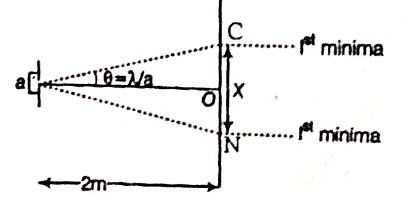
From Fig, sinθ \(=\frac{x/2}{D} =x/2D\)
\(sin \theta =\frac{ \lambda}{d} \)
\(\lambda/d=x/2D\)
\(\therefore x =\frac{2D\lambda}{d}=\frac{2 \times 2 \times 600\times 10^{-9}}{ 10^{-3}} \)
\(x=2.4 \times10^{-3}m =2.4\mathrm{~mm} \)
13.
Astigmatism:
Astigmatism is the defect arising due to different curvatures along different planes in the eye lens.
Remedy:
Use of Cylindrical, Bi-focal and progressive lenses.
14.
(i) The polaroid which polarises the light passing through it is called a polariser.
(ii) The polaroid which is used to examine whether a beam of light is polarised or not is called an analyser.
15.
(i) In Grating, the combined width of a ruling and a slit is called 'grating element' (1.e.) e = a + b.
16.
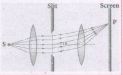
| S.No | Fresnel diffraction | Fraunhofer diffraction |
| (i) | Spherical or cylindrical wave front undergoes diffraction. | Plane wavefront undergoes diffraction. |
| (ii) | Light wave is from a source at finite distance. | Light wave is from a source at infinity. |
| (iii) | For laboratory conditions, convex lenses need not be used. | In laboratory conditions, convex lenses are to be used. |
| (iv) | Difficult to observe and analyse. | Easy to observe and analyse. |
| (v) | 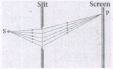 |
 |
17.
Two light sources are said to be coherent if they produce waves which have same phase or constant phase difference, same frequency or wavelength (monochromatic), same waveform and preferably same amplitude.
18.
According to Huygens's principle, each point of the wavefront is the source of secondary wavelets emanating from these points spreading out in all directions with the speed of the wave. These are called as secondary wavelets.
19.
Quantum theory of light:
Quantum theory states that light waves consist of small packets of energy called photons. The energy associated with each photon is E = hv, Where 'h' is Planck's constant (h = 6.625 x 10⁻³⁴ J s) and v is frequency of electromagnetic radiation.
20.
Salient features of corpuscular theory:
(i) A luminous body emits tiny massless perfectly elastic particles called corpuscles.
(ii) As the corpuscles are very small, the source does not suffer appreciable loss of mass.
(iii) They are not affected by gravity. so they travel with high speed in a straight line.
(iv) When these corpuscles impinge on the retina of the eye, the vision is produced.
(v) The different size of corpuscles is the reason for different colors.
(vi) The reflection is due to repulsion of the corpuscles by the medium.
(vii) The refraction is due to the attraction of the corpuscles by the medium.
(viii) This theory could not explain the reason why the speed of light is lesser in denser medium than in denser medium and also the phenomena like interference, diffraction and polarisation.
21.
(i) Its cost is very high due to scarity of large and flawless calcite crystals
(ii) Due to extraordinary ray passing obliquely through it the emergent ray is always displaced a little to one side.
(iii) The effective field of view is quite limited
(iv) Light emerging out of it is not uniformly plane polarised.
22.
(i) Similar to a rectangular slit, when a circular aperture or opening (like a lens or the iris of our eye) forms an image of a point object, the image formed will not be a point but a diffraction pattern of concentric circles that become fainter while moving away from the center as shown in Figure. These are known as Airy's discs
\(asin\theta =1.22\lambda \)
(ii) Here, the numerical value 1.22 comes for central "maximum formed by circular apertures.
For small angles, sin θ = θ
\(a\theta =1.22\lambda \)
Rewriting further,
\(\theta =\cfrac { 1.22\lambda }{ a } \ and \cfrac { { r }_{ o } }{ f } =\cfrac { 1.22\lambda }{ a } \)
\({ r }_{ o }=\cfrac { 1.22\lambda f }{ a } \)
23.
(i) The distance D between the screen and douhle slit should be as large as possibie.
(ii) The wavelength \(\lambda\) of light used must be as long as possible.
(iii) The distance d between the two slits must be as small as possible.
24.
(i) An astronomic telescope used to get the magnification of distant astronomical objects like stars, planets, moon etc.
(ii) The image formed by astronomicaltelescope willbe inverted. It has an objective of long focal length and a much larger aperture than the eyepiece as shown in Figure.
(iii) Light from a distant object enters the objective and a real image is formed in the tube at its second focal point.
(iv) The eyepiece magnifies this image producing a final inverted image.
Magnification of astronomical telescope:
The magnification m is the ratio of the angle β subtended by the image to the angle α which subtended by the object with the principal axis
\(m=\cfrac { \beta }{ \alpha } \) ......(1)
From the diagram, ,\(\alpha=\frac{h}{f_e} \ and \ \beta=\frac{h}{f_e}\) ...................(2)
\(m=\cfrac { { f }_{ 0 } }{ { f }_{ e } } \) .........................(3)
The length of the telescope is approximate, L = f0 + fe.
25.
When a beam of plane polarised light of intensity (Io) is incident on an analyser, the intensity of light (I) transmitted from the analyser varies directly as the square of the cosine of angle between the transmission axes of polariser and analyser.
\(I={ I }_{ o }cos^{ 2 }\theta \)
Consider the plane of polariser and analyser are inclined to each other at an angle ፀ. Let Io be the intensity and 'a' be the amplitude of the electric vector transmitted by the polariser. The amplitude 'a' of the incident light has two rectangular components, (acosθ) and (asinθ) which are the parallel and perpendicular components to the axis of transmission of the analyser. Only the component (acosθ) will be transmitted by the analyzer.
According to Malus's law
\(I\propto \left( acos\theta \right) ^{ 2 }\)
\(I=k\left( acos\theta \right) ^{ 2 }\)
Where k is constant of proportionality,
I = ka2 cos2 θ
I = Io = cos2 θ
Where Io = ka2 is the maximum intensity of light transmitted from the analyser.
26.
| S.No |
Polarised Light |
Unpolarised Light |
|---|---|---|
| (i) | It consists of waves having their electric field vibrations in a single plane normal to the direction of ray. | It consists of waves having their electric field and magnetic field vibrations in all directions normal to the direction of ray. |
| (ii) | Asymmetrical about the ray direction | Symmetrical about the ray direction. |
| (iii) | |It is obtained by converting unpolarised light using polaroids. | Produced by conventional light sources. |
27.
(i) Consider a parallel beam of light, incident on a reflecting plane surface such as a plane mirror XY as shown in Figure.
(ii) The incident wavefront is AB and the reflected wavefront is A'B' in the same medium. These wavefronts are perpendicular to the incident rays L, M and reflected rays L', M' respectively.
(iii) By the time point A of the incident wavefront touches the reflecting surface, point B is yet to travel a distance BB' to touch the reflecting surface a B'.
(iv) When point B falls on the reflecting surface at H', point A would have reached A.
(v) This is applicable to all the points on the wavefront. Thus, the reflected wavefront A'B' emanates as a plane wavefront. The two normals Nand N' are considered at the points where the rays Land Mfallon the reflecting surface.
(vi) As reflection happens in the same medium, the speed of light is the same before and after the reflection.
(vii) Hence, the time is taken for the ray to travel from B to B' is the same as the time taken for the ray to travel from A to A'.
(viii) Thus, the distance BB' is equal to the distance AA'; (A~A' = BB').
(a) The incident rays, the reflected rays, and the normal are in the same plane.
(b) Angle of incidence,\(\angle i=\angle NAL={ 90 }^{ o }-\angle NAB=\angle BAB'\)
Angle of reflection,
∠r= ∠N' B' M' = 900 - ∠N' B' A' = A' B' A'
(ix) For the two right-angle triangles, ΔABB' and ΔB' A' A', the right angles, ∠B and ∠A' are equal, (∠B and∠A = 900); the two sides, ∠A' and ∠B' are equal, (AA'= BB'); the side AB' is common.
(x) Thus, the two triangles are congruent. As per the property of congruency, the two angles, ∠BAB' and A' B' A' must also be equal.
i = r
Hence, the laws of reflection are proved.
28.
Horizontal distance, S = 1 km = 103 m
Horizontal speed, v = 3 x 10⁸ms-1 (assumed to be uniform)
\(t=\cfrac { S }{ v } =\cfrac { { 10 }^{ 3 } }{ 3\times { 10 }^{ 8 }{ ms }^{ -1 } } =\cfrac { 1 }{ 3\times { 10 }^{ 5 } } second\)
If y be the vertical fall in time t, then
\(y=\cfrac { 1 }{ 2 } { gt }^{ 2 }=\cfrac { 1 }{ 2 } \times \left( \cfrac { 1 }{ 3\times { 10 }^{ 5 } } \right) \) m = 5.5 x 10⁻¹¹m
This result is independent of the mass of the particle. As it is clear from the above result, the downward distance covered by the corpuscle is only 5.5 x 10⁻¹¹In for 103 m of horizontal distance covered by the corpuscle. So, we can neglect the effect of the earth's gravitation and safely assume that the corpuscles travel along a straight line.
29.
Let polaroids P1 and P3 be in a crossed positions.
Let the polaroid P2 make an angle e with the pass axis of polaroid Pr
Let I1 be the intensity of polarised light emerging our of P1 Then intensity of light after passing through P2 will I2 = I1cos2θ
Since P3 and P, are in crossed position, therefore, the angle made by P2 with P3 is \(\left( \cfrac { \pi }{ 2 } -\theta \right) \)
∴ The intensity of light coming out of P3 is
\({ I }_{ 3 }={ I }_{ 2 }{ cos }^{ 2 }\left( \cfrac { \pi }{ 2 } -\theta \right) \)
or \({ I }_{ 3 }={ I }_{ 2 }{ cos }^{ 2 }{ sin }^{ 2 }\theta =\theta ={ I }_{ 1 }\left( \cfrac { 1 }{ 2 } sin20 \right) ^{ 2 }\)
If I0 is the intensity of the unpolarised light falling on PI' then \({ I }_{ 1 }=\cfrac { { I }_{ o } }{ 2 } \)
\(\therefore { I }_{ 3 }=\cfrac { { I }_{ o } }{ 2 } \left( \cfrac { 1 }{ 2 } sin20 \right) ^{ 2 }\)
(i) Minimum outcoming intensity is zero.
(ii) Maximum outcoming intensity is received
when \(\theta =\cfrac { \pi }{ 4 } \)
\(\therefore \left( { I }_{ 3 } \right) _{ max }=\cfrac { { I }_{ o } }{ 2 } \left( \cfrac { 1 }{ 2 } \right) ^{ 2 }=\cfrac { { I }_{ o } }{ 8 } \)
30.
Path difference between interfering waves
= (SS2+ S2P) - (SS1 + S1)
= (S2P - S1P) + (SS2- SS1)
= \(\cfrac { d }{ D } y+0.25\lambda \)
For maximum
= \(\cfrac { d }{ D } y+0.25\lambda =n\lambda \)
or \(\cfrac { d }{ D } y=\left( n-0.25 \right) \lambda \)
For minimum,\(\cfrac { d }{ D } y+0.25\lambda \)
=\(\left( 2n+1 \right) \cfrac { \lambda }{ 2 } \)
or \(\cfrac { d }{ D } y=\left( 2n+1 \right) \cfrac { \lambda }{ 2 } -2\times 0.25\times \cfrac { \lambda }{ 2 } \)
or \(\cfrac { d }{ D } y=\left( 2n+0.5 \right) \cfrac { \lambda }{ 2 } \)
31.
Formula:
From the condition of diffraction,
a sin θ= nλ.. (for minima)
= \(\left( n+\cfrac { 1 }{ 2 } \right) \lambda \)
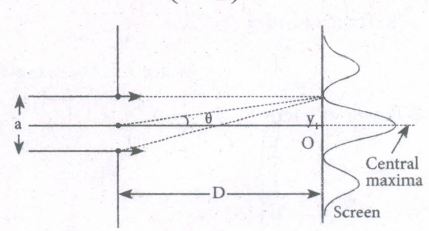
Provided n = 1, 2, 3 ... and n = 0 for central
maximum
From the condition of minima
a sin θ = λ. (n = 1)
Since the value of λ. is nm, so
\(a.\theta =\lambda \Rightarrow a.\cfrac { y }{ D } =\lambda \left[ amgle=\cfrac { arc }{ radius } \right] \)
= 2 x 10⁻⁴ m.
32.
The magnification due to the objective lens
\({ m }_{ o }=\cfrac { { v }_{ o } }{ \left( -{ \mu }_{ o} \right) } \)
If the object is close to the focus of the objective lens then
uo = fo and v = L
(L = distance between two lenses)
\({ m }_{ o }=\cfrac { L }{ { f }_{ o } } \)
If the final image is at the near point, then magnification due to the eye lens is
\({ m }_{ e }=\left( 1+\cfrac { D }{ { f }_{ e } } \right) \)
\(M={ m }_{ o }\times { m }_{ e }=\cfrac { L }{ { f }_{ o } } \left( 1+\cfrac { D }{ { f }_{ e } } \right) \)
The separation between the two lenses is 6.25 cm.
33.
Condition for bright fringe (or) maxima :
The condition for the point P to have a constructive interference (or) be a bright fringe Is,
Path diference, δ = nλ Where, n = 0, 1, 2,....
\(\therefore\frac{dy}{D}=n\lambda\)
\(y=n\frac{\lambda D}{d}(or)y_n=n\frac{\lambda D}{d}\) .....(4)
This is the condition for the point P to have a bright fringe. The distance yn is the distance or the nth bright fringe from the point O.
Condition for dark fringe (or) minima:
The condition for the point P to have a destructive interference (or) be a dark fringe is,
Path difference, δ = \((2n-1)\frac{\lambda}{2}\) Where, n = 1, 2, 3....
\(\therefore\frac{dy}{D}=(2n-1)\frac{\lambda}{2}\)
\(y=\left(\frac{(2n-1)}{2} \frac{\lambda D}{d}\right)(or)\left(\frac{(2 n-1)}{2} \frac{\lambda D}{d}\right) \) .....(5)
This is the condition for the point P to have a dark fringe. The distance yn is the distance of the nth dark fringe from the point O
Bandwidth:
The bandwidth \((\beta)\) is defined as the distance between any two consecutive bright or dark fringes.
\(\beta=y_{(n+1)}-y_{n}=\left((n+1) \frac{\lambda D}{d}\right)-\left(n \frac{\lambda D}{d}\right) \)
\(\beta=\frac{\lambda D}{d} \) .....(6)
Bright and Dark tinges are of same width equally spaced on either side of the central bright fringe.
34.
(i) The effect of diffraction has an adverse effect in the sharpness of the image tormed.
(ii) There is always a spread of central maximum in the image for every point of the object, for every point of the object acts as a point source.
(iii) The condition for central maximum (or first minimum) produced by rectangular slit is given by the equation,
\(a \sin \theta=\lambda\) ....(1)
(iv) But, a circular slit (aperture) produces diffraction pattern of concentric circles as shown in Figure.
(v) These are known as Airy's discs. Most of the optical instruments form images of objects only through the circular slits.
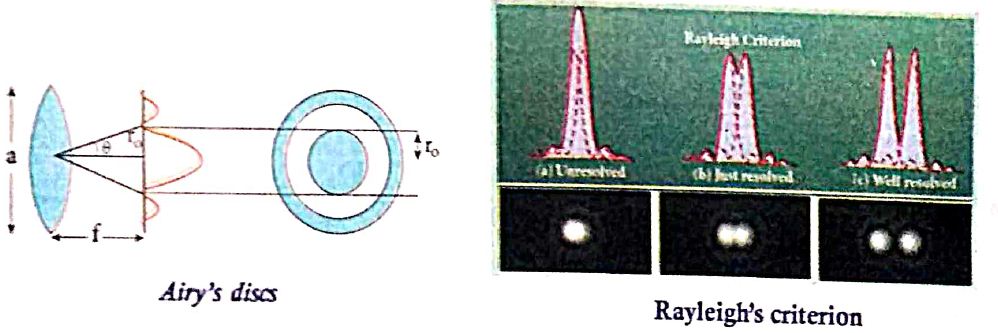
(vi) The condition for central maximum (or) first minimum for circular slit is,
\(\text { a } \sin \theta=1.22 \lambda\) .....(2)
(vii) Here, the numerical value 1.22 appears in the expression for central maximum (or) first minimum formed by circular slits.
For small angles,\(sin\theta = \theta\), the above equation becomes,
\(a\theta = 1.22\lambda\)
Rewriting further,
\(\theta=\frac{1.22 \lambda}{a}\) ......(3)
Form thegeometry, \(\theta=\frac{r_0}{f}\)
Substituting for in equation (3) and rearranging gives
\(r_0=\frac{1.22 \lambda f}{a}\) ....(4)
(viii) For example, let two point-sources of light close to cach other form image on a screen. The diffraction pattern of one point-source may overlap with another and produce a blurred image (or) un-resolved image as shown in Figure (a). To obtain a quality image (or) well resolved image, the two point-sources must be kept apart in such a way that their diffraction patterns do not overlap as shown in Figure (c).
(ix) According to Rayleigh's criterion, the two points on an image are said to be just resolved when the central maximum of one diffraction pattern coincides with the first minimum of the other and vice-versa as shown in Figure (b).
35.
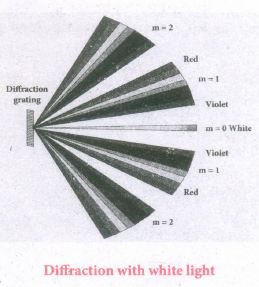
(i) Thediffraction pattern for white light consists of a white central maximum and on both side continuous coloured diffraction pattenrs are formed.
(ii) The central maximum is white as all the colours constructively meet at centre with no path difference. As \(\theta\) increases, the path difference fuifills the condition for maxima of different orders for all colours from violet to red.
(iii) It produces a spectrum of diffraction pattern from violet to red on either side of central maximum as shown in Figure.
(iv) By measuring the angle at which these colours appear for various orders of diffraction, the wavelength of different colours could be calculated using the formula.
\(\lambda =\cfrac { sin\theta }{ Nm } \)
(v) Here, N is the number of rulings per metre in the grating and m is the order of the diffraction image.
36.
(i) Gratting has multiple slits with equal widths of size comparable to the wavelength of diffracting light.
(ii) Grating is a plane sheet of transparent material on which opaque rulings are made with a fine diamond pointer.
(iii) The modern commercial grating contains about 6000 lines per centimeter. The rulings act as obstacles having a definite width b and the transparent space between the rulings act as slit of width a.
(iv) The combined width of a ruling and a slit is called Gratting element (e = a + b).
(v) points on slit separated by a distance equal to the grating element are called corresponding points.
(vi) A plane transmission grating is represented by AB in Figure. Let a plane wavefront of monochromatic light with wavelength λ be incident on the grating.
(vii) As the width of the slits is comparable to that of wavelength, the incident light undergoes diffraction.
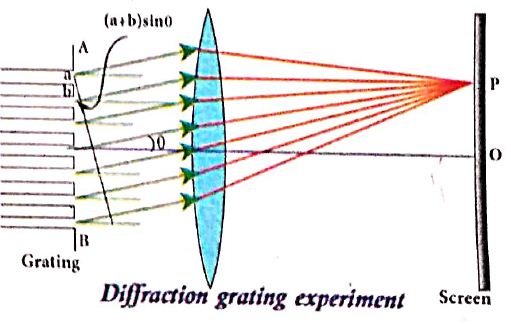
(viii) A diffraction pattern is obtained on the screen when the diffracted waves are focused on a screen using a convex lens.
(ix) Let us consider a point P at an angle θ with the perpendicular drawn from the center of the grating to the screen.
(x) The path difference ઠ between the diffracted waves from one pair of corresponding points is,
\(\delta =(a+b)sin\theta \) ........(1)
This path difference is the same for any pair of corresponding points. The point P on the screen will be maximum, when
ઠ= m λ where m = 0,1,2,3 ........(2)
Combining the above two equations, we get,
(a + b) sin θ = mλ ...............(3)
Here, m is called order of diffraction.
Condition for mth order maximum :
(i) On the side of central maxima different higher orders of diffraction maxima are formed at different angular positions. If we take,
\(N=\cfrac { 1 }{ a+b } \) .................(4)
(ii) Then, N gives the number of grating elements or rulings drawn per unit width of the grating. Normally, this number N is specified on the grating itself. Now, the equation becomes,
\(\cfrac { 1 }{ N } sin\theta =m\lambda \) (or) \(sin\theta =Nm\lambda \) ...............(5)
37.
For transmitted light :
(i) The light transmitted may interfere to produce a resultant intensity. Consider the path difference between the two light waves transmitted from B and D.
(ii) The two waves moved together and remained in phase up to B where splitting occurred.
The extra path travelled by the wave transmitted from D is the path inside the film, BC + CD.
(iii) If we approximate the incidence to be nearly normal (i = 0), then the points B and D are very close to each other.
(iv) The extra distance travelled by the wave is approximately twice thickness of the film, BC + CD = 2d. As this extra path is traversed inside the medium of refractive index m, the optical path difference is, d = 2μd.
(v) The condition for constructive interference in transmitted ray is,
\(2\mu d=n\lambda \) .....(1)
(vi) Similarly, the condition for destructive interference in transmitted ray is,
\(2\mu d=\left( 2n-1 \right) \cfrac { \lambda }{ 2 } \) .....(2)
For reflected light:
(i) It is experimentally and theoretically proved that a wave while travelling in a rarer medium and getting reflected by a denser medium, undergoes a phase change of π.
(ii) Hence, an additional path difference of \(\cfrac { \lambda }{ 2 } \) should be considered for reflected light.
(iii) Let us consider the 2 path difference between the light waves reflected by the upper surface at A and the other wave coming out at C after passing through the film.
(iv) The additional path travelled by wave coming out from C is the path inside the film, AB + BC. For nearly normal incidence this distance could be approximated as, AB + BC = 2d.
(v) As this extra path is travelled in the medium of refractive index μ, the optical path difference is, ઠ = 2μd.
(vi)The condition for constructive interference for reflected ray is,
\(2\mu d+\cfrac { \lambda }{ 2 } =n\lambda \) (or) \(2\mu d=\left( 2n-1 \right) \cfrac { \lambda }{ 2 } \) .....(3)
(vii) The additional path difference \(\cfrac { \lambda }{ 2 } \) is due to the phase change of π in rarer to denser reflection taking place at A.
(viii) The condition for destructive interference for reflected ray is
\(2\mu d+\cfrac { \lambda }{ 2 } =\left( 2N+1 \right) \cfrac { \lambda }{ 2 } \) (or) \(2\mu d=n\lambda \) ....(4)
38.
(i) Let us consider a parallel beam of light, incident on a reflecting plane surface such as a plane mirror XY.
(ii) The incident wavefront is AB and the reflected waterfront is A'B'.
(iii) These wavefronts are perpendicular to the incident rays L, M and reflected rays L', M', respectively.
(i) The incident rays, the reflected rays and the normal are in the same plane.
(ii) Angle of incidence, ∠i = ∠NAL = 90°- ∠NAB = ∠BAB'
Angle of reflection ∠r = ∠N'B'M = 90°- ∠N'B'A'= ∠A'B'A
(a) For the two right angle triangles, ∆ABB' and ∆B'A'A, the two right angles, ∠B and ∠A' are equal, (∠B and ∠A' = 90°); the two sides., AA' and BB' are equal, (AA' = BB'); the side AB' is common
(b) Thus the two triangles are congruent. As per the property of congruency, the two angles, ∠BAB' and ∠A'B'A must also be equal.
i = r
Hence, the laws of reflection are proved.

12th Standard Syllabus & Materials
12th Standard
TN 12th Computer Applications களப்பெயர் முறைமை (DNS) Sample Question Papers Study Material - QB365 Set A
NEW12th Standard
TN 12th Computer Applications வலையமைப்பு எடுத்துக்காட்டுகள் மற்றும் நெறிமுறைகள் Sample Question Papers Study Material - QB365 Set A
NEW12th Standard
TN 12th Computer Applications கணினி வலையமைப்பு ஓர் அறிமுகம் Sample Question Papers Study Material - QB365 Set A
NEW12th Standard
TN 12th Computer Applications PHP-உடன் MySQL-ஐ இணைத்தல் Sample Question Papers Study Material - QB365 Set A



Tamilnadu Stateboard 12th Standard Subjects

Maths

Chemistry
Physics

Biology

Computer Science

Business Maths and Statistics

Economics

Commerce

Accountancy

History

Computer Applications
Biology
Computer Technology
Computer Applications
Computer Science
Business Maths and Statistics
Commerce
Economics
Maths
Chemistry
Physics
Computer Technology
History
Accountancy

Tamil

English

French
Tamilnadu Stateboard Standards

