
 100% FREE ACCESS
12th Standard Syllabus & Materials
12th Standard
TN 12th Computer Applications மின்னணு தரவு பரிமாற்றம் Sample Question Papers Study Material - QB365 Set A
NEW12th Standard
TN 12th Computer Applications மின் - வணிக பாதுகாப்பு அமைப்புகள் Sample Question Papers Study Material - QB365 Set A
NEW12th Standard
TN 12th Computer Applications மின்னணு செலுத்தல் முறைகள் Sample Question Papers Study Material - QB365 Set A
NEW12th Standard
TN 12th Computer Applications மின் - வணிகம் Sample Question Papers Study Material - QB365 Set A
NEW12th Standard
TN 12th Computer Applications திறந்த மூல கருத்துருக்கள் Sample Question Papers Study Material - QB365 Set A
NEW12th Standard
TN 12th Computer Applications வலையமைப்பு வடமிடல் Sample Question Papers Study Material - QB365 Set A

Published on: 01/08/2019
Download Tamil Nadu 12th Standard Physics question papers, model tests, one-mark questions, important questions, and public exam papers in PDF format. Free study materials and answer keys for TN State Board students.
Questions + Answers key
Take MCQ Physics Test1.
A rectangular current carrying loop placed 2 cm away from a long, street, current - carrying conductors. What is the direction and magnitude of the net force acting on the loop.
2.
How will the magnetic field intensity at the contre of a circular coil carrying current change if the current through the coil is doubled and the radius of the coil is halved?
3.
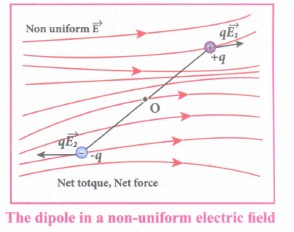
What happens when and electric dipole is held in a non-uniform electric field?
4.
Two resistors when connected in series and parallel, their equivalent resistances are 15 Ω and \(\frac{56}{15}\)Ω respectively. Find the individual resistances.
5.
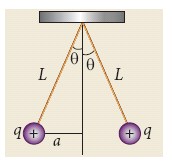
Two small-sized identical equally charged spheres, each having mass 1 g are hanging in equilibrium as shown in the figure. The length of each string is 10 cm and the angle θ is 30° with the vertical. Calculate the magnitude of the charge in each sphere. (Take g = 10 ms−2)
6.
A rectangular coil of area 2 x 10⁻⁴ m2 and 40 turns is pivoted about one of its vertical sides. The coil is in a radial horizontal field of 60G. What is the torsional constant of the hair springs connected to the coil if a current of 4.0 mA produces an angular deflection of 16°?
7.
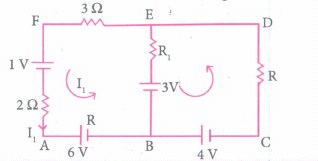
Use Kirchhoff's laws (rules) to determine the potential difference between points A and D when no current flows in the arm BE of the electric network shown in the figure below.
8.
Consider a point charge +q placed at the origin and another point charge -2q placed at a distance of 9 m from the charge +q. Determine the point between the two charges at which electric potential is zero.
9.
For a large charge accumulation, the end of the conductor should have larger curvature that is_________.
bigger radius
Smaller radius
maximum radius
less bent
10.
The value of constant 'K' in coulomb law is _____________.
0.9 x 10⁹ Nm2 C2
9 x 10⁻⁹ Nm2C2
9 x 10⁹ Nm-2 C-2
9 x 10⁹ Nm2 C-2
11.
Three wires of equal lengths are bent in the form of loops. One of the loops is circle, another is a semi-circle and the third one is a square. They are placed in a uniform magnetic field and same electric current is passed through them. Which of the following loop configuration will experience greater torque?
Circle
Semi-circle
Square
All of them
12.
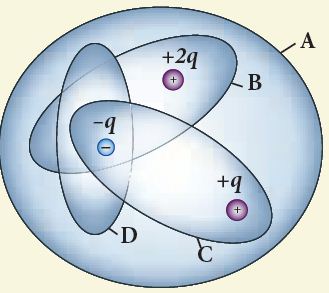
Four Gaussian surfaces are given below with charges inside each Gaussian surface. Rank the electric flux through each Gaussian surface in increasing order.
D < C < B < A
A < B = C < D
C < A = B < D
D > C > B > A
13.
A carbon resistor of (47 ± 4.7 ) k Ω to be marked with rings of different colours for its identification. The colour code sequence will be ______.
Yellow – Green – Violet – Gold
Yellow – Violet – Orange – Silver
Violet – Yellow – Orange – Silver
Green – Orange – Violet - Gold
14.
What do you mean by end resistance? How can it be rectified?
15.
What is conductor?
16.
What are Polar molecules? Give examples.
17.
What is meant by ‘electric field lines’?
18.
What do you mean by internal resistance of a cell?
19.
End rule
20.
Right hand thumb rule
21.
Electric Heaters
22.
Dielectric strength
23.
Electrostatic force
1.
The like currents i.e current in both the wire are in the same direction attracts each other. The force is repulsive when the current flows in opposite direction through the wires.
F = \(\frac { { \mu }_{ 0 }{ I }_{ 1 }{ I }_{ 2 }dl }{ 2\pi r } \)
i.e \(F\alpha \frac { 1 }{ r } \)
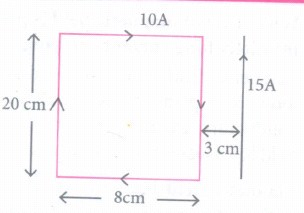
As the wire of the loop carrying the opposite current is near so the net force acting on the loop is repulsive.
2.
The magnetic field at the center of a circular coil
B = \(\frac { { \mu }_{ 0 }NI }{ 2R } \)
When current I is doubled and radius R is halved,
B' = \(\frac { { \mu }_{ 0 }N\times 2I }{ 2\left( \frac { R }{ 2 } \right) } \) = 4B
∴ magnetic field becomes four times the original field.
3.
If the electric field is not uniform, then the force experienced by +q is different from that experienced by -q. In addition to the torque, there will be net force acting on the dipole.
4.
Rs = R1 + R2 = 15 Ω (1)
\({ R }_{ p }=\frac { { R }_{ 1 }{ R }_{ 2 } }{ { R }_{ 1 }{ +R }_{ 2 } } =\frac { 56 }{ 15 } \Omega \quad \) (2)
From equation (1) substituting for R1 + R2 in equation (2)
\(\frac { { R }_{ 1 }{ R }_{ 2 } }{ 15 } =\frac { 56 }{ 15 } \Omega \)
∴ R1R2 = 56
\({ R }_{ 2 }=\frac { 56 }{ 15 } \Omega \) (3)
Substituting for R2 in equation (1) from equation (3)
\({ R }_{ 1 }+\frac { 56 }{ { R }_{ 1 } } =15\)
Then, \(\frac { { R }_{ 1 }^{ 2 }+56 }{ { R }_{ 1 } } =15\)
R12 + 56 = 15 R1
R12 - 15 R1 + 56 = 0
The above equation can be solved using factorisation.
R1 = 8 Ω (or) R1 = 7 Ω
If (R1 = 8 Ω)
Substituting in equation (1)
8 + R2 = 15
R2 = 15 – 8 = 7 Ω ,
R2 = 7 Ω i.e , (when R1 = 8 Ω ; R2 = 7 Ω)
If R1= 7 Ω
Substituting in equation (1)
7 + R2 = 15
R2 = 8 Ω , i.e , (when R1 = 7 Ω ; R2 = 8 Ω )
5.
If the two spheres are neutral, the angle between them will be 0o when hanged vertically. Since they are positively charged spheres, there will be a repulsive force between them and they will be at equilibrium with each other at an angle of 30° with the vertical. At equilibrium, each charge experiences zero net force in each direction. We can draw a free-body diagram for one of the charged spheres and apply Newton’s second law for both vertical and horizontal directions.
The free-body diagram is shown below
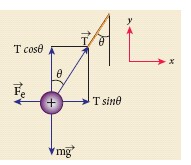
In the x-direction, the acceleration of the charged sphere is zero.
Using Newton’s second law \((\vec { { F }_{ tot }= } m\vec { a } )\), we have
T sinθ\(\hat { i } \) - Fe\(\hat { i } \) =0
T sinθ = Fe ......(1)
Here T is the tension acting on the charge due to the string and Fe is the electrostatic force between the two charges.
In the y-direction also, the net acceleration experienced by the charge is zero
Tcosθ\(\hat { j } \) - mg\(\hat { j } \) = 0
Tcosθ = mg ..(2)
By dividing equation (1) by equation (2),
tanθ = \(\frac { { F }_{ e } }{ mg } \) .....(3)
Since they are equally charged, the magnitude of the electrostatic force is
\({ F }_{ e }=k\frac { { q }^{ 2 } }{ { r }^{ 2 } } \) where k=\(\frac { 1 }{ 4\pi { \varepsilon }_{ 0 } } \)
Here r = 2a = 2Lsinθ. By substituting these values in equation (3),
tanθ = k\(\frac { { q }^{ 2 } }{ mg(2Lsin\theta )^{ 2 } } \) ..........(4)
Rearranging the equation (4) to get q
q = 2 Lsinθ\(\\ \sqrt { \frac { mgtan\theta }{ k } } \)
= 2 x 0.1 x sin 30o x \(\sqrt { \frac { 10^{ -3 }\times 10\times { tan30 }^{ 0 } }{ 9\times 10^{ 9 } } } \)
q = 8.01 x 10⁻⁸C = 80.1 nC
6.
B = 60G, A = 2 x 10⁻⁴m2
N = 40, I = 4mA = 4 x 10⁻³A
θ = 160
I =\(\frac { K\theta }{ BAN } \)
K = \(\frac { BANI }{ \theta } \)
= \(\frac { 40\times 60\times 2\times 10^{ -4 }\times 4\times 10^{ -3 } }{ 16 } \)
= 1.2 x 10⁻⁴ Nm/degree
7.
Applying kirchhoff's law (loop rule) for loop ABEFA, (since current is reversed, negative sing on both sides)
= R1 x 0 - 3 x I1 - 2I1 = -6-3-1
= 3I1 - 2I1= -10
= 5I1 = -10
I1 = 2A
for loop BCDEB
= R x I1 - R1 x 0 = -4 + 3
= I1R = 1
\(R=\cfrac { 1 }{ 2 } \Omega \)
Potential difference between A and D through path ABCD is
= 6-4 + VAD = I1R
= 10 + VAD = -2 x \(\cfrac { 1 }{ 2 } \)
= 10 + CAD = -1
VAD = -9 Volt
8.
According to the superposition principle, the total electric potential at a point is equal to the sum of the potentials due to each charge at that point.
Consider the point at which the total potential zero is located at a distance x from the charge +q as shown in the figure.
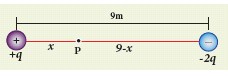
The total electric potential at P is zero.
Vtot = \(\frac { 1 }{ 4\pi { \varepsilon }_{ 0 } } \left( \frac { q }{ x } -\frac { 2q }{ (9-x) } \right) \)=0
Which gives \(\frac { q }{ x } -\frac { 2q }{ (9-x) } \)
or \(\frac { 1 }{ x } =\frac { 2 }{ (9-x) } \)
Hence, x = 3m
9.
(b)
Smaller radius
10.
(d)
9 x 10⁹ Nm2 C-2
11.
(a)
Circle
12.
The electric flux of D is less than that of C
The electric flux of C is less than that of B
The electric flux of B is less than that of A
13.
Yellow - 4
Violet - 7
Orange - 103
Silver - Tolerance - 10%
14.
The bridge wire is soldered at the ends of the copper strips. Due to imperfect contact, some resistance, might be introduced at the contact. These are called end resistances. This error can be eliminated, if another set of readings are taken with P and Q interchanged and the average value of P is found.
15.
The substances which have an abundance of free electrons are called conductors. These free electrons move at random throughout the conductor at a given temperature. In general due to this random motion, there is no net transfer of charges from one end of the conductor to other end and hence no current. When a potential difference is applied by the battery across the ends of the conductor, the free electrons drift towards the positive terminal of the battery, producing a net electric current.
16.
(i) In polar molecules, the centers of the positive and negative charges are separated even in the absence of an external electric field.
(ii) They have a permanent dipole moment.
(iii) Examples : H2O, N2O, HCI and NH3.
17.
Electric field lines are a set of continuous lines which represent the electric field in some region of space visually.
18.
The internal resistance of a cell is the resistance offered to the flow of current (by the electrolyte) inside the cell.
19.
To find the polarity of the solenoid
20.
Applied for circular coil carrying current
21.
Nichrome
22.
Maximum electric field
23.
Newton's III law

12th Standard Syllabus & Materials
12th Standard
TN 12th Computer Applications களப்பெயர் முறைமை (DNS) Sample Question Papers Study Material - QB365 Set A
NEW12th Standard
TN 12th Computer Applications வலையமைப்பு எடுத்துக்காட்டுகள் மற்றும் நெறிமுறைகள் Sample Question Papers Study Material - QB365 Set A
NEW12th Standard
TN 12th Computer Applications கணினி வலையமைப்பு ஓர் அறிமுகம் Sample Question Papers Study Material - QB365 Set A
NEW12th Standard
TN 12th Computer Applications PHP-உடன் MySQL-ஐ இணைத்தல் Sample Question Papers Study Material - QB365 Set A



Tamilnadu Stateboard 12th Standard Subjects

Maths

Chemistry
Physics

Biology

Computer Science

Business Maths and Statistics

Economics

Commerce

Accountancy

History

Computer Applications
Biology
Computer Technology
Computer Applications
Computer Science
Business Maths and Statistics
Commerce
Economics
Maths
Chemistry
Physics
Computer Technology
History
Accountancy

Tamil

English

French
Tamilnadu Stateboard Standards

