
 100% FREE ACCESS
12th Standard Syllabus & Materials
12th Standard
TN 12th Computer Applications மின்னணு தரவு பரிமாற்றம் Sample Question Papers Study Material - QB365 Set A
NEW12th Standard
TN 12th Computer Applications மின் - வணிக பாதுகாப்பு அமைப்புகள் Sample Question Papers Study Material - QB365 Set A
NEW12th Standard
TN 12th Computer Applications மின்னணு செலுத்தல் முறைகள் Sample Question Papers Study Material - QB365 Set A
NEW12th Standard
TN 12th Computer Applications மின் - வணிகம் Sample Question Papers Study Material - QB365 Set A
NEW12th Standard
TN 12th Computer Applications திறந்த மூல கருத்துருக்கள் Sample Question Papers Study Material - QB365 Set A
NEW12th Standard
TN 12th Computer Applications வலையமைப்பு வடமிடல் Sample Question Papers Study Material - QB365 Set A

Published on: 02/09/2019
Magnetism and Magnetic Effects of Electric Current
Download Tamil Nadu 12th Standard Physics question papers, model tests, one-mark questions, important questions, and public exam papers in PDF format. Free study materials and answer keys for TN State Board students.
Questions + Answers key
Take MCQ Physics Test1.
What is meant by hysteresis?
2.
Compare dia, para and ferro-magnetism.
3.
State Ampere’s circuital law.
4.
Let E be the electric field of magnitude 6.0 x 10⁶ N C–1 and B be the magnetic field magnitude 0.83 T. Suppose an electron is accelerated with a potential of 200 V, will it show zero deflection?. If not, at what potential will it show zero deflection.
5.
Two materials X and Y are magnetised whose values of intensity of magnetisation are 500 A m–1 and 2000 A m–1 respectively. If the magnetising field is 1000 A m–1, then which one among these materials can be easily magnetized?
6.
The repulsive force between two magnetic poles in air is 9 x 10⁻³ N. If the two poles are equal in strength and are separated by a distance of 10 cm, calculate the pole strength of each pole.
7.
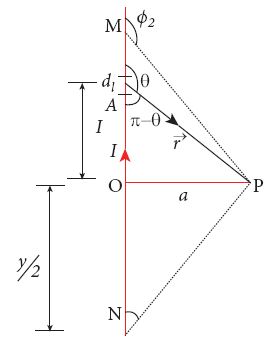
Calculate the magnetic field at a point P which is perpendicular bisector to current carrying straight wire as shown in figure.
8.
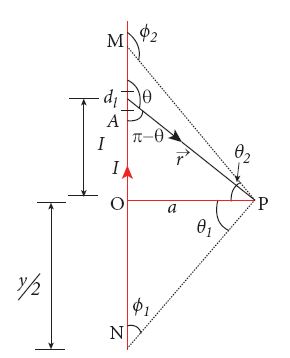
Show that for a straight conductor, the magnetic field
\(\overset { \rightarrow }{ B } =\frac { { \mu }_{ ° }I }{ 4\pi a } (cos\varphi _{ 1 }-cos\varphi _{ 2 })\hat { n } \)
\(=\frac { { \mu }_{ ° }I }{ 4\pi a } (sin{ \theta }_{ 1 }+sin{ \theta }_{ 2 })\hat { n } \)
9.
A simple pendulum with charged bob is oscillating with time period T and lets θ be the angular displacement. If the uniform magnetic field switched ON in a direction perpendicular to the plane of oscillation then ___________.
time period will decrease but θ will remain constant
time period remain constant but θ will decrease
both T and θ will remain the same
both T and θ will decrease
10.
The vertical component of Earth’s magnetic field at a place is equal to the horizontal component. What is the value of angle of dip at this place?
30°
45°
60°
90°
11.
A non-conducting charged ring carrying a charge of q, mass m and radius r is rotated about its axis with constant angular speed ω. Find the ratio of its magnetic moment with angular momentum is _____.
\(\\ \frac { q }{ m } \)
\(\\ \frac { 2q }{ m } \)
\(\\ \frac { q }{ 2m } \)
\(\\ \frac { q }{ 4m } \)
12.
Three wires of equal lengths are bent in the form of loops. One of the loops is circle, another is a semi-circle and the third one is a square. They are placed in a uniform magnetic field and same electric current is passed through them. Which of the following loop configuration will experience greater torque?
Circle
Semi-circle
Square
All of them
13.
A particle having mass m and charge q accelerated through a potential difference V. Find the force experienced when it is kept under perpendicular magnetic field \(\vec { B } \).
\(\sqrt { \frac { 2{ q }^{ 3 }BV }{ m } } \)
\(\sqrt { \frac { { q }^{ 3 }{ B }^{ 2 }V }{ 2m } } \)
\(\sqrt { \frac { 2{ q }^{ 3 }{ B }^{ 2 }V }{ m } } \)
\(\sqrt { \frac { { 2q }^{ 3 }BV }{ { m }^{ 3 } } } \)
1.
Hysteresis is the phenomenon of lagging of magnetic induction behind the magnetising field.
2.
| sno | Dia magnetic materials | Para magnetic materials | Ferromagnetic materials |
| (i) | In diamagnetic materials each electron orbit has finite orbital magnetic dipole moment. | In paramagnetic materials each atom (or) molecule has net magnetic dipole moment. |
The ferromagnetic materials have net dipole moment as in a paramagnetic material. |
| (ii) | Since the orbital planes are oriented in random manner, the vector sum of magnetic moments is zero. | Due to the random orientation of these magnetic moments, the net magnetic moment of the material is zero. | Within each domain, the magnetic moments are spontaneously aligned in a direction. |
| (iii) | The resultant magnetic moment for each atom is zero. | There is net magnetic dipole moment induced in the direction of the applied field. | Since the direction of magnetisation varies from domain to domain, net magnetisation of the specimen is zero. |
3.
Ampere's circuital law states that the line integral of magnetic field over a closed loop is μ0, times net current enclosed by the loop.
\(\oint _{ c }^{ }{ \vec { B } \vec { dl } } \) = μ0I enclosed.
4.
Electric field, E = 6.0 x 10⁶ N C-1 and magnetic field, B = 0.83 T.
Then.
\(v=\frac { E }{ B } =\frac { { 6.0\times 10 }^{ 6 } }{ 0.83 } =7.23\times { 10 }^{ 6 }{ ms }^{ -1 }\)
When an electron goes with this velocity, it shows null deflection. Since the accelerating potential is 200 V, the electron acquires kinetic energy because of this accelerating potential. Hence,
\(\frac { 1 }{ 2 } mv^{ 2 }=eV \)
\(v=\sqrt { \frac { 2eV }{ m } }\)
Since the mass of the electron, m = 9.1 x 10⁻³¹kg and charge of an electron, \(\left| q \right| =e=1.6\times { 10 }^{ -19 }C.\) The velocity acquired by the electron due to accelerating potential 200 V is
\({ v }_{ 200 }=\sqrt { \frac { 2\left( 1.6\times { 10 }^{ -19 } \right) \left( 200 \right) }{ \left( 9.1\times { 10 }^{ -31 } \right) } } =8.39\times { 10 }^{ 6 }m{ s }^{ -1 }\)
Since the speed v200 > v, the electron is deflected towards direction of Lorentz force. So, in order to have null deflection, the potential, we have to supply is
\(v=\frac { { 1mv }^{ 2 } }{ 2\quad e } =\frac { \left( 9.1\times { 10 }^{ -31 } \right) \times \left( 7.23\times { 10 }^{ 6 } \right) ^{ 2 } }{ 2\times \left( 1.6\times { 10 }^{ -19 } \right) } \)
V = 148.65 V
5.
The susceptibility of material X is
Xm,x = \(\frac { \left| \overset { \rightarrow }{ M } \right| }{ \left| \overset { \rightarrow }{ H } \right| } =\frac { 500 }{ 1000 } =0.5\)
The susceptibility of material Y is
Xm,y = \(\frac { \left| \overset { \rightarrow }{ M } \right| }{ \left| \overset { \rightarrow }{ H } \right| } =\frac { 2000 }{ 1000 } =2\)
Since, susceptibility of material Y is greater than that of material X, material Y can be easily magnetized than X.
6.
The magnitude of the force between two poles is given by
\( F =k\frac { { q }_{ m_A }{ q }_{ { m }_{ B } } }{ { r }^{ 2 } } \)
(Given : F = 9 × 10⁻³ N, r = 10 cm = 10 × 10–2 m
Since qmA = qmB = qm, we have
9 x 10-3 = 10-7 x \(\frac { { q }_{ m }^{ 2 } }{ { \left( 10\times { 10 }^{ -2 } \right) }^{ 2 } } \Rightarrow { q }_{ m }\) = 30NT-1
7.
Let the length MN = y and the point P is on its perpendicular bisector. Let O be the point on the conductor as shown in figure. Therefore,
\(OM=ON=\frac { y }{ 2 } ,then\)
\(cos\varphi _{ 1 }=\frac { \frac { y }{ 2 } }{ \sqrt { \frac { { y }^{ 2 } }{ 4 } +{ d }^{ 2 } } } =\frac { adjacent \ length }{ hypotenuse \ length } \)
\(=\frac { ON }{ PH } =-\frac { \frac { y }{ 2 } }{ \sqrt { \frac { { y }^{ 2 } }{ 4 } +{ a }^{ 2 } } } =-\frac { y }{ \sqrt { { y }^{ 2 }+{ 4a }^{ 2 } } } \)
\(cos\varphi _{ 1 }=\frac { adjacent \ length }{ hypotenuse \ length } =\frac { OM }{ PM } \)
\(=-\frac { \frac { y }{ 2 } }{ \sqrt { \frac { { y }^{ 2 } }{ 4 } +{ a }^{ 2 } } } =-\frac { y }{ \sqrt { { y }^{ 2 }+{ 4a }^{ 2 } } } \)
Hence,
\(\overset { \rightarrow }{ B } =\frac { { \mu }_{ ° }I }{ 4\pi a\sqrt { { y }^{ 2 }+{ 4a }^{ 2 } } } \hat { n } \)
For long straight wire, Y\(\rightarrow \infty ,\)
\(\overset { \rightarrow }{ B } =\frac { { \mu }_{ ° }I }{ 2\pi a } \hat { n } \)
The result obtained is the same as we obtained in equation (3.39).
8.
In a right angle triangle OPN let the angle \(\angle\)OPN = \(\theta \)1 which implies, \({ \varphi }_{ 1 }=\frac { \pi }{ 2 } -{ \theta }_{ 1 }\) and also in a right angle triangle OPM,
\(\angle\)OPN = \(\theta \)2 which implies, \({ \varphi }_{ 2 }=\frac { \pi }{ 2 } +{ \theta }_{ 2 }\)
Hence,
\(\overset { \rightarrow }{ B } =\frac { { \mu }_{ ° }I }{ 4\pi a } \left( cos\left( \frac { \pi }{ 2 } -{ \theta }_{ 1 } \right) -cos\left( \frac { \pi }{ 2 } +{ \theta }_{ 2 } \right) \right) \hat { n } \)
\(=\frac { { \mu }_{ ° }I }{ 4\pi a } (si{ n }_{ 1 }+{ sin }_{ 2 })\hat { n } \)
9.
(c)
both T and θ will remain the same
10.
\(tan \ I=\frac{B_V}{B_H}=1\)
∴ I = 45o
11.
Magnetic moment,
μ = IA
Angular momentum,
L = Iω
Ratio \(\frac{p_m}{L}=\frac{(q/T)\pi r^2}{mr^2\omega}=\frac{q}{2m}\)
12.
(a)
Circle
13.
Lorentz force F = Bqv
Energy w = qV
Energy is equal to kinetic energy,
\(qV=\frac{1}{2}mv^2\)
\(v=\sqrt { \frac {2qV }{ m } } \)
\(\therefore Lorentz \ force \ F= Bq\times \sqrt \frac{2qV}{m}=\sqrt { \frac { 2{ B }^{ 2 }{ q }^{ 3 }V }{ m } } \)

12th Standard Syllabus & Materials
12th Standard
TN 12th Computer Applications களப்பெயர் முறைமை (DNS) Sample Question Papers Study Material - QB365 Set A
NEW12th Standard
TN 12th Computer Applications வலையமைப்பு எடுத்துக்காட்டுகள் மற்றும் நெறிமுறைகள் Sample Question Papers Study Material - QB365 Set A
NEW12th Standard
TN 12th Computer Applications கணினி வலையமைப்பு ஓர் அறிமுகம் Sample Question Papers Study Material - QB365 Set A
NEW12th Standard
TN 12th Computer Applications PHP-உடன் MySQL-ஐ இணைத்தல் Sample Question Papers Study Material - QB365 Set A



Tamilnadu Stateboard 12th Standard Subjects

Maths

Chemistry
Physics

Biology

Computer Science

Business Maths and Statistics

Economics

Commerce

Accountancy

History

Computer Applications
Biology
Computer Technology
Computer Applications
Computer Science
Business Maths and Statistics
Commerce
Economics
Maths
Chemistry
Physics
Computer Technology
History
Accountancy

Tamil

English

French
Tamilnadu Stateboard Standards

