
 100% FREE ACCESS
12th Standard Syllabus & Materials
12th Standard
TN 12th Computer Applications மின்னணு தரவு பரிமாற்றம் Sample Question Papers Study Material - QB365 Set A
NEW12th Standard
TN 12th Computer Applications மின் - வணிக பாதுகாப்பு அமைப்புகள் Sample Question Papers Study Material - QB365 Set A
NEW12th Standard
TN 12th Computer Applications மின்னணு செலுத்தல் முறைகள் Sample Question Papers Study Material - QB365 Set A
NEW12th Standard
TN 12th Computer Applications மின் - வணிகம் Sample Question Papers Study Material - QB365 Set A
NEW12th Standard
TN 12th Computer Applications திறந்த மூல கருத்துருக்கள் Sample Question Papers Study Material - QB365 Set A
NEW12th Standard
TN 12th Computer Applications வலையமைப்பு வடமிடல் Sample Question Papers Study Material - QB365 Set A

Published on: 01/10/2019
Magnetism and Magnetic Effects of Electric Current
Download Tamil Nadu 12th Standard Physics question papers, model tests, one-mark questions, important questions, and public exam papers in PDF format. Free study materials and answer keys for TN State Board students.
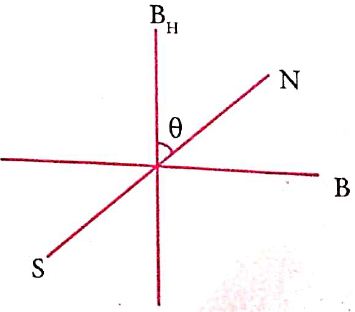
Questions + Answers key
Take MCQ Physics Test1.
What is meant by hysteresis?
2.
State Ampere’s circuital law.
3.
State Biot-Savart’s law.
4.
State Coulomb’s inverse law.
5.
Define magnetic flux.
6.
What is meant by magnetic induction?
7.
The repulsive force between two magnetic poles in air is 9 x 10⁻³ N. If the two poles are equal in strength and are separated by a distance of 10 cm, calculate the pole strength of each pole.
8.
The horizontal component and vertical component of Earth’s magnetic field at a place are 0.15 G and 0.26 G respectively. Calculate the angle of dip and resultant magnetic field. (G - gauss, cgs unit for magnetic field 1G = 10–4 T)
9.
A bar magnet is placed in a uniform magnetic field whose strength is 0.8 T. If the bar magnet is oriented at an angle 30o with the external field experiences a torque of 0.2 Nm. Calculate
(i) the magnetic moment of the magnet
(ii) the work done by the applied force in moving it from most stable configuration to the most unstable configuration and also compute the work done by the applied magnetic field in this case.
10.
An electron moving perpendicular to a uniform magnetic field 0.500 T undergoes circular motion of radius 2.50 mm. What is the speed of electron?
11.
Compute the intensity of magnetisation of the bar magnet whose mass, magnetic moment and density are 200 g, 2 A m2 and 8 g cm–3, respectively.
12.
When current is doubled deflection is also doubled in ______________.
moving coil galvanometer
tangent galvanometer
both of them
neither of two
13.
The most suitable metal for permanent magnet is ______________.
copper
aluminium
steel
iron
14.
The vertical component of Earth’s magnetic field at a place is equal to the horizontal component. What is the value of angle of dip at this place?
30°
45°
60°
90°
15.
A wire of length l carrying a current I along the Y direction is kept in a magnetic field is given by \(\vec { B } =\frac { \beta }{ \sqrt { 3 } } =(\hat { i } +\hat { j } +\hat { k } )T.\) The magnitude of Lorentz force acting on the wire is _____.
\(\sqrt { \frac { 2 }{ { 3 } } } \beta Il\)
\(\sqrt { \frac { 1 }{ { 3 } } } \beta Il\)
\(\sqrt { 2 } \beta Il\)
\(\sqrt { \frac { 1 }{ 2 } } \beta Il\)
16.
A circular coil of radius 5 cm and 50 turns carries a current of 3 ampere. The magnetic dipole moment of the coil is nearly ____.
1.0 A m2
1.2 A m2
0.5 A m2
0.8 A m2
17.
What is tangent law? Discuss in detail.
18.
Discuss Earth’s magnetic field in detail.
19.
End rule
20.
Maxwell's right hand cork screw rule
21.
Permanent magnets
22.
Ferromagnetic materials
23.
Diamagnetic materials
24.
Find the odd one out.
(a) MRI scan
(b) head phones
(c) Hard disc of laptop
(d) Capacitor
25.
Find the odd one out.
(a) Electric current
(b) Pole strength
(c) Magnetic flux
(d) Magnetic dipole moment
26.
Assertion: If two ends of a solenoid are bent and together to form a closed ring shape, it is called as toroid
Reason: Magnetic field due to a long current-carrying solenoid is m
B=\(\frac { \mu NI }{ L } \) =μnI (where, n=\(\frac { N }{ L } \))
Codes:
(a) Assertion and Reason are correct and Reason is the correct explanation of Assertion.
(b) Assertion and Reason are true but Reason is the false explanation of the Assertion.
(c) Assertion is true but Reason is false.
(d) Assertion is false but Reason is true
27.
(I) The ability of the materials to retain the magnetism in them even magnetising field vanishes is called remanence or retentivity
(II) Hysterisis means 'lagging beyond' which one is incorrect statement?
Which one is correct statement?
(a) I only
(b) II only
(c) both are correct
(d) none of these
28.
(I) Closed line integral means integral over a closed curve (or line), (symbol is \(\oint { } \) (or) \(\int _{ C }^{ }{ ] } \)
(II) Right hand thumb Rule is used to determine the direction of magnetic moment
Which one is correct statement?
(a) I only
(b) Il only
(c) both are correct
(d) none of these
1.
Hysteresis is the phenomenon of lagging of magnetic induction behind the magnetising field.
2.
Ampere's circuital law states that the line integral of magnetic field over a closed loop is μ0, times net current enclosed by the loop.
\(\oint _{ c }^{ }{ \vec { B } \vec { dl } } \) = μ0I enclosed.
3.
Biot-Savart's law states that, the magnitude of magnetic field \(d\vec { B } \) at a point P at a distance of r from the small elemental length taken on a conductor carrying current varies
(i) directly as the strength of the current I
(ii) directly as the magnitude of the length of element \(\vec { dl } \)
(iii) directly as the sine of the angle θ between \(\vec { dl } \) and \(\hat { r } \).
(iv) inversely as the square of the distance r between the point P and length of element \(\vec { dl } \).
\(d\vec { B } =\frac { { \mu }_{ 0 } }{ 4\pi } \frac { I\vec { dl } \times \hat { r } }{ { r }^{ 2 } } \)
4.
Coulomb's inverse square law states that the force of attraction or repulsion between two magnetic poles is directly proportional to the product of their pole strengths and inversely proportional to the square of the distance between them.
\(\vec { F } =k \frac { { q }_{ m_{A} }{ q }_{ m_{B} } }{ { r }^{ 2 } } \hat { r } \)
5.
Magnetic flux is defined as the number of magnetic field lines crossing per unit area kept normal to the direction of lines of force.
6.
(i) When a substance is placed in a uniform magnetising field, the substance gets magnetised.
(ii) The total magnetic field inside the specimen is equal to the sum of the magnetic field produced in vacuum due to the magnetising field and the magnetic field due to the induced magnetism of the substance.
7.
The magnitude of the force between two poles is given by
\( F =k\frac { { q }_{ m_A }{ q }_{ { m }_{ B } } }{ { r }^{ 2 } } \)
(Given : F = 9 × 10⁻³ N, r = 10 cm = 10 × 10–2 m
Since qmA = qmB = qm, we have
9 x 10-3 = 10-7 x \(\frac { { q }_{ m }^{ 2 } }{ { \left( 10\times { 10 }^{ -2 } \right) }^{ 2 } } \Rightarrow { q }_{ m }\) = 30NT-1
8.
BH = 0.15 G and BV = 0.26 G
tan I = \(\frac { 0.26 }{ 0.15 } \Rightarrow I=ta{ n }^{ -1 }(1.732)=60°\)
The resultant magnetic field of the Earth is
\(B=\sqrt { { B }_{ H }^{ 2 }+{ B }_{ V }^{ 2 } } =0.3G\)
9.
Uniform magnetic field B = 0.8 T
Angle of orientation θ = 30°
Torque, ፒ = 0.2 Nm.
(i) We know that torque ፒ = PmB sinθ
\(0.2=p_\mathrm{m} \times 0.8 \times \sin 30^{\circ} \)
\(0.2=p_\mathrm{m} \times 0.8 \times \frac{1}{2} \)
0.2 = 0.4 pm
\(p_m=\frac{0.2}{0.4}=0.5 \mathrm{Am}^{2}\)
(ii) Work done by the applied force to move the magnet from stable to unstable position.
\(\mathrm{W} =-p_\mathrm{m}B\left[\cos \theta_{2}-\cos \theta_{1}\right] \)
\(\mathrm{W} =-p_\mathrm{m}B\left(\cos 180^{\circ}-\cos 0^{\circ}\right) \)
\(\mathrm{W} =-p_\mathrm{m}B(-1-1)=2 \mathrm{p_mB} \)
\(\mathrm{W} =2 \times 0.5 \times 0.8=\mathbf{0 . 8} \mathbf{J} \)
Work done by the applied magnetic field are in opposite direction
\(\mathbf{W}_{\text {mag }}=-0.8 \mathrm{J}\)
10.
Charge of an electron q = –1.60 × 10⁻¹⁹ C ⇒ |q| = 1 60 x 10-19 C
Magnitude of magnetic field B = 0.500 T
Mass of the electron, m = 9.11 × 10⁻³¹ kg
Radius of the orbit, r = 2.50 mm = 2.50 × 10⁻³ m
Speed of the electron, V = \(q \frac{\mathrm{rB}}{\mathrm{m}}\)
\( v = 1.60 \times 10^{-19} \times\frac{ 2.50 \times 10^{-3} \times 0.500}{9.11 \times 10^{-31}}\)
\(v=2.195 \times 10^8 \mathrm{~m} \mathrm{s} ^{-1}\)
11.
Density of the magnet is
Density = \(\frac { Mass }{ volume } \Rightarrow Volume=\frac { Mass }{ Density } \)
\(Volume=\frac { 200\times 1{ 0 }^{ -3 }kg }{ \left( 8\times 1{ 0 }^{ -3 }kg \right) \times 1{ 0 }^{ 6 }{ m }^{ -3 } } =25\times { 10 }^{ -6 }{ m }^{ 3 }\)
Magnitude of magnetic moment pm = 2A m2
Intensity of magnetization,
\(I=\frac { magnetic\ moment }{ Volume } =\frac { 2 }{ 25\times { 10 }^{ -6 } } \)
M = 0.8 x 10⁵ Am-1
12.
(a)
moving coil galvanometer
13.
(c)
steel
14.
\(tan \ I=\frac{B_V}{B_H}=1\)
∴ I = 45o
15.
\(\vec { B } =\frac { \beta }{ \sqrt { 3 } } =(\hat { i } +\hat { j } +\hat { k } )T\)
Using an equation,
Lorentz force, \(\vec{F}=Il\hat{j}\times\vec B\)
We can get,
Lorentz force \(F=\sqrt { \frac { 2 }{ { 3 } } } \beta Il\)
16.
Dipole moment, \(\vec{p}_m=n\times I\times\vec{A}\)
\(\vec{p}_m\) = 50 x 3 x 3.14 x 25 x 10-4 ≈ 1.2 A m2
17.
(i) When a magnetic needle or magnet is freely suspended in two mutually perpendicular uniform magnetic fields, it will come to rest in the direction of the resultant of the two fields.
(ii) Let B be the magnetic field produced by passing current through the coil of the tangent galvanometer and BH be the horizontal component of earth's magnetic field.
(iii) Under the action of two magnetic fields, the needle comes to rest making angle with BH , such that
B = BH tan \(\theta\) .........(1)
Where B ⇒ magnetic field produced by current
BH ⇒ horizontal component of earth's magnetic field
Construction:
(i) Copper coil of wire wound on a non-magnetic circular frame such as brass or wood. Compass box is kept at centre.
(ii) This compass box consists of pivoted magnet and aluminum pointer.
(iii) This compass box is having circular scale graduated with four quadrants.
Working:
(i) Two magnetic fields are perpendicular to each other.
(ii) Magnetic induction due to the current in the coil acting to normal to the plane of the coil.
(iii) Magnetic induction at the centre of the coil,
\(B=μ_o\frac{NI}{2R}\) .....(2)
Sub. eqn.(1) in eqn. (2)
\(B_H tan \theta =μ_o\frac{NI}{2R}\)
\(B_H =μ_o\frac{NI}{2R}\frac{1}{tan\theta}\)
18.
There are three quantities required to specify the magnetic field of the Earth on its surface, which are often called as the elements of the Earth's magnetic field. They are:
(a) magnetic declination (D)
(b) magnetic dip or inclination (I)
(c) the horizontal component of the Earth's magnetic field (BH)
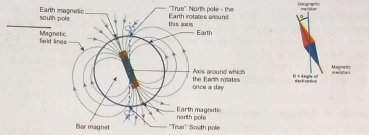
Let BE be the net Earth's magnetic field at any point P on the surface of the Earth. BE can be resolved into two perpendicular components.
Horizontal component, BH = BE cos I .... (1)
Vertical component, BV = BE sin I .....(2)
Dividing equation (1) and (2), we get,
\(=\frac{B_{V}}{B_{H}} ...(3)\)
(i) At magnetic equator:
The Earth's magnetic field is parallel to the surface of the Earth (i.e., horizontal) which implies that the needle of magnetic compass rests horizontally at an angle of dip, I = 0o Hence, BH = BE
BV = 0
This implies that the horizontal component is maximum and vertical component is zero at equator.
(ii) At magnetic poles:
The Earth's magnetic field is perpendicular to the surface of the Earth (i.e, vertical) which implies that the needle of magnetic compass rests vertically at an angle of dip, I = 90o
Hence, BH = 0
BV = BE
This implies that the vertical component is maximum at poles and horizontal component is zero at poles.
19.
To find the polarity of the solenoid
20.
To find the direction of magnetic field
21.
Steel, Alnico
22.
Fe, Ni, Co etc.,
23.
Bi, Sb, Cu
24.
Capacitor
25.
Magnetic dipole moment
26.
(b) Assertion and Reason are true but Reason is the false explanation of the Assertion.
27.
II only
28.
both are correct

12th Standard Syllabus & Materials
12th Standard
TN 12th Computer Applications களப்பெயர் முறைமை (DNS) Sample Question Papers Study Material - QB365 Set A
NEW12th Standard
TN 12th Computer Applications வலையமைப்பு எடுத்துக்காட்டுகள் மற்றும் நெறிமுறைகள் Sample Question Papers Study Material - QB365 Set A
NEW12th Standard
TN 12th Computer Applications கணினி வலையமைப்பு ஓர் அறிமுகம் Sample Question Papers Study Material - QB365 Set A
NEW12th Standard
TN 12th Computer Applications PHP-உடன் MySQL-ஐ இணைத்தல் Sample Question Papers Study Material - QB365 Set A



Tamilnadu Stateboard 12th Standard Subjects

Maths

Chemistry
Physics

Biology

Computer Science

Business Maths and Statistics

Economics

Commerce

Accountancy

History

Computer Applications
Biology
Computer Technology
Computer Applications
Computer Science
Business Maths and Statistics
Commerce
Economics
Maths
Chemistry
Physics
Computer Technology
History
Accountancy

Tamil

English

French
Tamilnadu Stateboard Standards

