
 100% FREE ACCESS
12th Standard Syllabus & Materials
12th Standard
TN 12th Computer Applications மின்னணு தரவு பரிமாற்றம் Sample Question Papers Study Material - QB365 Set A
NEW12th Standard
TN 12th Computer Applications மின் - வணிக பாதுகாப்பு அமைப்புகள் Sample Question Papers Study Material - QB365 Set A
NEW12th Standard
TN 12th Computer Applications மின்னணு செலுத்தல் முறைகள் Sample Question Papers Study Material - QB365 Set A
NEW12th Standard
TN 12th Computer Applications மின் - வணிகம் Sample Question Papers Study Material - QB365 Set A
NEW12th Standard
TN 12th Computer Applications திறந்த மூல கருத்துருக்கள் Sample Question Papers Study Material - QB365 Set A
NEW12th Standard
TN 12th Computer Applications வலையமைப்பு வடமிடல் Sample Question Papers Study Material - QB365 Set A

Published on: 29/10/2019
Download Tamil Nadu 12th Standard Physics question papers, model tests, one-mark questions, important questions, and public exam papers in PDF format. Free study materials and answer keys for TN State Board students.
Questions + Answers key
Take MCQ Physics Test1.
What is Snell’s window?
2.
Define magnetic flux.
3.
When does power factor of a series RLC circuit become maximum?
4.
A bicycle wheel with metal spokes of 1 m long rotates in Earth’s magnetic field. The plane of the wheel is perpendicular to the horizontal component of Earth’s field of 4×10⁻⁵T. If the emf induced across the spokes is 31.4 mV, calculate the rate of revolution of the wheel.
5.
Give the principle of AC generator.
6.
What is displacement current?
7.
Define ‘electric dipole’. Give the expression for the magnitiude of its electric dipole moment and the direction.
8.
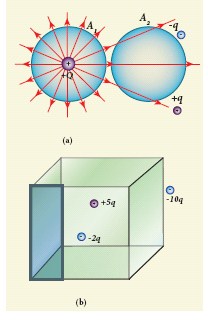
(i) In figure (a), calculate the electric flux through the closed areas A1 and A2.
(ii) In figure (b), calculate the electric flux through the cube.
9.
State Kirchhoff ’s voltage rule.
10.
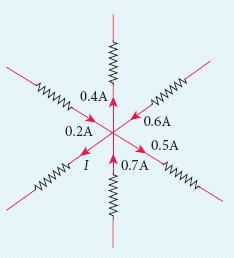
For the given circuit find the value of I.
11.
The gravitational waves were theoretically proposed by _____.
Conrad Rontgen
Marie Curie
Albert Einstein
Edward Purcell
12.
13.
The output transducer of the communication system converts the radio signal into ________.
Sound
Mechanical energy
Kinetic energy
None of the above
14.
The barrier potential of a silicon diode is approximately, ______.
0.7 V
0.3 V
2.0 V
2.2 V
15.
Atomic number of H-like atom with ionization potential 122.4 V for n = 1 is _____.
1
2
3
4
16.
If the mean wavelength of light from sun is taken as 550 nm and its mean power as 3.8 x 1026 W, then the number of photons emitted per second from the sun is of the order of _____.
1045
1042
1054
1051
17.
Stars twinkle due to, ______.
reflection
total internal reflection
refraction
polarisation
18.
Three wires of equal lengths are bent in the form of loops. One of the loops is circle, another is a semi-circle and the third one is a square. They are placed in a uniform magnetic field and same electric current is passed through them. Which of the following loop configuration will experience greater torque?
Circle
Semi-circle
Square
All of them
19.
When the current changes from +2A to −2A in 0.05 s, an emf of 8 V is induced in a coil. The co-efficient of self-induction of the coil is
0.2H
0.4H
0.8H
0.1H
20.
Which of the following is an electromagnetic wave?
α - rays
β - rays
\(\gamma\) - rays
all of them
21.
If the amplitude of the magnetic field is 3 x 10⁻⁶ T, then amplitude of the electric field for a electromagnetic waves is _____.
100 V m−1
300 V m-1
600 V m-1
900 V m-1
22.
An electric field \(\vec { E } =10x\hat { i } \) exists in a certain region of space. Then the potential difference V = Vo – VA, where Vo is the potential at the origin and VA is the potential at x = 2 m is _____.
10 V
-20 V
+20 V
-10 V
23.
Which charge configuration produces a uniform electric field?
point charge
uniformly charged infinite line
uniformly charged infinite plane
uniformly charged spherical shell
24.
25.
Two wires of A and B with circular cross section made up of the same material with equal lengths. Suppose RA = 3 RB, then what is the ratio of radius of wire A to that of B?
3
\(\sqrt3\)
\(\frac{1}{\sqrt3}\)
\(\frac{1}{3}\)
26.
Write short notes on
(a) microwaves
(b) X - rays
(c) Radio waves
(d) Visible spectrum
27.
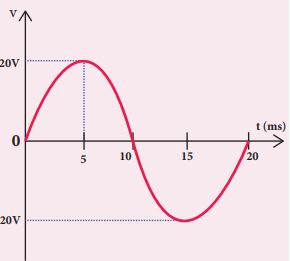
Write down the equation for a sinusoidal voltage of 50 Hz and its peak value is 20 V. Draw the corresponding voltage versus time graph.
28.
Define ‘Electric field’ and discuss its various aspects.
29.
State and explain Kirchhoff ’s rules
30.
What is tangent law? Discuss in detail.
31.
Give the uses of Foucault current.
32.
Discuss the source of electromagnetic waves.
1.
When light entering the water from outside is seen from inside the water, the view is restricted to a particular angle equal to the critical angle ic. The restricted illuminated circular area is called Snell's window
2.
Magnetic flux is defined as the number of magnetic field lines crossing per unit area kept normal to the direction of lines of force.
3.
Power factor will be maximum, when Φ = 0 i.e., \(\tan ^{-1}\left(\frac{X_L-X_C}{R}\right)=0\)
\(\therefore X_L=X_C \Rightarrow L \omega=\frac{1}{C \omega} \)
\(\therefore \omega=\frac{1}{2 \pi \sqrt{L C}}\)
∴ Current I be max \(I_m=\frac{V_m}{R}\)
Hence power factor of a RLC series circuit becomes maximum, when
(i) \(X_L=X_C\)
(ii) Current \(I_m=\frac{V_m}{R}\) will be maximum
(iii) Frequency \(\omega_r=\frac{1}{2 \pi \sqrt{L C}}\)
4.
Horizontal component of Earth's magnetic field, \(B_H=4 \times 10^{-5} \mathrm{~T}\)
Length of a spoke, l = 1 m,
Induced emf, \(e = 31.4 \times 10^{-3} \mathrm{~V}\)
Change in magnetic flux, \(d \phi=B d s\)
\(\therefore d \phi=B \times \pi l^2\)
we know that, \(d t=\frac{2 \pi}{\omega}\)
\(\therefore \text {Magnitude of induced emf, } e =\left|-\frac{d \phi}{d t}\right| \)
\(e =\frac{d \phi}{d t}=\frac{B \pi l^2}{2 \pi / \omega}=\frac{1}{2} B l^2 \omega \)
\(e =\frac{1}{2} B l^2 \times 2 \pi v=\pi B l^2 v \quad(\because \omega=2 \pi v)\)
∴ Rate of revolution, \(v=\frac{e}{\pi B l^2}\)
\(v =\frac{31.4 \times 10^{-3}}{3.14 \times 4 \times 10^{-5} \times(1)^2} \)
\(=\frac{10 \times 10^{-3+5}}{4}=\frac{10^3}{4}=250 \mathrm{rps}\)
∴ Rate of rotation of the wheel v = 250 revolutions/second.
5.
AC generator work on the principle of electromagnetic induction. The relative motion between a conductor and a magnetic field changes the magnetic flux linked with the conductor which in turn, induces an emf
6.
The displacement current can be defined as the current which comes into play in the region in which the electric field or the electric flux is changing with time.
7.
(i) Two equal and opposite charges separated by a small distance constitute an electric dipole.
(ii) The magnitude of the electric dipole moment is equal to the product of the magnitude of one of the charges and the distance between them, \(|\vec{p}|=2 q a\).
(iii) The electric dipole moment vector lies along the line joining two charges and is directed from -q to +q.
8.
(i) In figure (a), area A1 encloses the charge Q. So electric flux through this closed surface A1 is \(\frac { Q }{ { \varepsilon }_{ 0 } } \). But the closed surface A2 contains no charges inside, so electric flux through A2 is zero.
(ii) In figure (b), the net charge inside the cube is 3q and the total electric flux in the cube is therefore \(\Phi _{ E }=\frac { 3q }{ { \varepsilon }_{ 0 } } \).
Note that the charge -10 q lies outside the cube and it will not contribute the total flux through the surface of the cube.
9.
It states that in a closed circuit the algebraic sum of the products of the current and resistance of each part of the circuit is equal to the total emf included in the circuit.
10.
Applying Kirchoff’s rule to the point P in the circuit,
The arrows pointing towards P are positive and away from P are negative.
Therefore, 0.2A - 0.4A + 0.6A - 0.5A + 0.7A - I = 0
0.7 A - I = 0
1.5A - 0.9A – I = 0
0.6A - I = 0
I = 0.6 A
11.
Albert Einstein theoretically proposed the existence of gravitational waves in the year 1915.
12.
(c)
13.
(a)
Sound
14.
(a)
0.7 V
15.
\(V_{ionisation}=\frac{13.6}{n^2}Z^2 volt\)
\(Z=\sqrt\frac{V\times n^2}{13.6}=\sqrt\frac{122.4 \times I^2}{13.6}=\sqrt{9}=3\)
16.
\(\mathrm{P} =\frac{\mathrm{n}}{\mathrm{t}} \frac{\mathrm{hc}}{\lambda} \)
\(\frac{\mathrm{n}}{\mathrm{t}} =\frac{\mathrm{P} \lambda}{\mathrm{hc}} \)
\(\frac{\mathrm{n}}{\mathrm{t}} =\frac{3.8 \times 10^{26} \times 550 \times 10^{-9}}{6.6 \times 10^{-3} \times 3 \times 10^8}=1 \times 10^{-15}\)
17.
(c)
refraction
18.
(a)
Circle
19.
\(\text {emf } e=8 \mathrm{~V} \)
\(d I=I_1-I_0=2-(-2)=4 \mathrm{~A} \)
\(\text {dt }=0.05 \mathrm{~s} \)
\(L=\frac{-e}{d I / d t}=\frac{-8}{4 / 0.05} \)
\(=\frac{-8 \times 0.05}{4}=\frac{-0.40}{4} \)
=-0.1 H
-ve sign indicates that self-induced emf always opposes the current w.r.t. time.
20.
(c)
\(\gamma\) - rays
21.
Bo = 3 x 10⁻⁶T
Amplitude of electric field, Eo = Boc
Eo = 3 x 10-6 x 3 x 108 = 900V m -1
22.
\(\vec {E}\) = 10x\(\hat{i},\) when x = 2 m
\(\vec {E}\) = 10 x 2 x \(\hat{i}\) = 20\(\hat{i}\)
Since, \(E=\frac{-dV}{dx}\therefore V=+20 V\)
23.
(c)
uniformly charged infinite plane
24.
(a)
25.
\(R \propto \frac{1}{A}, R \propto \frac{1}{r^2} \)
\(R_A \propto \frac{1}{r_A^2}, R_B \propto \frac{1}{r_B^2} \)
\(\frac{r_A}{r_B}=\left(\frac{R_B}{R_A}\right)^{1 / 2}=\left(\frac{R_B}{3 R_B}\right)^{1 / 2}=\frac{1}{3^{\frac{1}{2}}}=\frac{1}{\sqrt{3}}\)
26.
(a) Microwaves:
It is produced by special vacuum tubes such as klystron, magnetron and gunn diode. The frequency range of microwaves is 109 Hz to 1011 Hz. These waves undergo reflection and can be polarised.
Uses:
It is used in radar system for aircraft navigation, speed of the vehicle, microwave oven for cooking and very long distance wireless communication through satellites.
(b) X-rays:
lt is produced when there is sudden stopping of high speed electrons at high-atomic number target, and also by electronic transitions among the innermost orbits of atoms. The frequency range of X-rays is from 1017 Hz to 1019 Hz. X-rays have more penetrating power than ultraviolet radiation.
Uses:
X-rays are used extensively in studying structures of inner atomic electron shells and crystal structures. It is used in detecting fractures, diseased organs, formation of bones and stones, observing the progress of healing bones. Further, in a finished metal product, it is used to detect faults, cracks, flaws and holes.
(c) Radio waves:
It is produced by accelerated motion of charges in conducting wires. The frequency range is from few Hz to 109 Hz. It obeys reflection and diffraction.
Uses:
It is uses in radio and television communication systems and also in cellular phones to transmit voice communication in the ultra high frequency band.
(d) Visible light:
Visible light is produced by incandescent bodies and also it is radiated by excited atoms in gases. The frequency range is from 4 x 10¹⁴ Hz to 8 x 10¹⁴ Hz. It obeys the laws of interference, diffraction and can be polarised. It exhibits photo-electric effect also.
Uses:
It can be used to study the structure of molecules, arrangement of electrons in external shells of atoms and it causes sensation of vision.
27.
f = 50Hz ; Vm = 20V
Instantaneous voltage, υ = Vm sinωt
= Vm sin2πvt
= 20sin(2π x 50)t = 20sin(100 x 3.14)t
υ = 20sin 314t
Time for one cycle, \(T=\frac { 1 }{ f } =\frac { 1 }{ 50 } =0.02s\)
= 20 x 10−3 s = 20ms
The wave form is given below
28.
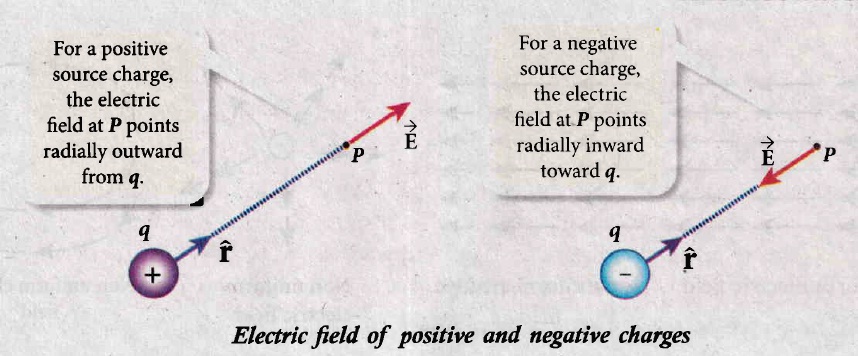
The electric field at the point P at a distance r from the point charge q is defined as the force that would be experienced by a unit positive charge placed at that point and is given by,
\(\vec{E}=\frac{\vec{F}}{q_{0}}=\frac{k q}{r^{2}} \hat{r}=\frac{1}{4 \pi \varepsilon_{0}} \frac{q}{r^{2}} \hat{r}\) ....(1)
where \(\hat{r}\) is the unit vector pointing from q to the point of interest P.
Important aspect of the Electric field:
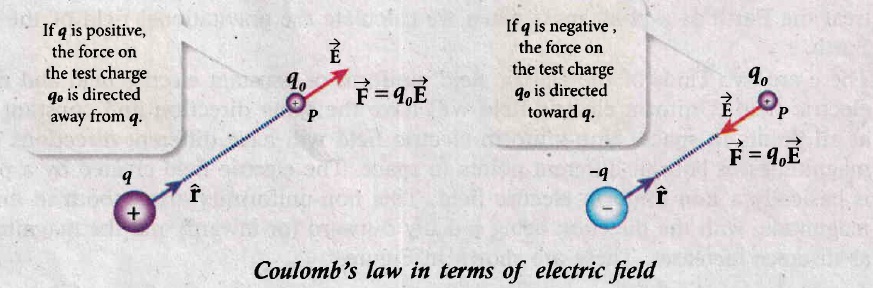
(i) If the charge q is positive then the electric field points away from the source charge and if q is negative, the electric field points towards the source charge q. This is shown in the Figure
(ii) If the electric field at a point P is \(\vec{E},\) then the force experienced by the test charge qo placed at the point P is \(\vec { F } ={ q }_{ 0 }\vec { E } \)
This is Coulomb's law in terms of electric field. This is shown in Figure
(iii) The equation (1) implies that the electric field is independent of the test charge qo and it depends only on the source charge q.
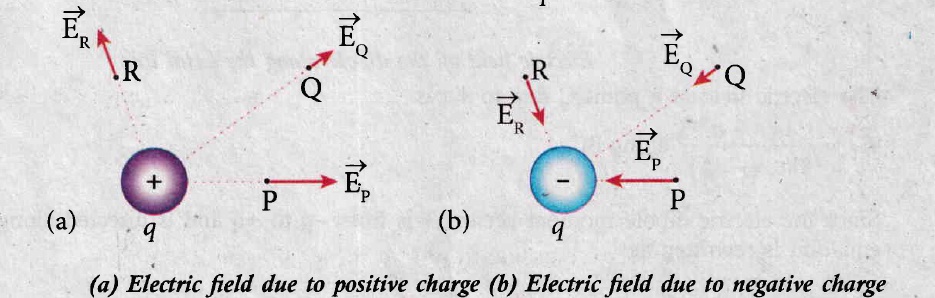
(iv) Since the electric field is a vector quantity, at every point in space, this field has unique direction and magnitude, as shown in Figures (a) and (b). From equation (1), we can infer that as distance increases, the electric field decreases in magnitude. Note that in Figures (a) and (b) the length of the electric field vector is shown for three different points. The strength or magnitude of the electric field at point P is stronger than at the points Q and R because the point P is closer to the source charge.
(v) In the definition of electric field, it is assumed that the test charge (q0) is taken sufficiently small, so that bringing this test charge will not move the source charge. In other words, the test charge is made sufficiently small such that it will not modify the electric field of the source charge.
(vi) The expression (1) is valid only for point charges. For continuous and finite size charge distributions, integration techniques must be used. These will be explained later in the same section. However, this expression can be used as an approximation for a finite-sized charge if the test point is very far away from the finite sized source charge. Note that we similarly treat the Earth as a point mass when we calculate the gravitational field of the Sun on the Earth.
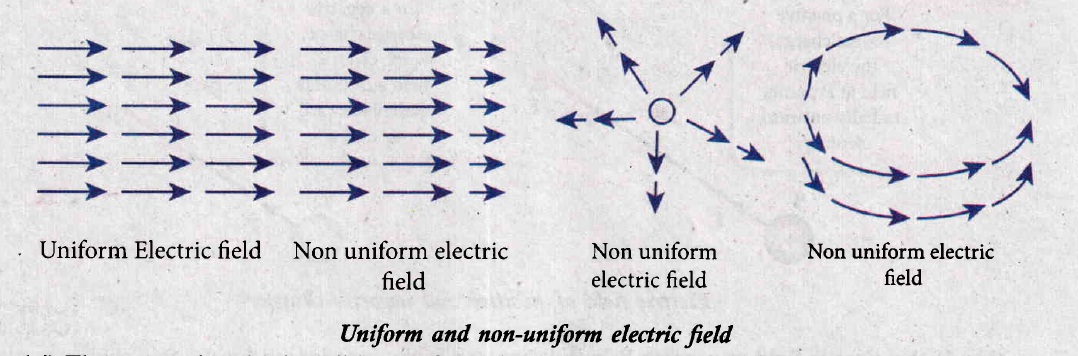
(vii) There are two kinds of the electric field : uniform or constant electric field and non-uniform electric field. Uniform electric field will have the same direction and constant magnitude at all points in space. Non-uniform electric field will have different directions or different magnitudes or both at different points in space. The electric field created by a point charge is basically a non uniform electric field. This non-uniformity arises, both in direction and magnitude, with the direction being radially outward (or inward) and the magnitude changes as distance increases. These are shown in Figure.
29.
Kirchhoff's First rule: (current rule)
(i) It states that the algebraic sum of the currents at any junction of a circuit is zero. It is a statement of law of conservation of electric charge.
(ii) All charges that enter a given junction in a circuit must leave that junction since charge cannot build up or disappear at a junction. By convention current entering the junction is taken as positive and current leaving the junction is taken as negative.
Applying law to the junction A in Figure.
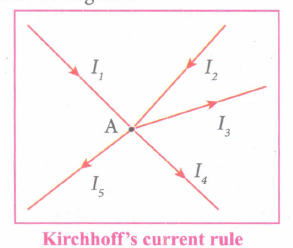
\({ I }_{ 1 }+{ I }_{ 2 }-{ I }_{ 3 }-{ I }_{ 4 }-{ I }_{ 5 }=0\)
(or)
\({ I }_{ 1 }+{ I }_{ 2 }=I_{ 3 }+{ I }_{ 4 }+{ I }_{ 5 }\)
Kirchhoff's Second rule (Voltage rule or Loop rule)
(i) It states that in a closed circuit the algebraic sum of the products of the current and resistance of each part of the circuit is equal to the total emf included in the circuit.
(ii) This rule follows from the law of conservation of energy for an isolated system (The energy supplied by the emf sources is equal to the sum of the energy delivered to all resistors).
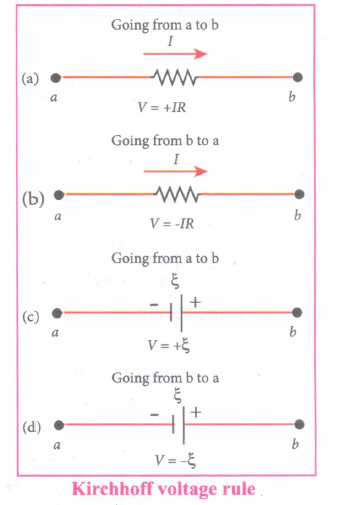
(iii) Kirchhof's voltage rule has to be applied only when all currents in the circuit reach a steady state condition.
(iv) The current in the various branches are constant. The product of current and resistance is taken as positive when the direction of the current is followed.
(v) Suppose if the direction of current is opposite to the direction of the loop, then product of current and voltage across the resistor is negative. It is shown in Figure (a) and (b).
(vi) The emf is considered positive when proceeding from the negative to the positive terminal of the cell.
30.
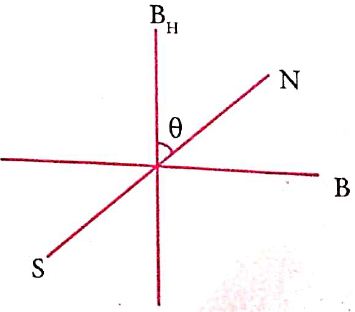
(i) When a magnetic needle or magnet is freely suspended in two mutually perpendicular uniform magnetic fields, it will come to rest in the direction of the resultant of the two fields.
(ii) Let B be the magnetic field produced by passing current through the coil of the tangent galvanometer and BH be the horizontal component of earth's magnetic field.
(iii) Under the action of two magnetic fields, the needle comes to rest making angle with BH , such that
B = BH tan \(\theta\) .........(1)
Where B ⇒ magnetic field produced by current
BH ⇒ horizontal component of earth's magnetic field
Construction:
(i) Copper coil of wire wound on a non-magnetic circular frame such as brass or wood. Compass box is kept at centre.
(ii) This compass box consists of pivoted magnet and aluminum pointer.
(iii) This compass box is having circular scale graduated with four quadrants.
Working:
(i) Two magnetic fields are perpendicular to each other.
(ii) Magnetic induction due to the current in the coil acting to normal to the plane of the coil.
(iii) Magnetic induction at the centre of the coil,
\(B=μ_o\frac{NI}{2R}\) .....(2)
Sub. eqn.(1) in eqn. (2)
\(B_H tan \theta =μ_o\frac{NI}{2R}\)
\(B_H =μ_o\frac{NI}{2R}\frac{1}{tan\theta}\)
31.
(a) Induction stove
(i) Induction stove is used to cook the food quickly and safely with less energy consumption. Below the cooking zone, there is a tightly wound coil of insulated wire.
(ii) The cooking pan made of suitable material, is placed over the cooking zone. When the stove is switched on, an alternating current flowing in the coil produces high frequency alternating magnetic field which induces very strong eddy currents in the cooking pan.
(iii) The eddy currents in the pan produce so much of heat due to Joule heating which is used to cook the food.
(b) Eddy current brake
(i) This eddy current braking system is generally used in high speed trains and roller coasters. Strong electromagnets are fixed just above the rails.
(ii) To stop the train, electromagnets are switched on. The magnetic field of these magnets induces eddy currents in the rails which oppose or resist the movement of the train. This is Eddy current linear brake.
(c) Eddy current testing
(i) It is one of the simple non-destructive testing methods to find defects like surface cracks, air bubbles present in a specimen.
(ii) A coil of insulated wire is given an alternating electric current, so that it produces an alternating magnetic field.
(iii) When this coil is brought near the test surface, eddy current is induced in the test surface.
(iv) The presence of defects causes the change in phase and amplitude of the eddy current that can be detected by some other means. In this way, the defects present in the specimen are identified.
(d) Electro magnetic damping:
(i) The armature of the galvanometer coil is wound on a soft iron cylinder.
(ii) Once the armature is deflected, the relative motion between the soft iron cylinder and the radial magnetic field induces eddy current in the cylinder.
(iii) The damping force due to the flow of eddy current brings the armature to rest immediately and then galvanometer shows a steady deflection. This is called electromagnetic damping.
32.
(i) Any stationary source charge produces only electric field. When the charge moves with uniform velocity, it produces steady current which gives rise to magnetic field (not time dependent, only space· dependent) around the conductor in which charge flows.
(ii) If the charged particle accelerates, it produces magnetic field in addition to electric field. Both electric and magnetic fields are time varying fields. Since the electromagnetic waves are transverse waves, the direction of propagation of electromagnetic waves is perpendicular to the plane containing electric and magnetic field vectors.
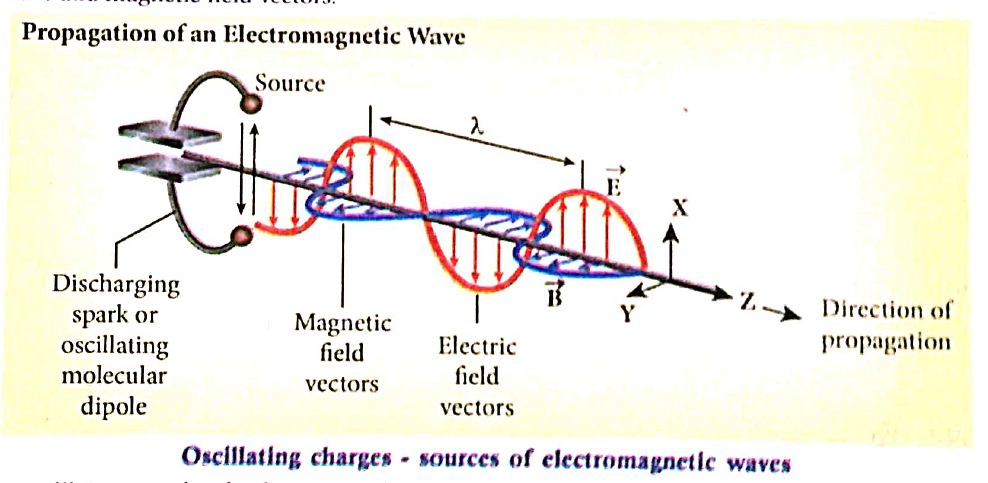
(iii) Any oscillatory motion is also an accelerating motion, so, when the charge oscillates (oscillating molecular dipole) about their mean position as shown in Figure, it produces electromagnetic waves.
(iv) Suppose the electromagnetic field in free space propagates along z-direction, and if the electric field vector points along x-axis then the magnetic field vector will be mutually perpendicular to both electric field and the direction of wave propogation. Thus,
Ex = Eo sin (kz - ωt)
By = Bo sin(Kz - ωt)
Where, Eo and Bo are amplitude of the oscillating electric and magnetic field, k is a wave number, ω is the angular frequency of the wave and \(\hat { k } \) (unit vector, here it is called propagation vector) denotes the direction of propagation of electromagnetic wave.
(vi) Note that both electric field and magnetic field oscillate with a frequency (frequency of electromagnetic wave) which is equal to the frequency of the source (here, oscillating charge is the source for the production of electromagnetic waves). In free space or in vacuum, the ratio between Eo and Bo is equal to the speed of electromagnetic wave, which is equal to speed of light c.
\(c=\frac { { E }_{ 0 } }{ { B }_{ 0 } } \)
In any medium, the ratio of Eo and Bo is equal to the speed of electromagnetic wave in that medium. Thus,
Further, the energy of electromagnetic waves comes from the energy of the oscillating charge.

12th Standard Syllabus & Materials
12th Standard
TN 12th Computer Applications களப்பெயர் முறைமை (DNS) Sample Question Papers Study Material - QB365 Set A
NEW12th Standard
TN 12th Computer Applications வலையமைப்பு எடுத்துக்காட்டுகள் மற்றும் நெறிமுறைகள் Sample Question Papers Study Material - QB365 Set A
NEW12th Standard
TN 12th Computer Applications கணினி வலையமைப்பு ஓர் அறிமுகம் Sample Question Papers Study Material - QB365 Set A
NEW12th Standard
TN 12th Computer Applications PHP-உடன் MySQL-ஐ இணைத்தல் Sample Question Papers Study Material - QB365 Set A



Tamilnadu Stateboard 12th Standard Subjects

Maths

Chemistry
Physics

Biology

Computer Science

Business Maths and Statistics

Economics

Commerce

Accountancy

History

Computer Applications
Biology
Computer Technology
Computer Applications
Computer Science
Business Maths and Statistics
Commerce
Economics
Maths
Chemistry
Physics
Computer Technology
History
Accountancy

Tamil

English

French
Tamilnadu Stateboard Standards

