
 100% FREE ACCESS
12th Standard Syllabus & Materials
12th Standard
TN 12th Computer Applications மின்னணு தரவு பரிமாற்றம் Sample Question Papers Study Material - QB365 Set A
NEW12th Standard
TN 12th Computer Applications மின் - வணிக பாதுகாப்பு அமைப்புகள் Sample Question Papers Study Material - QB365 Set A
NEW12th Standard
TN 12th Computer Applications மின்னணு செலுத்தல் முறைகள் Sample Question Papers Study Material - QB365 Set A
NEW12th Standard
TN 12th Computer Applications மின் - வணிகம் Sample Question Papers Study Material - QB365 Set A
NEW12th Standard
TN 12th Computer Applications திறந்த மூல கருத்துருக்கள் Sample Question Papers Study Material - QB365 Set A
NEW12th Standard
TN 12th Computer Applications வலையமைப்பு வடமிடல் Sample Question Papers Study Material - QB365 Set A

Published on: 27/09/2019
Zoology - Environmental Issues
Download Tamil Nadu 12th Standard Biology question papers, model tests, one-mark questions, important questions, and public exam papers in PDF format. Free study materials and answer keys for TN State Board students.
Questions + Answers key
Take MCQ Biology Test1.
What are medical wastes?
2.
What is meant by accelerated eutrophication?
3.
Define the term eutrophication.
4.
What is Acid rain?
5.
List out the green house gases. (Any four)
6.
Classify air pollutants.
7.
What is air pollution?
8.
How are sources of water pollution classified?
9.
What is Ozone?
10.
What would Earth be like without the greenhouse effect?
11.
Discuss the causes and effects of global warming. What measures need to be taken to control global warming?
12.
Expand
(i) CFC
(ii) AQI
(iii) PAN
13.
Write notes on the following:
a. Eutrophication
b. Algal Bloom
14.
What is SMOG and how it is harmful for us?
15.
1.
Any kind of waste that contains infectious material generated by hospitals, laboratories, medical research centers, Pharmaceutical companies and Veterinary clinics are called medical wastes.
2.
Pollutants from anthropogenic activities like effluents from the industries and homes can radically accelerate the aging process. This phenomenon is known as Cultural or Accelerated Eutrophication
3.
When run-off from land containing nutrients reaches water bodies like lakes, it results in dense growth of plant life. This phenomenon is called Eutrophication.
4.
Acid rain is a form of precipitation that contains acidic components, such as sulfuric acid or nitric acid. It damages trees, crops and harms marine animals (coral reefs) and induces corrosion.
5.
a) CO2
b) CFCs
c) Methane
d) Nitrous oxide
6.
Air pollutants can be
(i) discharge of dusts or particulate matter (PM: 2.5 and 10)
(ii) discharge of gases (SOx, NOx, CO and CO2)
7.
The alterations or changes in the composition of the Earth's atmosphere by natural or human activities (anthropogenic factors) are referred as Air Pollution.
8.
Sources of water pollution can also be classified in three ways. They are municipal wastes, industrial wastes and agricultural wastes.
9.
Ozone is found in the layer of the atmosphere called stratosphere. It acts as a protective covering that absorbs ultraviolet radiation from the sun. It is found about 15 and 50 kilometers from the ground level.
10.
The naturally occurring greenhouse gases in the air, mainly carbon dioxide, methane and water vapour trap radiation from the sun and act like a thermal blanket around our planet earth. Without the greenhouse gases, the earth would have an average temperature of -180 c and be covered in ice. The greenhouse effect keeps the earth warm enough to sustain life.
11.
Green House Effect and Global warming:
Natural environment and climate are dynamic and keep changing over course of time. Reasons for climate change
a) Human population growth
b) Industrialization
c) Associated anthropological activities the changes.
Impact on Global Warming:
(i) Large-scale changes of global environment can lead to hazards, which may include climate change, stratospheric ozone depletion, changes in ecosystems due to loss of biodiversity, changes in hydrological systems and the supplies of freshwater, land degradation, urbanization, and stress on food-producing systems.
(ii) Greenhouse gases (GHG) water vapour, carbon dioxide, methane, nitrous oxide, ozone and some artificial chemicals such as chlorofluorocarbons (CFCs) causes greenhouse effect. The absorbed energy warms the atmosphere and the surface of the Earth
(iii) Global warming will have a significant impact on people and nature. As global average temperatures rise, precipitation patterns could be affected. Extreme wet and dry conditions can be expected (flooding and desertification). Coastal areas shall become more vulnerable to storm surges as sea level rises. Plant and animal species will migrate or disappear in response to climate change.
(iv) Global warming can directly affect the flora and fauna. This could also result in shortage of food and even lead to a food crisis and affect the health of the people and organisms.
Control Measures:
The UNO has several measures to control or reduce pollution. Through various conventions organized by UNO, the countries assured to take steps to control or reduce emissions by factories and automobiles.
12.
(i) CFC - Chloro fluoro carbon
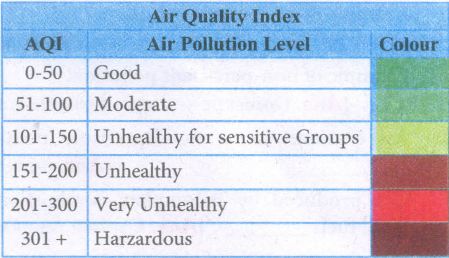
(ii) AQI - National Air Quality Index
(iii) PAN - Peroxyacetyl Nitrate
13.
(a) Eutrophication:
1. Eutrophication is defined as the process of nutrient enrichment of water and consequent loss of species diversity in water bodies.
2. Increased nutrient content of the water body causes algal bloom, excess growth of algae, especially planktonic algae.
3. It covers the water surface, secrete toxins and reduces the dissolved oxygen content of water.
4. These toxins inhibit the growth of other algae and plants and cause death of aquatic animals.
5. O2 deficiency may be a cause for death of animals (BOD).
(b) Algal Bloom:
1. A rapid growth of microscopic algae (or) cyanobacteria in water, often resulting in a coloured scum on the surface.
2. Rapid increase of accumulation in the population of algae in fresh water (or) marine water and is recognized by the discoloration in the water from their pigments.
14.
Smog is a type of air pollution caused by tiny particles in the air. The word comes from a mixture of the words smoke and fog.
(i) Smog generally refers to photochemical smog, which is created when sunlight reacts with nitrogen oxides and volatile organic compounds found in fossil fuel emissions from automobiles, factories and power plants.
(ii) These reactions create ground-level ozone and particulate matter, reducing visibility.
(iii) Smog can make breathing more difficult, especially for people with asthma.
(iv) Smog also affects plants and animals. It damages crops as well as causes health problems in pets, farm animals and human beings.
(v) Smog has also been known to cause corrosive damage to buildings and vehicles.
15.

12th Standard Syllabus & Materials
12th Standard
TN 12th Computer Applications களப்பெயர் முறைமை (DNS) Sample Question Papers Study Material - QB365 Set A
NEW12th Standard
TN 12th Computer Applications வலையமைப்பு எடுத்துக்காட்டுகள் மற்றும் நெறிமுறைகள் Sample Question Papers Study Material - QB365 Set A
NEW12th Standard
TN 12th Computer Applications கணினி வலையமைப்பு ஓர் அறிமுகம் Sample Question Papers Study Material - QB365 Set A
NEW12th Standard
TN 12th Computer Applications PHP-உடன் MySQL-ஐ இணைத்தல் Sample Question Papers Study Material - QB365 Set A



Tamilnadu Stateboard 12th Standard Subjects

Maths

Chemistry

Physics
Biology

Computer Science

Business Maths and Statistics

Economics

Commerce

Accountancy

History

Computer Applications
Biology
Computer Technology
Computer Applications
Computer Science
Business Maths and Statistics
Commerce
Economics
Maths
Chemistry
Physics
Computer Technology
History
Accountancy

Tamil

English

French
Tamilnadu Stateboard Standards

