
 100% FREE ACCESS
12th Standard Syllabus & Materials
12th Standard
TN 12th Computer Applications மின்னணு தரவு பரிமாற்றம் Sample Question Papers Study Material - QB365 Set A
NEW12th Standard
TN 12th Computer Applications மின் - வணிக பாதுகாப்பு அமைப்புகள் Sample Question Papers Study Material - QB365 Set A
NEW12th Standard
TN 12th Computer Applications மின்னணு செலுத்தல் முறைகள் Sample Question Papers Study Material - QB365 Set A
NEW12th Standard
TN 12th Computer Applications மின் - வணிகம் Sample Question Papers Study Material - QB365 Set A
NEW12th Standard
TN 12th Computer Applications திறந்த மூல கருத்துருக்கள் Sample Question Papers Study Material - QB365 Set A
NEW12th Standard
TN 12th Computer Applications வலையமைப்பு வடமிடல் Sample Question Papers Study Material - QB365 Set A

Published on: 02/09/2019
Zoology - Human Reproduction
Download Tamil Nadu 12th Standard Biology question papers, model tests, one-mark questions, important questions, and public exam papers in PDF format. Free study materials and answer keys for TN State Board students.
Questions + Answers key
Take MCQ Biology Test1.
The milk secreted by the mammary glands soon after child birth is called ______.
Mucous
Colostrum
Lactose
Sucrose
2.
The process which the sperm undergoes before penetrating the ovum is _____.
Spermiation
Cortical reaction
Spermiogenesis
Capacitation
3.
4.
The glandular accessory organ which produces the largest proportion of semen is ______.
Seminal vesicle
Bulbourethral gland
Prostate gland
Mucous gland
5.
The mature sperms are stored in the ____.
Seminiferous tubules
Vas deferens
Epididymis
Seminal vesicle
6.
Define gametogenesis.
7.
8.
At what stage of development are the gametes formed in new born male and female?
9.
10.
What is the composition of semen?
11.
What is colostrum? Write its significance.
12.
The following is the illustration of the sequence of ovarian events (a-i) in a human female.
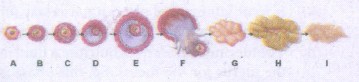
a) Identify the figure that illustrates ovulation and mention the stage of oogenesis it represents.
b) Name the ovarian hormone and the pituitary hormone that have caused the above-mentioned events.
c) Explain the changes that occurs in the uterus simultaneously in anticipation.
d) Write the difference between C and H.
13.
Explain the various phases of the menstrual cycle.
1.
(b)
Colostrum
2.
(d)
Capacitation
3.
(c)
4.
(a)
Seminal vesicle
5.
(c)
Epididymis
6.
Gametogenesis is the process of formation of gametes i.e., Sperms from primary spermatocytes and ova from primary oocyte in testes and ovaries respectively. Meiosis plays the most significant role in the process of gametogenesis.
7.
8.
Development of female gamete is called oogenesis. Oogenesis starts at the beginning of puberty.
Development of male gamete is called spermatogenesis. Spermatogenesis starts at puberty
9.
10.
Semen or seminal fluid is a milky white fluid which contains sperms and the seminal plasma, which is secreted from the seminal vesicles, prostate glands and bulbo urethal glands or Cowper's gland.
The semen comprises of Fructose, ascorbic acid, zinc, cholesterol, protein, calcium, chlorine, blood group antigens, citric acid, DNA, magnesium, Vitamin B12, phosphorous, sodium, potassium, uric acid,lactic acid, nitrogen, and other nutrients for the sperms.
11.
Colostrum is the yellowish fluid produced from the mother's mammary glands during initial few days of location, after parturition.
Significance:
1. It has less lactose than milk and almost no fat, but it contains more proteins, vitamin A and minerals.
2. Colostrum is also rich in IgA antibodies.
3. This helps to protect the infant's digestive tract against bacterial infection.
4. Breast milk is the ideal food for infants as it contains all the constituents in suitable concentration and is easily digestable.
5. It is fully sufficient till about 6 months of age and all infants must be breast fed by the mother to ensure the growth of a healthy baby.
12.
(a) The figure 'F' represent ovulation.
Stage of oogenesis - Ovulatory or luteal stage of oogenesis
(b) (i) The ovarian hormone is progesterone which is released during ovulation.
(ii) The pituitary hormones are the follicle-stimulating hormone (FSH) and Luteinizing hormone (LSH) which are released during and ovulation from anterior pituitary gland.
(c) The endometrium of the uterus gets thickened and blood supply to the endometrium increase.
(d) Figure 'C' represents the secondary follicle and figure h represents the degenerating corpus luteum.
| Secondary follicle | Corpus luteurn |
| lt is surrounded by layers of granulosa cells | Absence of granulosa cells |
| Theca layer is present | Theca layer is absent. |
13.
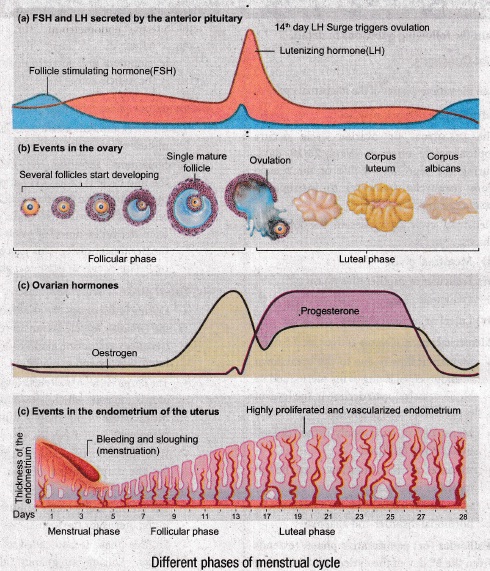
Menstrual cycle / Ovarian cycle
(i) The menstrual or ovarian cycle occurs approximately once in every 28/29 days, during the reproductive life of the female from menarche (puberty) to menopause except during pregnancy.
(ii) Menstrual cycle comprises of the following phases:
1. Menstrual phase
2. Follicular or proliferative phase
3. Ovulatory phase
4. Luteal or, secretory phase
(i) Menstrual phase: (Occurs and last for 3-5 days)
1. Menstrual flow is due to the breakdown of endometrial lining of the uterus, and its blood vessels due to decline in the level of progesterone and oestrogen.
2. Menstruation occurs only if the released ovum is not fertilized.
3. Absence of menstruation may be an indicator of pregnancy
4. However, it could also be due to stress, hormonal disorder and anaemia.
(ii) Follicular (or) proliferative phase: (extends from the 5th day of the cycle until the time of ovulation)
1. During this phase, the primary follicle in the ovary grows to become a fully mature Graafian follicle and simultaneously, the endometrium regenerates through proliferation. These changes in the ovary and the uterus are induced by the secretion of gonadotropins like FSH and LH, which increase gradually during the follicular phase. lt stimulates follicular development and secretion of oestrogen by the follicle cells.
(iii) Ovulatory phase (about 14th day):
1. Both LH and FSH attain peak level in the middle of the cycle.
2. Maximttm secretion of LH during the mid-cycle is called LH surge induces the rupture of the Graafian follicle and the release of the ovum (secondary oocyte) from the break down of ovary wall into the peritoneal cavity. This process called ovulation occurs at late luteal phase.
(iv) Luteal phase or secretory phase;
1. During luteal phase, the remaining part of the Graalian follicle is transformed into a transitory endocrine gland called corpus luteum at the end of ovulation.
2. The corpus luteum secretes a large amount of progesterone which is essential for the maintenance of the endometrium during pregnancy.
3. If fertilization takes place, it paves way for the implantation of the fertilized ovum.
4. The uterine wall secretes a nutritious fluid in the uterus for the foetus.
5. So, this phase is also called as secretory phase. During pregnancy all events of menstrual cycle stop and there is no menstruation.
6. In the absence of fertilization, the corpus luteum degenerates completely and leaves a scar tissue called corpus Albicans.
7. It also initiates the disintegration of the endometrium leading to menstruation, marking repetition of the next cycle.

12th Standard Syllabus & Materials
12th Standard
TN 12th Computer Applications களப்பெயர் முறைமை (DNS) Sample Question Papers Study Material - QB365 Set A
NEW12th Standard
TN 12th Computer Applications வலையமைப்பு எடுத்துக்காட்டுகள் மற்றும் நெறிமுறைகள் Sample Question Papers Study Material - QB365 Set A
NEW12th Standard
TN 12th Computer Applications கணினி வலையமைப்பு ஓர் அறிமுகம் Sample Question Papers Study Material - QB365 Set A
NEW12th Standard
TN 12th Computer Applications PHP-உடன் MySQL-ஐ இணைத்தல் Sample Question Papers Study Material - QB365 Set A



Tamilnadu Stateboard 12th Standard Subjects

Maths

Chemistry

Physics
Biology

Computer Science

Business Maths and Statistics

Economics

Commerce

Accountancy

History

Computer Applications
Biology
Computer Technology
Computer Applications
Computer Science
Business Maths and Statistics
Commerce
Economics
Maths
Chemistry
Physics
Computer Technology
History
Accountancy

Tamil

English

French
Tamilnadu Stateboard Standards

