
 100% FREE ACCESS
12th Standard Syllabus & Materials
12th Standard
TN 12th Computer Applications மின்னணு தரவு பரிமாற்றம் Sample Question Papers Study Material - QB365 Set A
NEW12th Standard
TN 12th Computer Applications மின் - வணிக பாதுகாப்பு அமைப்புகள் Sample Question Papers Study Material - QB365 Set A
NEW12th Standard
TN 12th Computer Applications மின்னணு செலுத்தல் முறைகள் Sample Question Papers Study Material - QB365 Set A
NEW12th Standard
TN 12th Computer Applications மின் - வணிகம் Sample Question Papers Study Material - QB365 Set A
NEW12th Standard
TN 12th Computer Applications திறந்த மூல கருத்துருக்கள் Sample Question Papers Study Material - QB365 Set A
NEW12th Standard
TN 12th Computer Applications வலையமைப்பு வடமிடல் Sample Question Papers Study Material - QB365 Set A

Published on: 24/07/2019
Human Reproduction
Download Tamil Nadu 12th Standard Biology question papers, model tests, one-mark questions, important questions, and public exam papers in PDF format. Free study materials and answer keys for TN State Board students.
Questions + Answers key
Take MCQ Biology Test1.
_____ are endocrine cells.
Inhibitin
Leydig cells
Oogonia
Sertoli cells
2.
Assertion (A): The acrosome of the Sperm cell contains Sperm lysin.
Reason (R): Sperm lysin destroys the deformed Sperm cells.
R explains A
A is right R is wrong
A an R are right R does not explains A
Both A and R are wrong
3.
4.
The foetal membrane that forms the basis of the umbilical cord is _____.
Allantois
Amnion
Chorion
Yolk sac
5.
The site of embryo implantation is the _____.
Uterus
Peritoneal cavity
Vagina
Fallopian tube
6.
What is the function of Sertoli cells?
7.
Explain the role of oxytocin and relaxin in parturition and lactation.
8.
Mention the importance of the position of the testes in humans.
9.
What is colostrum? Write its significance.
10.
Name the Cells noticed in the epithelial layer of Seminiferous tubules.
11.
12.
13.
Placenta is an endocrine tissue. Justify
14.
Differentiate Spermatogenesis and oogenesis.
15.
Explain the various phases of the menstrual cycle.
16.
Placenta
17.
Corpus luteum
18.
Sertoli cells
19.
Ley dig cell
20.
Ovulation
1.
(b)
Leydig cells
2.
(b)
A is right R is wrong
3.
(c)
4.
(a)
Allantois
5.
(a)
Uterus
6.
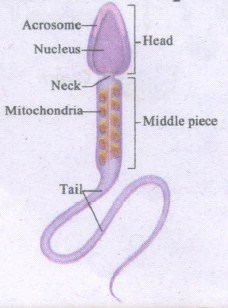
(i) Sertoli cells are elongated and pyramidal and provide nourishment to the sperms till maturation.
(ii) They also secrete inhibin, a hormone which is involved in the negative feedback control of sperm production.
7.
Relaxin
(i) It is a hormone secreted by the placenta and also by the corpus luteum during pregnancy.
(ii) It promotes parturition by relaxing the pelvic joints and by dilation of cervical ligaments with continued powerful contractions.
Oxytocin:
(i) It causes the "Let-Down" reflex.
(ii) The actual ejection of milk from the alveoli of the mammary glands.
(iii) During lactation, oxytocin also stimulates the recently emptied uterus to contract, helping it to return to pre-pregnancy size..
8.
1. Testes are the primary male sex organs.
2. They are a pair of ovoid bodies lying in the scrotum.
3. The scrotum is a sac of skin that hangs outside the abdominal cavity.
4. Since viable sperms cannot be produced at normal body temperature, the scrotum is placed outside the abdominal cavity to provide a temperature 2-3°C lower than the normal internal body temperature.
5. Thus, the scrotum acts as a thermoregulator for spermatogenesis.
9.
Colostrum is the yellowish fluid produced from the mother's mammary glands during initial few days of location, after parturition.
Significance:
1. It has less lactose than milk and almost no fat, but it contains more proteins, vitamin A and minerals.
2. Colostrum is also rich in IgA antibodies.
3. This helps to protect the infant's digestive tract against bacterial infection.
4. Breast milk is the ideal food for infants as it contains all the constituents in suitable concentration and is easily digestable.
5. It is fully sufficient till about 6 months of age and all infants must be breast fed by the mother to ensure the growth of a healthy baby.
10.
(a) Sertoli cells or Nurse cells
(b) Spermatogonic cells or male germ cells.
11.
12.
13.
Placenta during pregnancy secretes hormones such as human chorionic gonadotrophic (hcG) estrogen, progesterone and human placenta lactogen. So, placenta is regarded as an endocrine tissue.
14.
| Spermatogenesis | Oogenesis |
| It takes place in the seminiferous tubules of testis |
It occurs in the follicles of the ovary |
| It begins at puberty in males | In females it initiates in the foetal stages. |
| Spermatogonia are the sperm mother cells and many of them undergo maturation phase to form sperms. |
Oogonia is the the egg mother cell and only one cell undergoes maturation phase at a time except in cases of fraternal twins. |
| I & II Mieotic divisions are equal and each spermatogonia forms 4 haploid spermatids. |
I & II meiotic divisions are unequal and finally only one haploid ovum and 3 small haploid polar bodies are formed |
| The spermatids undergo a stage called Spermiogenesis to become functional sperm. |
No such changes are observed. |
| The meiotic divisions are completed and spermaticly are formed. |
The second meiotic division is never completed it fertilization does not take lace. |
15.
Menstrual cycle / Ovarian cycle
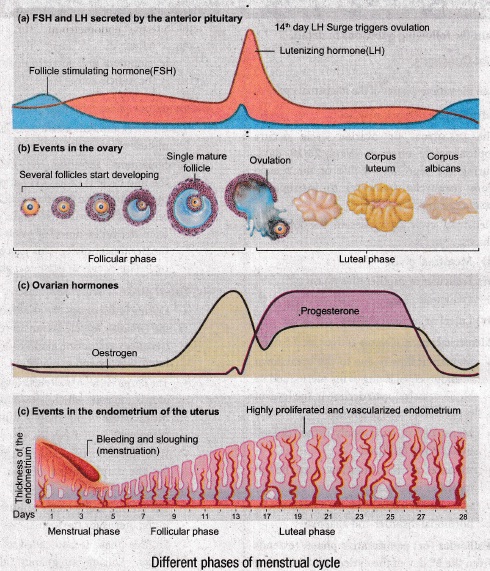
(i) The menstrual or ovarian cycle occurs approximately once in every 28/29 days, during the reproductive life of the female from menarche (puberty) to menopause except during pregnancy.
(ii) Menstrual cycle comprises of the following phases:
1. Menstrual phase
2. Follicular or proliferative phase
3. Ovulatory phase
4. Luteal or, secretory phase
(i) Menstrual phase: (Occurs and last for 3-5 days)
1. Menstrual flow is due to the breakdown of endometrial lining of the uterus, and its blood vessels due to decline in the level of progesterone and oestrogen.
2. Menstruation occurs only if the released ovum is not fertilized.
3. Absence of menstruation may be an indicator of pregnancy
4. However, it could also be due to stress, hormonal disorder and anaemia.
(ii) Follicular (or) proliferative phase: (extends from the 5th day of the cycle until the time of ovulation)
1. During this phase, the primary follicle in the ovary grows to become a fully mature Graafian follicle and simultaneously, the endometrium regenerates through proliferation. These changes in the ovary and the uterus are induced by the secretion of gonadotropins like FSH and LH, which increase gradually during the follicular phase. lt stimulates follicular development and secretion of oestrogen by the follicle cells.
(iii) Ovulatory phase (about 14th day):
1. Both LH and FSH attain peak level in the middle of the cycle.
2. Maximttm secretion of LH during the mid-cycle is called LH surge induces the rupture of the Graafian follicle and the release of the ovum (secondary oocyte) from the break down of ovary wall into the peritoneal cavity. This process called ovulation occurs at late luteal phase.
(iv) Luteal phase or secretory phase;
1. During luteal phase, the remaining part of the Graalian follicle is transformed into a transitory endocrine gland called corpus luteum at the end of ovulation.
2. The corpus luteum secretes a large amount of progesterone which is essential for the maintenance of the endometrium during pregnancy.
3. If fertilization takes place, it paves way for the implantation of the fertilized ovum.
4. The uterine wall secretes a nutritious fluid in the uterus for the foetus.
5. So, this phase is also called as secretory phase. During pregnancy all events of menstrual cycle stop and there is no menstruation.
6. In the absence of fertilization, the corpus luteum degenerates completely and leaves a scar tissue called corpus Albicans.
7. It also initiates the disintegration of the endometrium leading to menstruation, marking repetition of the next cycle.
16.
Relaxin
17.
progesteron
18.
Inhibin
19.
Testosterone
20.
Leutinising hormone

12th Standard Syllabus & Materials
12th Standard
TN 12th Computer Applications களப்பெயர் முறைமை (DNS) Sample Question Papers Study Material - QB365 Set A
NEW12th Standard
TN 12th Computer Applications வலையமைப்பு எடுத்துக்காட்டுகள் மற்றும் நெறிமுறைகள் Sample Question Papers Study Material - QB365 Set A
NEW12th Standard
TN 12th Computer Applications கணினி வலையமைப்பு ஓர் அறிமுகம் Sample Question Papers Study Material - QB365 Set A
NEW12th Standard
TN 12th Computer Applications PHP-உடன் MySQL-ஐ இணைத்தல் Sample Question Papers Study Material - QB365 Set A



Tamilnadu Stateboard 12th Standard Subjects

Maths

Chemistry

Physics
Biology

Computer Science

Business Maths and Statistics

Economics

Commerce

Accountancy

History

Computer Applications
Biology
Computer Technology
Computer Applications
Computer Science
Business Maths and Statistics
Commerce
Economics
Maths
Chemistry
Physics
Computer Technology
History
Accountancy

Tamil

English

French
Tamilnadu Stateboard Standards

