
 100% FREE ACCESS
12th Standard Syllabus & Materials
12th Standard
TN 12th Computer Applications மின்னணு தரவு பரிமாற்றம் Sample Question Papers Study Material - QB365 Set A
NEW12th Standard
TN 12th Computer Applications மின் - வணிக பாதுகாப்பு அமைப்புகள் Sample Question Papers Study Material - QB365 Set A
NEW12th Standard
TN 12th Computer Applications மின்னணு செலுத்தல் முறைகள் Sample Question Papers Study Material - QB365 Set A
NEW12th Standard
TN 12th Computer Applications மின் - வணிகம் Sample Question Papers Study Material - QB365 Set A
NEW12th Standard
TN 12th Computer Applications திறந்த மூல கருத்துருக்கள் Sample Question Papers Study Material - QB365 Set A
NEW12th Standard
TN 12th Computer Applications வலையமைப்பு வடமிடல் Sample Question Papers Study Material - QB365 Set A

Published on: 19/09/2019
Zoology - Molecular Genetics
Download Tamil Nadu 12th Standard Biology question papers, model tests, one-mark questions, important questions, and public exam papers in PDF format. Free study materials and answer keys for TN State Board students.
Questions + Answers key
Take MCQ Biology Test1.
Mention the inhibitory role of tetracycline and streptomycin in bacterial translation
2.
If a double-stranded DNA has 20% of cytosine, calculate the percentage of adenine in DNA.
3.
Distinguish between exons and introns
4.
Define transcription and name the enzyme involved in this process.
5.
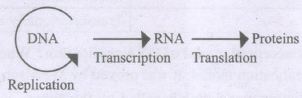
Who proposed the central dogma? Write its concept.
6.
What is nucleosome? How many base pairs are there in a typical nucleosome?
7.
How many base pairs are present in one complete turn of DNA helix? What is the distance between two consecutive base pairs?
8.
Point out the nitrogenous bases of RNA
9.
Differentiate nucleoside from nucleotide.
10.
What are nucleotides?
11.
Why is the term nucleic acid used for DNA and RNA?
12.
Mention any two ways in which single nucleotide polymorphism (SNPs) identified in human genome can bring revolutionary change in biological and medical science.
13.
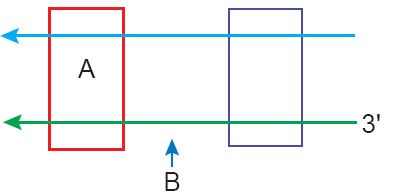
Name the parts marked ‘A’ and ‘B’ in the given transcription unit:
14.
Give reasons: ‘Genetic code is universal’.
15.
State any three goals of the human genome project.
1.
Tetracycline inhibits binding between aminoacyl tRNA and mRNA.
Streptomycin inhibits initiation of translation and causes misreading.
2.
Cytosine = 20, hence Guanine = 20
As per Chargaff's rule (A+T) = (G+C) = 100
Percent of Thymine + Adenine = 20 + 20 = 100
( T + A ) = ( 20 + 20) = 100
( T + A ) = 100 - ( 20 + 20 )
T + A = 100 - 40
T + A = 60
Therefore the percent of Adenine will be 60/2 = 30%.
3.
| Exons | Introns |
| Expressed sequences (Coding sequences) of an eukaryotic gene. | Intervering sequences (non-coding sequences) of an eukaryotic gene. |
4.
The process of copying genetic information from one strand of DNA into RNA is termed transcription. This process takes place in presence of DNA dependent RNA polymerase.
5.
Francis Crick proposed the Central dogma in molecular biology which states that genetic information flows as follows:
6.
The negatively charged DNA is wrapped around the positively charged histone octamere to form a structure called nucleosome. A typical nucleosome contains 200 bp of DNA helix
7.
There are ten base pairs in each turn with a distance of 0.34 x 10⁻⁹m between two adjacent base pairs.
8.
Adenine, Guanine, Cytosine and Uracil.
9.
| Nucleoside | Nucleotide |
| Nucleoside subunit is composed of nitrogenous bases linked to a pentose sugar molecule. | Nucleotide subunit is composed of nitrogenous bases, a pentose sugar, and a phosphate group. |
10.
In nucleic acids (DNA and RNA), the nitrogenous base is chemically linked to one molecule of sugar forming a nucleotide.
When a phosphate group is attached to the nucleoside, it becomes a nucleotide. The nucleotides are polymerised to form a polynucleotide chain (DNA and RNA).
11.
The phosphate functional group (PO4) present in DNA and RNA gives the property of an acid (releasing H+ ion or proton in solution) at physiological pH. Hence the name nucleic acid.
12.
There are 1.4 million locations where single base DNA differences (Called SNPs - Single Nucleotide Polymorphism - pronounce as snips) occurs in human's genome.
(i) By tracing human history
(ii) By finding chromosomal locations for disease associated sequences
13.
A - \(5^{\prime} \rightarrow 3^{\prime}\) is called a coding strand.
B - \(3^{\prime} \rightarrow 5^{\prime}\) is called a template strand.
14.
1. The genetic code is universal. It means that all known living systems use nucleic acids and the same three base codons (triplet codon) direct the synthesis of protein from amino acids. E.g, mRNA ,(UUU) codon codes for phenylalanine in all cells of all organisms.
2. Some exceptions are reported in prokaryotic, mitochondrial and chloroplast genomes. However similarities are more common than differences.
15.
(i) Identify all the genes (approximately 30000) in human DNA.
(ii) To store this information in databases.
(iii) Improve tools for data analysis.

12th Standard Syllabus & Materials
12th Standard
TN 12th Computer Applications களப்பெயர் முறைமை (DNS) Sample Question Papers Study Material - QB365 Set A
NEW12th Standard
TN 12th Computer Applications வலையமைப்பு எடுத்துக்காட்டுகள் மற்றும் நெறிமுறைகள் Sample Question Papers Study Material - QB365 Set A
NEW12th Standard
TN 12th Computer Applications கணினி வலையமைப்பு ஓர் அறிமுகம் Sample Question Papers Study Material - QB365 Set A
NEW12th Standard
TN 12th Computer Applications PHP-உடன் MySQL-ஐ இணைத்தல் Sample Question Papers Study Material - QB365 Set A



Tamilnadu Stateboard 12th Standard Subjects

Maths

Chemistry

Physics
Biology

Computer Science

Business Maths and Statistics

Economics

Commerce

Accountancy

History

Computer Applications
Biology
Computer Technology
Computer Applications
Computer Science
Business Maths and Statistics
Commerce
Economics
Maths
Chemistry
Physics
Computer Technology
History
Accountancy

Tamil

English

French
Tamilnadu Stateboard Standards

