
 100% FREE ACCESS
12th Standard Syllabus & Materials
12th Standard
TN 12th Computer Applications மின்னணு தரவு பரிமாற்றம் Sample Question Papers Study Material - QB365 Set A
NEW12th Standard
TN 12th Computer Applications மின் - வணிக பாதுகாப்பு அமைப்புகள் Sample Question Papers Study Material - QB365 Set A
NEW12th Standard
TN 12th Computer Applications மின்னணு செலுத்தல் முறைகள் Sample Question Papers Study Material - QB365 Set A
NEW12th Standard
TN 12th Computer Applications மின் - வணிகம் Sample Question Papers Study Material - QB365 Set A
NEW12th Standard
TN 12th Computer Applications திறந்த மூல கருத்துருக்கள் Sample Question Papers Study Material - QB365 Set A
NEW12th Standard
TN 12th Computer Applications வலையமைப்பு வடமிடல் Sample Question Papers Study Material - QB365 Set A

Published on: 07/09/2019
Zoology - Organisms and Population
Download Tamil Nadu 12th Standard Biology question papers, model tests, one-mark questions, important questions, and public exam papers in PDF format. Free study materials and answer keys for TN State Board students.
Questions + Answers key
Take MCQ Biology Test1.
Animals that can move from fresh water to sea called as______
Stenothermal
Eurythermal
Catadromous
Anadromous
2.
The relationship between sucker fish and shark is__________
Competition
Commensalism
Predation
Parasitism.
3.
4.
Organisms which can survive a wide range of temperature are called
Ectotherms
Eurytherms
Endotherms
Stenotherms
5.
All populations in a given physical area are defined as
Biome
Ecosystem
Territory
Biotic factors
6.
Classify the aquatic biomes of Earth.
7.
What is Zero Stress?
8.
9.
What is a Habitat?
10.
What is ecological density, crude density and population density?
11.
Differentiate J and S shaped curve
12.
Describe Growth Models/Curves.
13.
Give an account of the properties of soil.
1.
(c)
Catadromous
2.
(b)
Commensalism
3.
(b)
4.
(b)
Eurytherms
5.
(a)
Biome
6.
(i) Freshwater (Lakes, ponds, and rivers)
(ii) Brackish water (Estuaries and Wetlands)
(iii) Marine (Coral reefs, pelagic zones, and abyssal zones)
7.
This is the level of exposure of plants to environmental factors that leads to neither injury nor reduction in growth and yield of crops.
8.
9.
The natural home (or) environment of an animal, plant or other organism or it can be considered as the address of an organism
10.
(i) Ecological density: It is the size of a population in relation to the numbers per unit of habitat space. (Available area or volume that can be colonized by a population). Eg. 1000 fish in the volume of water in the pond.
(ii) Crude density: It is the size of a population in relation to the numbers per unit of total space. Eg. 1000 fish in a pond.
(iii) Population density: It is usually expressed as the number of individuals per unit area or volume. Eg. 100 trees per acre.
11.
| S. No. | J shaped curve | S shaped curve |
|---|---|---|
| 1. | When a population increases rapidly in an exponential fashion and then stops abruptly due to environmental resistance or due to sudden appearance of a limiting factor, they are said to exhibit J-shaped growth form, |
Some populations, as in a population of small mammals, increase lowly at first then more rapidly & gradually slow down as environmental resistance increases where by equilibrium is reached and maintained |
| 2. | Many insects show explosive increase in number during the rainy season followed by their disappearance at the end of season. | Their growth is represented by s shaped growth curve. |
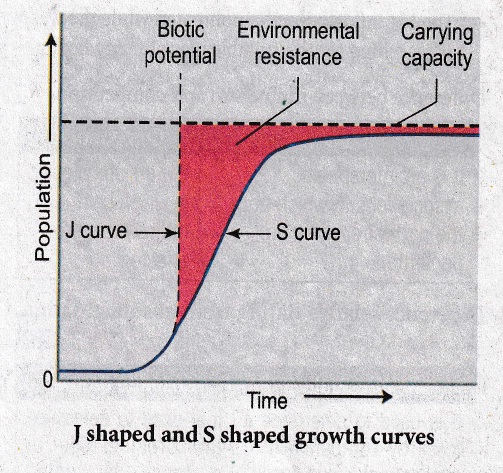
12.
Biotic potential:
It is the maximum reproductive capacity of an organism under optimum environmental conditions.
Carrying capacity:
The maximum number of organisms live in a region can support without environmental degradation is called carrying capacity.
Environmental resistance:
Is the sum total of the environmental limiting factors, both biotic and abiotic which together act to prevent the biotic potential of an organism from being realized.
13.
Properties of soil
(i) Texture of soil - The texture of soil is determined by the size of the soil particles. The types of soil include sand, silt and clay on the basis of their size differences.
(ii) Porosity - The space present between soil particles in a given volume of soil are called pore spaces. The percentage of soil volume occupied by pore space or by the interstitial spaces is called porosity of the soil.
(iii) Permeability of soil - The characteristic of soil that determines the movement of water through pore spaces is known as soil permeability. Soil permeability is directly dependent on the pore size. Water holding capacity of the soil is inversely dependent on soil porosity.
(iv) Soil Temperature - Soil gets its heat energy from solar radiation, decomposing organic matter, and heat from the interior of the earth. Soil temperature affects the germination of seeds, growth of roots and biological activity of soil-inhabiting micro-and macro-organisms.
(v) Soil water - In soil, water is not only important as a solvent and transporting agent, but also maintains soil texture, arrangement, and compactness of soil particles, making soil habitable for plants and animals.

12th Standard Syllabus & Materials
12th Standard
TN 12th Computer Applications களப்பெயர் முறைமை (DNS) Sample Question Papers Study Material - QB365 Set A
NEW12th Standard
TN 12th Computer Applications வலையமைப்பு எடுத்துக்காட்டுகள் மற்றும் நெறிமுறைகள் Sample Question Papers Study Material - QB365 Set A
NEW12th Standard
TN 12th Computer Applications கணினி வலையமைப்பு ஓர் அறிமுகம் Sample Question Papers Study Material - QB365 Set A
NEW12th Standard
TN 12th Computer Applications PHP-உடன் MySQL-ஐ இணைத்தல் Sample Question Papers Study Material - QB365 Set A



Tamilnadu Stateboard 12th Standard Subjects

Maths

Chemistry

Physics
Biology

Computer Science

Business Maths and Statistics

Economics

Commerce

Accountancy

History

Computer Applications
Biology
Computer Technology
Computer Applications
Computer Science
Business Maths and Statistics
Commerce
Economics
Maths
Chemistry
Physics
Computer Technology
History
Accountancy

Tamil

English

French
Tamilnadu Stateboard Standards

