
 100% FREE ACCESS
12th Standard Syllabus & Materials
12th Standard
TN 12th Computer Applications மின்னணு தரவு பரிமாற்றம் Sample Question Papers Study Material - QB365 Set A
NEW12th Standard
TN 12th Computer Applications மின் - வணிக பாதுகாப்பு அமைப்புகள் Sample Question Papers Study Material - QB365 Set A
NEW12th Standard
TN 12th Computer Applications மின்னணு செலுத்தல் முறைகள் Sample Question Papers Study Material - QB365 Set A
NEW12th Standard
TN 12th Computer Applications மின் - வணிகம் Sample Question Papers Study Material - QB365 Set A
NEW12th Standard
TN 12th Computer Applications திறந்த மூல கருத்துருக்கள் Sample Question Papers Study Material - QB365 Set A
NEW12th Standard
TN 12th Computer Applications வலையமைப்பு வடமிடல் Sample Question Papers Study Material - QB365 Set A

Published on: 03/09/2019
Zoology - Reproductive Health
Download Tamil Nadu 12th Standard Biology question papers, model tests, one-mark questions, important questions, and public exam papers in PDF format. Free study materials and answer keys for TN State Board students.
Questions + Answers key
Take MCQ Biology Test1.
Match column I with column II and select the correct option from the codes given below.
| Column I | Column II |
| A. Copper releasing IUD | (i) LNG-20 |
| B. Hormone releasing | (ii) Lippes loop IUD |
| C. Non medicated IUD | (iii) Saheli |
| D. Mini pills | (iv) Multiload-375 |
| A | B | C | D |
| (iv) | (ii) | (i) | (iii) |
| A | B | C | D |
| (iv) | (i) | (iii) | (ii) |
| A | B | C | D |
| (i) | (iv) | (ii) | (iii) |
| A | B | C | D |
| (iv) | (i) | (ii) | (iii) |
2.
3.
The approach which does not give the defined action of contraceptive is
Hormonal contraceptive-Prevents entry of sperms, prevent ovulation and fertilization
Vasectomy-Prevents spermatogenesis
Barrier method-Prevents fertilization
Intra uterine device-Increases phagocytosis of sperms, suppresses sperm motility and fertilizing capacity of sperms
4.
A contraceptive pill prevents ovulation by ______.
blocking fallopian tube
inhibiting release of FSH and LH
stimulating release of FSH and LH
causing immediate degeneration of released ovum.
5.
6.
Amniocentesis, the foetal sex determination test, is banned in our country, Is it necessary? Comment.
7.
What are the strategies to be implemented in India to attain total reproductive health?
8.
Which method do you suggest the couple to have a baby, if the male partner fails to inseminate the female or due to very low sperm count in the ejaculate?
9.
Select the correct term from the bracket and complete the given branching tree
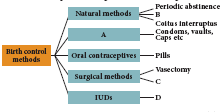
(Barriers, Lactational amenorrhoea, CuT, Tubectomy)
10.
What is amniocentesis? Why a statutory ban is imposed on this technique?
11.
12.
How are STDs transmitted?
13.
Describe the major STDs and their symptoms.
1.
(d)
| A | B | C | D |
| (iv) | (i) | (ii) | (iii) |
2.
(c)
3.
(b)
Vasectomy-Prevents spermatogenesis
4.
(b)
inhibiting release of FSH and LH
5.
(b)
6.
1. Amniocentesis is the pre-natal diagnostic technique in which a sample of amniotic fluid from the womb of a pregnant woman is taken during early stages of embryonic development and the cells are cultured and analysed synthetically.
2. Any chromosomal disorder or a metabolic error can be detected and if necessary MTP can be advised.
3. But this technique is misused for knowing the sex of the foetus followed by female foeticide.
4. Female foeticide refers to aborting the female in the mother's womb.
5. In order to prevent female foeticide and infanticide, Government of India has taken various steps like PCPNDT Act .(preconception and prenatal diagnostic technique act-1994) enacted to ban the identification of sex and to prevent the use of prenatal diagnostic techniques for selective abortion.
7.
(i) Creating awareness and providing medical assistance to build a healthy society.
(ii) Introducing sex education in schools to provide information about adolescence and adolescence related changes.
(iii) Educating couples and those in the marriageable age groups about the available birth control methods and family planning norms.
8.
The method I suggest is Artificial lnsemination Technique (AI)
1. In AI, the semen is collected either from the husband or a healthy donor and then artificially introduced into the vagina or into the uterus (IUI- Intra Uterine Insemination) of the female.
2. It is commonly used in cases where male partner are unable to inseminate the female due to very low sperm counts in the ejaculate.
9.
A - Barrier methods
B - Lactational amenorrhoea
C - Tubectomz
D - CuT
10.
Amniocentesis: It is a prenatal technique used to detect any chromosomal abnormalities in the foetus and it is being often misused to determine the sex of the foetus.
Once the sex of the foetus is known, there may be a chance of female foeticide. Hence a statutory ban on amniocentesis is imposed.
11.
12.
Sexually transmitted diseases (STD) or veneral diseases(VD) or Reproductive tract infections (RTI) are called as Sexually transmitted infections (STI).
Transmissions:
1. Normally STI are transmitted from person to person during intimate sexual contact with an infected partner.
2. Infections like Hepatitis-B and HIV are transmitted sexually as well as by sharing of infusion needles, surgical instruments, etc with infected people, blood transfusion (or) from infected mother to baby.
3. People in the age of 15 to 24years are prone to these infections.
4. The bacterial STI are gonorrhoea syphilis, chancroid, chlamydiasis and lymphogranuloma venereum.
5. The viral STI are genital herpes, genital warts Hepatitis-B and AIDS.
6. Trichomoniasis is a protozoan STI, and candidiasis is a fungal STI.
13.
The major sexually transmitted diseases are
(i) Gonorrhoea
1. Causative agent: Neisseria gonorrhoeae
2. Symptoms: Affects the urethra, rectum and throat and in females the cervix also get affected
3. Pain and pus discharge in the genital tract and burning sensation during urination.
4. Incubation period: 2 to 5 days
(ii) Syphilis
Causative agent : Treponema pallidum
Symptoms:
1. Primary stage: Formation of painless ulcer on the external genitalia.
2. Secondary stage : Skin lesions, rashes, swollen joints and fever and hair loss.
3. Tertiary stage : Appearance of chronic ulcers on nose. Lower legs and palate, loss of movement mental disorder visual impairment, heart problems, gummas (soft non-cancerous growths) etc.
(iii) Hepatitis B
1. Causative agent: Hepatitis B virus (HBV) with DNA.
2. Symptoms: Fatigue, jaundice, fever, rash and stomach pain.
3. Liver cirrhosis and liver failure occur in the later stage.
4. Incubation period: 30-80 days
(iv) AIDS:
1. Causative agent: Human immuno deficiency Virus (HIV) .
2. Symptoms: Enlarged lymph nodes, prolonged fever, prolonged diarrhoea, weight reduction, night sweating.
3. Incubation periods: 2 to 6 weeks even more than 10 years

12th Standard Syllabus & Materials
12th Standard
TN 12th Computer Applications களப்பெயர் முறைமை (DNS) Sample Question Papers Study Material - QB365 Set A
NEW12th Standard
TN 12th Computer Applications வலையமைப்பு எடுத்துக்காட்டுகள் மற்றும் நெறிமுறைகள் Sample Question Papers Study Material - QB365 Set A
NEW12th Standard
TN 12th Computer Applications கணினி வலையமைப்பு ஓர் அறிமுகம் Sample Question Papers Study Material - QB365 Set A
NEW12th Standard
TN 12th Computer Applications PHP-உடன் MySQL-ஐ இணைத்தல் Sample Question Papers Study Material - QB365 Set A



Tamilnadu Stateboard 12th Standard Subjects

Maths

Chemistry

Physics
Biology

Computer Science

Business Maths and Statistics

Economics

Commerce

Accountancy

History

Computer Applications
Biology
Computer Technology
Computer Applications
Computer Science
Business Maths and Statistics
Commerce
Economics
Maths
Chemistry
Physics
Computer Technology
History
Accountancy

Tamil

English

French
Tamilnadu Stateboard Standards

