
 100% FREE ACCESS
12th Standard Syllabus & Materials
12th Standard
TN 12th Computer Applications மின்னணு தரவு பரிமாற்றம் Sample Question Papers Study Material - QB365 Set A
NEW12th Standard
TN 12th Computer Applications மின் - வணிக பாதுகாப்பு அமைப்புகள் Sample Question Papers Study Material - QB365 Set A
NEW12th Standard
TN 12th Computer Applications மின்னணு செலுத்தல் முறைகள் Sample Question Papers Study Material - QB365 Set A
NEW12th Standard
TN 12th Computer Applications மின் - வணிகம் Sample Question Papers Study Material - QB365 Set A
NEW12th Standard
TN 12th Computer Applications திறந்த மூல கருத்துருக்கள் Sample Question Papers Study Material - QB365 Set A
NEW12th Standard
TN 12th Computer Applications வலையமைப்பு வடமிடல் Sample Question Papers Study Material - QB365 Set A

Published on: 31/12/2022
QB365 provides a detailed and simple solution for every Possible Questions in Class 12 Biology Subject - Important 5 Mark English Medium. It will help Students to get more practice questions, Students can Practice these question papers in addition to score best marks.
Download Tamil Nadu 12th Standard Biology question papers, model tests, one-mark questions, important questions, and public exam papers in PDF format. Free study materials and answer keys for TN State Board students.
Questions + Answers key
Take MCQ Biology Test1.
How Prokaryotes and Eukaryotes evolved?
2.
Explain the events in life cycle of Plasmodium in the secondary host/Man.
3.
Explain the mechanism of lac-operon of the E-coli.
4.
Name the three primary germ layers of embryo. Also, mention any three organs or organ systems developing from each layer.
5.
Give a detailed account on various natural methods of contraception.
6.
Write notes on binary fission in animals.
7.
Write notes on chromosomal abnormalities in human beings. (or) What is aneuploidy? Explain it
8.
A person is infected by HIV. How will you diagnose for AIDS?
9.
10.
What are the effects of deforestation and benefits of agroforestry?
11.
Draw a pyramid from following details and explain in brief.
Quantities of organisms are given-Hawks - 50, plants - 1000.rabbit and mouse - 250 + 250, pythons and lizard - 100 + 50 respectively.
12.
13.
14.
How can we control eutrophication?
15.
What are stem cells? Explain its role in the field of medicine
16.
Write short notes on the following.
a) Brewer's yeast
b) Ideonella sakaiensis
c) Microbial fuel cells
17.
Explain the basic concepts involved in plant tissue culture
18.
How does Mutation theory of De Vries differ from Lamarck and Darwin’s view in the origin of new species.
19.
How are STDs transmitted?
20.
Write the advantages of herbicide tolerant crops
21.
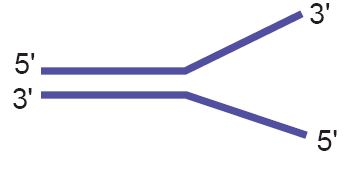
a) Identify the figure given below
b) Redraw the structure as a replicating fork and label the parts
c) Write the source of energy for this replication and name the enzyme involved in this process.
d) Mention the differences in the synthesis of protein, based on the polarity of the two template strands.
22.
The following is the illustration of the sequence of ovarian events (a-i) in a human female.
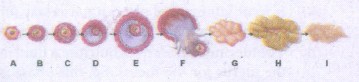
a) Identify the figure that illustrates ovulation and mention the stage of oogenesis it represents.
b) Name the ovarian hormone and the pituitary hormone that have caused the above-mentioned events.
c) Explain the changes that occurs in the uterus simultaneously in anticipation.
d) Write the difference between C and H.
23.
What is gene mapping? Write its uses
24.
Given below are some human organs. Identify one primary and one secondary lymphoid organ. Explain its role. Liver, thymus, stomach, thyroid, tonsils.
25.
Give reasons for the following:
(a) Some organisms like honey bees are called parthenogenetic animals
(b) A male honey bee has 16 chromosomes where as its female has 32 chromosomes
26.
27.
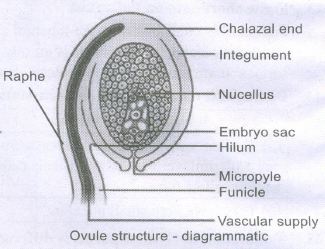
With a suitable diagram explain the structure of an ovule.
28.
In north eastern states, the jhum culture is a major threat to biodiversity – substantiate.
29.
Brief about female heterogamety.
30.
Give an account on the role of Jasminum in perfuming
1.
1. Abiotically produced molecules can spontaneously self assemble into droplets that enclose a watery solution and maintain a chemical environment different from their surroundings.
2. Scientists call these spheres as protobionts. Liposomes are lipids in a solution that can self assemble into a lipid bilayer. Some of the proteins inside the liposomes acquired the properties of enzymes resulting in fast multiplication of molecules.
3. The coacervates with nucleoprotein and nutrients had a limiting surface membrane that had the characters of a virus or free living genes.
4. Sub-sequently number of genes united to form proto-viruses somewhat similar to present day viruses.
5. Two major cell types that appeared during this time were significant. One form of the earliest cell contained clumps of nucleoproteins embedded in the cell substance.
6. Such cells were similar to the Monera. They are considered as ancestral to the modern bacteria and blue green algae
7. The other form of earliest cells contained nucleoprotein clumps that condensed into a central mass surrounded by a thin membrane
8. This membrane separated nucleoproteins from the cell substances. Such cells were referred to as Protista
9. When the natural sources of food in the ocean declined in course of time the ancestors of Monera and Protista had to evolve different methods for food procurement.
10. These may be summarized as parasitism, saprophytism, predatorism or animalism and chemosynthesis or photosynthesis. When the number of photosynthetic organisms increased there was an increase in the free O2 in the sea and atmosphere.
CH4 + ZO 2→ CO2 + 2H2O
4NH3 + 3O2→2N2 + 6H2O
11. The atmospheric oxygen combined with methane and ammonia to form CO2 and free nitrogen.
12. The presence of the free O2 brought about the evolution of aerobic respiration which could yield large amounts of energy by oxidation of food stuffs. Thus both Prokaryotes and Eukaryotes evolved.
2.
Life cycle of Plasmodium :
(i) The life cycle of Plasmodium involves three phases namely schizogony,gamogony and sporogony.
(ii) The parasite enters the human blood stream through the bite of an infected female Anopheles mosquito.
(iii) As it feeds, the mosquito injects the saliva containing the sporozoties.
(iv) The sporozoite within the blood stream enter the hepatic cells of the liver.
(v) It undergoes multiple asexual fission (schizogony) and produces merozoties which are released from liver cells.
(vi) The merozoites penetrate the RBC's. Inside the RBC of blood, the merozoite begins to develop unicellular trophozoites. The trophozoite grows in size and a central vacuole develops p them to one side of cytoplasm and becomes the signet ring stage.
(vii) The trophozoite nucleus divides asexually to produce the schizont.
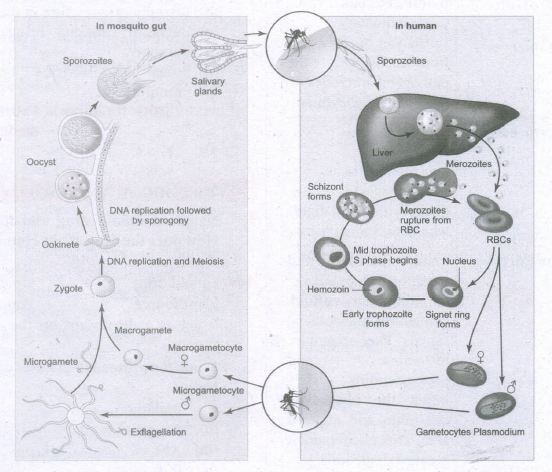
(viii) The schizont divides and produces mononucleated merozoites.
(ix) Eventually the erythrocyte lyses, releasing the merozoites and haemozoin toxin into the blood stream to infect other erythrocytes.
(x) Lysis of red blood cells results in fever and other symptoms.
(xi) This erythrocytic stage is cyclic and repeats itself approximately every 48 to 72 hours or longer depending on the species of Plasmodium involved.
(xii) The sudden release of merozoites triggers an attack on the RBCs.
(xiii) Occasionally, merozoites differentiate into macrogametocytes and microgametocytes. when these are ingested by a mosquito, they develop into male and female gametes respectively.
3.
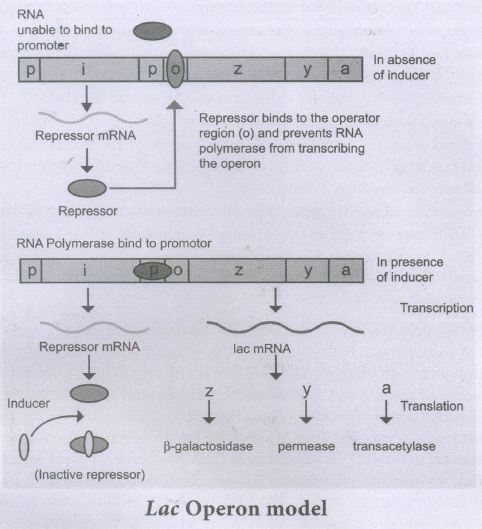
The Lac (Lactose) operon: The metabolism of lactose in E-coli requires three enzymes - permease, β-galactosidase (β-gal) and transacetylase. The enzyme permease is needed for entry of lactose into the cell, β-galactosidase brings about hydrolysis of lactose to glucose and galactose, while transacetylase transfers acetyl group from acetyl Co A to β-galactosidase. The lac operon consists of one regulator gene ('i' gene refers to inhibitor) promoter sites (P), and operator site (o). Besides these, it has three structural genes namely lac z, y and lac a. The lac 'z' gene codes for β-galactosidase, lac 'y' gene codes for permease and 'a' gene codes for transacetylase.
Jacob and Monod proposed the classical model of Lac operon to explain gene expression and regulation in E-coli. In lac operon, a polycistronic structural gene is regulated by a common promoter and regulatory gene. When the cell is using its normal energy source as glucose; the 'i' gene transcribes a repressor mRNA and after its translation, a repressor protein is produced. It binds to the operator region of the operon and prevents translation, as a result, β-galactosidase is not produced. In the absence of preferred carbon source such as glucose, if lactose is available as an energy source for the bacteria then lactose enters the cell as a result of permease enzyme. Lactose acts as an inducer and interacts with the repressor to inactivate it. The repressor protein binds to the operator of the operon and prevents RNA polymerase from transcribing the operon. In the presence of inducer, such as lactose or allolactose, the repressor is inactivated by interaction with the inducer. This allows RNA polymerase to bind to the promotor site and transcribe the operon to produce lac mRNA which enables formation of all the required enzymes needed for lactose metabolism. This regulation of lac operon by the repressor is an example of negative control of transcription initiation.
4.
| Germ Layers | Organ (or) Organ Systems | |
|---|---|---|
| a. | Ectoderms | Central nervous system, peripheral nervous system, and mammary gland. |
| b. | Mesoderm | Cartilage and bones, muscles, urinogenital organs |
| c | Endoderm | Epithelium of respiratory tract, liver, thyroid gland. |
5.
Natural method is used to prevent meeting of sperm with ovum. i.e., Rhythm method (safe period), coitus interruptus, continuous abstinence and lactational amenorrhoea.
a. Periodic abstinence/rhythm method: Ovulation occurs at about the 14th day of the menstrual cycle. Ovum survives for about two days and sperm remains alive for about 72 hours in the female reproductive tract. Coitus is to be avoided during this time.
b. Continuous abstinence is the simplest and most reliable way to avoid pregnancy is not to have coitus for a defined period that facilitates conception.
c. Coitus interruptus is the oldest family planning method. The male partner withdraws his penis before ejaculation, thereby preventing deposition of semen into the vagina.
d. Lactational amenorrhoea : Menstrual cycles resume as early as 6 to 8 weeks from parturition. However, the reappearance of normal ovarian cycles may be delayed for six months during breast-feeding. This delay in ovarian cycles is called lactational amenorrhoea. It serves as a natural, but an unreliable form of birth control. Suckling by the baby during breast-feeding stimulates the pituitary to secrete increased prolactin hormone in order to increase milk production. This high prolactin concentration in the mother's blood may prevent menstrual cycle by suppressing the release of GnRH (Gonadotropin Releasing Hormone) from hypothalamus .and gonadotropin secretion from the pituitary.
6.
In binary fission, the parent organism divides into two halves and each half forms a daughter individual. The nucleus divides first amitotically or mitotically (karyokinesis), followed by the division of the cytoplasm (cytokinesis). The resultant offsprings are genetically identical to the parent. Depending on the plane of fission, binary fission is of the following types
(i) Simple irregular binary fission
(ii) Transverse binary fission
(iii) Longitudinal binary fission
(iv) Oblique binary fission
(i) Simple irregular binary fission is seen in Amoeba like irregular shaped organisms, where the plane of division is hard to observe. The contractile vacuoles cease to function and disappear. The nucleoli disintegrate and the nucleus divides mitotically. The cell then constricts in the middle, so the cytoplasm divides and forms two daughter cells.
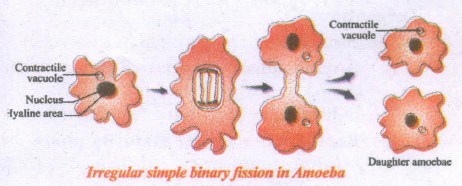
(ii) In Transverse binary fission, the plane of the division runs along the transverse axis of the individual. E.g. Paramecium and Planaria. In Paramecium the macronucleus divides by amitosis and the micronucleus divides by mitosis.
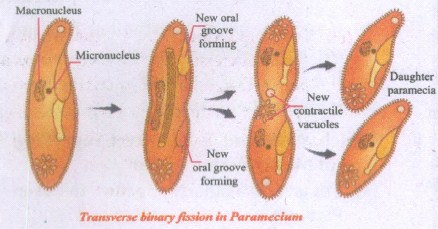
(iii) In Longitudinal binary fission the nucleus and the cytoplasm divides in the longitudinal axis of the organism. In flagellates, the flagellum is retained usually by one daughter cell. The basal granule is divided into two and the new basal granule forms a flagellum in the other daughter individual. E.g. Vorticella and Euglena.
(iv) In Oblique binary fission the plane of division is oblique. It is seen in dinoflagellates. E.g. Ceratium.
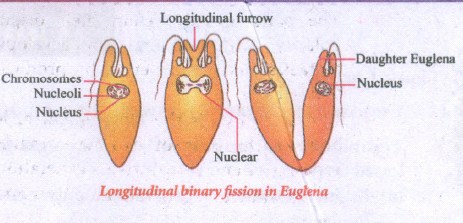
7.
In human beings the diploid (2n) body cell has 46 chromosomes (23 pairs).
i) chromosomal abnormalities are caused by errors is the number or structure of chromosome.
ii) Failure of chromatids to segregate during cell division resulting in the gain or loss of of one or more choromosomes called aneuploidy. It is caused by the nondisjunction of chromosomes.
iii) There abnormalities causes various syndromes in human beings. They are
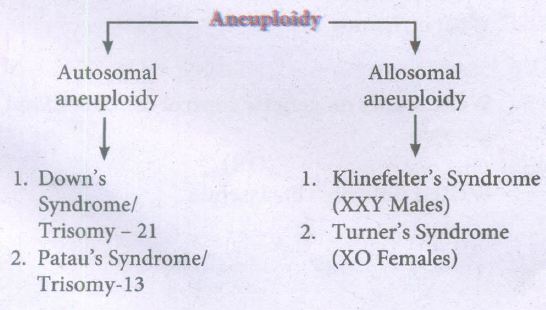
1. Down's Syndrome/ Trisomy-21:
Trisomic condition of chromosome - 21
Symptoms :
(i) severe mental retardation,
(ii) Defective development of the central nervous system,
(iii) increased separation between the eyes,
(iv) flattened nose, ears are malformed,
(v) mouth is constantly open and the tongue protrudes.
2. Patau's Syndrome/ Trisomy-13
i) Trisomic condition of chromosome l3 results in Patau's syndrome.
ii) Meiotic non disjunction is thought to be the cause for this chromosomal abnormality.
ii) It is characterized by
symptoms
(i) multiple and severe body malformations as well as profound mental deficiency.
(ii) Small head with small eyes,
(iii) cleft palate,
(iv) malformation of the brain
(v) internal organs
b. Allosomal abnormalities is human beings:
Mitotic or meiotic non-disjunction of sex chromosomes causes allosomal abnormalities. Several sex chromosomal abnormalities have been detected. Eg. Klinefelter's syndrome and Turner's syndrome.
1. Klineletter's Syndrome(XXY Males):
(i) It is due to the presence of an additional copy of the X chromosome resulting in a karyotype of 47, XXY.
(ii) Persons with this syndrome have 47 chromosomes (44AA+XXY).
symptoms
sterile males, tall, obese, with long limbs, high pitched voice, under developed genitalia and have feeble breast (gynaecomastia) development.
2. Turner's Syndrome (XO Females):
(i) It is due to the loss of a X chromosome resulting in a karyotype of 45, X.
(ii) Persons with this syndrome have 45 chromosomes (44 autosomes and one X chromosome) (44AA + XO) and are sterile females.
symptoms
Low stature, webbed neck, under developed breast, rudimentary gonads lack of menstrual cycle during puberty, are the main symptoms of this syndrome.
8.
A simpl blood tes is available that can determine wheth r the person has been, infected with HIV. The ELISA test (Enzyme Linked ImmunoSorbent Assay) detects the presence of HIV antibodies. It is a preliminary test: Western blot test is more reliable and a confirmatory test. It detects the viral core proteins.r lf both tests detect the presence ofl:he antibodies, the person is corfsidered to be HIV positive. The vaccines are classified as first, second and third generation vaccines.
(i) First generation vaccine is further subdivided into live attenuated vaccine, killed vaccine and toxoids.
(a) Live attenuated vaccines use the weakened (attenuated), aged, less virulent form of the virus. E.g. Measles, mumps and rubella (MMR) vaccine and the Varicella (chickenpox) vaccine.
(b) Killed (inactivated) vaccines are killed or inactivated by heat and other methods. E.g. Salk's polio vaccine.
(c) Toxoid vaccines contain a toxin or chemical secreted by the bacteria or virus. They make us immune to the harmful effects of the infection, instead of to the infection itself. E.g. DPT vaccine (Diphtheria, Pertussis and Tetanus).
(ii) Second generation vaccine contains the pure surface antigen of the pathogen. E.g. Hepatitis- B vaccine.
(iii) Third generation vaccine contains the purest and the highest potency vaccines which are synthetic in generation. The latest revolution in vaccine is DNA vaccine or recombinant vaccine.
9.
10.
Effects of deforestation:
(i) Burning of forest wood release stored carbon, a negative impact just opposite of carbon sequestration,
(ii) Trees and plants bind the soil particles. The removal of forest cover increases soil erosion and decreases soil fertility. Deforestation in dry areas leads to the formation of deserts.
(iii) The amount of runoff water increases soil erosion and also creates flash flooding, thus reducing moisture and humidity.
(iv) The alteration of local precipitation patterns leading to drought conditions in many regions. It triggers adverse climatic conditions and alters water cycle in the ecosystem.
(v) It decreases the bio-diversity significantly as their habitats are disturbed and disruption of natural cycles.
(vi) Loss of livelihood for forest dwellers and rural people.
(vii) Increased global warming and account for one-third of total CO2 emission.
(viii) Loss of life support resources, fuel, medicinal herbs, and wild edible fruits.
Benefits of agroforestry:
(i) It is an answer to the problem of soil and water conservation and also to stabilize the soil (salinity and water table) reduce landslide and water run-off problem.
(ii) Nutrient cycling between species improves and organic matter is maintained.
(iii) Trees provide a micro climate for crops and maintain O2 - CO2 balanced, atmospheric temperature and relative humidity.
(iv) Suitable for dry land where rainfall is minimum and hence it is a good system for alternate land use pattern.
(v) Multipurpose tree varieties like Acacia are used for wood pulp, tanning, paper, and firewood industries.
(vi) Agroforestry is recommended for the following purposes. It can be used as Farm Forestry for the extension of forests, mixed forestry, shelterbelts, and linear strip plantation.
11.
Grassland ecosystem : There is a gradual decrease in the number of organisms in each trophic level from producers to primary consumers and then to secondary consumers, and finally to tertiary consumers. Therefore pyramids of number in grassland ecosystem are always upright.
12.
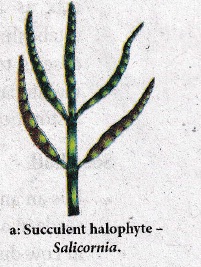
13.
14.
1. Improvement of the purifying performance of waste water treatment plants, installing tertiary treatment systems to reduce nutrient concentration.
2. Implementation of effective filter ecosystems to remove nitrogen and phosphorus present in the run-off water.
3. Reduction of phosphorus in detergents.
4. Rationalisation of agricultural techniques through proper planning of fertilization and use of slow release fertilizers.
5. Use of alternative practices in animal husbandry to limit the production of waste water.
15.
(i) Stem cells are undifferentiated cells found in most of the multicellular animals.
(ii) These cells maintain their undifferentiated state even after undergoing repeated mitotic divisions.
(iii) Stem cells research has the potential to revolutionize the future of medicine with the ability to regenerate damaged and diseased organs.
(iv) Stem cell research has the potential to revolutionize the future of medicine with the ability to regenerate damaged and diseased organs.
(v) They are capable of self renewal and exhibit 'cellular potency'.
(vi) They can differentiate into all types of cells that are derived from any of the three germ layers ecto, endo and mesoderms.
(vii) In mammals there are two types of stem cells namely embryonic stem cells & adult stem cells (ES).
(viii) ES are pleuripotent and can produce the three primary germ layers ectoderm, Mesoderm and endoderm.
(ix) Embryonic stem cells are multipotent stem cells that can differentiate into a number of type of cells.
(x) ES cells are isolated from the epiblast tissue of the inner cell mass of a blastocyst.
(xi) When stimulated ES can develop into more than 200 cells Qpes of the adult body.
(xii) ES cells are immortal i.. e they can proliferate in a sterile culture medium and maintain their undifferentiated state.
(xiii) Adult stem cells are found in various tissues of children as well as adults.
(xiv) An adult stem cell or somatic stem cell can divide and create another cell similar to it.
(xv) Most of the adult stem cells are multipotent and can act as a repair system of the body and replenishing adult tissues.
(xvi) The red bone marrow is a rich source of adult stem cells.
(xvii) The most important and potential application of human stem cells is the generation of cells and tissues that could be used for cell based therapies.
(xviii) Human stem cells could be used to test new drugs.
16.
(a) Brewer's yeast:
(i) Saccharomyces cerevisiae commonly called brewer's yeast.
(ii) It is used for fermenting malted cereals and fruit juices to produce various alcoholic beverages.
(iii) Wine is made from the fermentation of grape juice.
(iv) Grape juice is fermented by various strains of Saccharomyces cerevisiae into alcohol.
(v) Beer is produced from germinated barley malt grain by Saccharowces carlsbergensis or Saccharomyces cerevisiae.
(vi) Rum is made from fermented sugarcane or molasses or directly from sugarcane juice by Saccharomyces cerevisiae.
(vii) Whisky is a type of distilled alcoholic beverage made from fermented grain mash.
(viii) It is the major producer- of ethanol (C2H5OH)
(ix) It is used as industrial alcohol and also used for laboratory and fuel purposes.
(x) It is used for commercial production of enzymes.
(b) Ideonella sakaiensis:
(i) Ideonella sakaiensis is currently tried for recycling of PET plastics.
(ii) These bacteria use PETase and MHETase enzymes to breakdown PET plastic into terephthalic acid and ethylene glycol.
(c) Microbial fuel cells (MFC)
1. Microbial fuel cells work by allowing bacteria to oxidize and reduce organic molecules.
2. Bactedal respiration is basically one big redox reaction in which electrons are being moved around.
3. A MFC consists of an anode and a cathode separated by a proton exchange membrane.
4. Microbes at the anode oxidize the organic fuel generating protons which pass through the membrane to the cathode and the electrons pass through the anode to the external circuit to generate current.
17.
Basic concepts of Tissue Culture
Basic concepts of plant tissue culture are totipotency, differentiation, dedifferentiation and redifferentiation.
Totipotency
The property of live plant cells that they have the genetic potential when cultured in nutrient medium to give rise to a complete individual plant.
Differentiation
The process of biochemical and structural changes by which cells become specialized in form and function.
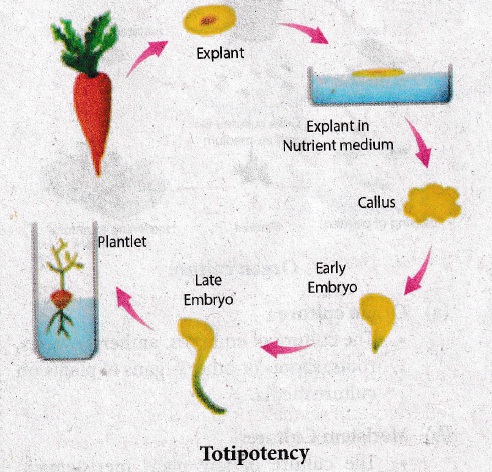
Redifferentiation
The further differentiation of already differentiated cell into another type of cell. For example, when the component cells of callus have the ability to form a whole plant in a nutrient medium, the phenomenon is called redifferentiation.
Dedifferentiation
The phenomenon of the reversion of mature cells to the meristematic state leading to the formation of callus is called dedifferentiation. These two phenomena of redifferentiation and dedifferentiation are the inherent capacities of living plant cells or tissue. This is described as totipotency.
18.
1. Hugo de Vries by his experiment suggest that variations is caused due to mutation among the genetic sequence of an individual.
2. Hugo de vries for the first time gave the term saltation which stands for huge mutation in a single step resulting in speciation.
3. Darwin during his voyage in H.M.S. Beagle he found that living organism share similar features existed from million of years.
4. Evolution is a sequential process that leads to betterment of life forms to cope with change in environment and that is passed to successive generation called as natural selection.
5. Mutation is a random process and direction which is not specific.
19.
Sexually transmitted diseases (STD) or veneral diseases(VD) or Reproductive tract infections (RTI) are called as Sexually transmitted infections (STI).
Transmissions:
1. Normally STI are transmitted from person to person during intimate sexual contact with an infected partner.
2. Infections like Hepatitis-B and HIV are transmitted sexually as well as by sharing of infusion needles, surgical instruments, etc with infected people, blood transfusion (or) from infected mother to baby.
3. People in the age of 15 to 24years are prone to these infections.
4. The bacterial STI are gonorrhoea syphilis, chancroid, chlamydiasis and lymphogranuloma venereum.
5. The viral STI are genital herpes, genital warts Hepatitis-B and AIDS.
6. Trichomoniasis is a protozoan STI, and candidiasis is a fungal STI.
20.
Advantages of Herbicide Tolerant Crops:
1. Weed control improves higher crop yields;
2. Reduces spray of herbicide;
3. Reduces competition between crop plant and weed;
4. Use of low toxicity compounds which do not remain active in the soil; and
5. The ability to conserve soil structure and microbes.
21.
(a) Replicating fork of DNA
(b)
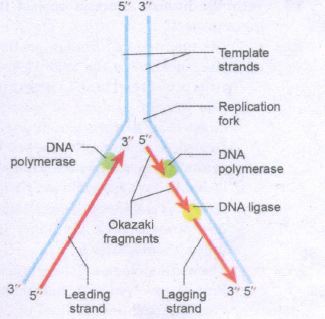
(c) Source of Energy:
NTP's are used in the synthesis of RNA primers and ATP is used as an energy source for some of the enzymes, needed to initiate and sustain DNA synthesis occurs at the replication fork.
Enzymes involved in replication :
(i) DNA Helicase
(ii) DNA polymerase
(iii) Topoisomerase/DNA Gyrase
(iv) DNA ligase
(v) Primase
(d) Both the strands of (parental) DNA act as template for the synthesis of new strands
1. On the templates strand with \(3^{\prime} \rightarrow 5^{\prime}\) polarity the new strand (leading strand) is synthesized as a continuous stretch. It is called continuous synthesis (DNA polymerase carryout polymerisation).
2. On the other strand \(5^{\prime} \rightarrow 3^{\prime}\) polarity DNA synthesized as short stretches; it is called discontinuous synthesis.
3. Later the short stretches of DNA are joined by DNA-ligases into a continuous strand called lagging strand.
22.
(a) The figure 'F' represent ovulation.
Stage of oogenesis - Ovulatory or luteal stage of oogenesis
(b) (i) The ovarian hormone is progesterone which is released during ovulation.
(ii) The pituitary hormones are the follicle-stimulating hormone (FSH) and Luteinizing hormone (LSH) which are released during and ovulation from anterior pituitary gland.
(c) The endometrium of the uterus gets thickened and blood supply to the endometrium increase.
(d) Figure 'C' represents the secondary follicle and figure h represents the degenerating corpus luteum.
| Secondary follicle | Corpus luteurn |
| lt is surrounded by layers of granulosa cells | Absence of granulosa cells |
| Theca layer is present | Theca layer is absent. |
23.
The diagrammatic representation of position of genes and related distances between the adjacent genes is called gene mapping.
Uses
(i) Used to determine gene order.
(i) Identify the locus of a gene.
(i) Calculate the distance between genes.
(i) Useful in predicting results of dihybrid and trihybrid crosses.
(i) Allows the geneticists to understand the overall genetic complexity of particular organism.
24.
(i) The primary lymphoid organ is thymus.
(ii) The secondary lymphoid organ is tonsils.
Role of Primary lymphoid organ: Thymus
(i) Thymus is most active during the neonatal and pre-adolescent periods.
(ii) The thymus is a flat and bilobed organ located behind the sternum, above the heart.
(iii) Each lobe of the thymus contains numerous lobules, separated from each other by connective tissue called septa (cross walls).
(iv) Each lobule is differentiate into an outer cortex and an inner medulla. Within each lobule, the developing T cells called thymocytes are arranged into an outer cortex and an inner medulla
(v) An inner medulla contains immature thymocytes and outer cortex has matured thymocyte
(vi) One of its main secretions is the hormone thymosin. It stimulates the T cells to become mature and immunocompetent. By the early teens, (upto 12-13 years) the thymus begins to atrophy and is replaced by adipose tissue (binding tissue).
Secondary lymphoid organ :
(i) The tonsils (palatine tonsils) are a pair of soft tissue masses located at the back of the throat (pharynx ).
(ii) The tonsils are part of the lymphatic system which help to fight against the infections. They stop invading germs including bacterin and viruses.
25.
(a) Some organisms like honeybees are called parthenogenetic animals.
1. In case of honeybees both haploid and diploid individuals formed, as a result of incomplete parthenogenesis.
2. Both sexual reproduction and parthenogenesis are inclusive.
3. Fertilized eggs (zygote) give rise to queen and workers (both are females) by the process of sexual reproduction.
4. Unfertilized eggs (ova) of females develop into drones (males) by the process of parthenogenesis.
(b) A male honeybee has 16 chromosomes where as its female has 32 chromosomes
1. It is because of haplodiploidy which is a sex determination system, in which males develop from unfertilized eggs (parthenogenesis) and are haploid (16n) and females develop frorn fertilized eggs and are diploid (32n) (sexual reproduction).
2. As unfertilized egg carries only half number of chromosome as compared to fertilized egg.
Therefore male honeybees have 16 chromosomes where as female has 32 chromosomes.
26.
27.
(i) A mature ovule (megasporangium) consist of a stalk and a body
(ii) Funicle - The stalk of the ovule by which it attaches the ovule to the placenta.
(iii) Integuments - one or two protective covering around the nucellus
(iv) Micropyle - Pore present at the tip of the ovule where the integument is absent
(v) Chalaza - The basal region of the body of the ovule where the nucellus, the integument and funicle meet or merge
(vi) Embryosac- The female gametophyte oval sac like structure in the nucellus, toward the micropylar end.
28.
(i) In shifting cultivation, plots of natural tree vegetation are burnt away and the cleared patches are farmed for 2-3 seasons, after which their fertility reduces to a point where crop production is no longer profitable.
(ii) The farmer then abandons this patch and cuts down a new patch of forest trees elsewhere for crop production. This system is practiced in northeastern regions of India.
(iii) When vast areas are cleared and burnt, it results in loss of forest cover, pollution, and discharge of CO2 which in turn attributes to a loss of habitat and climate change which has an impact on the faunal diversity of that regions.
(iv) Carrot grass (Parthenium) and lantana introduced into our country have become invasive and caused environmental damage; they pose a threat to the native species of plants in our forests.
29.
1. In this method of sex determination, the homogametic male possesses two 'X' chromosomes as in certain insects and certain vertebrates like fishes, reptiles and birds producing a single type of gamete.
2. The female sex consists of a single 'Y' chromosome. Thus the females are heterogametic and produce two types of eggs.
3. To avoid confusion with the XX-XO and XX-XY trues of sex determination, the alphabets 'Z' and 'W 'are used here instead of X and Y respectively.
4. Heterogametic females are of two types, ZO-ZZ type and ZW-ZZ type.
30.
1. Used for worship, ceremonial purposes, incense and fumigants, making perfumed hair oils, cosmetics and soaps.
2. Used for soothing, relaxing antidepressant qualities.

12th Standard Syllabus & Materials
12th Standard
TN 12th Computer Applications களப்பெயர் முறைமை (DNS) Sample Question Papers Study Material - QB365 Set A
NEW12th Standard
TN 12th Computer Applications வலையமைப்பு எடுத்துக்காட்டுகள் மற்றும் நெறிமுறைகள் Sample Question Papers Study Material - QB365 Set A
NEW12th Standard
TN 12th Computer Applications கணினி வலையமைப்பு ஓர் அறிமுகம் Sample Question Papers Study Material - QB365 Set A
NEW12th Standard
TN 12th Computer Applications PHP-உடன் MySQL-ஐ இணைத்தல் Sample Question Papers Study Material - QB365 Set A



Tamilnadu Stateboard 12th Standard Subjects

Maths

Chemistry

Physics
Biology

Computer Science

Business Maths and Statistics

Economics

Commerce

Accountancy

History

Computer Applications
Biology
Computer Technology
Computer Applications
Computer Science
Business Maths and Statistics
Commerce
Economics
Maths
Chemistry
Physics
Computer Technology
History
Accountancy

Tamil

English

French
Tamilnadu Stateboard Standards

