
 100% FREE ACCESS
12th Standard Syllabus & Materials
12th Standard
TN 12th Computer Applications மின்னணு தரவு பரிமாற்றம் Sample Question Papers Study Material - QB365 Set A
NEW12th Standard
TN 12th Computer Applications மின் - வணிக பாதுகாப்பு அமைப்புகள் Sample Question Papers Study Material - QB365 Set A
NEW12th Standard
TN 12th Computer Applications மின்னணு செலுத்தல் முறைகள் Sample Question Papers Study Material - QB365 Set A
NEW12th Standard
TN 12th Computer Applications மின் - வணிகம் Sample Question Papers Study Material - QB365 Set A
NEW12th Standard
TN 12th Computer Applications திறந்த மூல கருத்துருக்கள் Sample Question Papers Study Material - QB365 Set A
NEW12th Standard
TN 12th Computer Applications வலையமைப்பு வடமிடல் Sample Question Papers Study Material - QB365 Set A

Published on: 07/09/2019
Zoology - Applications of Biotechnology
Download Tamil Nadu 12th Standard Biology question papers, model tests, one-mark questions, important questions, and public exam papers in PDF format. Free study materials and answer keys for TN State Board students.
Questions + Answers key
Take MCQ Biology Test1.
Recombinant Factor VIII is produced in the ______ cells of the Chinese Hamster
Liver cells
blood cells
ovarian cells
brain cells.
2.
3.
How many amino acids are arranged in the two chains of Insulin
Chain A has 12 and Chain B has 13
Chain A has 21 and Chain B has 30 amino acids
Chain A has 20 and Chain B has 30 amino acids
Chain A has 12 and chain B has 20 amino acids.
4.
Dolly, the sheep was obtained by a technique known as
Cloning by gene transfer
Cloning without the help of gametes
Cloning by tissue culture of somatic cells
Cloning by nuclear transfer
5.
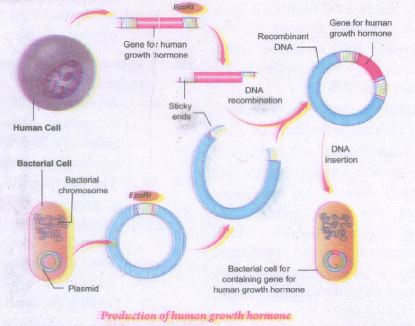
Explain the steps involved in the production of recombinant hGH
6.
How was Insulin obtained before the advent of rDNA technology? What were the problems encountered?
7.
Explain how “Rosie” is different from a normal cow
8.
Differentiate between Somatic cell gene therapy and germline gene therapy
9.
What are DNA vaccines?
10.
If a person thinks he is infected with HIV, due to unprotected sex, and goes for a blood test. Do you think a test such as ELISA will help? If so why? If not, why?
11.
12.
PCR is a useful tool for early diagnosis of an Infectious disease. Elaborate
1.
(c)
ovarian cells
2.
(a)
3.
(b)
Chain A has 21 and Chain B has 30 amino acids
4.
(d)
Cloning by nuclear transfer
5.
(i) Human growth hormones somatostatin and somatotropin such as are peptide hormones secreted by the pituitary gland that helps in the growth and development by increasing the uptake of amino acids and promoting protein synthesis. Deficiency of human growth hormone causes dwarfism, which could be treated by injecting hGH extracted from the human pituitary glands.
(ii) Using recombinant DNA technology hGH can be produced. The gene for hGH is isolated from the human pituitary gland cells.
(iii) The isolated gene is inserted into a plasmid vector and then is transferred into E. coli.
(iv) The recombinant E. coli then starts producing human growth hormone. The recombinant E. coli are isolated from the culture and mass production ofhGH is carried out by fermentation technology.
(v) A recombinant form of a human growth hormone called somatropin is used as a drug to treat growth disorders in children.
6.
1. The human insulin is synthesized by the \(\beta\) cells of Islets of Langerhans in the pancreas. It is formed of 51 amino acids which are arranged in two polypeptide chains, A and B. The polypeptide chain A has 21 amino acids while the polypeptide chain B has 30 amino acids.
2. In the early years, insulin isolated and purified from the pancreas of pigs and cows was used to treat diabetic patients. Due to minor differences in the structure of the animal Insulin as compared allergic reactions in some diabetic patients.
7.
1. In 1997, Rosie, the first transgenic cow produced human protein enriched milk, which contained the human alpha lactalbumin.
2. Alpha lactalbumin is a protein composed of 123 amino acidic and 4 disulphide bridges, with a molecular weight of 14178 Da.
3. In human milk, & lactalbumin is the most abundant protein comprising 25% of total protein found in human milk.
4. It is synthesized by the mammary glands & lactalbumin binds calcium and zinc ions and possesses bactericidal antitumor activities.
8.
| S.No. | SOMATIC CELL GENE THERAPY | GERMLINE GENE THERAPY |
|---|---|---|
| i. | Therapeutic genes transferred into the somatic cells. | Therapeutic genes transferred into the germ cells. |
| ii. | Introduction of genes into bone marrow cells, blood cells, skin cells, etc., | Genes introduced into eggs and sperms. |
| iii. | Will not be inherited in later generations. | Heritable and passed on to later generations. |
9.
(i) Genetic immunization by using DNA vaccines is a novel approach that came into being in 1990.
(ii) The immune response of the body is stimulated by a DNA molecule.
(iii) A DNA vaccine consists of a gene encoding an antigen protein, inserted on to a plasmid, and then incorporated into the cells in a target animal.
(iv) DNA instructs the cells to make antigenic molecules which are displayed on its surfaces. This would evoke an antibody response to the free floating antigen secreted by the cells.
(v) The DNA vaccine cannot cause the disease as it contains only copies of a few of its genes.
(vi) DNA vaccines are relatively easy and inexpensive to design and produce.
(vii) Vaccines produced by these new techniques have definite advantages like producing target proteins, long lasting immunity and trigger immune response only against specific pathogens with less toxic effects.
10.
1. Yes the test ELISA helps.
2. ELlSA stands for Enzyme linked lmmuno Sorbent Assay.
3. It is used for the detection of (HIV) AIDS disease.
4. ELISA is based on the principle of antigen antibody interaction, by pathogen can be detected by the presence of antigens (Proteins, glycoproteins etc). or by detecting the antibodies synthesized by the host against the pathogen.
5. Thus it helps to identify the infection of HIV leads to AIDS.
6. The foreign DNA that is introduced is called the transgene and the animals that are produced by DNA manipulations are called transgenic animals or the genetically engineered or genetically modified organisms.
11.
12.
(i) PCR is a very sensitive technique which enables the amplification of desired DNA from a limited amount of DNA template.
(ii) A technique can be also used for amplifications of RNA in which case it is referred to as reverse transcription PCR (RT-PCR). In this process the RNA molecules (mRNA) must be converted to complementary DNA by the enzyme reverse transcriptase (reverse transcription).
(iii) The cDNA then serves as the template for PCR.
(iv) The specificity and sensitivity of PCR is useful for the diagnosis of inherited disorders (genetic, viral; bacterial, diseases).
(v) Hence, it can detect the presence of an infectious organism in the infected patient at an early stage of infection (even before the infectious organism has multiplied into large number).

12th Standard Syllabus & Materials
12th Standard
TN 12th Computer Applications களப்பெயர் முறைமை (DNS) Sample Question Papers Study Material - QB365 Set A
NEW12th Standard
TN 12th Computer Applications வலையமைப்பு எடுத்துக்காட்டுகள் மற்றும் நெறிமுறைகள் Sample Question Papers Study Material - QB365 Set A
NEW12th Standard
TN 12th Computer Applications கணினி வலையமைப்பு ஓர் அறிமுகம் Sample Question Papers Study Material - QB365 Set A
NEW12th Standard
TN 12th Computer Applications PHP-உடன் MySQL-ஐ இணைத்தல் Sample Question Papers Study Material - QB365 Set A



Tamilnadu Stateboard 12th Standard Subjects

Maths

Chemistry

Physics
Biology

Computer Science

Business Maths and Statistics

Economics

Commerce

Accountancy

History

Computer Applications
Biology
Computer Technology
Computer Applications
Computer Science
Business Maths and Statistics
Commerce
Economics
Maths
Chemistry
Physics
Computer Technology
History
Accountancy

Tamil

English

French
Tamilnadu Stateboard Standards

