
 100% FREE ACCESS
12th Standard Syllabus & Materials
12th Standard
TN 12th Computer Applications மின்னணு தரவு பரிமாற்றம் Sample Question Papers Study Material - QB365 Set A
NEW12th Standard
TN 12th Computer Applications மின் - வணிக பாதுகாப்பு அமைப்புகள் Sample Question Papers Study Material - QB365 Set A
NEW12th Standard
TN 12th Computer Applications மின்னணு செலுத்தல் முறைகள் Sample Question Papers Study Material - QB365 Set A
NEW12th Standard
TN 12th Computer Applications மின் - வணிகம் Sample Question Papers Study Material - QB365 Set A
NEW12th Standard
TN 12th Computer Applications திறந்த மூல கருத்துருக்கள் Sample Question Papers Study Material - QB365 Set A
NEW12th Standard
TN 12th Computer Applications வலையமைப்பு வடமிடல் Sample Question Papers Study Material - QB365 Set A

Published on: 19/09/2019
Zoology - Human Health and Diseases
Download Tamil Nadu 12th Standard Biology question papers, model tests, one-mark questions, important questions, and public exam papers in PDF format. Free study materials and answer keys for TN State Board students.
Questions + Answers key
Take MCQ Biology Test1.
Explain the process of replication of retrovirus after it gains entry into the human body.
2.
Given below are some human organs. Identify one primary and one secondary lymphoid organ. Explain its role. Liver, thymus, stomach, thyroid, tonsils.
3.
On which basis, the antibodies are classified? Name them.
4.
Draw a simplified diagram of immunoglobulin.
5.
Name the Agranulocytes involved in immune response
6.
Why secondary immune response is more effective than primary immune response?
7.
Name any four human viral diseases.
8.
What causes shivering in malarial patient?
9.
Mention the three phases in the life of Plasmodium parasite with their respective host.
10.
List the signs and symptoms of mental depression.
11.
Name two plants with hallucinogenic properties.
12.
What is a digenic organism?
13.
Name the causal agent of African sleeping sickness and the vector.
14.
List out chemical alarm signals produced during inflammation.
15.
What are interferons? Mention their role.
1.
(i) After getting into the body of the person, the virus enters into macrophages where RNA genome of the virus replicates to form viral DNA with the help of the enzyme reverse transcriptase.
(ii) This viral DNA gets incorporated into the DNA of host cells and directs the infected cells to produce viral particles.
(iii) The macrophages continue to produce viral particles and act like a HIV factory. simultaneously, HIV enters into helper T-lymphocytes (TH), replicates and produces progenies viruses.
The progenies viruses are released into the blood attack other helper T-lymphocytes. This is repeated, leading to a progressive decrease in the number of helper T-lymphocytes in the body of the infected person.
(v) During this period, the person suffers from bouts of fever, diarrhea and weight loss. Due to decrease in the number of helper T-lymphocytes, the person starts suffering from infections that could have been otherwise overcome, such as those due to bacteria especially mycobacterium viruses; fungi and even parasites like toxoplasma.
(vi) The patient becomes so immune deficient that he/she is unable to protect himself/herself against infections.
2.
(i) The primary lymphoid organ is thymus.
(ii) The secondary lymphoid organ is tonsils.
Role of Primary lymphoid organ: Thymus
(i) Thymus is most active during the neonatal and pre-adolescent periods.
(ii) The thymus is a flat and bilobed organ located behind the sternum, above the heart.
(iii) Each lobe of the thymus contains numerous lobules, separated from each other by connective tissue called septa (cross walls).
(iv) Each lobule is differentiate into an outer cortex and an inner medulla. Within each lobule, the developing T cells called thymocytes are arranged into an outer cortex and an inner medulla
(v) An inner medulla contains immature thymocytes and outer cortex has matured thymocyte
(vi) One of its main secretions is the hormone thymosin. It stimulates the T cells to become mature and immunocompetent. By the early teens, (upto 12-13 years) the thymus begins to atrophy and is replaced by adipose tissue (binding tissue).
Secondary lymphoid organ :
(i) The tonsils (palatine tonsils) are a pair of soft tissue masses located at the back of the throat (pharynx ).
(ii) The tonsils are part of the lymphatic system which help to fight against the infections. They stop invading germs including bacterin and viruses.
3.
The antibodies are classified into five major categories, based on their physiological and biochemical properties. They are IgG (gamma), IgM(mu), IgA (alpha), IgD(delta) and IgE (epsilon).
4.
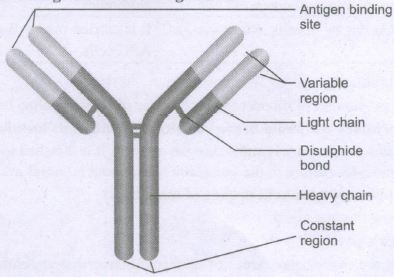
5.
(a) Lymphocyte
(b) Monocytes
6.
Due to the establishment of immunological memory of the first encounter, the secondary immune response highly intense and effective
7.
1. Common cold
2. Mumps
3. Measles
4. Viral hepatitis
5. Dengue fever
6. Chikungunya
7. Chicken pox
8. Poliomyelitis
8.
After infection of RBC with sporozoite, when the RBC ruptures a toxic substance haemozoin is released which causes shivering chills and high fever followed by sweating
9.
(a) Schizogony occurs in man.
(b) Gamogony occurs in man.
(c) Sporogony occurs in gut of mosquito
10.
(i) Loss of self confidence and self esteem Anxiety
(ii) Not being able to enjoy things that are
(iii) usually pleasurable or interesting
11.
Atropa belladonna and Datura
12.
(i) An organism which completes its life cycle in two hosts is said to be digenic,
(ii) Eg : plasmodium vivax which casues malaria is a digenic parasite invading man as secondary host and female Anopheles mosquito as primary host.
13.
Casual agent - Trypanosoma gambiense
Vector - Tsetse fly
14.
(i) An infection or tissue injury usually causes redness (rubber), swelling (tumor), pain (dolor). and production of heat (color) that may result in fever
(ii) Such localised expression is called inflammatory response, which occur due to release of certain chemical alarm signals such as histamine and prostaglandins.
15.
Interferons: These are the proteins made and released by host cells in response to the presence of pathogens such as viruses, bacteria, parasites etc
RoIe: They inhibit viral infections and stimulate the entire immune system to fight disease. They also regulate many kinds of cell functions

12th Standard Syllabus & Materials
12th Standard
TN 12th Computer Applications களப்பெயர் முறைமை (DNS) Sample Question Papers Study Material - QB365 Set A
NEW12th Standard
TN 12th Computer Applications வலையமைப்பு எடுத்துக்காட்டுகள் மற்றும் நெறிமுறைகள் Sample Question Papers Study Material - QB365 Set A
NEW12th Standard
TN 12th Computer Applications கணினி வலையமைப்பு ஓர் அறிமுகம் Sample Question Papers Study Material - QB365 Set A
NEW12th Standard
TN 12th Computer Applications PHP-உடன் MySQL-ஐ இணைத்தல் Sample Question Papers Study Material - QB365 Set A



Tamilnadu Stateboard 12th Standard Subjects

Maths

Chemistry

Physics
Biology

Computer Science

Business Maths and Statistics

Economics

Commerce

Accountancy

History

Computer Applications
Biology
Computer Technology
Computer Applications
Computer Science
Business Maths and Statistics
Commerce
Economics
Maths
Chemistry
Physics
Computer Technology
History
Accountancy

Tamil

English

French
Tamilnadu Stateboard Standards

