
 100% FREE ACCESS
12th Standard Syllabus & Materials
12th Standard
TN 12th Maths Applications of Matrices and Determinants Sample Question Papers Study Material - QB365 Set A
NEW12th Standard
TN 12th Computer Applications மின்னணு தரவு பரிமாற்றம் Sample Question Papers Study Material - QB365 Set A
NEW12th Standard
TN 12th Computer Applications மின் - வணிக பாதுகாப்பு அமைப்புகள் Sample Question Papers Study Material - QB365 Set A
NEW12th Standard
TN 12th Computer Applications மின்னணு செலுத்தல் முறைகள் Sample Question Papers Study Material - QB365 Set A
NEW12th Standard
TN 12th Computer Applications மின் - வணிகம் Sample Question Papers Study Material - QB365 Set A
NEW12th Standard
TN 12th Computer Applications திறந்த மூல கருத்துருக்கள் Sample Question Papers Study Material - QB365 Set A

Published on: 12/10/2019
Zoology - Immunology
Download Tamil Nadu 12th Standard Biology question papers, model tests, one-mark questions, important questions, and public exam papers in PDF format. Free study materials and answer keys for TN State Board students.
Questions + Answers key
Take MCQ Biology Test1.
Mention preventive measures for AIDS.
2.
Explain the structure of immunoglobulin with suitable diagram.
3.
Why is an antibody molecule represented as H2 L2?
4.
Explain the process of replication of retrovirus after it gains entry into the human body.
5.
Where are B-cells and T-cells produced in the human body? How do they differ from each other? Mention any two differences.
6.
Differentiate between:
Autoimmune disease and Immunodeficiency disease
7.
Differentiate between:
Humoral and CMI immunity
8.
9.
Differentiate between:
Primary and secondary immune responses
10.
Differentiate between:
Innate immunity and acquired immunity
1.
(i) Use of safe blood for transfusion
(ii) Use of disposable needles
(iii) Prevention of drug abuse
(iv) Advocating safe sex
2.
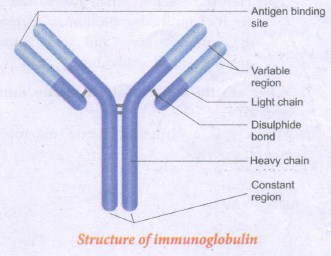
(i) In the 195"os,experiments by Porter and Edelman revealed the basic structure of the immunoglobulin.
(ii) An antibody molecule is Y shaped structu re that comprises of four polypeptide chains, two identical light chains (L) of molecular weight 25,000 Da (approximately 214 amino acids) and two identical heavy chains (H) of molecular weight 50,000 Da (approximately 450 amino acids).
(iii) The polypeptide chains are linked together by di-sulphide (S-S) bonds. One light chain is attached to each heavy chain and two heavy chains are attached to each other to form a Y shaped (Fig.) structure. Hence, an antibody is represented by H2L2.
(iv) Each chain (L and H) has two terminals. They are C - terminal (Carboxyl) and amino or N-terminal.
(v) Each chain (L and H) has two regions. They have variable (V) region at one end and a much larger constant (C) region at the other end.
(vi) Antibodies responding to different antigens have very different (V) regions but their (C) regions are the same in all antibodies.
(vii) In each arm of the monomer antibody, the (V) regions of the heavy and light chains combines to form an antigen - binding site shaped to 'fit' a specific antigenic determinant. Thus each antibody monomer has two such antigen - binding regions.
(viii) The (C) regions that forms the stem of the antibody monomer determine the antibody class and serve common functions in all antibodies.
3.
Porter and Edelman revealed the basic structure of the immunoglobulin. An antibody molecule is Y shaped structure that comprises of four polypeptide chains, two identical light chains (L) of molecular weight 25,000 Da (approximately 214 amino acids) and two identical heavy chains (H) of molecular weight 50,000 Da (approximately 450 amino acids). The polypeptide chains are linked together by di-sulphide (S-S) bonds. One light chain is attached to each heavy chain and two heavy chains are attached to each other to form a Y shaped structure. Hence, an antibody is represented by H2 L2.
4.
(i) After getting into the body of the person, the virus enters into macrophages where RNA genome of the virus replicates to form viral DNA with the help of the enzyme reverse transcriptase.
(ii) This viral DNA gets incorporated into the DNA of host cells and directs the infected cells to produce viral particles.
(iii) The macrophages continue to produce virus and in this way acts like a HIV factory.
(iv) Simultaneously, HIV enters into helper T-Iymphocytes, replicates and produces progeny viruses. The progeny viruses released in the blood attack other helper T-lymphocytes. The process is repeated.
(v) During this period, the person suffers from bouts of fever, diarrhoea and weight loss. Due to decrease in the number of helper T lymphocytes, the person starts suffering from infections and becomes immune deficient and unabie to protect against any infection.
5.
B and T cells are the two type of lymphocytes. Both are produced in the bone marrow.
| S.No | B lymphocytes (B cells) | T lymphocytes(T cells) |
| i. | They stay in the bone marrow until they are mature. |
T lymphocytes leave the bone marrow and mature in the thymus gland. |
| ii. | B cells can bind with antigens and produce antibodies or become memory cells. |
T cells do not produce antibodies. They recognize antigen cells and destroy them presenting. |
| iii. | It is not classified into different types. | T cells are of two types. Helper T cells and KillerT cells. |
6.
| S.No | Autoimmune disease | Immunodeficiency disease |
| i. | If the immune system of the body fails to distinguish foreign molecules from self, then it reacts destructively against the host's own molecules. This is known as autoimmune disease. |
An immunodeficiency disease results from the failure of one or more components of the immune system which could be due to genetic reasons, radiation, infections etc., |
| ii. | Eg: Multiple sclerosis is a autoimmune disease | Eg: AIDS is a Immunodeficiency disease. |
7.
| S.No | Humoral Immunity | Cell mediated immunity |
| i. | When Pathogens are destroyed by the production of antibodies, it is known as antibody mediated or hurmoral immunity. |
When Pathogens are destroyed by cells without producing antibodies it is known as cell mediated immunity. |
| ii. | This is brought about by B cells with the aid of antigen presenting cells and T helper cells. |
This is brought about by T cells, macrophages and natural killer cells |
8.
9.
| S.No | Primary immune responses | secondary immune responses |
| i. | It occurs as a result of primary contact with an antigen. |
It occurs as a result of second and subsequent contacts with the same antigen. |
| ii. | Antibody level reaches peak in 7 to 10 days | Antibody level reaches peak in 3 to 5 days. |
| iii. | Prolonged period isrequired to establish immunity | It establishes immunity in a short time. |
| iv. | There is rapid decline in antibody level. | Antibody level remains high for longer period. |
| v. | It appears mainly in the lymph nodes and spleen. |
It, appears mainly in the bone marrow followed by the spleen and lymph nodes. |
10.
| S.No | Innate Immunity | Acquired Immunity |
| i. | Innate Immunity is the natural phenomenon of resistance to infection which an individual possesses right from birth. |
The immunity that an individual acquires after birth is known as acquired immunity. |
| ii. | The innate defense mechanisms are non-specific and are effective against a wide range of infectious agents. |
The unique features of acquired immunity are antigenic specificity, diversity, recognition of self and non-self and immunological memory |
| iii. | Innate Immunity comprises of anatomicalphysiological, phagocytic and inflammatory barriers. |
It has two components cell mediated immunity and antibody mediated immunity. |

12th Standard Syllabus & Materials
12th Standard
TN 12th Computer Applications வலையமைப்பு வடமிடல் Sample Question Papers Study Material - QB365 Set A
NEW12th Standard
TN 12th Computer Applications களப்பெயர் முறைமை (DNS) Sample Question Papers Study Material - QB365 Set A
NEW12th Standard
TN 12th Computer Applications வலையமைப்பு எடுத்துக்காட்டுகள் மற்றும் நெறிமுறைகள் Sample Question Papers Study Material - QB365 Set A
NEW12th Standard
TN 12th Computer Applications கணினி வலையமைப்பு ஓர் அறிமுகம் Sample Question Papers Study Material - QB365 Set A



Tamilnadu Stateboard 12th Standard Subjects

Maths

Chemistry

Physics
Biology

Computer Science

Business Maths and Statistics

Economics

Commerce

Accountancy

History

Computer Applications
Biology
Computer Technology
Computer Applications
Computer Science
Business Maths and Statistics
Commerce
Economics
Maths
Chemistry
Physics
Computer Technology
History
Accountancy

Tamil

English

French
Tamilnadu Stateboard Standards

