
 100% FREE ACCESS
12th Standard Syllabus & Materials
12th Standard
TN 12th Computer Applications மின்னணு தரவு பரிமாற்றம் Sample Question Papers Study Material - QB365 Set A
NEW12th Standard
TN 12th Computer Applications மின் - வணிக பாதுகாப்பு அமைப்புகள் Sample Question Papers Study Material - QB365 Set A
NEW12th Standard
TN 12th Computer Applications மின்னணு செலுத்தல் முறைகள் Sample Question Papers Study Material - QB365 Set A
NEW12th Standard
TN 12th Computer Applications மின் - வணிகம் Sample Question Papers Study Material - QB365 Set A
NEW12th Standard
TN 12th Computer Applications திறந்த மூல கருத்துருக்கள் Sample Question Papers Study Material - QB365 Set A
NEW12th Standard
TN 12th Computer Applications வலையமைப்பு வடமிடல் Sample Question Papers Study Material - QB365 Set A

Published on: 02/09/2022
QB365 provides a detailed and simple solution for every Possible Creative Questions in Class 12 Physics Subject - Retirement and Death of a Partner, English Medium. It will help Students to get more practice questions, Students can Practice these question papers in addition to score best marks.
Download Tamil Nadu 12th Standard Physics question papers, model tests, one-mark questions, important questions, and public exam papers in PDF format. Free study materials and answer keys for TN State Board students.
Questions + Answers key
Take MCQ Physics Test1.
The half-life of radium is 1600 years. After how many years will one gram of the pure radium be reduced to one centigram?
2.
The age of a rock containing lead and uranium is equal to 1.5 x 10⁹ years. The uranium is decaying into lead with half-life equal to 4.5 x 10⁹ years, Find the ratio of lead to uranium present in the rock, assuming initially no lead was present in the rock.
(Given: 21/3 = 1.259)
3.
Calculate the amount of \(_{ 84 }^{ 210 }{ Po }\) required to the particle of activity 5 millicurie. Given half-life of Po = 138 days, NA = 6.023 X 10²³, 1 curie = 3.7 x 10¹⁰ disintegrations.
4.
For a radioactive material, half-life period is 600s. If initially there are 600 number of molecules, find the time taken for disintegration of 450 molecules and the rate of disintegration.
5.
A radioactive nucleus X converts into stable nucleus Y. Half-life of X is 50 years. Calculate the age of the radioactive sample when the ratio of X and Y is 1:15.
6.
The binding energies per nucleon for deuteron \((_{ 1 }^{ 2 }{ H })\) and helium \((_{ 2 }^{ 4 }{ He) }\) are 1.1 MeV and 7 MeV respectively. Determine the energy released when two deuterons fuse to form a helium nucleus \((_{ 2 }^{ 4 }{ He) }\)
7.
In an ore containing uranium, the ratio of \(^{ 238 }{ U }\) to \(_{ }^{ 206 }{ Pb }\) nuclei are 3. Calculate the age of the ore assuming that all the lead present in the ore is the final stable product of \(^{ 238 }{ U }\). Take half-life of \(^{ 238 }{ U }\) to be 4.5 x 10⁹ years.
8.
In a nuclear reactor, \(_{ }^{ 235 }U{ }\) undergoes fission liberating 200 MeV of energy. The reactor has a 10% efficiency and produces 1000 MW power. If the reactor is to function for 10 years, find the total mass of uranium required.
9.
Obtain the amount \(_{ 27 }^{ 60 }{ Co }\) necessary to provide a radioactive source of 8.0 mCi strength. The half-life of \(_{ 27 }^{ 60 }{ Co }\) is 5.3 years.
10.
Two stable isotopes of lithium \(_{ 3 }^{ 6 }{ Li }\) and \(_{ 3 }^{ 7 }{ Li }\) have respective abundances of 7.5% and 92.5%. These isotopes have masses 6.01512 u and 7.01600 u respectively. Find the atomic mass of lithium.
11.
The half-life of \(_{ 38 }^{ 90 }{ Sr }\) is 28 years. What is the disintegration rate of 15 mg of this isotope?
12.
Explain Chain reaction.
13.
Write the application of alpha decay in smoke detectors.
14.
What are the drawbacks of Rutherford atom model?
15.
Explain the results of Rutherford α-particle scattering experiment.
1.
\(\frac { { N }_{ 0 } }{ N } ={ 2 }^{ t/T }\)
(or) 102 = 2t/1600
\(\frac { 1 }{ { 10 }^{ -2 } } ={ 2 }^{ t/1600 }\)
(or) \(2{ log }_{ 10 }10=\frac { t }{ 1600 } { log }_{ 10 }2\)
(or) \(t=\frac { 2\times 1600 }{ { log }_{ 10 }2 } =\frac { 3200 }{ 0.3010 } =10631.2\) = years
2.
Let No, be the number of uranium nuclides present at the initial moment of time and Nu and NPb be the number of uranium and lead nuclides present.
Now \(\frac { { N }_{ u } }{ { N }_{ 0 } } { =\left( \frac { 1 }{ 2 } \right) }^{ t/{ T }_{ 1/2 } }={ \left( \frac { 1 }{ 2 } \right) }^{ 1/3 }=\frac { 1 }{ 1.259 } \)
\(\frac { { Nu } }{ { N }_{ u }+{ N }_{ Pb } } =1.259\)
or \(\frac { Nu }{ { N }_{ u }+{ N }_{ Pb } } =1.259\)
or \(\frac { Nu }{ { N }_{ u }+{ N }_{ Pb } } -1=1.259-1\)
or \(\frac { { N }_{ Pb } }{ { N }_{ u } } =0.259\)
3.
A = Nλ and \(\lambda =\frac { { log }_{ e }2 }{ { T }_{ 1/2 } } \)
or N = \(\frac { A }{ { log }_{ e }2 } { T }_{ 1/2 }\)
Number of moles, n = \(\frac { N }{ { N }_{ A } } \)
\(=\frac { 5\times { 10 }^{ -3 }\times 3.7\times { 10 }^{ 10 }\times 138\times 24\times 3600 }{ 0.693\times 6.023\times { 10 }^{ 23 } } \)
= 5.28 x 10⁻⁹
Mass of Po = nM = 5.28 x 10-9 x 210 g
= 1.1 x 10⁻⁶ g = 1.1 μg.
4.
The initial number of molecules, No = 150
The final number of molecules, N = 150
\(\frac { N }{ { N }_{ 0 } } ={ \left( \frac { 1 }{ 2 } \right) }^{ n } \ or \ \frac { 150 }{ 600 } ={ \left( \frac { 1 }{ 2 } \right) }^{ n }\)
\({ \left( \frac { 1 }{ 2 } \right) }^{ 2 }={ \left( \frac { 1 }{ 2 } \right) }^{ n } \ or \ n=2=\frac { t }{ { T }_{ 1/2 } } \)
t = 2 x 600 s = 1200 s
Best of disintegration,
\(R=\frac { dN }{ dt } =-\lambda N\)
\(=\frac { 0.693 }{ { T }_{ 1/2 } } \times 150\)
\(=\frac { 0.693 }{ { 600} } \times 150\) = 0.173
disintegration/second at the instant when 150 molecules were remaining.
5.
Let the initial number of nuclei X = No
Number of nuclei of X left at any time t = Nx
Number of nuclei of Y at any time t = No-Nx = Ny
Now, NX = N0e-λt
NY = N0 - NX = Noe-λt
It is given that \(\frac { { N }_{ X } }{ { N }_{ Y } } =\frac { 1 }{ 15 } \)
\(\frac { { N }_{ o }{ e }^{ -\lambda t } }{ { N }_{ o }({ 1-e }^{ -\lambda t }) } =\frac { 1 }{ 15 } \ or \ { e }^{ -\lambda t }=1\)
e-λt = 16
\(\lambda t={ log }_{ e }2^{ 4 }=4\times { log }_{ e }2=4\times 0.693\)
\(t=4\times \frac { 0.693 }{ \lambda } \)
\(t=4\times { T }_{ 1/2 }=4\times 50=200\) years
6.
The fusion reaction is as under:
\(_{ 1 }^{ 2 }{ H+ }_{ 1 }^{ 2 }{ H\rightarrow }_{ 2 }^{ 4 }{ He }+Q\) (energy)
Deuteron contains 2 nucleons. Binding energy per nucleon is 1.1 MeV. Binding energy of each deuteron nucleus is 2 x 1.1 i.e. 2 .2 MeV
Total binding energy before reaction
= 2 x 2.2 MeV = 4.4 MeV
Total binding energy after reaction
= 4 x 7 MeV = 28 MeV
Clearly the energy released is (28 - 4.4) MeV
i.e. 23.6. MeV
7.
Using \(N={ N }_{ 0 }{ e }^{ -\lambda t }\), we get
\(3=4{ e }^{ -\lambda t }\) or \(\frac { 4 }{ 3 } ={ e }^{ -\lambda t }\)
or In 4 - In 3 = λt
or \(t=\frac { ln4-ln3 }{ \lambda } =\frac { ln4-ln3 }{ 0.6931 } T\)
\(=\frac { 1.38629-1.09861 }{ 0.6931 } \times 4.5\times { 10 }^{ 9 }yr\)
= 1.868 x 10⁹ yr
8.
The reactor produces 1000 MW power or 109 W power or 109 Js-1 of power. The reactor is to function for 10 years. Therefore, total energy which the reactor will supply in 10 years is
E = (Power) (time)
= (109 Js-1) (10 x 365 x 24 x 3600 s)
= 3.1536 x 10¹⁷ J.
But since the efficiency of the reactor is only 10%, therefore actual energy needed is 10 times of it or 3.1536 x 10¹⁸ J. One uranium atom liberates 200 MeV of energy or 200 x 1.6 x 10-13 J or 3.2 x 10⁻¹¹ J of energy. So number of uranium atoms needed are
\(\frac { 3.1536\times { 10 }^{ 18 } }{ 3.2\times { 10 }^{ -11 } } =0.9855\times { 10 }^{ 29 }\)
or number of kg-moles of uranium needed are
\(n=\frac { 0.9855\times { 10 }^{ 29 } }{ 6.20\times { 10 }^{ 26 } } =163.7\)
Hence total mass of uranium required is
m = (n) M = (163.7) (235) kg
or m = 38470 kg.
or m = 3.847 x 10⁴ g
9.
Strength of radioactive source
= 8.0 mCi = 8.0 x 10⁻³ Ci
= 8.0 x 10-3 x 3.7 x 1010 disintegrations s-1
Since the strength of the source decreases with time,
\(\therefore \frac { dN }{ dt } =-29.6\times { 10 }^{ 7 }\)
But \(\frac { dN }{ dt } =-\lambda N\)
\(\therefore =-\lambda N=-29.6\times { 10 }^{ 7 }\)
or \(\lambda N=-29.6\times { 10 }^{ 7 }N=\frac { 29.6\times { 10 }^{ 7 } }{ \lambda } \)
or \(N=\frac { 29.6\times { 10 }^{ 7 }\times T }{ 0.693 } \)
10.
The atomic weight of lithium
= \(\frac { 7.5\times 6.01512+92.5\times 7.01600 }{ 100 } \)
\(=\frac { 45.1134+648.98 }{ 100 } =6.94093\)
11.
\(N=\frac { 6.023\times { 10 }^{ 23 } }{ 90 } \times 15\times { 10 }^{ -3 }\)
\(\frac { dN }{ dt } =\lambda N=\frac { 0.693 }{ { T }_{ 1/2 } } N\)
= \(\frac { 0.693 }{ 28\times 365\times 24\times 60\times 60 } \times \frac { 6.023{ 10 }^{ 23 } }{ 90 } \times 15\times { 10 }^{ -3 }Bq\)
= 7.878 x 10¹⁰ Bq.
12.
Chain reaction :
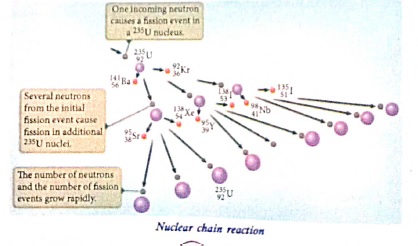
(i) When one \({ }_{92}^{235} \mathrm{U}\) Unucleus undergoes fission,the energy released might be small. But from each fission reaction, three neutrons are released.
(ii) These three neutrons can cause further fission in three other \({ }_{92}^{235} \mathrm{U}\) nuclei which in turn produce nine neutrons. These nine neutrons initiate fission in another 27 \({ }_{92}^{235} \mathrm{U}\) nuclei and so on.
(iii) This process is called a chain reaction and the number of neutrons goes on increasíng almost in geonetric progression. There are two kinds of chain reactions :
(a) uncontrolled chain rcaction
(b) controlled chain reaction.
(a) uncontrolled chain rcaction :
The number of neutrons multiplies indefinitely and the entire amount of energy released in a fraction of second.
Example : Atom bomb.
(b) controlled chain reaction :
The average number of neutrons released in each stage is kept as one such that it is possible to store the released energy.
Example : Nuclear reactor.
13.
(i) The smoke detector uses around 0.2 mg of a man-made weak radioactive isotope called americium \((_{ 95 }^{ 241 }{ Am })\)
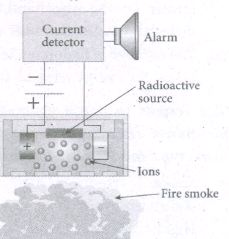
(ii) This radioactive source is placed between two oppositely charged metal plates and α radiations from \(_{ 95 }^{ 241 }{ Am }\) continuously ionize the nitrogen, oxygen molecules in the air space between the plates
(iii) As a result, there will be a continuous flow of small steady currents in the circuit.
(iv) If smoke enters, the radiation is being absorbed by the smoke particles rather than air molecules.
(v) As a result, the ionization and along with it the current is reduced. This drop-in current is detected by the circuit and the alarm starts.
(vi) The radiation dosage emitted by americium is very much less than the safe level, so it can be considered harmless.
14.
Rutherford atom model helps in the calculation of the diameter of the nucleus and also the size of the atom but has the following limitations
(a) This model fails to explain the distribution of electrons around the nucleus and also the stability of the atom.
According to classical electrodynamics,.any accelerated charge emits electromagnetic radiations. Due to emission of radiations, it loses its energy. Hence, it can no longer .sustain the circular motion. The radius of the orbit, therefore, becomes smaller and smaller (undergoes spiral motion) and finally the electron should fall into the nucleus and the atoms should disintegrate. But this does not happen.
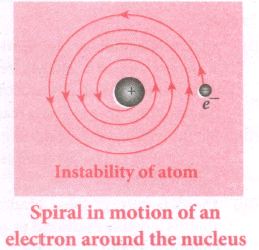
(b) According to this model, emission of radiation must be continuous and must give continuous emission spectrum but experimentally we observe only line (discrete) emission spectrum for atoms.
15.
(i) In 1911, Geiger and Marsden did a remarkable experiment based on the advice of their teacher Rutherford, which is known as the scattering of alpha particles by gold foil.
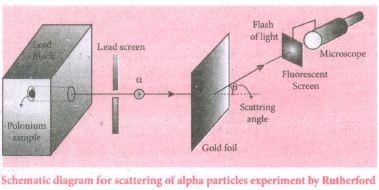
(ii) The experimental arrangement. A source of alpha particles (radioactive material, for example, polonium) is kept inside a thick lead box, with a fine hole.
(iii) The alpha particles coming through the fine hole of the lead box pass through another fine hole made on the lead screen. These particles are now allowed to fall on a thin gold foil and it is observed that the alpha particles passing through gold foil are scattered through different angles.
(iv) A movable screen (from 0° to 180°) which is made up of zinc sulphide (ZnS) is kept on the other side of the gold foil to collect the alpha particles. Whenever alpha particles strike the screen, a flash of light is observed which can be seen through a microscope.
(v) Rutherford proposed an atom model based on the results of alpha scattering. experiment.
(vi) In this experiment, alpha particles (positively charged particles) are allowed to fall on the atoms of a metallic gold foil. The results of this experiment. Rutherford expected the nuclear model, but the experiment showed the model.
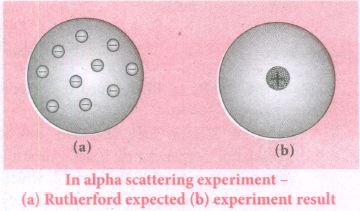
(a) Most of the alpha particles were un-deflected through the gold and went straight.
(b) Some of the alpha particles are deflected through a small angle.
(c) A few alpha particles (one in a thousand) are deflected through an angle more than 90°.
(d) Very few alpha particles returned back (backscattered) that is, deflected back by 180°.

12th Standard Syllabus & Materials
12th Standard
TN 12th Computer Applications களப்பெயர் முறைமை (DNS) Sample Question Papers Study Material - QB365 Set A
NEW12th Standard
TN 12th Computer Applications வலையமைப்பு எடுத்துக்காட்டுகள் மற்றும் நெறிமுறைகள் Sample Question Papers Study Material - QB365 Set A
NEW12th Standard
TN 12th Computer Applications கணினி வலையமைப்பு ஓர் அறிமுகம் Sample Question Papers Study Material - QB365 Set A
NEW12th Standard
TN 12th Computer Applications PHP-உடன் MySQL-ஐ இணைத்தல் Sample Question Papers Study Material - QB365 Set A



Tamilnadu Stateboard 12th Standard Subjects

Maths

Chemistry
Physics

Biology

Computer Science

Business Maths and Statistics

Economics

Commerce

Accountancy

History

Computer Applications
Biology
Computer Technology
Computer Applications
Computer Science
Business Maths and Statistics
Commerce
Economics
Maths
Chemistry
Physics
Computer Technology
History
Accountancy

Tamil

English

French
Tamilnadu Stateboard Standards

