
 100% FREE ACCESS
6th Standard CBSE Syllabus & Materials
6th Standard CBSE
CBSE 6th Social Science The Value of Work - New Sample Question Papers Study Material - QB365 Set A
NEW6th Standard CBSE
CBSE 6th Social Science Family and Community - New Sample Question Papers Study Material - QB365 Set A
NEW6th Standard CBSE
CBSE 6th Social Science India's Cultural Roots - New Sample Question Papers Study Material - QB365 Set A
NEW6th Standard CBSE
CBSE 6th Social Science India,That is Bharat - New Sample Question Papers Study Material - QB365 Set A
NEW6th Standard CBSE
CBSE 6th Social Science Timeline and sources of history - New Sample Question Papers Study Material - QB365 Set A
NEW6th Standard CBSE
CBSE 6th Social Science Oceans and Continents - New Sample Question Papers Study Material - QB365 Set A

Published on: 31/12/2018
6 Class Test
Download CBSE Class 6th Standard CBSE Social Science question papers, sample papers, important questions, and previous year solved papers in PDF format. Get free study materials, NCERT solutions, and exam preparation resources for Class 6th Standard CBSE Social Science
Questions + Answers key
Take MCQ Social Science Test
1.
Harisena composed a prashasti in praise of Gautamiputra Shri Satakarni
2.
Pune, being a big city, has a Municipal Corporation.
3.
The Rose Bridge is in Arunachal Pradesh
4.
The rivers Narmada and Brahmaputra flowed through Magadha.
5.
Objects that are made of hard imperishable substances usually survive for a long time.
6.
Which of these persons maintains land records in village?:
Pradhan
Sewak
Patwari
Headman
7.
Great Qing was a pilgrim from:
Rome
Greece
China
Somalia
8.
The arrangement made by the people for the dead was:
funeral pyre
coffins
mummies
burials
9.
Where do labourers stand?
At labour chowk
At cinema halls
At ramlila ground
At home
10.
Which of the following dams is a downstream dam?
Mettur darn
Hirakud dam
Krishnasagar dam
None of the above
11.
Where is 97 per cent of the earth's water found?
In seas
Under ground
In lakes
In oceans
12.
During the South-West monsoon period, the moisture laden winds blow from
land to sea
sea to land
plateau to plains
13.
How many languages are there that are people's mother tongues?
more than 1500
more than 16000
more than 1600
more than 1400
14.
In ancient India, the Milky Way Galaxy was known as
Akash Ganga
Nakshatra Ganga
Antariksha
Vyom
15.
Under which tree, did Buddha attain his enlightenment?
Mango tree
Banana tree
Peepal tree
Apple tree
16.
What is the difference between the shops on the street and the shops in the market?
17.
What are the negative stereotypes that common people have regarding the blind people in a society?
18.
Define Divergent boundary
19.
What is the language of the Rigveda?
20.
Name any man-made Indian satellite.
21.
What are the main constituents of the atmosphere? How are they essential for life?
22.
How big is the Universe?
23.
Write the names of the two houses of the Indian Parliament?
24.
Which people follow the religion of Judaism?
25.
Discuss why it is important to study our past.
26.
In what ways do you think that the life of a raja was different from that of a dasa or dasi?
27.
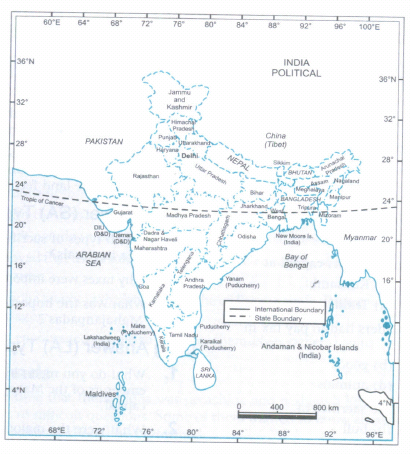
Find the state in which you live in the political map on page 136. Were there any janapada in your state? If yes, name them.
If not, name the janapadas that would have been the closest to your state, and mention whether they
were to the East, West, North or South.
28.
Cai Lun
29.
Ayodhya
30.
Jatakas
31.
Mandapa
32.
Stupa
33.
We have more than____that are people's mother tongues, and there are more than a hundred dance forms.
34.
Does the Earth follow exactly the same orbit every year?
35.
______________ processions, and ______________ can sometimes lead to conflicts.
36.
________________ occur in the areas which receive heavy rainfall.
37.
________________is recognised as the author of the Sanskrit Ramayana
38.
Compare the livelihood challenges faced by rural and urban women.
39.
Write a few lines on the wildlife of India
40.
How are the members of the Lok Sabha elected?
41.
Mention the main features of Ashvamedha.
42.
Do you think that the life of farmers and herders who supplied food to the Harappan cities was different from that of the farmers and herders. Give reasons for your answer.
43.
Count the squares given in the picture and answer the following:
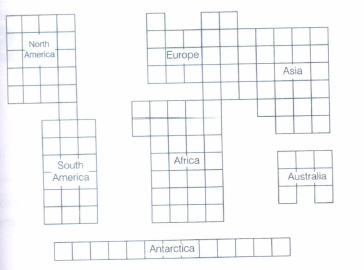
(i) Name the largest continent.
(ii) Which is larger- Europe or Australia?
1.
(b)
2.
(a)
3.
(a)
4.
(b)
5.
(a)
6.
(c)
Patwari
7.
(c)
China
8.
(d)
burials
9.
(a)
At labour chowk
10.
(a)
Mettur darn
11.
(d)
In oceans
12.
(b)
sea to land
13.
(c)
more than 1600
14.
(a)
Akash Ganga
15.
(c)
Peepal tree
16.
()
17.
()
The negative stereotypes in a society regarding blind people are that they are helpless, dependant and miserable.
18.
()
Divergent boundary: Boundary where plates move apart or spread
19.
()
The Rigveda is in old or Vedic Sanskrit
20.
()
INSAT, EDUSAT, IRS etc.
21.
Our earth is surrounded by a layer of gases which is known as the atmosphere. It is mainly composed of 78% Nitrogen, 21% Oxygen, 1% Carbon dioxide and other gases. They are essential for life in the following ways:
(i) Required in various forms to maintain the fertility of soil.
(ii) Help plants to grow which provide us food.
(iii) Carbon dioxide helps plant to manufacture food in the presence of sunlight.
22.
Determining the size of the Universe is a hard job. Even the most advanced instruments, which allow astronomers to observe galaxies 10 to 12 billion Light Years away, give no clue to what lies beyond the distance. The Universe is limitless.
23.
The two Houses of the Indian Parliament are the Rajya Sabha and Lok Sabha.
24.
Judaism constitutes the religious doctrines and a rite of the Jews as enjoined in the laws of Moses. Judaism is based on Zoroastrianism. It has given rise to two great religions of the world which are Christianity and Islam.
25.
It is important to study about our past as it gives a lot of information regarding the political, social, economic and cultural life of the people in the earlier days. By studying about our past:
(i) We can find out about the eating habits, the clothing and housing pattern of the people of the earlier times.
(ii) We can gather information about the lives of hunters, farmers, merchants, priest, craftsmen, musicians, poets and scientists.
(iii) We can learn about the lives of children, the songs they sang, the plays they saw, the games that they played and the kind of toys with which they played.
26.
In Rig-Vedic society, raja enjoyed highest position with the priests. They fought war to capture man and cattle, land and water. The dasa or dasi were in the lowest position in the society.They could not perform sacrifices and spoke different languages. They were captured in wars. They were treated as the property of their owner and had to do any kind of work their owner wanted.
27.
Hints for students
(i) Name and location of your state or Union Territory, write the name of your region.
(ii) Look carefully in the map, is any janapada site in your state/UTs.
(iii) If yes, name that janapadas.
(iv] If not, look all directions of your state (East, West, North, South).
(v) See the map
28.
()
Invented paper
29.
()
Capital city of Kosala
30.
()
Stories told by ordinary people
31.
()
Place in temples where people could assemble
32.
()
Mound
33.
()
1600 languages
34.
()
No, the Earth doesn't follow exactly the same orbit every year due to changing positions of the planets.
35.
()
Religious, celebrations
36.
()
Tropical rain forests
37.
()
Valmiki
38.
Challenges faced by rural women:
(i) Poor resource base and resource quality (small or no agricultural land and water).
(ii) Illiteracy and lack of skill.
(iii) Lack of awareness on different government schemes and programmes.
(iv) Lack of knowledge of disasters.
Challenges faced by urban women:
(i) Lack of employment and irregular jobs.
(ii) Lack of job security and low wages.
(iii)Lack of sufficient and timely credit support system for petty trades.
(iv) Fear of eviction by police and civic bodies.
(v) Congested and hazardous working conditions
39.
There are thousands of species of animals and a large variety of reptiles, amphibians, mammals, birds, insects and worms which dwell in the forest of India.
(i) The tiger is our national animal. It is found in various parts of the country. Gir forest in Gujarat is the home of Asiatic lions.
(ii) Elephants and one-horned rhinoceroses roam in the forests of Assam. Elephants are also found in Kerala and Karnataka.
(iii) Camels and wild asses are found in the Great Indian desert and the Rann of Kuchchh.
(iv) Wild goats, snow leopards, bears, etc. are found in the Himalayan region.
(v) Besides these, many other animals are found in our country such as monkey, wolf, jackal, nilgai, cheetah, etc.
(vi) There are several hundreds of species of snakes found in India. Cobras and kraits are important among them. India is equally rich in bird life.
(vii) The peacock is our national bird. Other common birds are parrots, pigeons, mynah, geese, bulbul and ducks.
(viii) There are several bird sanctuaries which have been formed to give birds their natural habitat. These provide the birds with protection from hunters.
40.
(i) The members of the Lok Sabha are elected directly by the people.
(ii) Territorial areas called Parliamentary Constituencies are set up in each State and Union territory for the purpose of elections.
(iii) Seats are allotted to various States on the basis of their respective population.
(iv) Any number of candidates may contest an election from the same constituency.
(v) The candidate who secures majority of vote is declared elected to the Lok Sabha.
41.
(i) The Ashvamedha or horse sacrifice was one of the rituals. In this, a horse was let loose to wander freely and it was guarded by the Rajas.
(ii) If the horse wandered into the kingdoms of other Rajas and they stopped it then they had to fight.
(iii) If they allowed the horse to pass, it meant that they accepted that the Raja wanted to perform the sacrifice and was stronger than them.
(iv) These Rajas were then invited to the sacrifice, which was performed by specially trained priests. The Raja that organised the sacrifice was recognised as very powerful.
42.
The farmers and herders in the earlier period cultivated the fields themselves and domesticated the animals. The farmers and herders who gave food to the Harappan cities knew about agriculture and domestication of animals. So, they supplied food to the city dwellers and they also provided their own food.
43.
(i) Asia with 44 squares is the largest continent.
(ii) Europe (10 squares) is larger than Australia (8 squares).

6th Standard CBSE Syllabus & Materials
6th Standard CBSE
CBSE 6th Social Science Locating Places on the Earth - New Sample Question Papers Study Material - QB365 Set A
NEW6th Standard CBSE
CBSE 6th Science A Journey Through States of Water - New Sample Question Papers Study Material - QB365 Set A
NEW6th Standard CBSE
CBSE 6th Science Temperature and its Measurement - New Sample Question Papers Study Material - QB365 Set A
NEW6th Standard CBSE
CBSE 6th Science Materials Around Us - New Sample Question Papers Study Material - QB365 Set A



CBSE 6th Standard CBSE Subjects
CBSE Standards




