
 100% FREE ACCESS
6th Standard Syllabus & Materials
6th Standard
TN 6th Tamil பருவம் 1 - இயல் 1 - மொழி -தமிழ்த்தேன் - இன்பத்தமிழ் Sample Question Papers Study Material - QB365 Set A
NEW6th Standard
TN 6th English T1 - Supplementary - The Apple Tree and The Farmer Sample Question Papers Study Material - QB365 Set A
NEW6th Standard
TN 6th English T1 - Prose - When The Trees Walked Sample Question Papers Study Material - QB365 Set A
NEW6th Standard
TN 6th Social Science T3 - CIV - Road Safety Sample Question Papers Study Material - QB365 Set A
NEW6th Standard
TN 6th Social Science T3 - CIV - Local Bodies - Rural and Urban Sample Question Papers Study Material - QB365 Set A
NEW6th Standard
TN 6th Social Science T3 - CIV - Democracy Sample Question Papers Study Material - QB365 Set A

Published on: 17/01/2019
6-Std - Term 3 Geography Important Questions
Download Tamil Nadu 6th Standard Social Science question papers, model tests, one-mark questions, important questions, and public exam papers in PDF format. Free study materials and answer keys for TN State Board students.
Questions + Answers key
Take MCQ Social Science Test
1.
Name the important festivals celebrated in Europe
2.
Give a short note on the population of Europe
3.
Name a few countries which enjoy the Mediterranean type of climate
4.
What are the important rivers of Europe?
5.
Name the important mountains found in the Alpine system.
6.
Asia is called the ‘Land of Contrasts’- Justify.
7.
Name the ports found is Asia.
8.
How does physiography play a vital role in determining the population of Asia?
9.
Write a short note on monsoon climate.
10.
Name the important intermontane plateaus found in Asia
11.
Name the four hemispheres of the Earth.
12.
What are lines of latitude and longitude?
13.
How many times would the sun pass overhead a line of longitude?
14.
What is local time?
15.
What is a geoid?
16.
Differentiate: Landslide – Avalanche
17.
Chennai, Cuddalore and Cauvery delta are frequently affected by floods. Give reason.
18.
Write a short note on ‘Thunder and lightning’.
19.
What are the two types of disasters? Give examples.
20.
Define Disaster
21.
What are the significant lines of latitude? Explain the zones found between them.
22.
How are the hemispheres divided on the basis of lines of latitude and longitude? Explain with diagrams.
23.
What is flood? Explain the do’s and don’ts during floods.
24.
The total number of lines of longitude are
370
380
360
390
25.
The total number of lines of latitude are
171
161
181
191
26.
A day has _____________.
1240 minutes
1340 minutes
1440 minutes
1140 minutes
27.
The Sun is found overhead the Greenwich Meridian at
12 midnight
12 noon
1 p.m.
11 a.m.
28.
180° line of longitude is
Equator
International Date Line
Prime Meridian
North Pole
29.
The 23 ½° N line of latitude is called _____________
Tropic of Capricorn
Tropic of Cancer
Arctic Circle
Antarctic Circle
30.
The area found between 0° and 180° E lines of longitude is called
Southern Hemisphere
Western Hemisphere
Northern Hemisphere
Eastern Hemisphere
31.
The North Pole is
90° N Latitude
90° S latitude
90° W Longitude
90° E longitude
32.
The shape of the Earth is _____________
Square
Rectangle
Geoid
Circle
33.
The North western highlands and the Alpine mountain range.
34.
Intermontane plateaus and southern plateaus.
1.
Christmas, Easter, Good Friday, the Saint Day, Redentore, Tomatina and Carnival are the important festivals of Europe.
2.
(i) Europe is the third most populous continent, after Asia and Africa.
(ii) The population of Europe was 742 million in 2018, which accounted for 9.73% of the world's population.
(iii) The population density in Europe is 34 persons / km2.
(iv) Monaco has the highest density of population in Europe [26105 persons / km2] as well as in the world.
(v) Iceland has a very low density of population. [3 persons / km2]
3.
(i) Portugal
(ii) Spain
(iii) Italy
(iv) Greece
(v) Monaces
(vi) Vatican city
(vii) San Marino
(viii) Malta
4.
Volga, Danube, Dnieper, Rhine, Rhone, Po, Thames.
5.
The important mountain ranges are the Sierra Nevada, the Pyrenees, the Alps, the Apennines, the Dinaric Alps, the Caucasus and the Carpathian.
6.
(i) Asia is the biggest continent.
(ii) It has different types of land features such as mountain, plateau, plain, valley, bay, island etc.
(iii) It also has different climatic conditions from the equator to polar region.
(iv) Many races, languages, religions and cultures are followed by people who live in Asia.
(v) So, Asia is called 'the land of contrasts'.
7.
Tokyo, Shanghai, Singapore, Hong Kong, Chennai, Mumbai, Karachi and Dubai are the important seaports in Asia.
8.
(i) The population is unevenly distributed because of various physical features.
(ii) River plains and industrial regions have high density of population, whereas low density is found in the interior parts of Asia.
9.
(i) The Arabic word Monsoon means Season.
(ii) Monsoon refers to the seasonal reversal in the wind direction between seasons every year.
(iii) Eg: North East Monsoon - Tamil Nadu.
10.
(i) The plateau of Anatolia (Pontine to Taurus)
(ii) The plateau of Iran (Elburz to Zagros mt)
(iii) The plateau of Tibet (Kunlun to Himalayas)
11.
(i) Northern hemisphere
(ii) Southern hemisphere
(iii) Eastern hemisphere
(iv) Western hemisphere
12.
(i) The imaginary lines which are drawn horizontally on East-West direction on the Earth are called the lines or Parallels of latitudes.
(ii) The imaginary lines drawn vertically connecting the North pole and the south pole called lines or meridians of longitude.
13.
The Sun is overhead on a line of longitude only once in a day.
14.
When the sun is overhead on a particular line of longitude, it is 12 noon at all the places located on that line of longitude. This is called local time.
15.
(i) The Earth which is spherical, is flat at the poles and bulges at the Equator.
(ii) The Earth cannot be compared with any other geometrical shape as it has a very unique shape.
(iii) Hence, its shape is called a geoid.
16.
| Landslide | Avalanches |
| The movement of a mass of rocks, debris, soil etc., down slope is celled landslide. | A large amount of ice, snow and rock falling quickly down the side of a mountain is called an Avalanches. |
17.
(i) Due to heavy rainfall from North east Monsoon.
(ii) Inefficient engineering design in the construction of embankments, dams, and canals
(iii) Did not follow some important safety precautions.
18.
(i) Thunder is a series of sudden electrical discharge resulting from atmospheric conditions.
(ii) This discharge results in sudden flashes of light and trembling sound waves which are commonly known as thunder and lightning.
19.
Disaster is broadly classified into natural and manmade disasters.
(i) Natural disasters - Earthquake, Tsunamis, Cyclone, Floods etc.
(ii) Man-made disasters - Fire, Building and Industry accidents, Transport accidents etc.
20.
A disaster is a serious disruption of the functioning of a society involving human and material loss.
21.
Important lines of latitude:
1. North pole 90o N.
2. Tropic of Capricorn 231/2o S.
3. Arctic Circle 661/2o N.
4. Antartic Circle 661/2o S.
5. Tropic of Cancer 231/2o N.
6. South Pole 90o S.
7. Equator 0o.
Zones of the Earth:
Torrid zone:
(i) It lies 0o to 231/2o North and South latitude.
(ii) The Sun's rays fall vertically over this region and the average temperature is very high.
Temperate zone:
(i) It lies 231/2o N to 661/2o North and South latitude.
(ii) The Sun's rays fall slantingly. Moderate temperature prevails in this region.
Frigid zone:
(i) It lies 661/2o N to 90o North and South latitude.
(ii) The Sun's rays fall further inclined, throughout the year. The temperature is very low.
22.
Northern Hemisphere:
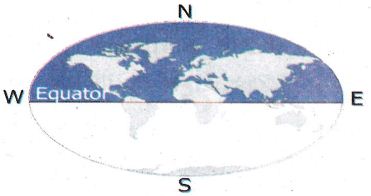
The area of the Earth found. between the Equator [0o] and the North pole [90o] is called the Northern Hemisphere.
Southern Hemisphere:
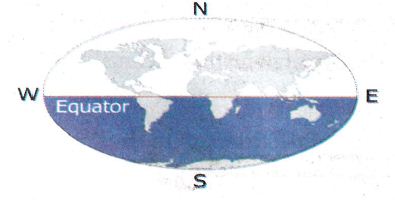
The area of the Earth from the equator to the South pole [90oS] is called the Southern Hemisphere.
Eastern Hemisphere:
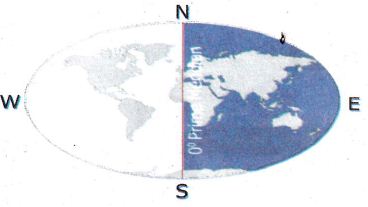
The part of the Earth between the 0o line of longitude and the 180o East line of longitude is known as the Eastern Hemisphere.
Western Hemisphere:
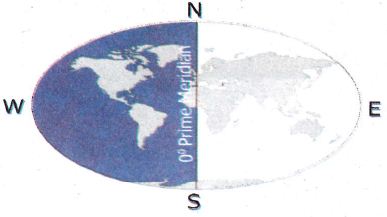
The part of the Earth from 0o line of longitude to 180o West line of longitude is called as Western Hemisphere.
23.
Flood:
An overflow of a large amount of water, beyond its normal limits, especially on the rain fed areas is called a flood.
Do's during flood:
(i) Cut off gas connection and electricity.
(ii) Leave immediately through the prescribed.
(iii) Drink hot water.
Don'ts:
(i) Try to connect electricity once it is cut.
(ii) Operate vehicles.
(iii) Swim against floods.
(iv) Avoid going on excursions.
(v) Neglect flood warning messages.
24.
(c)
360
25.
(c)
181
26.
(c)
1440 minutes
27.
(b)
12 noon
28.
(b)
International Date Line
29.
(b)
Tropic of Cancer
30.
(d)
Eastern Hemisphere
31.
(a)
90° N Latitude
32.
(c)
Geoid
33.
| S.No | The North western highlands | The Alpine mountain range |
| 1. | Region includes the mountains and plateaus of Norway, Sweden, Finland, Scotland and Iceland. | The alpine mountain system consists of a chain of young fold mountains found in the southern part.of Europe. |
| 2. | This region has the most beautiful fjord coast. | Eg: It lies Sierra Wevada, Pyrenees, Kaskasas are important mountains. |
34.
| S.No | Intermontane plateaus | Southern plateaus |
| 1. | Intermontane plateaus are wide tablelands that are formed or situated between mountain ranges, when a plateau is surrounded by mountains on all sides, it is refers to an Intermontane plateaus | The southern plateaus are relatively lower than the northern plateaus. |
| 2. | Eg: Tibetan Plateau, Bolivian plateaus. | The four important southern plateaus are the Arabian Plateau, Deccan Plateau, Shan Plateau and the Yunnan Plateau. |

6th Standard Syllabus & Materials
6th Standard
TN 6th Social Science T3 - GEO - Understanding Disaster Sample Question Papers Study Material - QB365 Set A
NEW6th Standard
TN 6th Social Science T3 - GEO - Globe Sample Question Papers Study Material - QB365 Set A
NEW6th Standard
TN 6th Social Science T3 - GEO - Asia and Europe Sample Question Papers Study Material - QB365 Set A
NEW6th Standard
TN 6th Social Science T3 - HIS - South Indian Kingdoms Sample Question Papers Study Material - QB365 Set A



Tamilnadu Stateboard 6th Standard Subjects
Tamilnadu Stateboard Standards



