
 100% FREE ACCESS
6th Standard CBSE Syllabus & Materials
6th Standard CBSE
CBSE 6th Social Science The Value of Work - New Sample Question Papers Study Material - QB365 Set A
NEW6th Standard CBSE
CBSE 6th Social Science Family and Community - New Sample Question Papers Study Material - QB365 Set A
NEW6th Standard CBSE
CBSE 6th Social Science India's Cultural Roots - New Sample Question Papers Study Material - QB365 Set A
NEW6th Standard CBSE
CBSE 6th Social Science India,That is Bharat - New Sample Question Papers Study Material - QB365 Set A
NEW6th Standard CBSE
CBSE 6th Social Science Timeline and sources of history - New Sample Question Papers Study Material - QB365 Set A
NEW6th Standard CBSE
CBSE 6th Social Science Oceans and Continents - New Sample Question Papers Study Material - QB365 Set A

Published on: 24/09/2019
Playing with Numbers
Download CBSE Class 6th Standard CBSE Mathematics question papers, sample papers, important questions, and previous year solved papers in PDF format. Get free study materials, NCERT solutions, and exam preparation resources for Class 6th Standard CBSE Mathematics
Questions + Answers key
Take MCQ Mathematics Test
1.
Try arranging 18 marbles in rows and find the factors of 18
2.
Find the side of the largest possible square slabs which can be paired on the floor of a room 2m 50cm long and 1m 50cm broad. Also, find the number of such slabs to pair the floor.
3.
Find the least number, which when divided by 24, 32 and 36 leaves the remainder 19, 27 and 31 respectively.
4.
Find the greatest possible length, which can be used to measure exactly the length 7m, 3m 85 cm and 12 m 95 cm.
5.
Find a 4-digit odd number using each of digits 1, 2, 4 and 5 only once such that when the first and last digits are interchanged, it is divisible by 4.
6.
On a morning walk, three persons step off together and their steps measure 40 cm, 42 cm and 46 cm, respectively.
(a) What is the minimum distance each should walk so that each can cover the same distance in complete steps?
(b) What are the benifits of morning walk?
7.
Three boys step off together from the same place. If their steps measure 36 cm, 48 cm and 54 cm, at what distance from the starting point will they again step together?
8.
A merchant has 120 L of oil of one kind, 180 L of another kind and 240 L of a third kind. He wants to sell the oil by filling the three kinds of oil in tins of equal capacity. What should be the greatest capacity of such tin?
9.
Write a digit in the blank space of the following number, so that the number formed is divisible by 11. 8___9484
10.
Find the possible factors of 45, 30, 36.
1.
(i) 1 marble in each row

Number ofrows = 18
Total number of marbles = 1 x 18 = 18
(ii) 2 marbles in each row

Number of rows = 9
Total number of marbles = 2 x 9 = 18
(iii) 3 marbles in each row

Number of rows = 6
Total number of marbles = 3 x 6 = 18
(iv) 6 marbles in each row

Number of rows = 3
Total number of marbles = 6 x 3 = 18
(v) 9 marbles in each row

Number of rows = 2
Total number of marbles = 9 x 2 = 18
(vi) All 18 marbles in one row

Number of rows = 1
Total number of marbles = 18 x 1 = 18
Hence, 18 can be written as a product of two
numbers in different ways as:
18=1x18
18 = 2 x 9
18 = 3 x 6
18 = 6 x 3
18 = 9 x 2
18 = 18 x 1
Thus, 1,2,3,6,9 and 18 are exact divisors of 18.
2.
50, 15
3.
283
4.
Required length = HCF of 7 m, 3 m 85 cm and 12m 95 cm or HCF of 700 cm, 385 cm and 1295 cm.
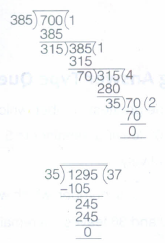
Hence, required length is 37 cm.
5.
The 4-digit number will be an odd number, if the unit place digit is an odd number (i.e. 1 or 5).
Total such odd numbers are,
4125,4215,1245,1425,2145,2415,4251,4521,5241,5421,2451,2541.
Also we know that, any 4-digit number is divisible by 4,if the last two digit number is divisible by 4.
Consider a number 4521, if we interchange the first and the last digit, the new number will be 1524. Here, we see that the last two digit (i.e. 24) is divisible by 4. So, the number 1524 is divisible by 4. Hence, the required 4-digit number is 4521.
6.
(a) The steps measure of each person is 40 cm 42 cm and 46 cm. So, the minimum distance each should walk is the LCM of 40, 42 and 46.
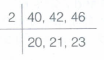
LCM of 40, 42 and 46 = 2 x 20 x 21 x 23
=19320 cm
= 193.2 m
(b) Morning walk benefits us in many ways. It maintain our good health. Some benefits of morning walk are listed below:
(i) Strengthen our heart
(ii) Delays or prevents major diseases or illness
(iii) Reduces blood pressure and the risk of stroke
(iv) Reduces cholestrol
(v) Boost immune system
7.
Given, their steps measure is 36 cm, 48 cm and 54cm.
We must find the LCM of 36, 48, 54,
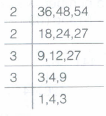
LCM of 36, 48 and 54 =2x2x3x3x4x3=432
They again step together from the starting point at 432 cm = 4 m 32 cm
8.
Given, merchant have 120 L of oil one kind, 180 L of another kind and 240 L of a third kind.
The required capacity of a tin will be HCF of 120, 180 and 240
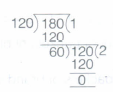
HCF of 120 and 180 is 60.
Now, we find the HCF of 60 and 240

The HCF of 60 and 240 is 60.
Hence, HCF of 120, 180 and 240 is 60.
\(\therefore\) The required capacity of a tin = 60 L
9.
Let the required unknown digit be x.
Then, the number becomes
\(\begin{matrix} 8 \\ \downarrow \\ E \end{matrix}\begin{matrix} x \\ \downarrow \\ O \end{matrix}\begin{matrix} 9 \\ \downarrow \\ E \end{matrix}\begin{matrix} 4 \\ \downarrow \\ O \end{matrix}\begin{matrix} 8 \\ \downarrow \\ E \end{matrix}\begin{matrix} 4 \\ \downarrow \\ O \end{matrix}\)
Sum of digits at odd places from right = 4 + 4 + x = 8+x
Sum of digits at even places from right = 8 + 9 + 8= 25
\(\because\) Number is divisible by 11.
\(\therefore\) Difference of digits will be 0 or 11.
\(\Rightarrow\)25 - (8 + x) = 0 or 11
\(\Rightarrow\)25 - 8 - x = 0 or 11 \(\Rightarrow\) 17 - x = 0 or 11
Taking difference 0, 17-x=0 \(\Rightarrow\) x=17+0 \(\Rightarrow\) x=17 [but 17 is not a single digit number, so it is not possible]
Taking difference 11, 17 - x = 11 \(\Rightarrow\) x = 17 - 11= 6
So, required digit to write in the blank space is 6.
10.
(i) We have, 45
On dividing 45 by 1,
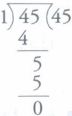
We get, divisor = 1 and quotient = 45
i.e. 1 x 45 = 45
So, 1 and 45 are factors of 45.
Now, on dividing 45 by 3,
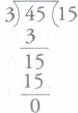
We get. divisor = 3 and quotient = 15
i.e. 3x15=45
so, 3 and 15 are factors of 45.
Again, on dividing 45 by 5,

We get, divisor = 5 and quotient = 9
i.e. 5 x 9 = 45
so, 5 and 9 are factors of 45.
Again, on dividing 45 by 9, we get quotient 5
i.e. 9 x 5 = 45
But it is repetition of the above step, so we will stop this process here.
Hence. factors of 45 are 1, 3. 5. 9. 15 and 45.
Note Here, on dividing 45 by 2, 4, 6, 7, ... , we get remainder. So, we will not consider these cases.
(ii) We have, 30
On dividing 30 by 1.
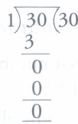
We get. divisor = 1 and quotient = 30
i.e. 1 x 30 = 30
So, 1 and 30 are factors of 30.
Now, on dividing 30 by 2.
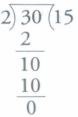
We get, divisor = 2 and quotient = 15
i.e. 2 x 15 = 30
So, 2 and 15 are factors of 30.
Again. on dividing 30 by 3,
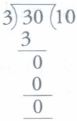
We get, divisor = 3 and quotient = 10
i.e. 3 x 10 = 30
so, 3 and 10 are factors of 30.
Again on dividing 30 by 5,

We get, divisor = 5 and quotient = 6
i.e. 5 x 6=30
So, 5 and 6 are factors of 30.
Again, on dividing 30 by 6, we get quotient 5.
But it is repetition of the above step, so we will stop this process here.
Hence, the factors of 30 are 1, 2, 3, 5, 6. 10, 15 and 30.
(iii) We have, 36
On dividing 36 by 1,
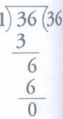
We get. divisor = 1 and quotient = 36
i.e. 1 x 36 = 36
So, 1 and 36 are factors of 36.
Now, on dividing 36 by 2.
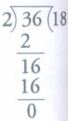
We get. divisor = 2 and quotient = 18
i.e. 2 x 18 =36
So, 2 and 18 are factors of 36.
Again, on dividing 36 by 3,
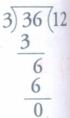
We get. divisor = 3 and quotient = 12
i.e. 3 x 12 = 36
So. 3 and 12 are factors of 36.
Again, on dividing 36 by 4,

We get, divisor = 4 and quotient = 9
i.e. 4 x 9 =36
So. 4 and 9 are factors of 36.
Again. on dividing 36 by 6,

We get, divisor = 6 and quotient = 6
i.e. 6 x 6 = 36
So. 6 and 6 are factors of 36.
Again, on dividing 36 by 9, we get quotient 4.
But it is repetition of the above second last step, so we will stop this process here.
Hence, factors of 36 are 1,2,3,4,6,9, 12, 18 and 36.

6th Standard CBSE Syllabus & Materials
6th Standard CBSE
CBSE 6th Social Science Locating Places on the Earth - New Sample Question Papers Study Material - QB365 Set A
NEW6th Standard CBSE
CBSE 6th Science A Journey Through States of Water - New Sample Question Papers Study Material - QB365 Set A
NEW6th Standard CBSE
CBSE 6th Science Temperature and its Measurement - New Sample Question Papers Study Material - QB365 Set A
NEW6th Standard CBSE
CBSE 6th Science Materials Around Us - New Sample Question Papers Study Material - QB365 Set A



CBSE 6th Standard CBSE Subjects
CBSE Standards




