
 100% FREE ACCESS
6th Standard CBSE Syllabus & Materials
6th Standard CBSE
CBSE 6th Social Science The Value of Work - New Sample Question Papers Study Material - QB365 Set A
NEW6th Standard CBSE
CBSE 6th Social Science Family and Community - New Sample Question Papers Study Material - QB365 Set A
NEW6th Standard CBSE
CBSE 6th Social Science India's Cultural Roots - New Sample Question Papers Study Material - QB365 Set A
NEW6th Standard CBSE
CBSE 6th Social Science India,That is Bharat - New Sample Question Papers Study Material - QB365 Set A
NEW6th Standard CBSE
CBSE 6th Social Science Timeline and sources of history - New Sample Question Papers Study Material - QB365 Set A
NEW6th Standard CBSE
CBSE 6th Social Science Oceans and Continents - New Sample Question Papers Study Material - QB365 Set A

Published on: 19/01/2019
Understanding Elementary Shapes Cycle Test 2
Download CBSE Class 6th Standard CBSE Mathematics question papers, sample papers, important questions, and previous year solved papers in PDF format. Get free study materials, NCERT solutions, and exam preparation resources for Class 6th Standard CBSE Mathematics
Questions + Answers key
Take MCQ Mathematics Test
1.
Examine whether the following are polygons. It anyone among them is not, say why?

2.
In a parallelogram, how many pairs of opposite sides are parallel?
3.
In the given figure, if PR 丄SQ, then name all the right angles.
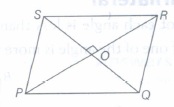
4.
Name the types of following triangles.
ΔABC with AB = 8.7 cm, AC = 7 cm and BC = 6 cm.
5.
Study the following diagram. The line I is perpendicular to line m.
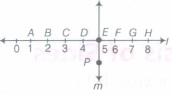
Are these true?
(i) AC> FG (ii) CD = GH (iii) BC < EH
6.
Which angle has a larger measure?
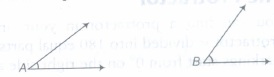
First estimate and then measure.
Measure of \(\angle A\) =
Measure of \(\angle B\) =
7.
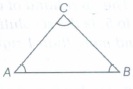
Write the name of the angles in ΔABC.
8.
Draw the following and check the angle with your RA (right angle) tester going, from 4 to 8.
9.
The hour hand of a clock moves from 12 to 5. Is the revolution of the hour handmore than 1 right angle?

10.
Find the number of right angles, formed when the hour hand turned clockwise from 2 to 11.
11.
Where will the hour hand of a clock stop, if it starts, from 10 and turns through 3 right angles?
12.
Find the number of right angles turned through by the hour hand of a clock, when it goes from 5 to 11.
13.
Where will the hand of a clock stop if it starts at 2 and makes \(\frac { 1 }{ 2 } \) of a revolution, clockwise?
14.
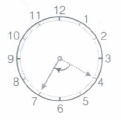
What fraction of a clockwise revolution does the hour hand of a clock turn through, when it oes from 4 to 7
15.
Is in ΔABC, sum of any two sides is greater than the third side?
16.
If line segment AB = 8 cm. Then, what is the length of line segment \(\overline{ AC } \), where AC = CL = LM = MB ?

17.
Name the line segments and also compare them.

18.
Compare the given line segments

19.
If B is the mid-point of \(\overline{ AC } \) and C is the mid-point of \(\overline{ BD } \), where A, B, C and D lie on a straight line, say why AB = CD?
20.
Draw any line segment, say \(\overline{ AB } \). Take any point C lying in between A and B. Measure the lengths of AB, BC and AC. Is AB = AC + CB?
21.
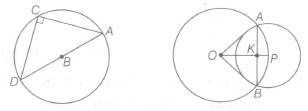
Using the information given, name the right angles in each part of figure.
(a) AC 丄 BD
(b) AE 丄 CE
(c) AC 丄 CD
(d) OP 丄 AB
22.
During Maths lab activity, each student was given four broomsticks of length 8 cm, 8 cm, 5 cm, 5 cm to make different types of quadrilaterals.
(a) How many quadrilaterals can be formed using four broomsticks?
(b) Name the types of quadrilateral formed.
(c) While doing this activity, which value is depicted?
23.
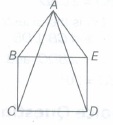
In figure, BCDE is a square and a 3-D shape has been formed by joining the point A in space with the vertices B, C, D and E. Name the 3-D shape and also its
(i) vertices
(ii) edges and
(iii) faces.
24.
Construct two line segments AB and CO of lengths 2.5 cm and 3.2 cm. Construct another segment EF, whose length is the sum of these two segments. Measure the new length.
25.
Draw five triangles and measure their sides. Check in each case, if the sum of the lengths of any two sides is always less than the third side.
26.
In a scalene triangle, all sides are _______
27.
Number of faces in a triangular pyramid are _______
28.
The number of degrees between the hands of a clock, when the time is 3 O' clock ______
29.
The number of diagonals in a hexagon is ________
30.
An angle larger than a right angle but less than a straight angle is an ______ angle.
31.
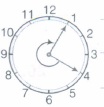
Write the revolution for each figure.
32.
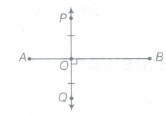
In the given figure, PQ 丄 AB and PO = OQ. Is PQ, the perpendicular bisector of line segment AB? Why or why not?
33.
Using the information given, name the right angles in each part of figure.
AC 丄 BD 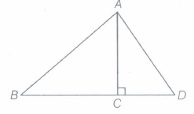
34.
Which points in figure, appear to be mid-point of the line segments? When you locate a mid-point, name the two equal line segments formed by it.
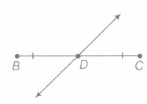
35.
Will the lengths of line segment AB and line segment BC make the length of line segment AC in figure?
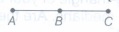
36.
The Shape
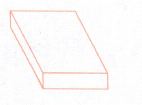
is of
cuboid
cylinder
cone
sphere
37.
The measure of a reflex angle is
180o
<180o
>180o
<90o
38.
Find the number of right angles turned through by the hour hand of a clock when it goes from 3 to 12.
1
2
3
4
39.
Through what angle does the hour hand of a clock turn through, when it goes from 2 to 11?
270°
90°
360°
180°
40.
Through what angle measure does the hour hand of a clock turn through, when it goes from 3 to 9?
90°
360°180° none of these
180°
none of these
41.
The angle measure for half a revolution is
90°
180°
360°
none of these.
42.
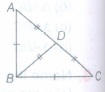
In figure, AB = BC and AD = BD = DC. Then, the number of isosceles triangles in the figure is
1
2
3
4
43.
A polygon has prime number of sides. Its number of sides is equal to the sum of the two least consecutive primes. The number of diagonals of the polygon is
4
5
7
10
44.
Where will the hand of a clock stop, if it start at 5 and makes \(\frac { 1 }{ 4 } \) of a revolution clockwise?
7
8
9
10
45.
Measures of the two angles between hour and minutes hands of a clock at 9 O' clock are
60°, 300°
270°, 90°
75°, 285°
30°, 330°
1.
It is an open figure. So, it is not a polygon.
2.
Two pairs
3.
The right angles in the given figure are \(\angle POQ, \angle QOR, \angle ROS, \angle SOP.\)
4.
Given, AB = 8.7 cm, AC = 7 cm and BC = 6 cm
here, AB ≠ BC ≠ CA
i.e. all the sides are of different length.
So, it is a scalene triangle.
5.
(i) Here, AC = AB + BC = 1 + 1 = 2 units [AB = BC = 1unit]
and FG = 1 unit
\(\therefore\) AC > FG is true.
(ii) Here, CD = 1 unit and GH = 1 unit
\(\therefore\) CD = GH is true.
(iii) Here, BC = 1 unit
and EH = EF + FG + GH = 1 + 1 + 1 = 3 units
\(\therefore\) BC < EH is true.
6.
Observing the given angles, we find that \(\angle B > \angle A\) .
On measuring, we find that
Measure of \(\angle A = 40°\)
Measure of \(\angle B =65°\)
∴ \(\angle B > \angle A.\)
7.
\(\angle C\) = Obtuse angle, \(\angle A\) and \(\angle B\) = Acute angles.
8.
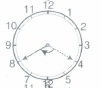
On checking the angle moved by an hour hand, while going from 4 to 8 by RA (right angle) tester, it is clear that it is more than 1 right angle.
9.
Yes,it is clear from the figure that, hour hand makes one right angle from 12 to 3 and since 5 lies between 3 and 6. So, revolution of the hour hand is more than 1 right angle.

10.
3 right angle
11.
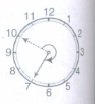
It is clear from the figure, that the hour hand starts from 10 and turns through 3 right angles. Hence, it will be reach at 7.
12.
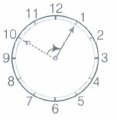
Here, the hour hand moves from 5 to 11. It starts from 5 and covers digits 6, 7, 8, 9, 10 and 11. So, hour hand turned by two right angles.
13.
If the hand of a clock starts at 2 and makes \(\frac { 1 }{ 2 } \) of.a revolution, clockwise, i.e. two right angles, it stops at 8.
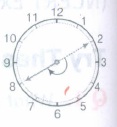
14.
The situation from 4 to 7 on clock is given in the figure.
Hence, from 4 to 7, hour hand turns through \(\frac { 1 }{ 4 } \) of a revolution, clockwise.
15.
Yes, sum of any two sides in ΔABC is greater than the third side.
16.
\(\overline { AC } \)=2 cm
17.
Line segments \(\overline { AB } ,\overline{ CD } ,\overline{ MN } \)and \(\overline { AB } =\overline { CD } ,\overline{ AB } >\overline { MN } \).
18.
\(\overline{ XY } >\overline{ AB } \).
19.
Given, B is the mid-point of \(\overline{ AC } \)
∴ AB = BC .....(i)
and C is the mid-point of \(\overline{ BD } \).
∴ BC = CD .......(ii)
i.e.,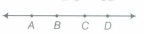
Now, on adding Eqs. (i) and (ii), we get
AB + BC = BC + CD
∴ AB = CD
20.
Let AB be the line segment of length 6 ern and point C lying between A and B.
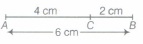
On measuring the lengths ofline segments AB, AC and CB using ruler, we find that AB = 6 cm, AC = 4 cm and CB= 2 cm
Now, AC + CB= 4+ 2=6 cm = AB
i.e. AC + CB = AB
So, we can say that C lies between A and B.
21.
(a) Since, AC 丄 BD, it means \(\angle E = 90°\)
∴ \(\angle AEB, \angle BEC, \angle CED\) and \(\angle AED\) are right angles.
(b) Since, AE 丄 CE, it means \(\angle E = 90°\)
∴ \(\angle AEC\) is a right angle.
(c) Since, AC 丄 CD, it means \(\angle C= 90°\)
∴ \(\angle ACD\) is a right angle.
(d) Since, OP 丄 AB, it means \(\angle K = 90°\)
\(\therefore\ \ \ \ \ \angle AKO, \angle OKB, \angle BKP\) and \(\angle AKP\) are right angles.
22.
Given, four broom sticks of length 8 cm, 8 cm, 5 cm and 5 cm.
(a) Three types of quadrilaterals can be formed.
(b) Name of the quadrilaterals are rectangle, parallelogram and kite.
(c) The value is scientific, temper and curiosity.
23.
The 3-D shape formed is a square pyramid
(i) Vertices are A, B, C, D and E.
(ii) Edges are AB, AC, AD, AE, BC, CD, DE and EB.
(iii) Faces are: square BCDE, ΔABC, ACD, ΔADE and ΔABE.
24.
Now, first of all, we draw AB = 2.5 cm and CD = 3.2 cm.

\(\overline{ AB } +\overline { CD } =\overline { EF } \)
Now, we have to draw a line segment
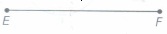
∴ \(\overline { EF } =\overline{ AB } +\overline{ CD } \) = 2.5 +3.2 = 5.7 cm
Hence, new length is 5.7 cm.
25.
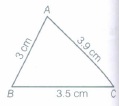
(i) Here, we draw a ΔABC.
In which, AB = 3 cm,
BC = 3.5 cm and AC = 3.9 cm
Now, by adding two sides of Δ ABC
i.e. AB + BC = 3 + 3.5
= 6.5 cm
Clearly, AB + BC > AC
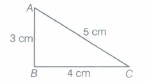
(ii) Here, we draw a ΔABC in which AB =3 cm, BC = 4 cm and AC = 5 cm.
Now, by adding two sides of ΔABC
i.e. AB + BC = 3 + 4 = 7 cm
Clearly, AB + BC > AC.
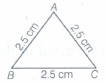
(iii) Here, we draw a ΔABC in which AB = BC = AC = 2.5 cm
Now, by adding two sides of ΔABC
i.e. AB + BC = 2.5 + 2.5 = 5 cm
Clearly, AB + BC > AC
(iv) Here, we draw a ΔABC in which
AB = 3 cm, BC = 35 cm and AC = 4 cm
Now, by adding two sides of ΔABC.
i.e. AB + BC = 3 + 35 = 65 cm
Clearly, AB + BC > AC
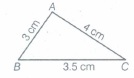
(v) Here, we draw a ΔABC in which AB = 2 cm, BC = 4 cm and AC = 45 cm.
Now, by adding two sides of ΔABC
i.e. AB + BC = 2 + 4 = 6 cm
Clearly, AB + BC > AC.
From all these conclusions, we observe that in each case, the sum of the lengths of any two sides is greater than the third side. So, the sum of the lengths of any two sides can never be less than the third side.
26.
()
unequal
27.
()
3
28.
()
900
29.
()
nine
30.
()
Obtuse
31.
\(\frac { 3 }{ 4 } \) revolution
32.
PQ is not the perpendicular bisector of line segment AB because AO \(\neq\) BO.
33.
\(\angle ACD = \angle ACB = 90°\)
34.
In the figure, D is the mid-point of \(\overline{ BC } \) and \(\overline{ BD } \) = \(\overline{ CD } \).
35.
Here, \(\overline { AB } +\overline { BC } =\overline { AC } \)
Hence, the length of line segment \(\overline{ AB } \) and \(\overline{ BC } \) make the length of line segment \(\overline{ AC } \).
36.
(a)
cuboid
37.
(c)
>180o
38.
(c)
3
39.
40.
(c)
180°
41.
(b)
180°
42.
(c)
3
43.
(b)
5
44.
(b)
8
45.
(b)
270°, 90°

6th Standard CBSE Syllabus & Materials
6th Standard CBSE
CBSE 6th Social Science Locating Places on the Earth - New Sample Question Papers Study Material - QB365 Set A
NEW6th Standard CBSE
CBSE 6th Science A Journey Through States of Water - New Sample Question Papers Study Material - QB365 Set A
NEW6th Standard CBSE
CBSE 6th Science Temperature and its Measurement - New Sample Question Papers Study Material - QB365 Set A
NEW6th Standard CBSE
CBSE 6th Science Materials Around Us - New Sample Question Papers Study Material - QB365 Set A



CBSE 6th Standard CBSE Subjects
CBSE Standards




