
 100% FREE ACCESS
6th Standard CBSE Syllabus & Materials
6th Standard CBSE
CBSE 6th Social Science The Value of Work - New Sample Question Papers Study Material - QB365 Set A
NEW6th Standard CBSE
CBSE 6th Social Science Family and Community - New Sample Question Papers Study Material - QB365 Set A
NEW6th Standard CBSE
CBSE 6th Social Science India's Cultural Roots - New Sample Question Papers Study Material - QB365 Set A
NEW6th Standard CBSE
CBSE 6th Social Science India,That is Bharat - New Sample Question Papers Study Material - QB365 Set A
NEW6th Standard CBSE
CBSE 6th Social Science Timeline and sources of history - New Sample Question Papers Study Material - QB365 Set A
NEW6th Standard CBSE
CBSE 6th Social Science Oceans and Continents - New Sample Question Papers Study Material - QB365 Set A

Published on: 06/12/2018
CBSE Class 6 is a crucial grade in your secondary school education. So learning with effective preparation is a must. Our study materials for CBSE Class 6 follow the latest CBSE syllabus and are prepared by subject experts who have much experience in the academic industry. By referring to our solutions, students get a clear understanding of each concept in detail. Students who have referred to our solutions have seen a significant increase in overall marks and ease in understanding the subjects. Our study materials are not only used by students but also by educational institutes in India.
In this post, we are going to provide you with the most important questions of Science exam from the chapter Fun with Magnets. You should know answers to these questions in all likelihood to score good marks in Class 6 Science exam.
In this question paper, the questions are cover from the science chapter Fun with Magnets. Questions are prepared as per NCERT guidelines by the help of expert teachers.
The latest sample papers have been designed as per the latest blueprints, syllabus and examination trends. Sample papers should be practiced in examination condition at home or school and also show it to your teachers for checking or compare with the answers provided.
Download CBSE Class 6th Standard CBSE Science question papers, sample papers, important questions, and previous year solved papers in PDF format. Get free study materials, NCERT solutions, and exam preparation resources for Class 6th Standard CBSE Science
Questions + Answers key
Take MCQ Science Test
1.
_________is a tool used by sailors and travellers to find direction.
2.
Refrigerator doors use the _________property of magnet.
3.
Hammering destroys the____________________of a small magnet inside.
4.
When a bar magnet is broken, each of broken part will have ...... pole/poles.
5.
A magnet always has ________________poles.
6.
By breaking a magnet into two pieces, we can separate the north and south poles of the magnet.
7.
Attraction is the true test of magnetism
8.
A bar magnet has three poles.
9.
Rubber is a magnetic material
10.
Artificial magnets were discovered in Greece.
11.
State the ways through which a magnet can be demagnetised.
12.
Kanchan is a class VI student. She has to show an activity in school exhibition. But, she has no idea. Her friend Suresh advised her to do an activity in which rope stands without any support with the help of magnet and ask her to take a small rope, a magnet, a cup and a stand.
(a) State the values that Suresh reflect here?
(b) Name some non-magnetic materials.
13.
Suggest an arrangement to store a U-shaped magnet. How is this different from storing a pair of bar magnets?
14.
A toy car has a bar magnet laid hidden inside its body along its length. Using another magnet, how will you find out which pole of the magnet is facing the front of the car?
15.
Where are poles of a bar magnet located?
16.
Riya's mother is stitching buttons on a shirt. The needle has slipped from her hand onto the floor. Can Riya help her mother to find the needle?
17.
Why does the freely suspended magnet always align itself in the north-south direction?
18.
Mention a way to magnetise a magnetic material with a natural magnet.
19.
State whether is it possible to isolate North and South pole of a magnet.
20.
In which direction, a freely suspended magnet orients themselves?
21.
Three identical iron bars are kept on a table. Two out of three bars are magnets. In one of the magnets the North-South poles are marked. How will you find out which of the other two bars is a magnet? Identify the poles of this magnet
22.
You are provided with two identical metal bars. Out of the two, one is a magnet. Suggest two ways to identify the magnet.
23.
Magnets are used in
refrigerator doors
credit cards
door bells
All of these
24.
In a magnet, the regions of maximum attraction are:
All over the body
At the two ends of the magnet
At anyone end of the magnet
At the centre of the magnet
25.
When the south poles of two magnets are kept close, they will__________
attract
repel
rotate
remain unaffected
26.
Strength of a bar magnet is minimum at
Ends
Poles
Centre of magnet
None of the above
27.
Magnets lose their magnetism when:
Heated
Hammered
Dropped from height
All of these
28.
A freely suspended magnet always points in the
upside down
East-West direction
North-South direction
Any direction by chance
29.
Like poles of magnet always
repel
attract
Both (a) and (b)
None of these
30.
Attraction is seen between the poles of two bar magnets in the case of
North pole of one magnet with the North pole of other
south pole of one magnet with the South pole of other
north pole of one magnet with the South pole of other
All of the above
31.
North pole of a magnet can be identified by
another magnet having its poles marked as North Pole and South pole
another magnet no matter whether the poles are marked or not
using an iron bar
using iron filings
32.
A bar magnet is immersed in a heap of iron filings and pulled out. The amount of iron filings Clinging to the
North pole is almost equal to the South pole
North pole is much less than the South pole
North pole is much less than the South pole
magnet will be same all along its length
33.
In which direction does a freely suspended magnet align itself ?
34.
What is a magnet
35.
In which country was the magnet use discovered
36.
What is magnetite?
37.
What about objects in the classroom?
1.
()
Magnetic compass
2.
()
attracting
3.
()
magnetic properties
4.
()
North and South
5.
()
two
6.
(b)
7.
(b)
8.
(b)
9.
(b)
10.
(a)
11.
There are following two ways to demagnetise a magnet
(i) by heating
(ii) by hammering
12.
(i) Suresh is cooperative, intelligent and creative boy.
(ii) Some non-magnetic materials are plastic, stainless steel, glass, fibre, etc.
13.
It is a suggested way shown in figure below
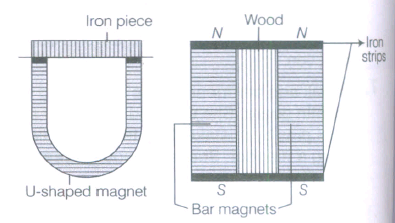
U-shaped magnet is kept along with an iron piece while bar magnets are kept along with iron strips and magnets separated by wood along their length.
14.
If we face North pole towards the front side of the car and the car is attracted, it means its front side pole is South pole and if it is going away, it means its front side is North pole.
15.
The poles of a bar magnet are located at the two ends of a bar magnet as shown below:
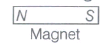
These two poles are North pole (N) and South pole (S).
16.
Yes, Riya can help her mother to find the needle by using a magnet. Since needle is made of iron so it will easily stick to the magnet.
17.
Earth behaves like a huge bar magnet, with poles at its ends. The north pole of this bar magnet points approximately towards the geographical south pole and its south pole points approximately towards the geographical north pole. The north pole of a freely suspended magnet points towards the geographical north pole because it is attracted by the earth's magnetic south pole and the south pole of a freely suspended magnet points towards the geographical south pole because it is attracted by the earth's magnetic north pole. Hence, the freely suspended magnet always aligns itself in the north-south direction.
18.
A magnetic material can be magnetised by rubbing in a particular direction.
19.
No, it is not possible to isolate North and South pole of a magnet.
20.
A freely suspended magnet orients themselves in the North-South direction.
21.
It can be found in following ways:
(i) Take the bar magnet with known poles in you hand.
(ii) Take one of the other two iron bars in other hand.
(iii) Bring one side of iron bar towards the south pole of the bar magnet and note down whether it is attracted or repelled.
(iv) Bring other side of iron bar towards the south pole of the bar magnet and again note down the same thing.
(v) If there is an attraction in both cases i.e.,(iii) and (iv), then it is definitely a simple iron bar.
(vi) If there is an attraction in one case and repulsion in other case, then it is a bar magnet.
(vii) Do the same for the third iron bar. Now, poles can be found in following ways-If in case (iii), the bar is attracted, then it is North pole of the identified bar magnet. If the bar is repelled, then it is a south pole of the identified bar magnet.
22.
The two ways to identify the magnet are
(i) Hang the metal bars with a thread and having its level horizontal one by one and let it stop in any direction. Now, if we move it by"pushing it slowly and it returns to the same direction, it means that it is a magnet otherwise it is an iron bar simply.
(ii) Take some iron filings and move the iron bars over these iron filings one by one. If iron filings are attracted very strongly at poles, then it is a magnet and if it is not attracted, then it is simply an iron bar.
23.
(d)
All of these
24.
(b)
At the two ends of the magnet
25.
(b)
repel
26.
(c)
Centre of magnet
27.
(d)
All of these
28.
(c)
North-South direction
29.
(a)
repel
30.
(c)
north pole of one magnet with the South pole of other
31.
(a)
another magnet having its poles marked as North Pole and South pole
32.
(a)
North pole is almost equal to the South pole
33.
()
A freely suspended magnet always aligns itself in the geographical north-south direction
34.
()
A material which shows an attraction for magnetic materials such as iron, cobalt and nickel is called a magnet. When it is suspended freely, it points in the geographical north-south direction
35.
()
Magnet use was first discovered in Greece.
36.
()
Magnetite is one of the natural ores of iron and also known as natural magnet.
37.
()
There may be two types of objects in the classroom, viz. magnetic as well as non-magnetic.
Magnetic objects: Objects made up of iron, nickel etc.
Non-magnetic objects: Objects made up of wood, plastic, cloth, glass etc.

6th Standard CBSE Syllabus & Materials
6th Standard CBSE
CBSE 6th Social Science Locating Places on the Earth - New Sample Question Papers Study Material - QB365 Set A
NEW6th Standard CBSE
CBSE 6th Science A Journey Through States of Water - New Sample Question Papers Study Material - QB365 Set A
NEW6th Standard CBSE
CBSE 6th Science Temperature and its Measurement - New Sample Question Papers Study Material - QB365 Set A
NEW6th Standard CBSE
CBSE 6th Science Materials Around Us - New Sample Question Papers Study Material - QB365 Set A



CBSE 6th Standard CBSE Subjects
CBSE Standards




